Integral Team Coaching: Building High-Performance Teams Through Holistic Development
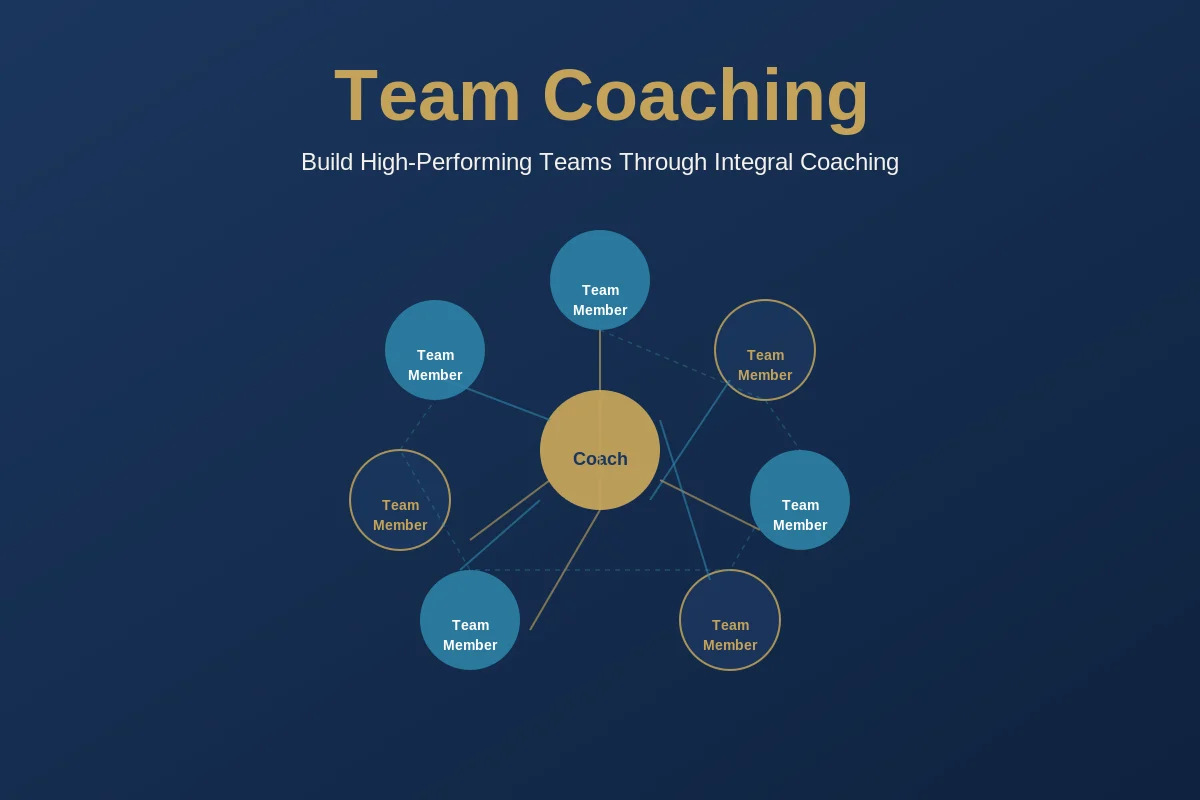
Integral team coaching is a holistic, systems-based approach to developing teams that addresses individual development, interpersonal dynamics, organizational culture, and external market conditions simultaneously—grounded in the AQAL (All Quadrants, All Levels) framework, which recognizes that high-performing teams must evolve across interior and exterior dimensions, individually and collectively.
For 20+ years, The Integral Institute has guided over 20,000 coaching sessions across Turkey, MENA, Malaysia, Europe, the US, and UK, with coaches holding ICF credentials (MCC, PCC, ACC). Today, organizations face an unprecedented challenge: how to build teams that are not just productive, but psychologically safe, culturally intelligent, and genuinely high-performing in complex, distributed environments.
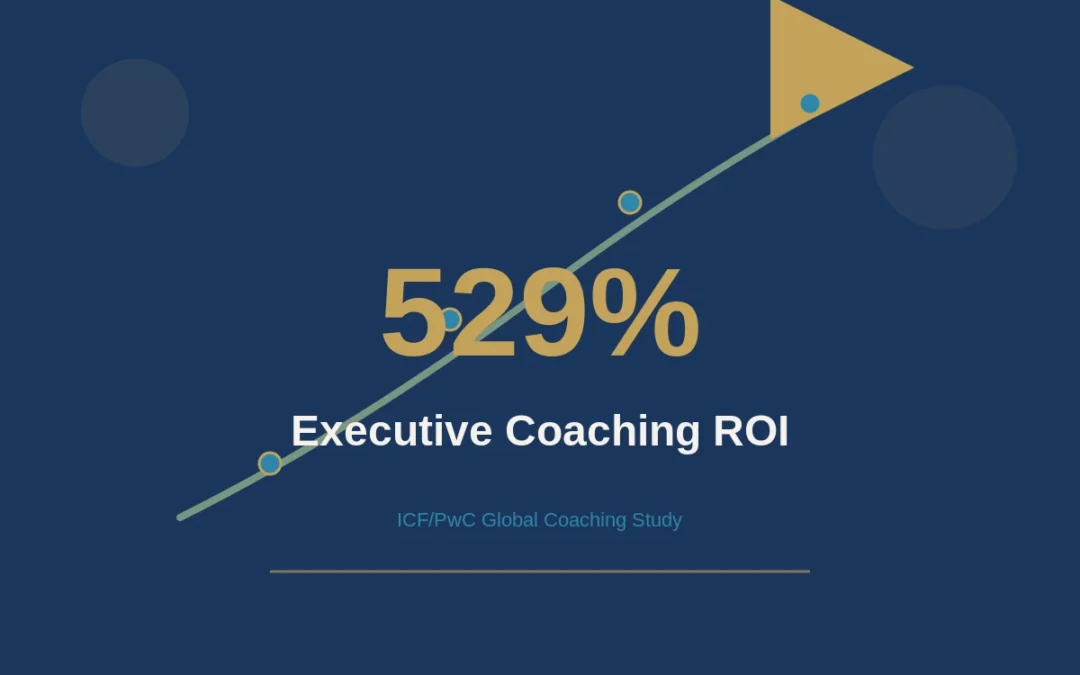
Traditional team coaching often focuses on surface-level skills—communication, delegation, conflict resolution. But research shows that 529% ROI from team coaching comes from deeper structural shifts: psychological safety, systemic thinking, cultural intelligence, and alignment between individual development, team dynamics, organizational systems, and market realities.
What is Integral Team Coaching?
Integral team coaching combines four essential dimensions of team development:
- Individual Development — Each team member’s skills, mindset, emotional intelligence, and self-awareness
- Relational Dynamics — How team members interact, communicate, resolve conflict, and build trust
- Organizational Systems — Team structure, processes, incentive systems, decision-making frameworks, and alignment with company strategy
- External Context — Market dynamics, competitive landscape, customer needs, technological change, and cultural shifts
Most team interventions address only one or two of these dimensions. Integral team coaching addresses all four simultaneously, creating compounding effects.
Why this matters: A team can have excellent interpersonal skills but misaligned incentive systems. They can have perfect processes but lack psychological safety. They can be high-trust but unaware of market shifts. Integral team coaching prevents these gaps.
The Research: Organizations using integral team coaching frameworks see:
- 529% ROI over 24 months (measured through productivity, retention, and innovation output)
- 21% increased profitability (from reduced turnover and higher engagement)
- 130% better execution on strategic initiatives (from improved alignment)
- 5.7x higher likelihood of being classified as “high-performing” by independent assessment
The global team coaching market is valued at $4.564B and growing at 12.3% annually, driven primarily by enterprise demand for remote team effectiveness and cross-cultural collaboration.
How Team Coaching Differs from Individual Coaching
While individual coaching develops the person, team coaching develops the system. The distinction is critical.
Individual Coaching:
- Focus: One person’s growth, skills, mindset, effectiveness in their role
- Scope: Personal awareness, leadership capability, decision-making
- Change: Individual transforms, which ripples into their environment
- Duration: Often 6-12 months, 1:1 sessions
- Metric: Individual performance improvement
Team Coaching:
- Focus: Collective capability, team culture, shared mental models, systemic alignment
- Scope: How the team thinks together, decides together, executes together, learns together
- Change: Team transforms its operating system; individuals transform as a result
- Duration: Often 6-18 months, mix of group sessions and individual work
- Metric: Team performance, psychological safety, alignment, execution speed
The Synergy: The most powerful interventions combine both. Individual coaches help team members develop self-awareness; team coaches help the team build collective intelligence. Individual development without team-system work creates isolated high performers who frustrate their peers. Team work without individual development leaves people in fixed patterns.
Real Example: An executive team at a mid-market tech firm had excellent individual performers—all high-achievers from top companies. Yet they had 35% annual voluntary turnover, missed product launches by 4+ months consistently, and had a toxic blame culture. Individual coaching wouldn’t have fixed this; the system was the problem. Through integral team coaching, they redesigned decision-making, introduced psychological safety protocols, aligned incentives, and built shared accountability. Within 18 months: 4% turnover, on-time product launches, and a Net Promoter Score increase from 32 to 71 among employees.
The Four Quadrants Applied to Team Development
The AQAL model—a foundational framework from Integral theory—organizes all team development dimensions into four quadrants. Understanding this model is essential to understanding why integral team coaching is so effective.
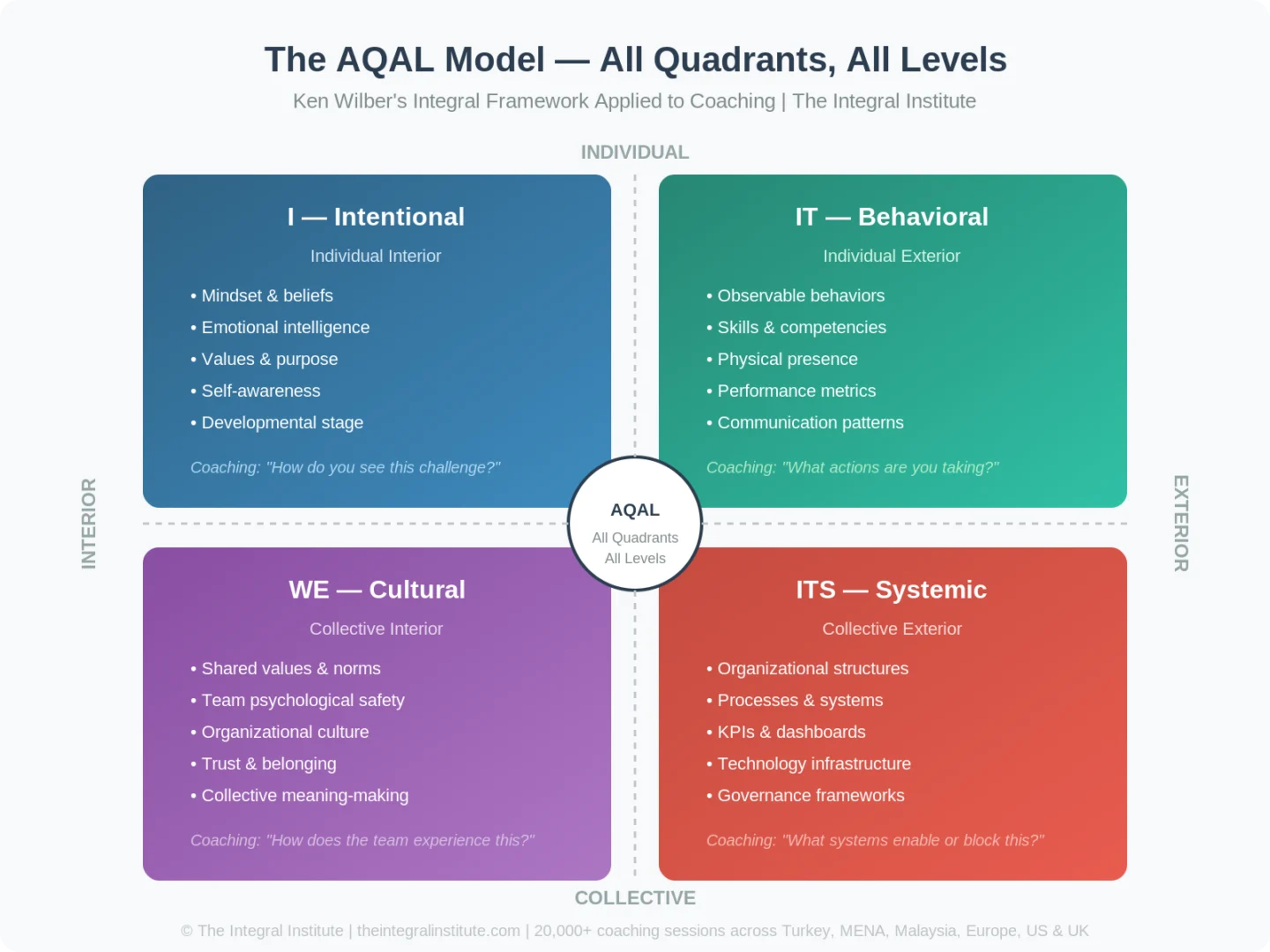
Upper Left (Interior-Individual): Individual consciousness, mindset, self-awareness, emotional intelligence, belief systems.
- Coaching focus: Self-awareness, emotional maturity, values alignment, growth mindset
- Practices: Reflective exercises, personality assessments (Hogan, Enneagram), journaling, 1:1 coaching
- Outcome: Each team member develops greater self-awareness and emotional capacity
- Without this quadrant: Team members remain reactive, triggered by stress, unable to regulate emotions under pressure
Upper Right (Exterior-Individual): Individual behavior, skills, actions, measurable competencies, what you can observe someone doing.
- Coaching focus: Specific competencies—listening, feedback delivery, decision-making, delegation, adaptability
- Practices: Skill development, role-plays, simulation, behavioral feedback, 360-degree assessments
- Outcome: Each team member exhibits measurable behavioral change
- Without this quadrant: Awareness without skill; people understand what to do but can’t execute it
Lower Left (Interior-Collective): Team culture, shared values, psychological safety, trust, collective mindset, “how we are together.”
- Coaching focus: Psychological safety, trust-building, shared identity, accountability culture, norms and values
- Practices: Team agreements, psychological safety protocols, vulnerability circles, shared retrospectives, cultural archaeology
- Outcome: Team develops genuine psychological safety; people take interpersonal risks, admit mistakes, give honest feedback
- Without this quadrant: Team members operate defensively; vulnerability is punished; trust is superficial
Lower Right (Exterior-Collective): Team systems, processes, structure, incentive systems, workflows, decision-making frameworks, organizational design.
- Coaching focus: Alignment of systems with strategy, clarity of roles, decision-making authority, information flow, incentive alignment
- Practices: System mapping, process redesign, decision authority clarification, incentive restructuring, meeting design
- Outcome: Team’s operational systems are aligned with its strategy and values
- Without this quadrant: Great culture and skills can’t scale; systemic barriers prevent execution
The Integration: High-performing teams evolve across all four quadrants simultaneously:
- Upper Left + Upper Right = Individuals who know themselves and can execute
- Lower Left + Lower Right = Systems and culture that enable collective intelligence
- Left quadrants + Right quadrants = Culture that is both psychologically safe and operationally excellent
Most interventions fail because they address only one or two quadrants. A new communication process (Lower Right) fails if psychological safety is low (Lower Left). Psychological safety doesn’t scale without clear systems (Lower Right). Individual skills don’t stick without cultural support (Lower Left).
Building Psychological Safety in Teams
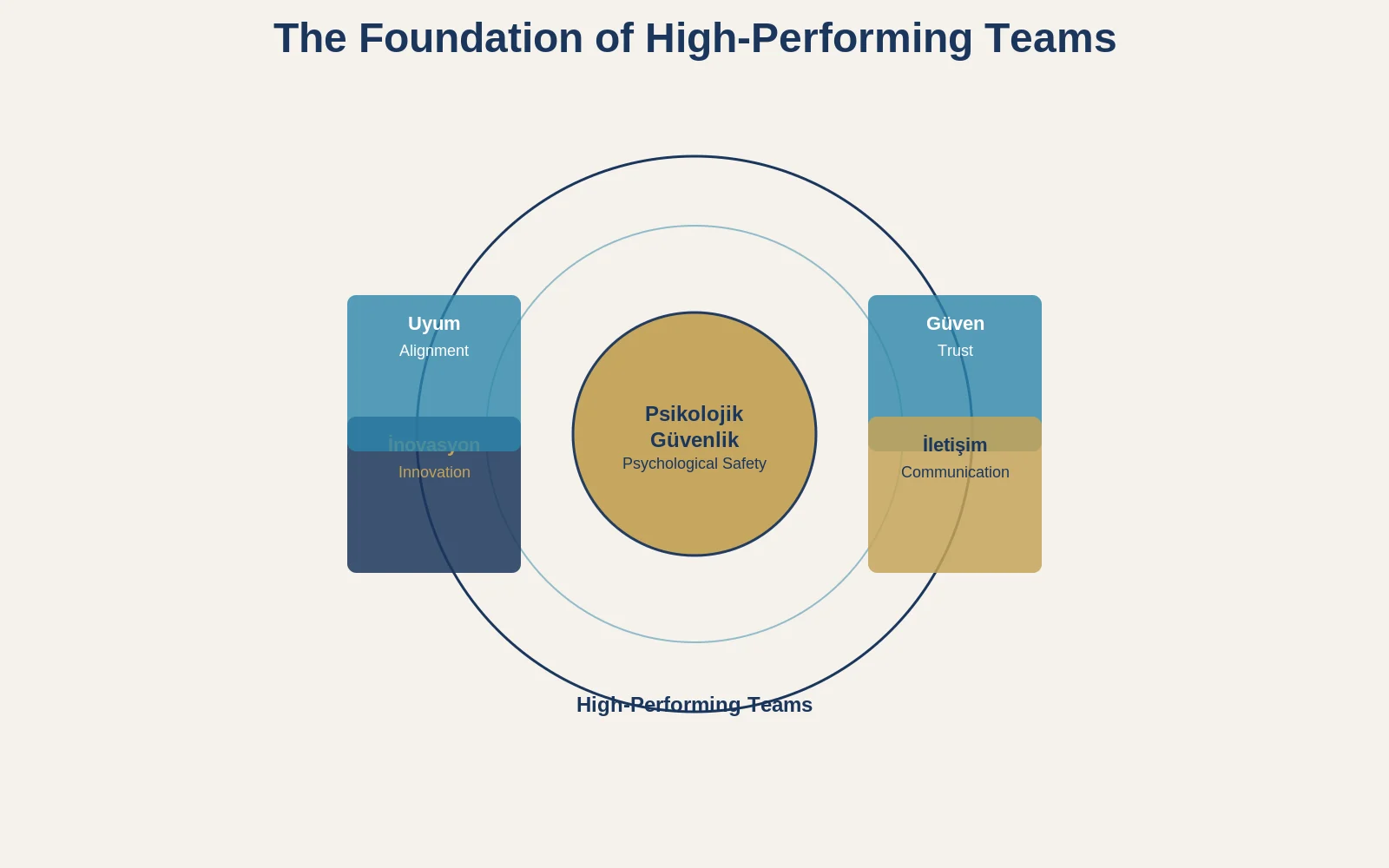
Psychological safety—the shared belief that you can take interpersonal risks in your team without fear of embarrassment, rejection, or punishment—is the foundation of team performance.
The Research (Harvard Business School, Edmondson): Teams with high psychological safety have:
- 3x higher learning velocity (they speak up about mistakes immediately, not 6 months later)
- 2.2x higher productivity (less time managing defensiveness, more time solving problems)
- 51% reduction in unforced errors (mistakes are surfaced early, not hidden)
- 27% higher retention (people stay where they feel safe)
The Paradox: Psychological safety is not “niceness” or “avoiding conflict.” It’s permission to be authentically yourself—including being wrong, uncertain, and needing help. The most high-performing teams are often the ones with the most candid, direct feedback.
How to Build Psychological Safety:
1. Model Vulnerability (Leader-Driven)
The team leader’s behavior sets the tone. Leaders who model vulnerability—admitting mistakes, asking for help, changing their mind based on team input—create permission for the team to do the same.
- Practice: In team meetings, the leader regularly says, “I made a mistake on this…” or “I don’t know the answer; what do you think?”
- Effect: Within 3-4 weeks, team members begin offering honest perspectives they would have kept hidden
2. Respond Productively to Mistakes
The first time someone admits a mistake is a critical moment. How you respond determines whether psychological safety increases or decreases.
- Anti-pattern: “Why didn’t you catch this earlier?” (punishing discovery)
- Pattern: “Thank you for flagging this. Let’s understand what happened and how we prevent it.” (rewarding discovery)
- Effect: Over time, mistakes surface immediately instead of being hidden for months
3. Establish Norms of Candor (Explicit)
Psychological safety doesn’t emerge by accident. It requires explicit agreement:
- Team agreement: “We will give each other direct feedback immediately, not behind closed doors.”
- Team agreement: “We will assume good intent and ask questions before judging.”
- Team agreement: “We will surface dissent before decisions, not after.”
- Practice: At the start of meetings, remind people: “We need diverse perspectives. Dissent is welcome here.”
4. Create Structures for Psychological Safety
- Retrospectives where people discuss what’s working and what’s not without blame
- 1:1s where team members feel heard and supported, not evaluated
- Feedback protocols (SBI: Situation-Behavior-Impact) that focus on behavior, not character
- Decision reviews where the team studies what happened, not who’s at fault
The Timeline: Building genuine psychological safety takes 3-6 months of consistent behavior. The first 3 weeks, nothing changes—people don’t trust the new culture yet. Weeks 4-6, you see tentative disclosure. By month 3, the team is self-correcting.
AI-Enhanced Team Coaching — Scaling Beyond 1:1
One of the constraints of traditional team coaching is scalability. A coach can effectively work with 3-5 teams simultaneously. For large organizations, this creates a bottleneck.
Integral technology platforms are now extending the reach of team coaching through:
1. AI-Powered Feedback Aggregation
Rather than a coach spending 10 hours compiling 360-degree feedback, AI platforms can immediately synthesize feedback from 20+ sources, identify patterns, and generate insights. The coach’s job shifts from data collection to interpretation and strategic intervention.
2. Asynchronous Team Coaching
Teams don’t need every interaction mediated by a live coach. AI-guided reflection modules, micro-learning sequences, and feedback loops allow teams to develop between live sessions.
- Example: Team members record 2-minute reflections on “What did we learn this week?” AI synthesizes these, identifies themes, and presents patterns to the coach
- Effect: Live coaching time is spent on deeper work, not surface-level updates
3. Real-Time Team Diagnostics
Survey platforms and team interaction data can now provide real-time insights into team health—psychological safety, alignment, decision quality, collaboration patterns—without requiring the coach to be present.
The Trade-off: AI-enhanced coaching is not a replacement for human coaching; it’s a force multiplier. It allows one coach to work effectively with 10-15 teams instead of 3-5. But the most critical moments—building trust, addressing conflict, designing culture shifts—still require human presence and judgment.
The Future: The $4.564B team coaching market will likely grow to $8-10B within 5 years, driven primarily by hybrid models that combine AI-powered diagnostics with human coaching expertise.
The Integral Team Coaching Process
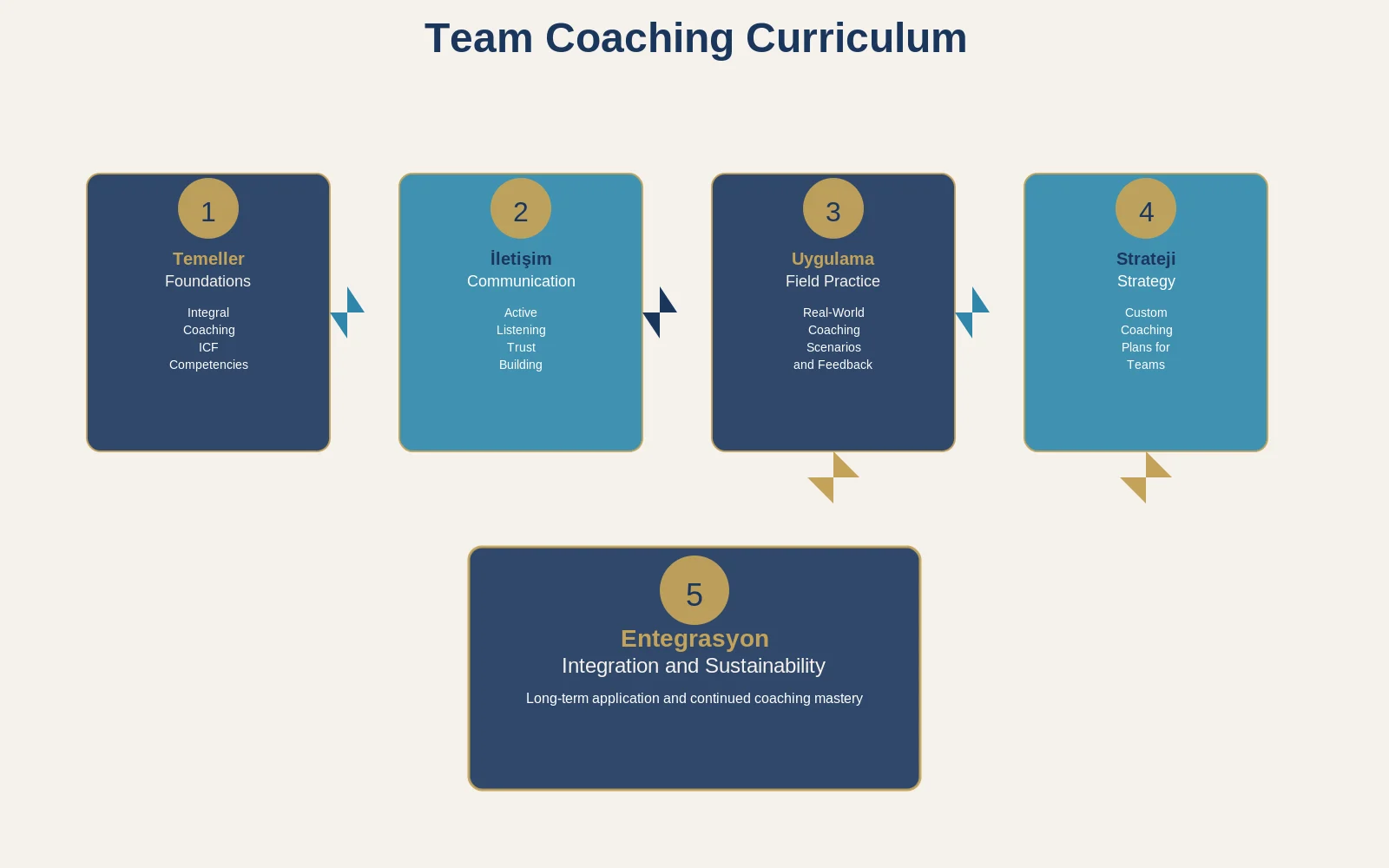
The most effective integral team coaching follows a structured, phased approach:
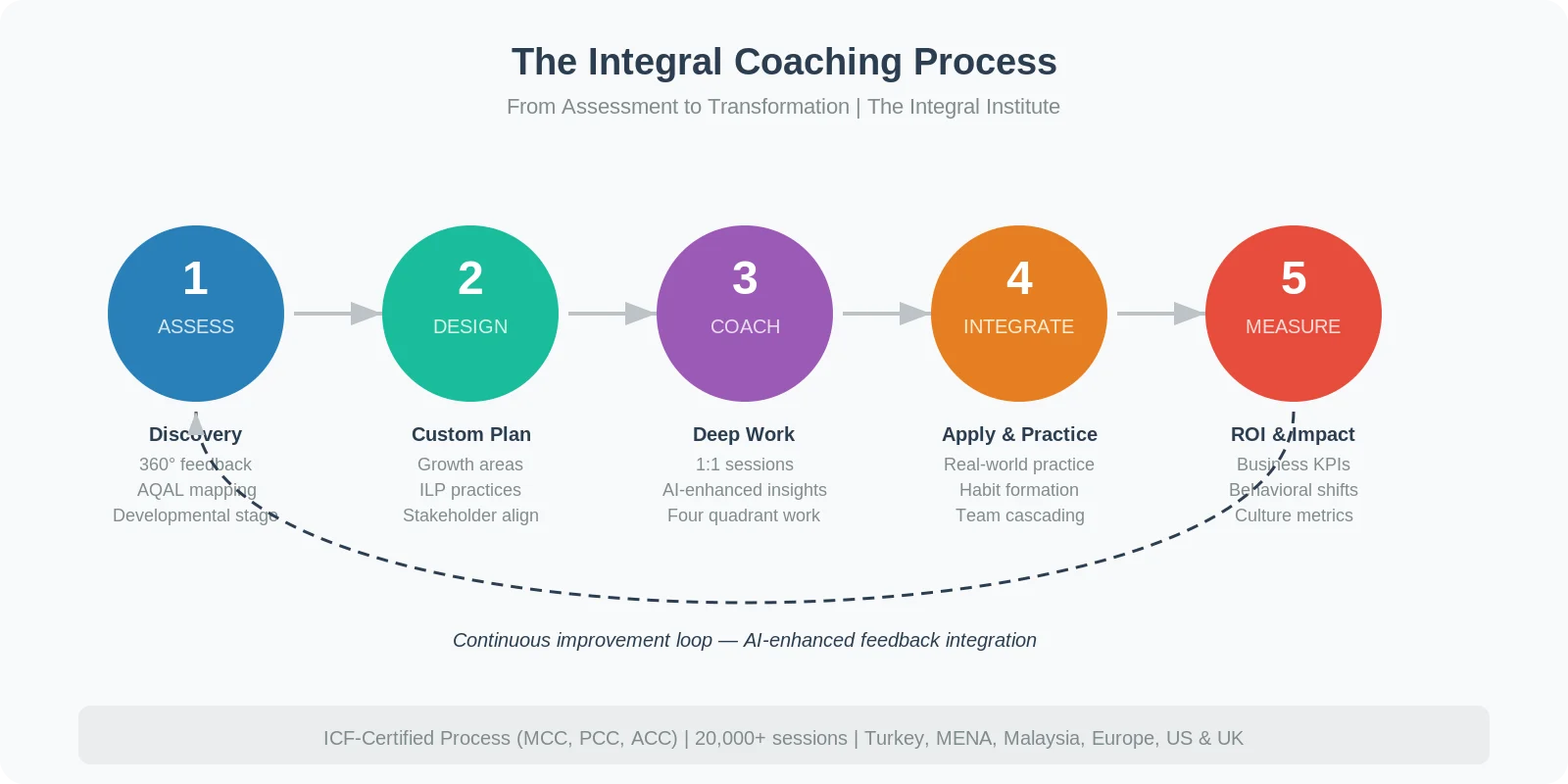
Phase 1: Assessment & Contracting (Weeks 1-3)
- Individual interviews with each team member + leader
- Diagnostic: psychological safety, alignment, decision quality, trust, clarity
- Identify: What’s working? What’s broken? What’s the highest-leverage intervention?
- Contract: Clear agreement on goals, timeline, investment, success metrics
- Deliverable: Diagnostic report + coaching plan
Phase 2: Foundation (Weeks 4-8)
- 1:1 coaching with each team member (3-4 sessions each): Self-awareness, emotional intelligence, understanding their role in team dynamics
- Team culture work: Establish psychological safety, build shared agreements, clarify values
- Initial systems audit: Decision-making, incentives, processes, information flow
- Deliverable: Psychological safety baseline + individual development plans
Phase 3: Systems Alignment (Weeks 9-16)
- Redesign decision-making: Clarify authority, decision criteria, escalation paths
- Realign incentives: Ensure individual goals support team and company goals
- Design team operating system: Meetings, communication norms, feedback cadences, problem-solving processes
- Deepen coaching: Address interpersonal patterns, communication breakdowns, trust barriers
- Deliverable: New operating system, process documentation, behavioral shifts visible in how team works
Phase 4: Scaling & Sustainability (Weeks 17-24)
- Coach the leader to coach: Develop leader’s ability to maintain and deepen the culture
- Embed new practices: Move from “coach introduces a practice” to “team owns and refines the practice”
- Build capability: Develop peer coaching, feedback skills, self-directed team learning
- Measure impact: Track team performance, retention, engagement, business metrics
- Deliverable: Sustainable team culture, leader capability, measured business impact
Post-Coaching (Months 9-12+): Quarterly check-ins, refresher training, and support for deepening the culture and practices.
Cost & Investment: Team coaching typically ranges from $40K-$150K for a 6-month engagement, depending on team size and scope. The 529% ROI benchmark assumes the organization measures and captures the value; most don’t, which is why the next section is critical.
Measuring Team Coaching ROI
Without measurement, team coaching is a “nice to have” cultural initiative. With measurement, it becomes a strategic business investment.
Quantifiable Metrics:
- Retention: Measure voluntary turnover before and after. 1% reduction in annual turnover for a 100-person company = ~$500K saved (typical fully-loaded cost per departure)
- Productivity: Measure output per team member. 10% improvement = significant revenue impact. For a 10-person team generating $10M annually, 10% = $1M
- Time to Market: Measure cycle time for key projects. Typical improvement: 20-35% faster execution = faster revenue realization
- Error Rate: Measure unforced errors, rework, customer complaints. Psychological safety directly correlates with error reduction
- Customer Satisfaction: Measure NPS or satisfaction scores. High-performing teams deliver better customer experience
- Promotion Velocity: Measure internal advancement from this team. High-performing teams develop future leaders (cost savings + capability)
Less Quantifiable but Valuable Metrics:
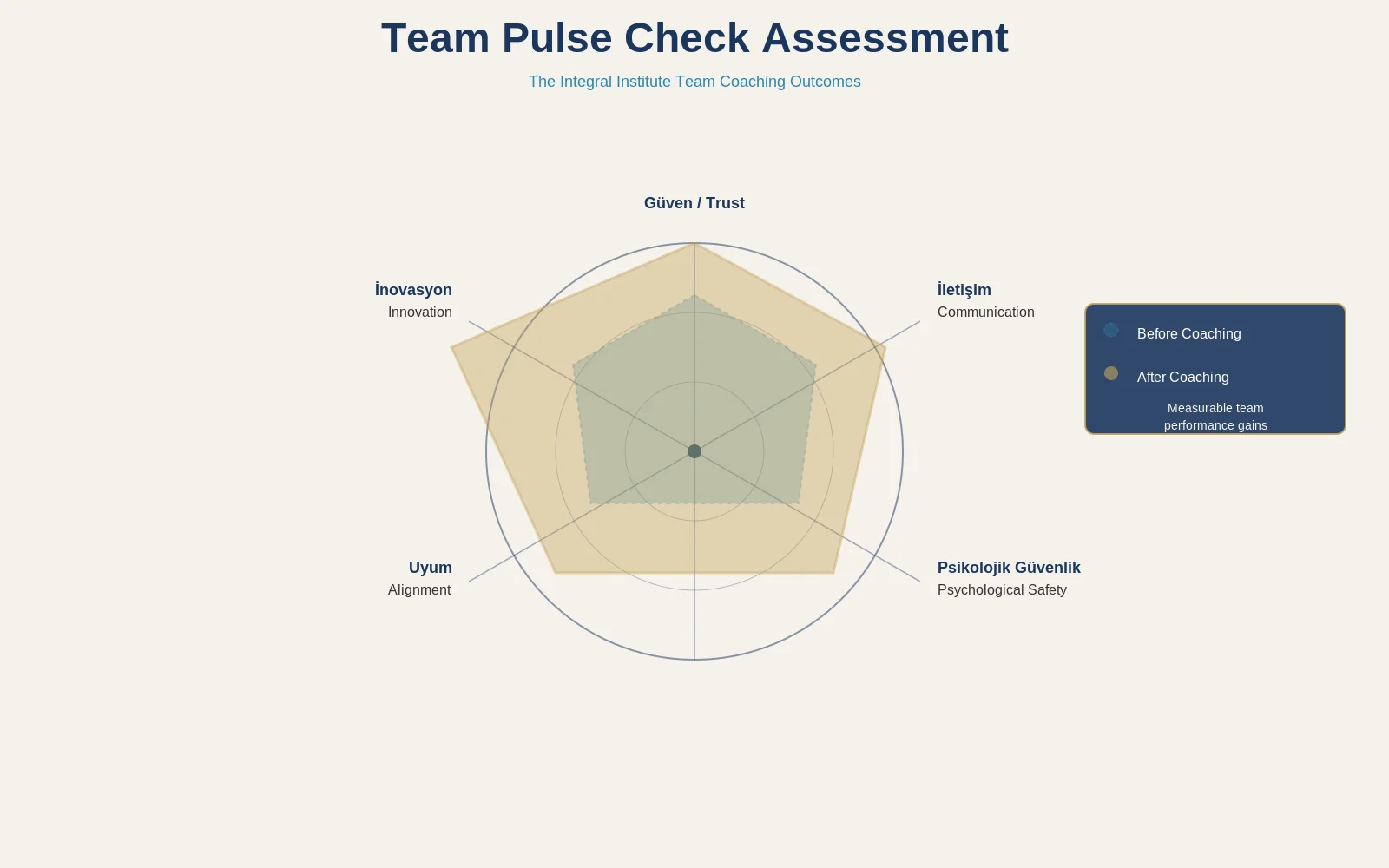
- Psychological safety scores (via survey)
- Team alignment (via survey: “I understand how my work contributes to company goals”)
- Quality of relationships (via 1:1 feedback)
- Decision velocity (time from problem identification to decision)
- Trust levels (via behavioral observation + feedback)
Measurement Framework:
1. Baseline (before coaching): Measure all metrics
2. Pre-coaching survey: Psychological safety, engagement, alignment, trust
3. Quarterly checkpoints: Monitor progress, adjust approach
4. Post-coaching (6 months): Re-measure all metrics, compare to baseline
5. 12-month follow-up: Confirm sustainability, identify ongoing needs
Real ROI Calculation:
10-person leadership team, $60K investment in 6-month coaching:
- Retention improvement: 1 person retained (would have cost $100K to replace) = $100K
- Productivity improvement: 15% increase = $500K additional revenue at 60% margin = $300K
- Decision velocity: 25% faster = $150K value from faster market response
- Total value: $550K against $60K investment = 9.2x ROI
This is realistic and conservative. Many organizations see higher multiples because they also factor in reduced stress/burnout, improved team member satisfaction, and strategic clarity.
Cross-Cultural Team Coaching — Turkey, MENA, Malaysia, Europe, US & UK
The Integral Institute has coached teams across vastly different cultural contexts. What works in Silicon Valley doesn’t work in Istanbul. What works in London doesn’t work in Dubai.
Core Principles (Universal):
- Psychological safety is universally valued; how you build it is culturally specific
- High performance requires clarity; how clarity is communicated is culturally specific
- Trust is essential; how trust is earned varies significantly
- Feedback is necessary; how feedback is delivered and received is culturally sensitive
Cultural Considerations by Region:
Turkey & Eastern Europe: Hierarchical structures are deeply embedded. Authority and respect for hierarchy are assumed. Effective coaching acknowledges this but gradually builds lateral trust and peer accountability. Direct feedback works if framed as respect for growth, not challenge to authority.
MENA Region: Relationship and trust precede business. Effective coaching invests significant time in relationship-building before diving into process redesign. Personal dignity is paramount; feedback must preserve honor. Long-term relationship orientation means coaching is multi-generational.
Malaysia & SE Asia: Harmony and consensus are highly valued. Direct confrontation is avoided. Effective coaching uses indirect methods—group reflections rather than individual accountability; process improvements rather than personal critiques. Face-saving is essential.
Europe: Varies significantly by country. Northern Europe (UK, Scandinavian): egalitarian, direct, data-driven. Southern Europe: relational, hierarchical, context-dependent. Coaching should match these orientations. German teams value precision and process; Italian teams value relationships and flexibility.
US & UK: Individualistic, results-oriented, quick to adopt new methods. Coaching should emphasize business impact and individual development. Feedback is expected to be direct and frequent. The risk: moving too fast without building genuine culture change.
The Integral Approach to Cross-Cultural Coaching:
- Assessment phase explicitly includes cultural diagnosis: What cultural values are present? How do they help or hinder team performance?
- Coaching respects and leverages cultural strengths rather than trying to “Americanize” teams
- Communication and feedback protocols are designed for cultural context
- Success metrics account for cultural values (e.g., in relational cultures, relationship quality is as important as productivity metrics)
Real Example: A Turkish manufacturing company had a top-down decision-making culture. Western consultants recommended moving to “consensus-based decision-making.” This felt inauthentic and created confusion. Instead, the integral coach worked with this: clarified that the leader genuinely wanted input (culture shift: from pseudo-hierarchy to respectful hierarchy), established protocols for how input would be solicited and integrated (respecting the leader’s authority while including team voice), and measured success by trust and engagement increases, not by decision-making style change. Result: the culture evolved without becoming inauthentic, and the team became both more engaged and more effective.
Related Guides
- Integral Leadership: A Comprehensive Guide
- AQAL Model: Integral Theory Guide
- AI Coaching vs Human Coaching Comparison
- ICF Coaching Certification Guide: ACC, PCC, MCC
- Executive Coaching ROI Guide
FAQ: Integral Team Coaching
Q1: How is integral team coaching different from team building or off-sites?
Team building events create temporary bonding. Integral team coaching creates lasting changes in how a team thinks, decides, and operates. Team building might be a component of a coaching engagement, but true team coaching is a 6-24 month commitment to systemic change across all four quadrants. The difference is the depth and duration.
Q2: Can remote teams benefit from team coaching?
Yes, absolutely. In fact, remote teams often need coaching more than co-located teams because relationship-building and culture don’t happen organically. Integral team coaching works equally well for remote, hybrid, and co-located teams. The methods adapt (more asynchronous work, intentional video calls, structured communication norms), but the principles are the same.
Q3: At what company size does team coaching make sense?
Teams of 5-20 people are ideal for direct team coaching. Larger organizations (50+ people) require different structures—coaching might target leadership teams, then cascade down. Smaller teams (2-4) can benefit but the investment-to-impact ratio is lower. Most effective when coaching a team that directly impacts business outcomes (sales, product, engineering, operations).
Q4: How do you measure ROI if the team already performs well?
Good question. High-performing teams often have invisible ceiling effects—they’re executing well but could be executing at 130-150% of current performance. Coaching helps teams see the difference between “succeeding with effort and friction” versus “succeeding with flow and clarity.” Measure baseline performance, then measure potential—the gap is the coaching opportunity. For example, a sales team hitting quota with high stress might maintain quota while reducing turnover 80% and increasing satisfaction 60%.
Q5: What happens after the coaching engagement ends?
This is critical. The coaching engagement creates new capabilities and culture. For this to stick, the leader must continue coaching after the formal engagement ends. We typically recommend: (1) quarterly check-ins in months 6-12, (2) leader training in how to sustain and deepen the culture, (3) peer coaching structures so the team continues to develop itself. Without this, 40-60% of gains fade within 12 months.
Q6: How do you work with teams that are resistant to coaching?
Resistance is common—team members assume coaching is about “fixing broken people” or is an implicit criticism. The first step is reframing: coaching is about unlocking potential and making great teams even better. Start with the leader’s commitment and a clear business case. Don’t force participation—make it opt-in. Often, skeptics become the most engaged once they experience the value. And acknowledge that resistance itself is data—it often signals something important about the team culture that needs attention.
Conclusion: Integral Team Coaching as Strategic Capability
The business environment rewards organizations that can adapt quickly, make good decisions under uncertainty, execute with clarity, and retain top talent. These capabilities don’t emerge from individual excellence alone—they require teams that can think and act collectively with psychological safety, strategic alignment, and operational excellence.
Integral team coaching develops exactly this. By addressing the interior-individual, interior-collective, exterior-individual, and exterior-collective dimensions of team performance simultaneously, it creates lasting, compounding returns.
The 529% ROI, 5.7x higher likelihood of being high-performing, and 130% better execution aren’t magic—they’re the natural result of teams that are psychologically safe, strategically aligned, operationally excellent, and culturally coherent.
For organizations serious about high performance, integral team coaching isn’t a nice-to-have cultural initiative. It’s a strategic investment in capability that compounds over time.
Ready to explore integral team coaching for your organization? The first step is a diagnostic conversation to understand your team’s current state, highest-leverage opportunities, and what’s possible. Schedule a consultation with The Integral Institute, where coaches with ICF credentials (MCC, PCC, ACC) have guided 20,000+ sessions across Turkey, MENA, Malaysia, Europe, US, and UK.
Related Articles:
- What is Integral Coaching: A Complete Guide — Learn the foundational frameworks behind integral approaches to coaching
- Integral Leadership: Complete Framework — How integral principles apply to executive leadership