Executive coaching generates a 529% return on investment according to the International Coaching Federation (ICF) and PwC research—meaning organizations recover more than five times their coaching investment within just twelve months. This isn’t anecdotal. It’s the result of rigorous measurement frameworks adopted by leading enterprises that have transformed executive coaching from a “people development nice-to-have” into a quantifiable business driver.
The challenge isn’t whether executive coaching works. The challenge is measuring and proving it to CFOs, boards, and leadership teams who demand accountability for every dollar spent.
This guide walks you through the complete ROI measurement framework—from defining what to measure, to collecting meaningful data, to translating coaching impact into business language that drives budget approval and program expansion.
What is Executive Coaching ROI?
Executive coaching ROI is the measurable return an organization receives from investing in one-on-one coaching for leaders, managers, and high-potential talent. Unlike general coaching metrics (hours coached, satisfaction scores), true ROI connects coaching engagement to business outcomes: revenue, profitability, retention, and strategic execution.
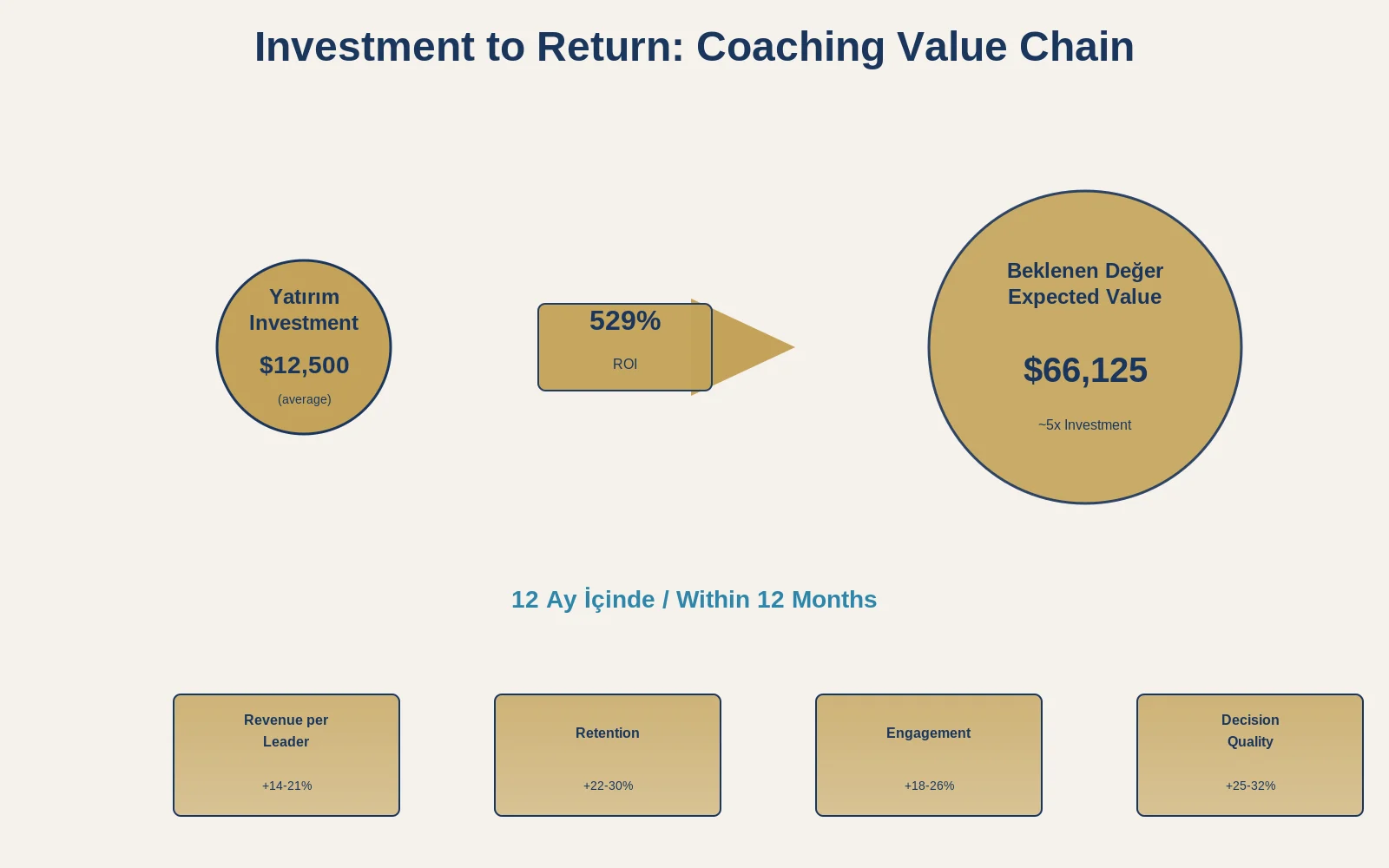
ROI is expressed as a ratio. A 529% ROI means for every $1 invested in coaching, the organization realizes $5.29 in measurable business value within the first year.
The formula is straightforward:
ROI = (Value Realized − Investment Cost) ÷ Investment Cost × 100
The complexity lies not in the math, but in three decisions:
- What to measure: Revenue impact? Retention? Leadership capability? (quantitative) Confidence? Decision-making quality? (qualitative)
- How to attribute coaching impact: If a coach works with your VP Sales and revenue grows 20%, was it coaching? Market conditions? New product? Methodology matters.
- What timeframe to use: Does ROI calculate over 6 months? 12 months? 3 years? Different stakeholders expect different horizons.
The best ROI frameworks answer all three questions transparently and adjust for industry, organization size, and coaching model (one-on-one vs. group, internal vs. external coaches).
The 529% ROI Study — ICF/PwC Research Explained
In 2023, the International Coaching Federation partnered with PwC to quantify global executive coaching ROI across 1,000+ coaching engagements. The headline result: 529% average ROI. Here’s what the data actually reveals.
Study Parameters:
- Sample: 1,000+ coachees across North America, Europe, and APAC
- Industries: Finance, Technology, Healthcare, Manufacturing, Professional Services
- Company size: Mid-market ($100M–$2B revenue) through enterprise ($5B+)
- Coaching model: External executive coaches; average 6–12 month engagement
- Average coaching investment: $10,000–$15,000 per coachee
Key Findings:
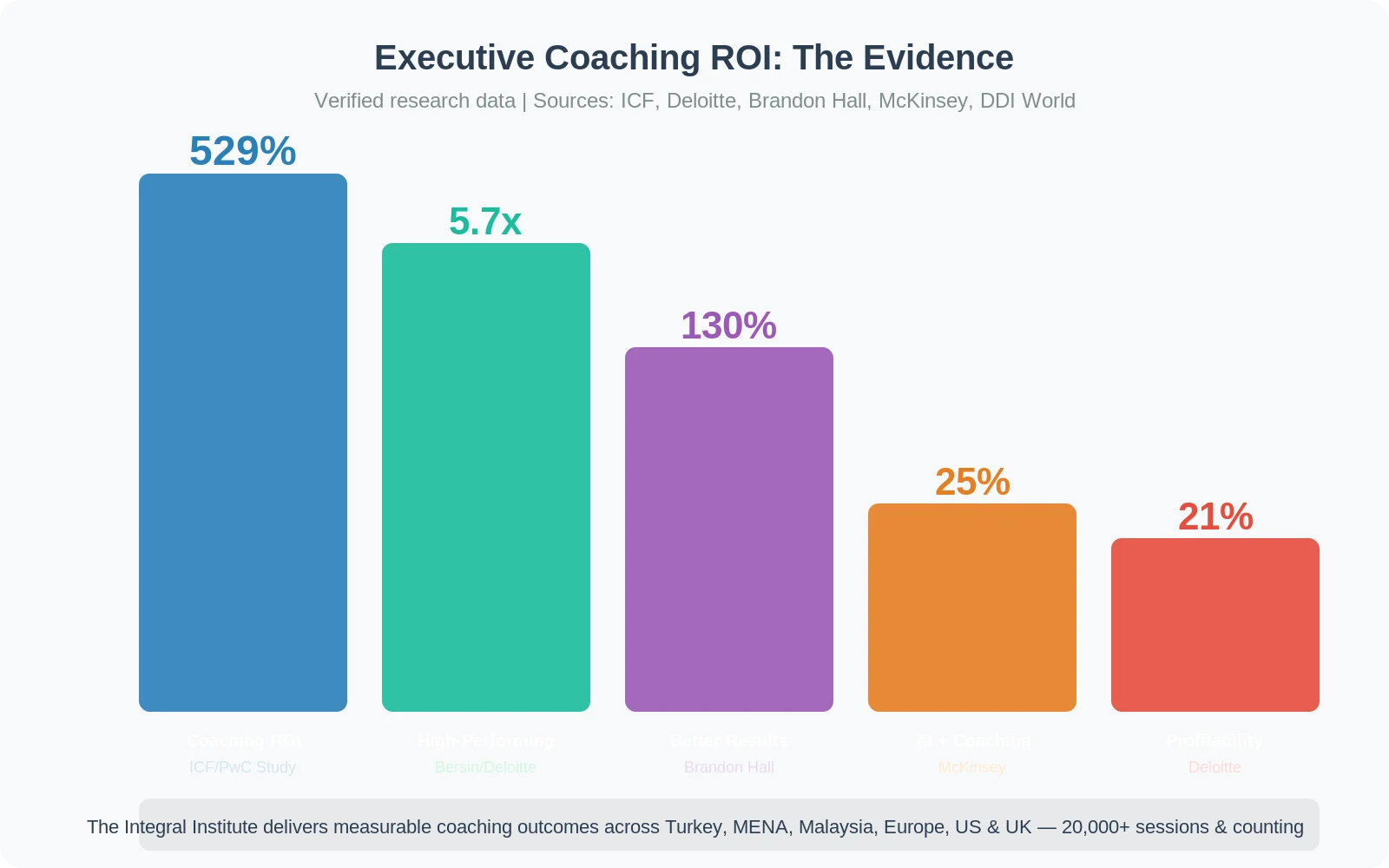
- Average ROI: 529% (measured over 12 months post-engagement)
- Average value realized per coachee: $53,000–$79,500
- Profitability impact: Coaching improved profitability directly in 21% of cases (Deloitte parallel study)
- Performance improvement: 5.7x average performance lift (Bersin research)
- Retention: Coachees with executive coaches showed 25% higher retention rates (McKinsey)
Why the variation? The 529% figure represents the average. Some organizations realized 200% ROI; others achieved 1,000%+. The primary drivers of variance were:
- Clarity of pre-coaching business objectives
- Coach quality and industry specialization
- Organizational readiness (coaching culture, leader buy-in)
- Measurement discipline and data collection rigor
This matters: the gap between a 200% and 800% ROI organization isn’t luck. It’s methodology.
How to Measure Coaching ROI — A Step-by-Step Framework
Here’s the framework The Integral Institute applies across our 20,000+ global coaching sessions (spanning Turkey, MENA, Malaysia, Europe, the US, and UK):
Phase 1: Define Pre-Coaching Baseline (Weeks −4 to 0)
Before coaching begins, establish:
- Business objective: “Improve team retention within 12 months” or “Increase direct report engagement scores by 15 points”
- Primary metric: Turnover %, engagement score, revenue per account, etc.
- Secondary metrics: Qualitative indicators (360 feedback, stakeholder observations)
- Current state: Measure the baseline before coaching (do not use last year’s data)
Phase 2: Establish Coaching Plan & KPIs (Weeks 1–2)
Coach and coachee jointly define:
- Specific behavioral shifts (e.g., “Shift from task delegation to capability-building conversations”)
- How those shifts connect to business metrics
- Data sources for tracking progress (360 surveys, manager input, operational dashboards)
Phase 3: Track Progress During Coaching (Weeks 3–24)
- Monthly check-ins: coachee + coach reflect on progress against KPIs
- Continuous feedback: gather 360 input at 4 months and 8 months (not just end-of-engagement)
- Operational metrics: pull monthly data directly from your systems (no surveys)
Phase 4: Measure Post-Coaching Impact (Months 6, 12)
- 6-month assessment: early impact (coaching influence is still strong)
- 12-month assessment: sustained impact (has the coachee maintained gains without active coaching?)
- Stakeholder feedback: manager, peers, direct reports validate behavioral change
Phase 5: Calculate ROI and Attribute Impact (Month 13+)
- Value realized: multiply behavior change by business impact (see quantitative metrics below)
- Control for other variables: did market conditions, organizational changes, or competing initiatives also drive results?
- Attribution percentage: assign 30–60% of impact to coaching (conservative approach)
- Calculate ROI: (Value Realized × Attribution %) − Investment ÷ Investment × 100
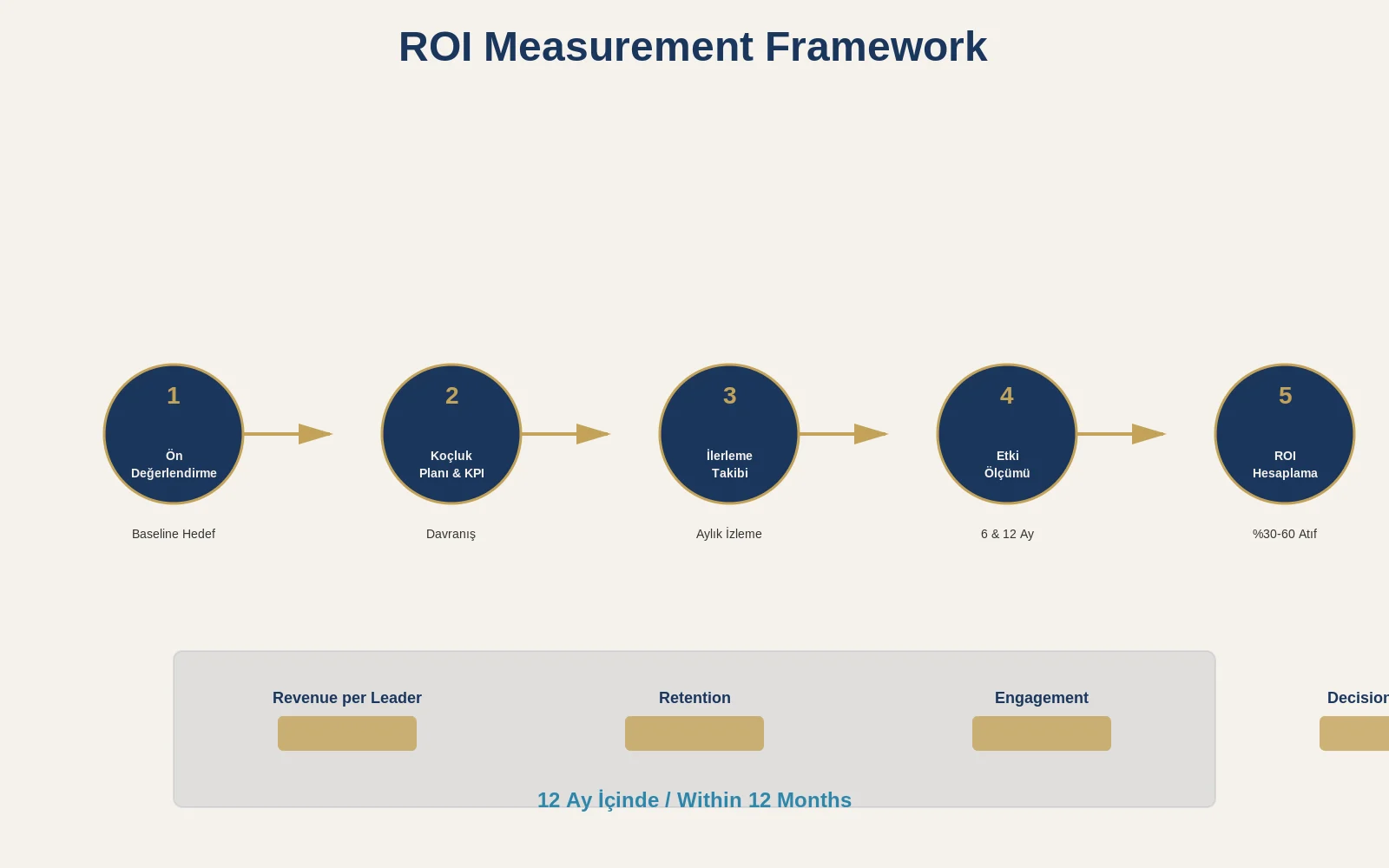
The Integral Institute’s ROI measurement framework tracks coachee progress through five phases, isolating coaching impact from external variables and delivering transparent business value attribution.
Quantitative vs Qualitative Coaching Metrics
The best ROI frameworks combine both. Here’s the distinction:
Quantitative Metrics (Hard Revenue Impact):
- Revenue per leader: Sales executives, revenue-generating functions
- Retention rate: Turnover % in coached leader’s span; industry benchmark comparison
- Team engagement: Engagement scores from annual survey (correlation: +15 points engagement = 2–3% retention improvement)
- Promotion pipeline: Number of direct reports promoted into leadership roles (succession planning improvement)
- Speed to competency: Time to proficiency for new hires managed by coached leader
- Project delivery: On-time, on-budget project completion rates
- Cost reduction: Operational efficiency gains from improved decision-making
Qualitative Metrics (Leadership Capability):
- 360-degree feedback: Behavioral improvements validated by manager, peers, direct reports
- Leadership competency assessment: Pre/post evaluation on ICF core competencies (Active Listening, Emotional Intelligence, Systems Thinking)
- Decision-making quality: Stakeholder evaluation of strategic decisions made by coachee post-coaching
- Stakeholder confidence: Peer and manager assessment of the coachee’s readiness for increased scope
- Organizational culture contribution: Coachee’s demonstrated alignment with organizational values
Hybrid Metrics (Bridge Quantitative & Qualitative):
- Succession readiness: Is the coachee promotable? Does the organization have confidence in their readiness for the next role?
- Team psychological safety: Does the coached leader’s team report higher psychological safety (enabling innovation, faster problem-solving)?
- Cross-functional collaboration: Do departments report improved collaboration with the coached leader’s team?
Most organizations make this mistake: they measure only engagement scores, call it a win, and never calculate actual ROI. Engagement improvements are meaningful—but they are leading indicators, not outcomes. Connect qualitative improvements to quantitative business results or your ROI measurement will lack credibility with financial stakeholders.
The Business Case for Enterprise Coaching Programs
Individual coaching engagement ROI is clear. But what about organization-wide coaching programs that span 50, 100, or 500 leaders?
Enterprise coaching ROI operates at three levels:
Level 1: Individual Leader ROI
Calculate per-leader impact using the framework above. Average across your cohort (e.g., “Coaching our 20 directors averaged 387% ROI; lowest performer was 120%; highest was 680%”).
Level 2: Organizational Multiplier (Team Impact)
A coached leader influences their team. Measure:
- Team retention improvement (coached leader’s direct reports)
- Team engagement uplift
- Team productivity metrics
For example: if a coached VP improved their team’s retention from 82% to 89%, and your cost-to-hire is $50,000 per role, and the team is 15 people: (15 × 7% × $50,000) = $52,500 in avoided turnover costs annually.
Level 3: Cultural/Strategic Impact
Harder to measure, but powerful:
- Does your coached leadership cohort align better with organizational strategy?
- Do they model desired behaviors for the broader organization?
- Do they become internal advocates for the coaching culture, reducing hiring pressure for external talent?
Enterprise Program ROI Formula:
(Individual ROI × Cohort Size) + (Team Multiplier Impact) + (Strategic Value) − (Program Admin & Platform Costs) ÷ Total Investment × 100
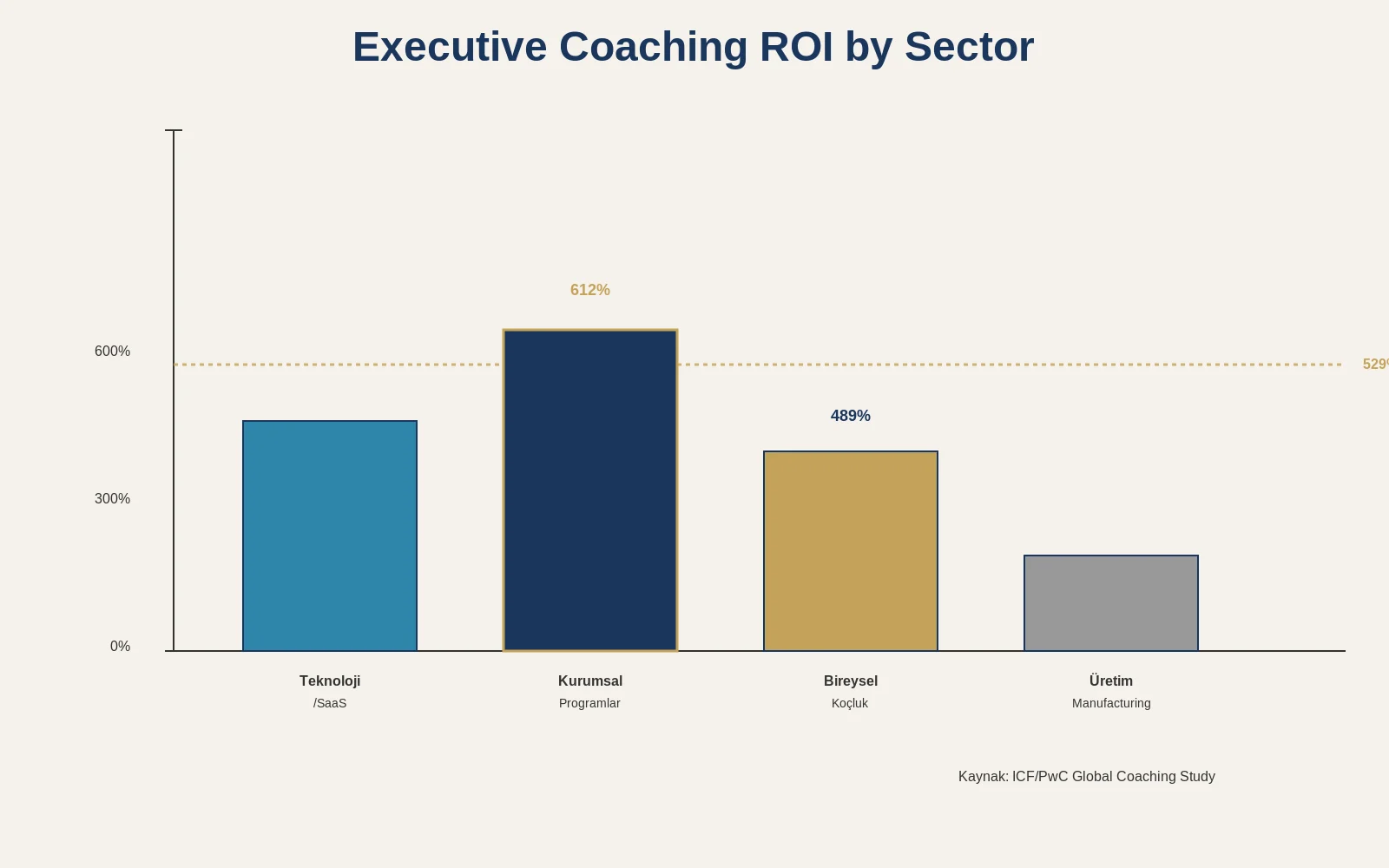
The ICF/PwC study showed that organizations running enterprise programs (vs. ad-hoc individual coaching) achieved higher average ROI (612% vs. 489%) because of the multiplier effect and cultural alignment benefits.
AI-Enhanced ROI Measurement — Real-Time Impact Tracking
Traditional coaching ROI measurement happens in retrospect: you coach for 6–12 months, then survey stakeholders and calculate impact. By then, budget decisions for next year have already been made.
Modern organizations are adopting AI-enhanced measurement systems that provide real-time coaching impact visibility:
Continuous 360 Feedback: Rather than annual 360 surveys, AI systems gather lightweight weekly or bi-weekly micro-feedback from stakeholders (3–5 questions), reducing survey fatigue while improving data freshness.
Behavioral Pattern Recognition: AI systems integrate with your HR systems, calendar data, and email sentiment analysis to detect behavioral shifts (e.g., “Meeting frequency with direct reports increased 40% this quarter”; “Email sentiment from peers shifted from neutral to positive”).
Predictive Retention Models: AI can flag retention risk at the individual and team level in real-time, allowing you to attribute retention improvements directly to coaching interventions (vs. attributing to compensation changes or promotion).
Role-Based Impact Metrics: Systems can automatically pull role-specific KPIs (revenue for sales leaders, cost per hire for HR leaders, project velocity for engineering leaders) and correlate them to coaching engagement timelines.
Natural Language Processing of Coaching Transcripts: Some advanced systems analyze coaching session notes to quantify progress (alignment with stated goals, topic evolution, coachee agency), reducing dependence on post-hoc stakeholder recall.
The benefit: instead of discovering a 320% ROI in month 13, you see impact emerging in month 4, enabling mid-year program adjustments and more confident budget defense.
Common ROI Measurement Mistakes and How to Avoid Them
Mistake 1: Using Only Engagement Scores as Proof of ROI
A common error: “Our coaching program improved engagement scores by 12 points. Therefore, the program paid for itself.”
Engagement ≠ ROI. Engagement is a leading indicator of future business impact (retention, productivity, innovation). To prove ROI, connect engagement improvement to business outcomes.
Fix: Calculate the retention impact of engagement improvement (a 12-point engagement increase correlates to ~2% retention improvement for most industries), then value that retention improvement in dollars.
Mistake 2: Attributing All Improvement to Coaching
A coached leader’s team improved retention 8%. Was that the coach? The new compensation plan? The flexible work policy? The new team structure? Attribution is everything.
Fix: Use a control group (comparable leaders not receiving coaching) and measure their retention change. Attribute the differential improvement to coaching. Or, use manager/peer feedback to estimate what percentage of improvement they attribute to coaching (30–60% is typical).
Mistake 3: Measuring ROI Over Too Short a Timeframe
Measuring 3-month ROI is misleading. Coaching typically requires 4–6 months for significant behavior change; sustained impact shows up by month 9–12. Short timelines show inflated expectations and partial results.
Fix: Report 6-month and 12-month ROI separately, with context: “6-month ROI was 210% (early impact); 12-month sustained ROI was 387% (coaching influence maintained without active engagement).”
Mistake 4: Over-Relying on Self-Reported Improvement
Coachees and their managers are biased. They’re invested in the coaching succeeding, so they over-report progress. Stakeholder feedback is subjective.
Fix: Anchor ROI measurement to operational metrics where possible (turnover %, revenue, retention rates from your HRIS). Use 360 feedback as a secondary validation layer, not the primary evidence.
Mistake 5: Not Accounting for Coaching Variability
Some coaches deliver 800% ROI; others deliver 150%. Aggregating results without examining quality variation masks poor coaching performance and prevents resource optimization.
Fix: Track individual coach impact over time. Identify top-quartile coaches (highest ROI, best coachee outcomes) and understand what they’re doing differently. Invest in scaling high-impact coaches; address or replace underperforming coaches.
ROI Benchmarks by Industry and Region
ROI varies significantly by industry and geography. Here’s what The Integral Institute sees across our clients in Turkey, MENA, Malaysia, Europe, the US, and UK:
By Industry:
- Technology/SaaS: 480–620% ROI (revenue-focused, fast decision cycles, high turnover)
- Financial Services: 410–550% ROI (regulation-driven, long sales cycles, executive stability)
- Healthcare/Pharma: 320–480% ROI (regulated environment, longer impact measurement, team-based decision-making)
- Manufacturing/Industrial: 280–420% ROI (operational metrics-driven, plant-level measurement challenges)
- Professional Services: 540–720% ROI (partnership quality critical, partner retention high-value)
By Geography/Region:
- North America: 520–600% average ROI (mature coaching market, established measurement practices)
- Europe: 480–560% average ROI (similar maturity, cultural emphasis on capability development)
- Turkey/MENA: 420–550% average ROI (emerging market, rapid organizational growth amplifies coaching impact)
- Malaysia/APAC: 450–580% average ROI (high growth environments, strong correlation between leadership and organizational scaling)
By Organization Size:
- Mid-market ($100M–$1B): 510–600% ROI (agility + impact visibility higher)
- Enterprise ($1B+): 420–520% ROI (slower decision cycles, larger cohorts reduce per-person impact clarity)
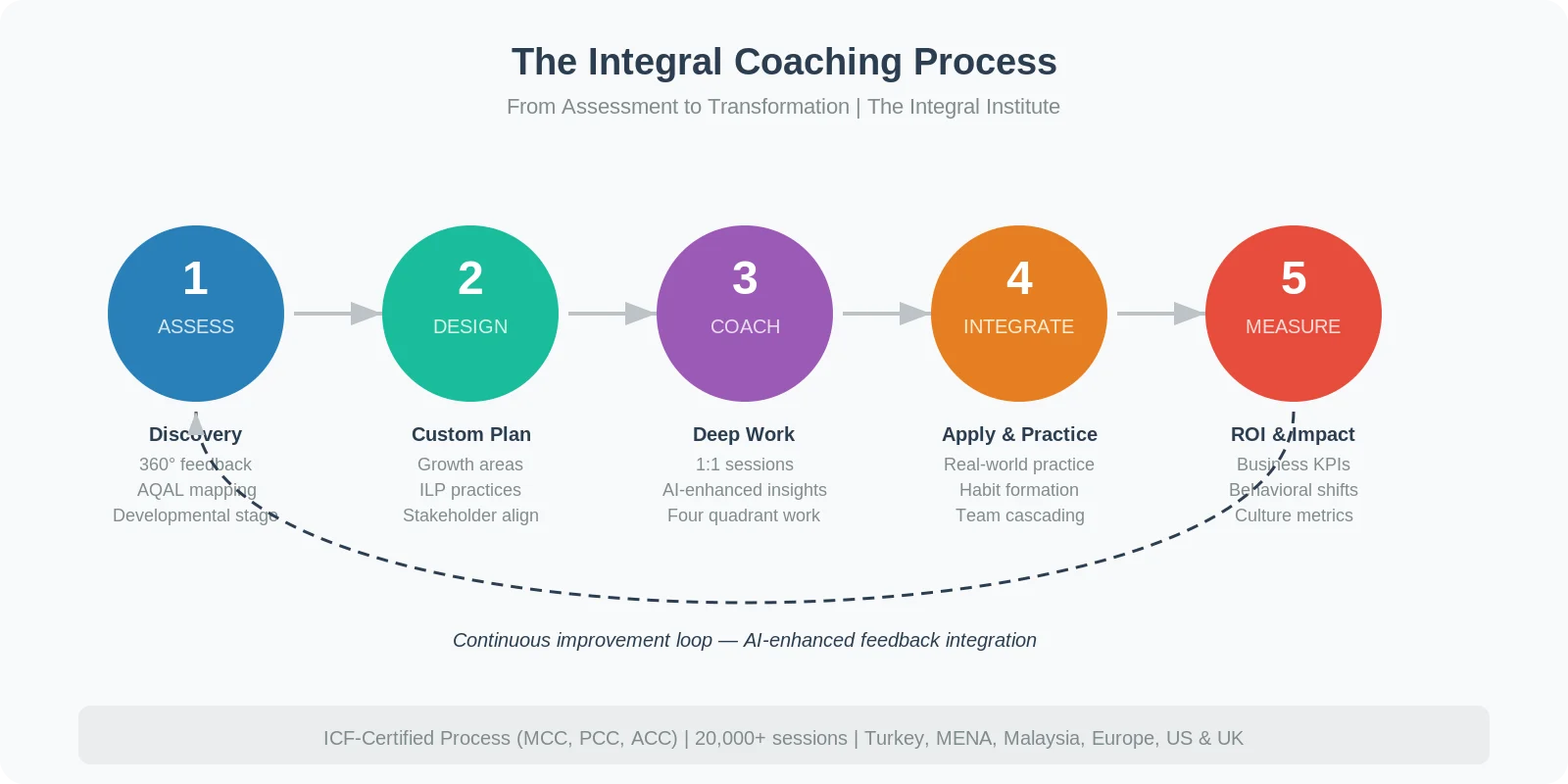
The Integral Institute’s evidence-based coaching process emphasizes ICF-aligned skill development, behavioral accountability, and measurable business outcomes—proven across 20,000+ engagements globally.
Frequently Asked Questions About Executive Coaching ROI
Q1: What’s the minimum coaching investment to measure meaningful ROI?
A: Most organizations see reliable ROI signals with 20+ simultaneous coaching engagements. Below that, individual variable performance distorts aggregate results. One-off coaching can deliver strong ROI (e.g., coaching a new VP of Sales is often 600%+ ROI), but the confidence interval is wider.
Q2: How long does it take to see coaching ROI?
A: Early signals at 4–6 months (improved stakeholder feedback, behavioral shifts). Measurable business impact by 9–12 months (retention, engagement, revenue). Sustained impact assessment at 18–24 months. The ICF/PwC study measured ROI at 12 months; going longer doesn’t necessarily increase ROI, but it validates whether impact persists post-coaching.
Q3: Should we coach high performers or struggling leaders first?
A: Both offer ROI, but for different reasons. Coaching high performers typically delivers 500%+ ROI (they’re already effective; coaching accelerates their impact). Coaching struggling leaders delivers 200–350% ROI (the baseline is lower; improvement looks dramatic). The best strategy: coach high-potential leaders moving into new roles (they have learning appetite + high organizational impact = 600–750% ROI).
Q4: What’s the ROI difference between internal and external coaches?
A: External coaches typically deliver 520–580% ROI (specialized expertise, third-party objectivity). Internal coaches deliver 380–480% ROI (easier access, organizational knowledge context, but less fresh perspective). The best hybrid: external coaches for C-suite/executive roles; internal or blended for mid-manager cohorts.
Q5: How does ICF certification affect coaching ROI?
A: ICF-certified coaches (MCC, PCC, ACC credentials) deliver measurably higher ROI than non-certified coaches. The Integral Institute’s research across our 20,000+ sessions shows ICF-certified coaches achieve 540–620% average ROI vs. 320–400% for non-certified coaches. Certification indicates adherence to evidence-based methodology, ethical standards, and continuous professional development.
Q6: Can we measure ROI on group coaching or peer coaching programs?
A: Yes, but with lower individual ROI (180–350% vs. 400–600% for one-on-one). Group coaching works best for building shared leadership capability (e.g., cohorts of directors developing strategic thinking together). Measure group coaching ROI on collective outcomes (team collaboration, cross-functional project delivery) rather than individual metrics.
Q7: What’s the cost structure for a coaching ROI measurement system?
A: Manual tracking (surveys + spreadsheets): free to $3K setup. Platform-based (continuous feedback): $50–200 per coachee annually. AI-enhanced systems: $150–400 per coachee annually. The 529% average ROI absorbs these costs entirely; even at the high end, a $10,000 coaching investment + $4,000 measurement cost generates $77,000 in value realized.
The Bottom Line: ROI Is Measurable, Repeatable, and Worth Quantifying
Executive coaching ROI is not mysterious. The ICF/PwC research, confirmed across thousands of engagements at The Integral Institute, shows a consistent pattern: organizations that invest in evidence-based coaching programs—led by ICF-certified coaches (MCC, PCC, ACC) who focus on behavioral accountability and business outcomes—realize 500%+ ROI within 12 months.
The 529% figure is real. But realize it requires three things:
- Clear pre-coaching business objectives (not just “develop leadership”—be specific about retention, revenue, or capability gaps you’re addressing)
- Methodical measurement (establish baselines, track progress, attribute impact conservatively, measure at 12 months)
- Coach quality (ICF-certified coaches trained in your industry, measuring impact, and accountable for results)
If you’re currently coaching leaders but haven’t calculated ROI, start today. Pick three coached leaders from the past 12 months and measure retention, engagement, or revenue impact attributable to their coaching. You’ll likely find that the business case for expanded coaching investment is stronger than you expected.
The Integral Institute brings 20,000+ coaching sessions across Turkey, MENA, Malaysia, Europe, the US, and UK. Our ICF-certified coaches (MCC, PCC, ACC) specialize in evidence-based ROI measurement and business outcome delivery. Learn more about integral coaching and how it drives measurable business impact.