

Key Facts
If you are currently evaluating leadership models for your organization, you have likely realized that the “one-size-fits-all” era is over. The complexity of modern business—compounded by rapid technological shifts and distributed workforces—requires more than just a list of management tactics.
You might be looking at Transformational Leadership to drive change, or Adaptive Leadership to navigate uncertainty. Perhaps you are exploring Servant Leadership to boost engagement. But the challenge isn’t usually picking the one right model; it’s understanding how to integrate them into a cohesive strategy that actually works when the pressure is on.
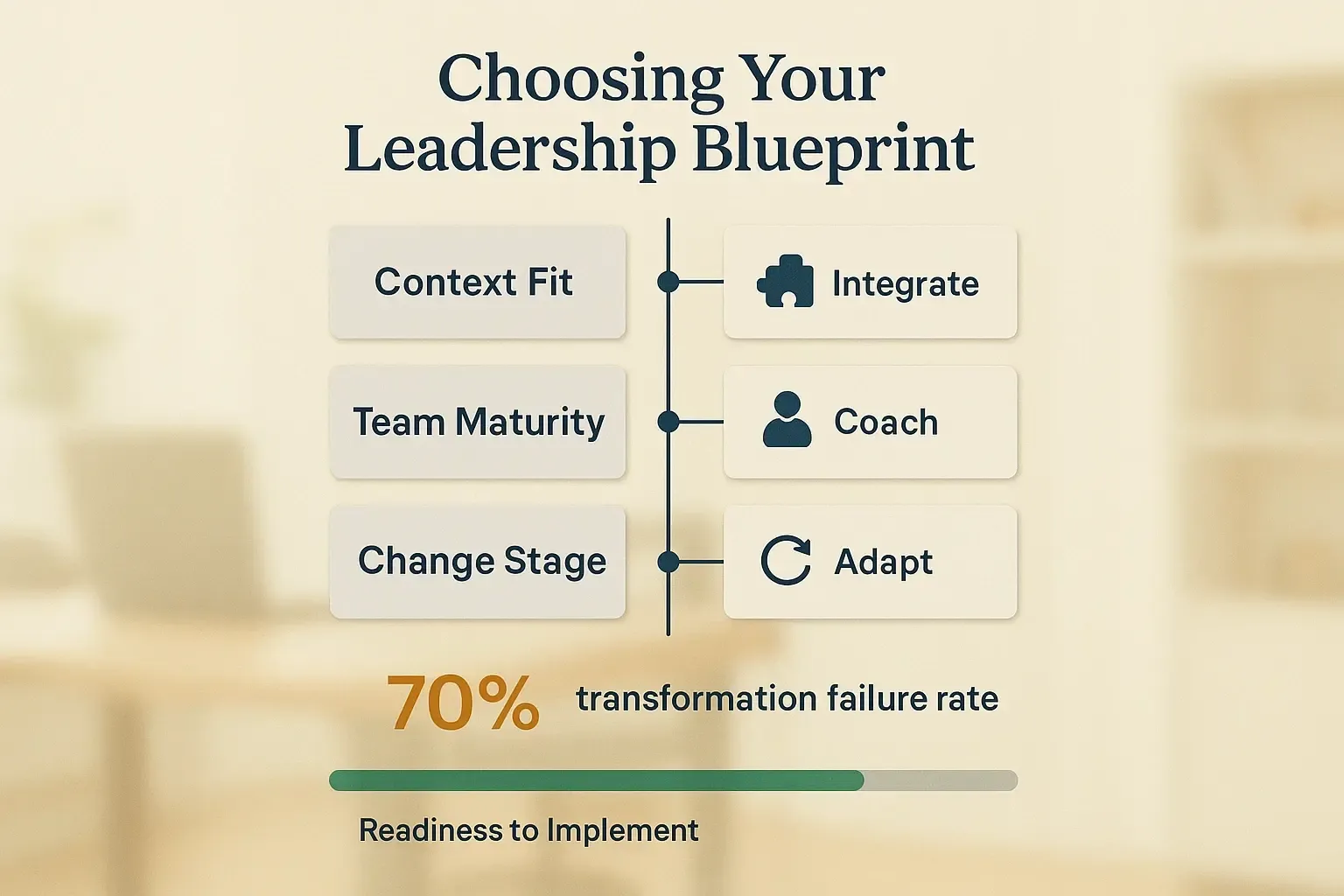
Research from McKinsey and Harvard Business Review consistently indicates that nearly 70% of organizational transformations fail. This rarely happens because the strategy was wrong; it happens because the leadership capability wasn’t complex enough to handle the human and systemic reality of the change.
This guide moves beyond surface-level definitions. We will deconstruct how Integral Leadership acts not as a competitor to these other models, but as a meta-framework—an operating system—that allows you to deploy the right methodology at the right time.
Evaluating the Landscape: A Comparative View
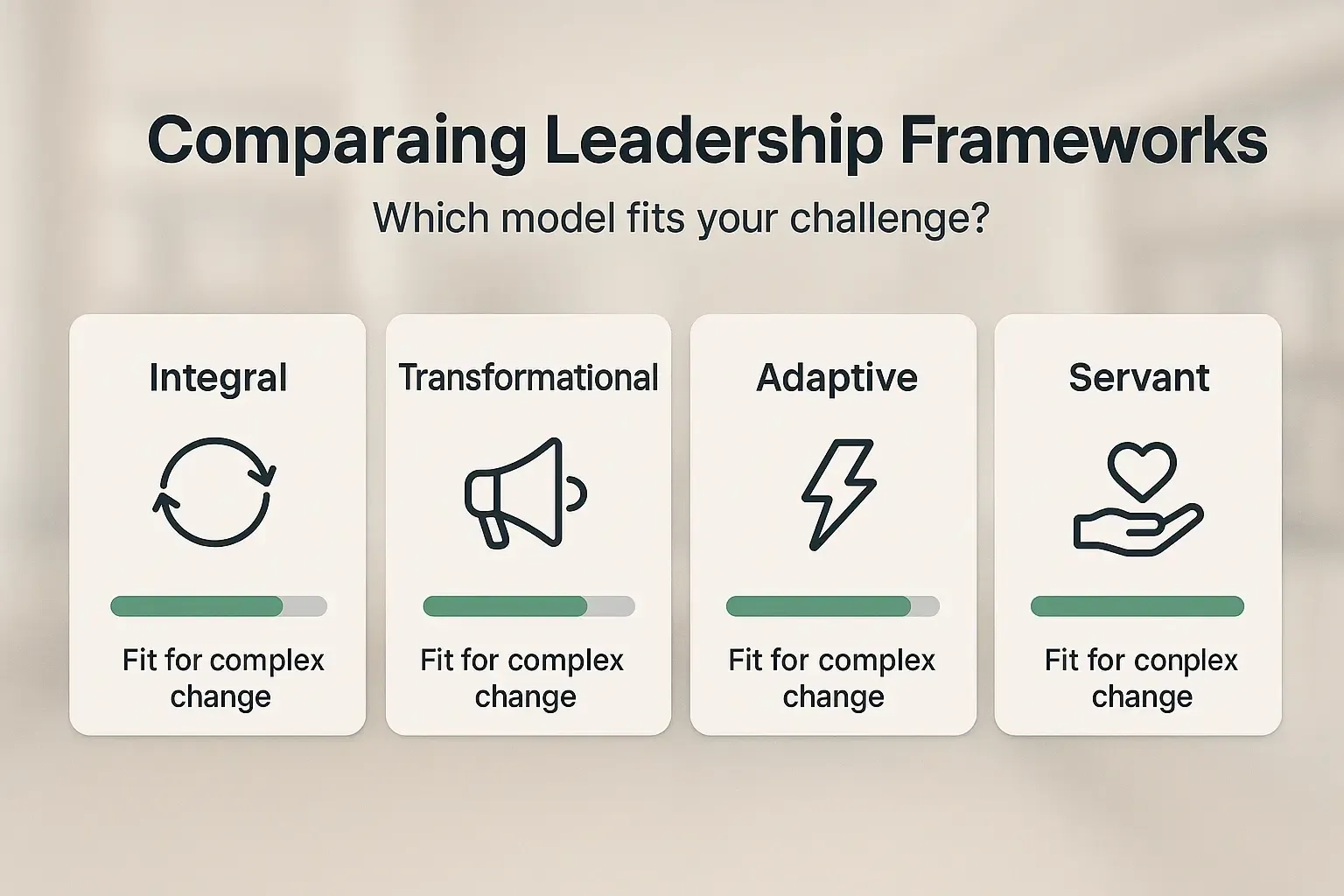
Before diving into the mechanics of Integral Theory, it is vital to see where it sits in relation to the frameworks you are likely comparing. Most leadership models focus on specific “lines” of development—behavior, culture, or strategy. Integral Leadership attempts to include all of them.
The Fragmentation Problem
The reason many leadership initiatives stall is fragmentation. You might have a leader who is technically brilliant (high cognitive intelligence) and uses an “Adaptive” strategy, but lacks the emotional intelligence (EQ) to maintain psychological safety, causing the team to fracture under stress.
Integral Leadership is designed to solve this by ensuring leaders are developing across multiple intelligences simultaneously—cognitive, emotional, spiritual, and somatic.
The Pillars of Integral Leadership: The AQAL Model
At the core of the integral program is Ken Wilber’s AQAL framework (All Quadrants, All Levels). While this theory can get academically dense, for a decision-maker, it comes down to four critical lenses through which a leader must view every problem.
If you miss one of these lenses, you have a blind spot that will likely derail your results.
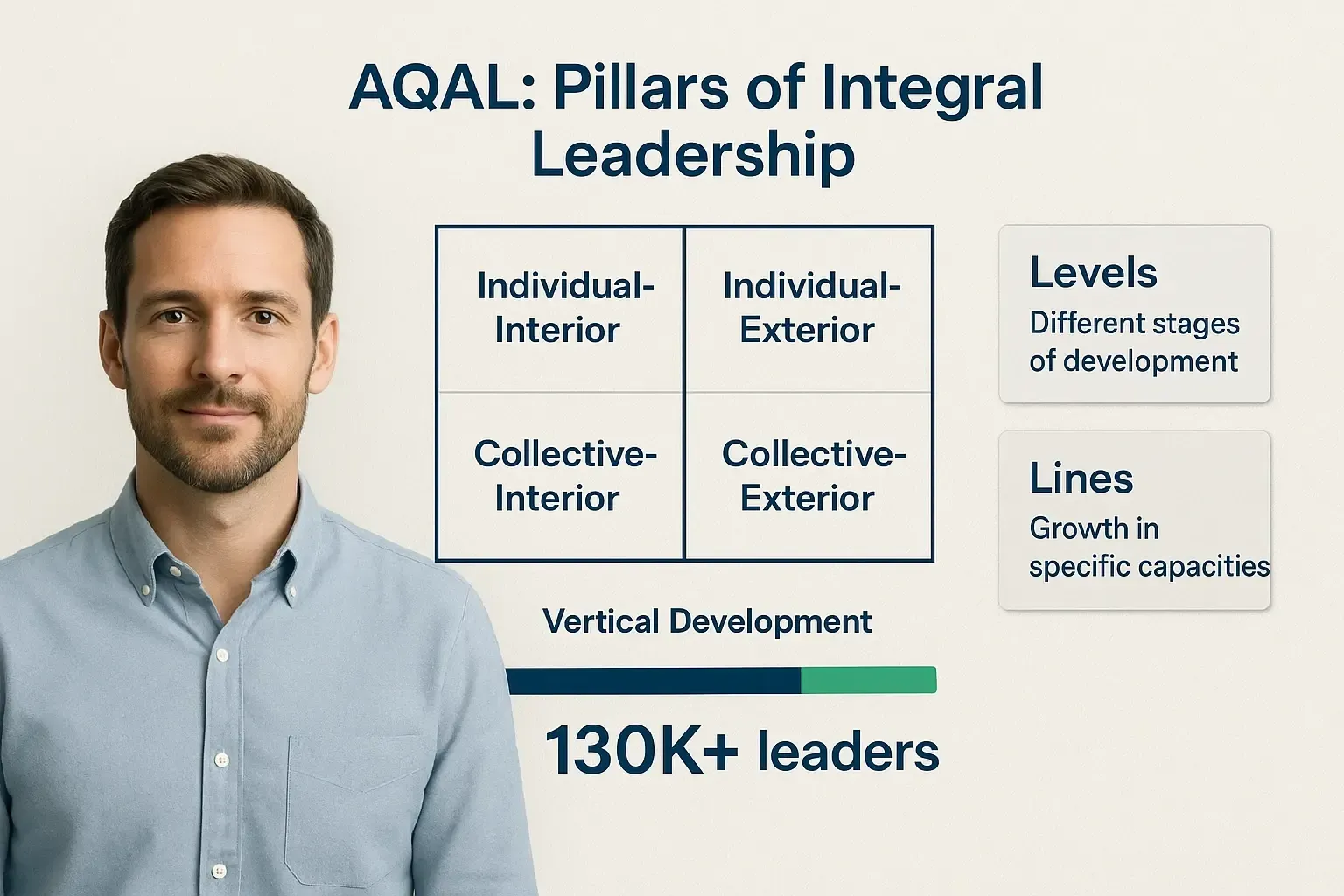
1. The Individual-Interior (Mindset & Intention)
This is the “I” space. It covers a leader’s internal reality—values, self-awareness, and emotional capacity.
- The Risk: A leader with a rigid mindset cannot drive an agile strategy, no matter how good the plan is.
2. The Individual-Exterior (Behavior & Skills)
This is the “It” space (Individual). It covers observable behaviors, skills, and technical execution.
- The Risk: High intention without execution leads to “visionary” leaders who never deliver.
3. The Collective-Interior (Culture & Relationships)
This is the “We” space. It encompasses shared values, morale, and the unwritten rules of the team.
- The Risk: Ignoring this quadrant is why “culture eats strategy for breakfast.”
4. The Collective-Exterior (Systems & Structures)
This is the “Its” space (Plural). It covers workflows, technology, organizational hierarchy, and metrics.
- The Risk: You can have great people and culture, but if the systems (like compensation or IT) fight the goals, performance creates friction.
An effective integral leader scans all four quadrants constantly. They don’t just ask, “What do we need to do?” (Behavior). They ask, “What mindset do I need to lead this?” (Interior), “How will the team culture react?” (Culture), and “Do our systems support this change?” (Systems).
Comparing Global Frameworks vs. The Integral Approach
To make a confident decision, you need to understand how the integral leadership approach interacts with other methodologies you may be considering.
Integral vs. Transformational Leadership
Transformational Leadership focuses on inspiring teams to exceed expectations through a shared vision. It relies heavily on the “Four I’s”: Idealized Influence, Inspirational Motivation, Intellectual Stimulation, and Individualized Consideration.
- The Overlap: Integral frameworks embrace the visionary aspect of Transformational leadership.
- The Integral Value Add: Transformational leaders can sometimes burn out teams by pushing for constant change without recognizing systemic limits (The Systems Quadrant). Integral theory adds the “Sustainability” check, ensuring the internal energy of the leader and the team is replenished.
Integral vs. Servant Leadership
Servant Leadership flips the hierarchy, prioritizing the needs of the team and stakeholders above the leader’s own.
- The Overlap: Both prioritize ethical behavior and the growth of individuals.
- The Integral Value Add: The critique of Servant Leadership is that it can sometimes lead to “nice guy” indecision or a lack of strategic edge in crisis moments. Integral leadership integrates the heart of a servant with the spine of a decisive executive, allowing for “tough love” when necessary for the collective good.
Integral vs. Adaptive Leadership
Adaptive Leadership is built for navigating “wicked problems” where there are no clear technical solutions. It requires mobilizing people to tackle tough challenges and thrive.
- The Overlap: This is highly compatible with the Integral view of complex environments.
- The Integral Value Add: Adaptive leadership demands high psychological safety. Without the “Individual-Interior” work (deep self-awareness) provided by integral training, leaders often project their own anxiety onto the organization, sabotaging the adaptive process.
The “Dark Side” of Leadership: Managing Risk
One aspect rarely discussed in sales brochures is the “Dark Side” of leadership models. Every framework has a shadow.
- Transformational Shadow: Narcissism and manipulation. The leader becomes the “hero” and the organization becomes dependent on them.
- Adaptive Shadow: Avoiding responsibility by pushing too much stress onto the team under the guise of “giving the work back to the people.”
At The Integral Institute, we believe that acknowledging these shadows is the first step to mitigating them. Research on leadership derailment highlights that strengths overused become weaknesses. An integral approach involves rigorous self analysis to identify where your preferred style might be creating toxicity or bottlenecks.
The MOFU Decision: Is Your Organization Ready?
Choosing an integral approach isn’t just about buying a training course; it’s about committing to vertical development. “Horizontal” development adds skills (new software, new techniques). “Vertical” development expands the capacity of the leader’s mind to hold complexity.
How do you know if this is the right path for your current evaluation?
Decision Criteria
- Complexity of Challenge: If your problems are technical (known solutions), standard management training works. If your problems are adaptive (unknown solutions, requiring behavior change), you need an integral approach.
- Leadership Maturity: Are your leaders ready to look inward? Integral work requires self analysis and vulnerability.
- Cultural Appetite: Is the organization willing to discuss “soft” topics like values and fears alongside “hard” topics like KPIs?
Cultivating the Integral Leader
If you decide to move forward with an integral framework, the implementation focuses on developing specific competencies.
1. Vertical Development
This involves moving leaders from “Socialized Mind” (seeking validation) to “Self-Authoring Mind” (guided by internal compass) to “Self-Transforming Mind” (able to hold opposing truths). This is the gold standard for C-level mentoring.
2. Multiple Intelligences
We assess and develop leaders across different “lines”:
- Cognitive: Strategic thinking.
- Emotional: Managing self and others (Crucial for coaching and motivating in hybrid workplaces).
- Somatic: Presence and energy management.
3. Understanding Your Elements
Using tools like the 4 elements assessment helps leaders understand their natural energetic stance—whether they lead with Fire (action), Water (connection), Air (vision), or Earth (structure)—and how to balance them.
FAQ: Common Evaluation Questions
Q: Is Integral Leadership too theoretical for my pragmatic leadership team?A: It is rooted in theory but applied in practice. The goal isn’t to teach leaders philosophy, but to give them a diagnostic tool (AQAL) that solves problems faster. It reduces the time wasted on “fixing” symptoms (like poor morale) by identifying the root cause (like misaligned systems).
Q: How does this fit with our existing Agile or Lean initiatives?A: Perfectly. Agile is a “Collective-Exterior” system. Integral Leadership ensures the “Individual-Interior” (mindset) and “Collective-Interior” (culture) actually support Agile, rather than resisting it.
Q: Can we measure ROI on this?A: Yes. Data from the Leadership Circle (based on over 130,000 leaders) shows a direct correlation between “Creative” (Integral) leadership competencies and business performance metrics, including profitability and market share.
Next Steps
The shift to Integral Leadership is a shift from “doing leadership” to “being a leader.” It is a comprehensive journey that transforms not just how your managers work, but how they perceive the world.
If you are ready to explore how this framework applies to your specific organizational context, we invite you to deepen your evaluation.
- Explore: Review our integral leadership and coaching programs for managers.
- Assess: Consider utilizing the 4 elements assessment to baseline your team’s current dynamic.
- Connect: Reach out to The Integral Institute to discuss a tailored roadmap for your leadership team.