

Imagine for a moment that you are navigating a dense forest. You have a map, but it only tells you where the trees are right now—it doesn’t tell you how the forest is growing, how the seasons are changing the terrain, or where the path might lead next year.
This is the current state of most personality assessments. Tools like MBTI or DiSC give us a snapshot of our “horizontal” traits—our preferences and styles. They tell us what kind of hiker we are. But they rarely tell us where we are on the mountain.
We are entering a new era where Artificial Intelligence meets Integral Theory. This convergence promises something far more profound than a static label: a dynamic, real-time map of your human evolution. By using machine learning to analyze the subtle patterns in how we think, speak, and act, we are moving toward a future where we can visualize our own vertical development—our growth from one stage of consciousness to the next.
But how does a machine measure wisdom? And can an algorithm truly understand the complexity of the human soul? Let’s explore this fascinating frontier.
The Foundation: Understanding the “Integral” Map
Before we plug in the AI, we need to understand the operating system. Integral Theory, popularized by philosopher Ken Wilber, is often called a “Theory of Everything.” While that sounds ambitious, at its core, it is a meta-framework that helps us ensure we aren’t leaving anything out.
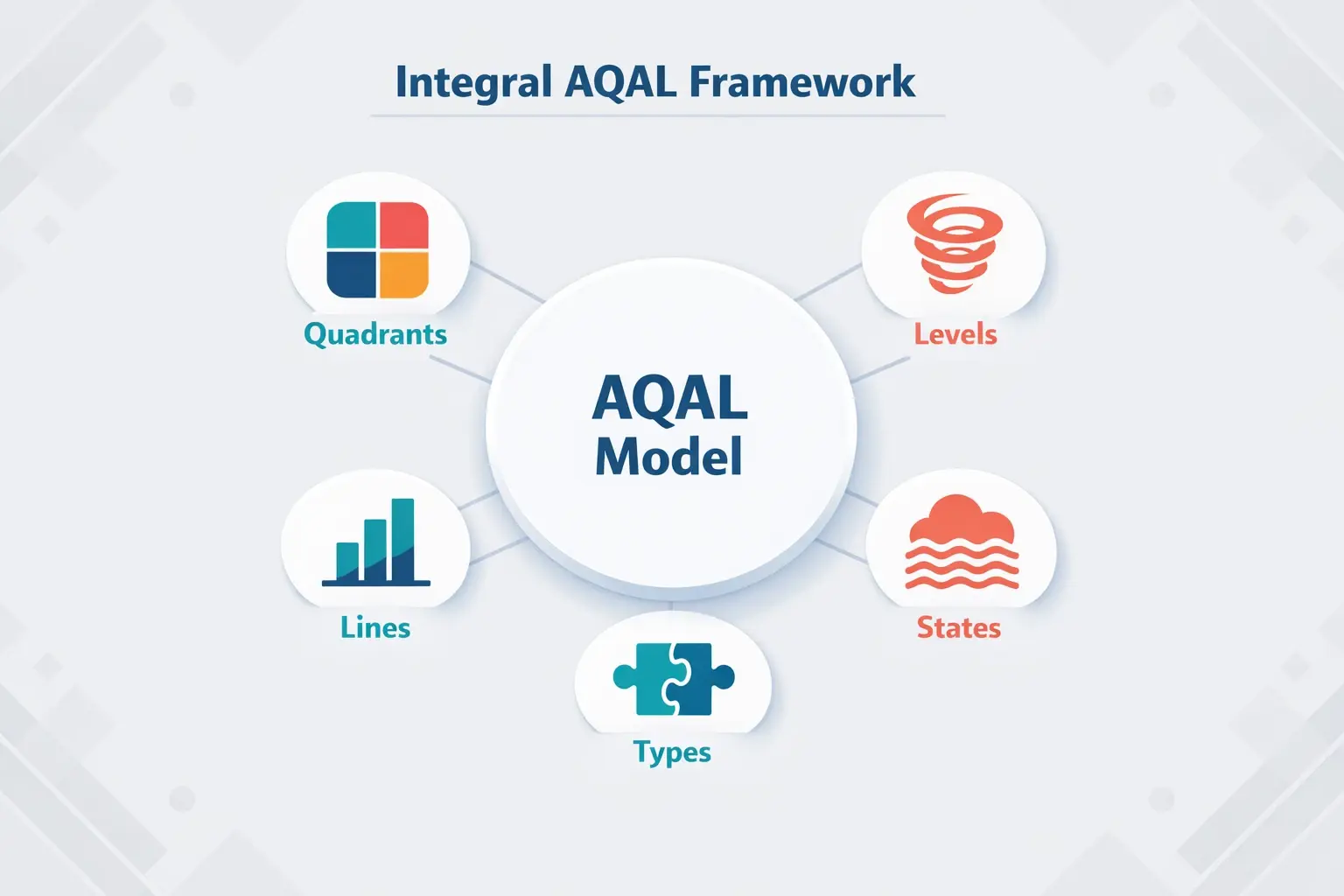
To map human growth effectively, we look at the AQAL Model (All Quadrants, All Levels). An integral leader understands that growth isn’t just about getting smarter (cognitive line); it’s about expanding in four dimensions simultaneously:
- Upper-Left (Interior-Individual): Your thoughts, emotions, and psychology.
- Upper-Right (Exterior-Individual): Your behavior, skills, and biology.
- Lower-Left (Interior-Collective): Your culture, shared values, and relationships.
- Lower-Right (Exterior-Collective): The systems, environment, and structures you operate within.
Vertical Development: The “Levels”
Most traditional coaching focuses on skill acquisition (learning a new software, improving public speaking). This is horizontal growth. Integral Theory focuses on vertical development—changing how you make sense of the world.
Think of it like upgrading your internal computer processor. You move from “Egocentric” (me-focused) to “Ethnocentric” (group-focused) to “Worldcentric” (global empathy) and beyond. In frameworks like Spiral Dynamics, these are color-coded stages. The challenge has always been that identifying these stages requires deep, subjective analysis by a master coach.
This is where technology changes the game.
How AI Decodes Developmental Stages
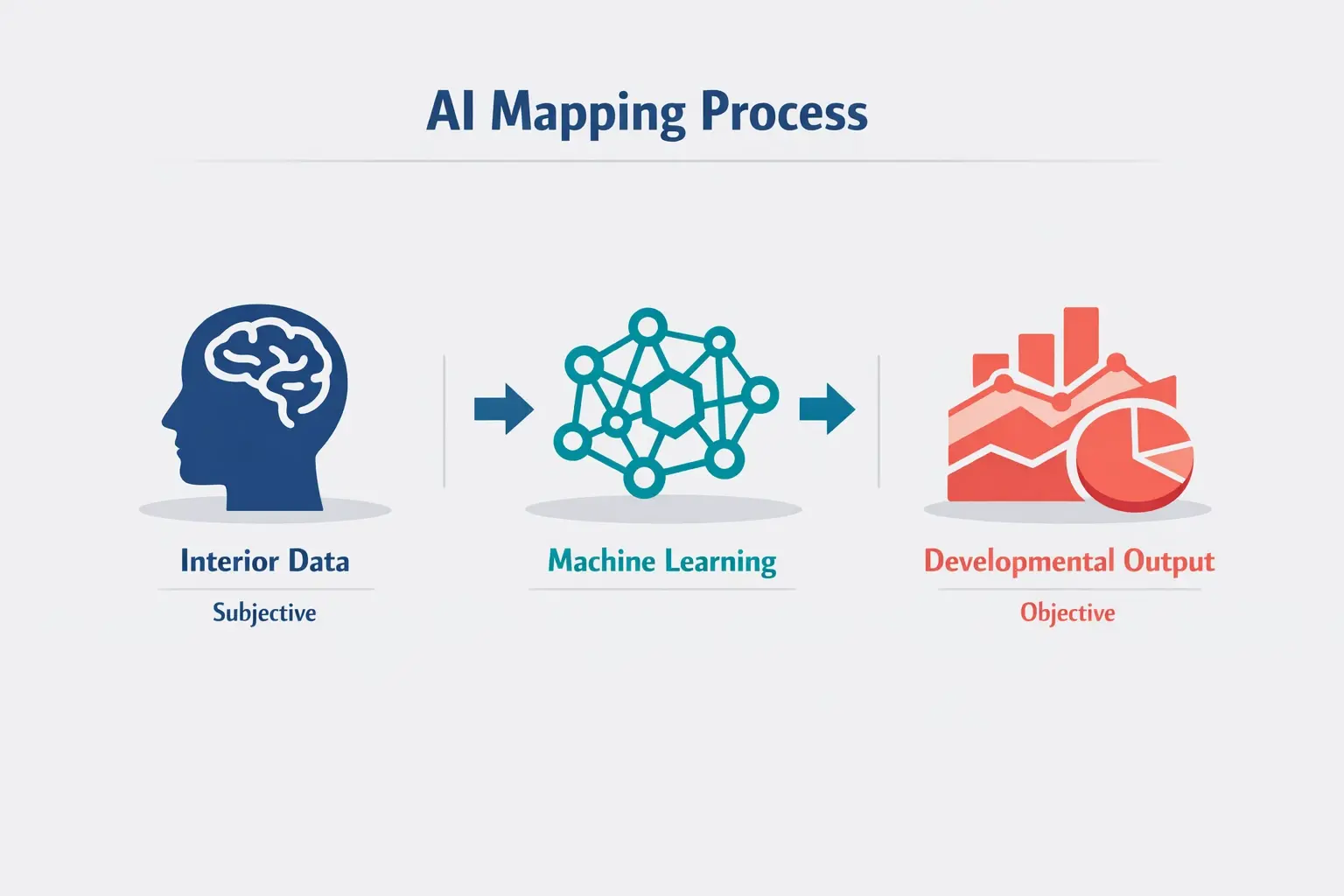
AI is, fundamentally, a pattern recognition machine. It excels at finding correlations in massive datasets that humans might miss. When applied to developmental psychology, AI doesn’t just “read” your text; it analyzes the structure of your thinking.
1. Linguistic Complexity and Value Memes
Natural Language Processing (NLP) has advanced to the point where it can detect the “center of gravity” in a person’s communication.
- Egocentric language often focuses on power, immediate needs, and “I” statements.
- Ethnocentric language emphasizes rules, belonging, and “We” statements (often excluding “They”).
- Worldcentric language demonstrates systemic thinking, holding multiple perspectives, and navigating paradoxes.
By analyzing email communication, journal entries, or verbal transcripts, an AI model can map the density of these “value memes.”
2. Behavioral Patterns and Biometrics
The Upper-Right quadrant deals with what is objectively measurable. AI can analyze patterns in decision-making speed, stress responses (via biometric wearables), and calendar management. Does the individual react to stress by shutting down (a protective state) or by seeking collaboration (a higher-order state)?
3. Systemic Context Analysis
We cannot grow in a vacuum. Advanced AI models can also analyze the environment—the Lower-Right quadrant. For example, by looking at a decentralized organizational structure chart, AI can assess if an individual’s current environment supports their growth stage or suppresses it. If a person operating at a high level of autonomy is placed in a rigid hierarchy, the data will likely show friction and regression.
The Conceptual Walkthrough: From Data to Insight
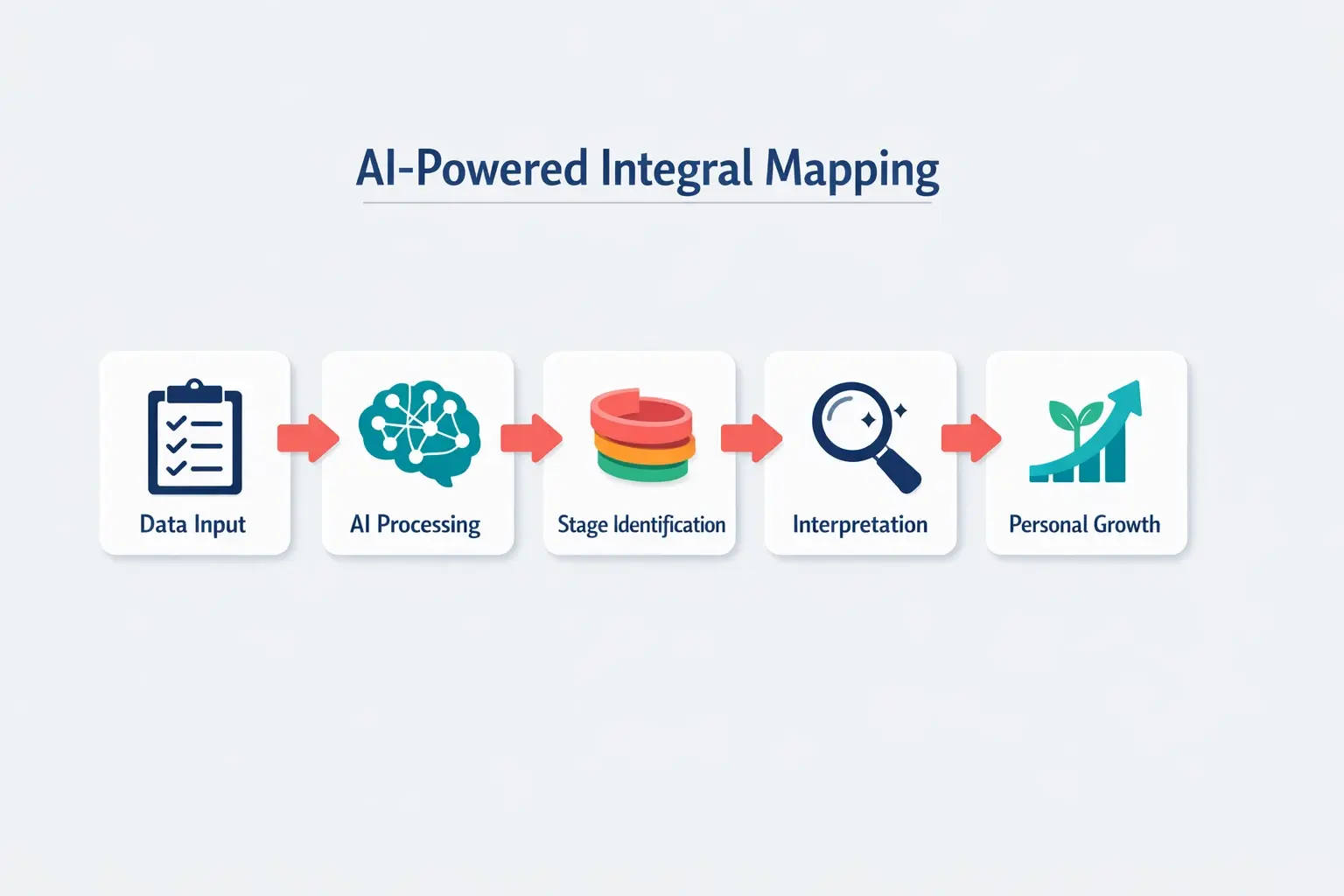
So, what does this actually look like in practice? It isn’t about feeding a resume into a computer. It is a holistic data integration process.
Step 1: Multi-Dimensional Data Collection
The system gathers data from the four quadrants. This might include self-assessments (Upper-Left), feedback from a 1 – 1 executive coaching session (Lower-Left), and performance metrics (Upper-Right).
Step 2: The “Psychograph” Generation
Integral Theory teaches us that we don’t grow evenly. We might be highly advanced cognitively (smart) but underdeveloped emotionally. An AI model can generate a “Psychograph”—a visual chart showing your development across different “lines” (moral, cognitive, emotional, interpersonal).
This prevents the “halo effect” where we assume that because someone is a brilliant engineer, they must also be an emotionally intelligent leader.
Step 3: Identifying the “Leading Edge”
The most valuable insight AI can offer is identifying your “Leading Edge”—the cusp of your next developmental leap. By spotting the moments where you almost grasp a higher complexity but slip back into old habits, the system can suggest precise “micro-practices” to stabilize that new stage.
The Ethical Frontier: Proceed with Caution
While the potential for personalized growth is immense, combining AI-driven competitive intelligence frameworks with personal psychology raises significant ethical questions.
- The Trap of Labeling: AI is deterministic; humans are fluid. There is a risk that an AI assigns a “Red” or “Orange” label to a person, causing them to feel boxed in rather than understood. Integral Theory emphasizes that stages are something we move through, not who we are.
- Privacy and the “Black Box”: To map a developmental stage requires intimate data. Who owns this data? In a corporate setting, could this be weaponized to deny promotions based on an algorithmic assessment of “maturity”?
- The Human Element: AI can provide the map, but it cannot walk the path. An inside mentor—a human guide—is still essential to help interpret the data and provide the empathy a machine cannot.
Why This Matters Now
We are living in a time of unprecedented complexity. The challenges we face—climate change, global polarization, economic shifts—cannot be solved from the same level of consciousness that created them.
By democratizing access to developmental stage mapping, we move high-level psychological insight out of the exclusive domain of expensive consulting and into the hands of learners everywhere. It allows us to see our own blind spots, appreciate the perspectives of others, and accelerate our journey toward becoming more “whole.”
This isn’t just about building better workers; it’s about fostering more complete human beings.
Frequently Asked Questions
Is AI capable of understanding human emotion?
AI does not “feel” emotion, but it can recognize patterns of emotion with high accuracy. Through sentiment analysis and biometric data, it can identify states of stress, joy, or openness, which are indicators of how we are processing our experiences.
Does this replace human coaches?
No. Think of AI as an MRI machine and the coach as the doctor. The AI provides a detailed scan that wasn’t visible to the naked eye, but the integral institute philosophy has always emphasized that human connection is the catalyst for transformation. The coach helps the individual make sense of the map.
Can my developmental stage change?
Absolutely. That is the goal. Integral Theory is based on the concept of “Transcend and Include.” As you grow, you don’t lose your previous stages; you wrap them in a deeper understanding. AI mapping is designed to track this movement over time, unlike static personality tests.
Continuing the Journey
The intersection of AI and Integral Theory is still in its early morning. We are just beginning to see how these tools can support our evolution. If you are curious about your own developmental path or how these frameworks apply to your organization, the best next step is to deepen your understanding of the core principles that drive human growth.
Start by observing your own thinking patterns today. Are you defending your viewpoint, or are you curious about the system that created the viewpoint? That simple shift is the first step in vertical development.