
Imagine sitting in a quarterly board meeting. The slides are polished, the KPIs are green, but there’s an uneasy tension in the room. A competitor—one you considered a second-tier player just six months ago—has just launched a product that renders your Q4 roadmap obsolete. They didn’t just outwork you; they out-predicted you. According to DDI World research, only 14% of CEOs believe they have the leadership talent needed to drive growth, making structured leadership development a strategic imperative.
For many Chief Executive Officers, this is the nightmare scenario. In a volatile global economy, the traditional methods of competitive intelligence (CI)—periodic SWOT analyses, trade show gossip, and manual news monitoring—are no longer sufficient. They are rear-view mirrors in a world that demands a telescope. The ICF/PwC Global Coaching Study confirms that executive coaching delivers an average ROI of 529%, with organizations reporting measurable improvements in leadership effectiveness and business outcomes.
This is where Artificial Intelligence changes the game. We aren’t talking about generating email drafts or summarizing meeting notes. We are talking about leveraging advanced AI analytics and predictive modeling to turn “noise” into “signal.”
For the modern leader, AI-powered competitive intelligence is not just a technological upgrade; it is a fundamental shift in how strategic decisions are made. It moves an organization from reacting to disruptions to anticipating them.
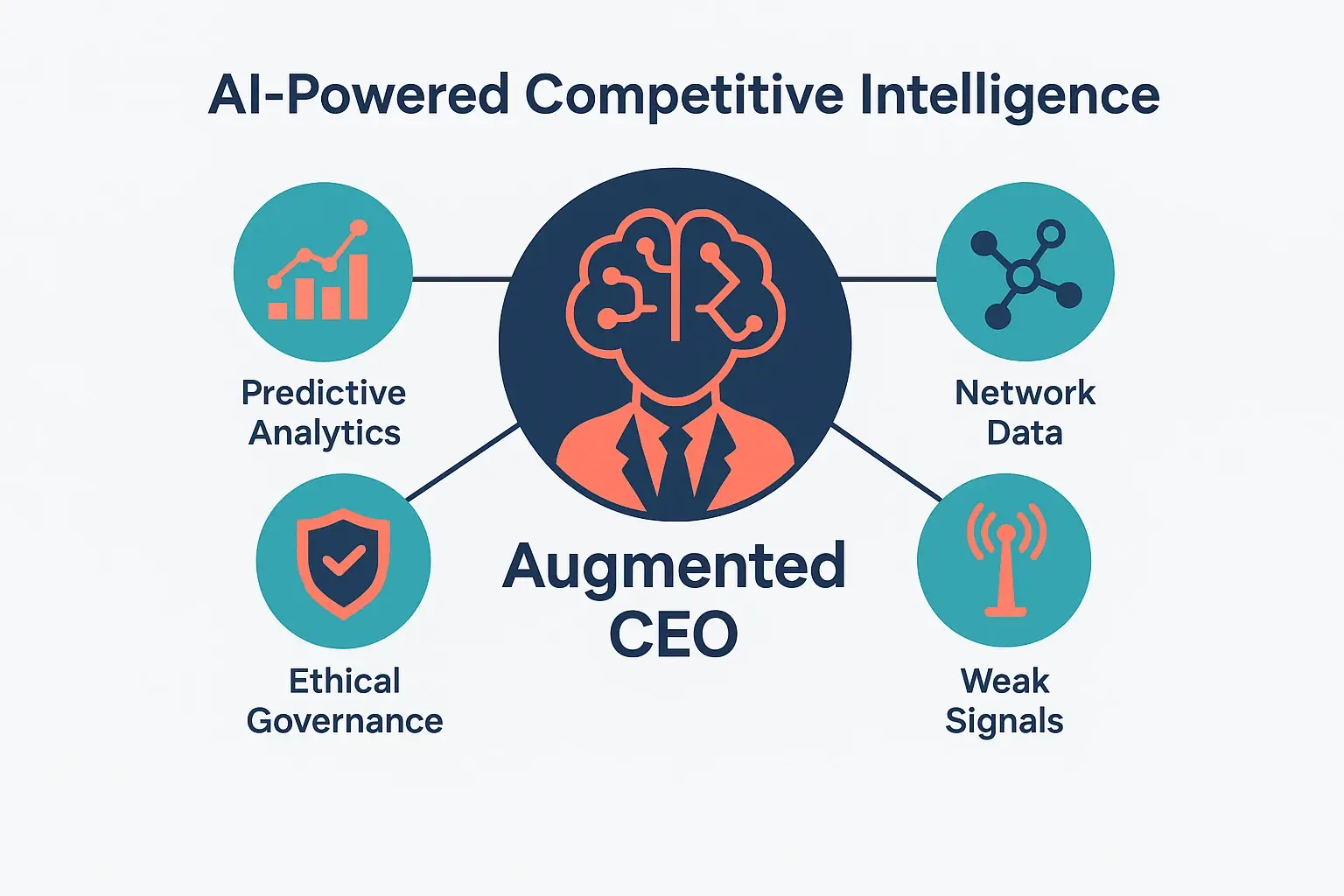
The Augmented CEO: Redefining Strategic Foresight
At its core, AI-powered competitive intelligence is the process of using machine learning algorithms to collect, process, and analyze vast amounts of data to answer a critical question: What happens next?
Historically, CEOs have relied on intuition backed by limited data. Today, the volume of data available—from patent filings and hiring patterns to social media sentiment and supply chain shifts—exceeds human processing capacity.
This doesn’t mean the CEO is replaced. Far from it. It gives rise to the “Augmented CEO.” In this model, AI handles the heavy lifting of data synthesis, providing the executive with clear probabilities and scenarios. The CEO then applies their vision, ethics, and contextual understanding to make the decision.
To truly leverage this, one must cultivate integral leadership capabilities, ensuring that the human element of decision-making remains the guiding force behind the data.
The “Weak Signal” Advantage
The greatest value of AI in this context is its ability to detect “weak signals.” These are subtle indicators of change that are statistically significant but invisible to the naked eye.
- Traditional CI: Notices a competitor launched a new product (Reactive).
- AI-Powered CI: Notices a competitor hired five PhDs in material science and filed three obscure patents 18 months ago (Proactive).
By identifying these weak signals, you gain the most valuable asset in business: time. Time to pivot, time to acquire, or time to fortify your defenses.
The Framework: From Detection to Action
Implementing AI for competitive intelligence isn’t about buying a software tool; it’s about adopting a cycle of intelligence that feeds directly into your strategic planning.
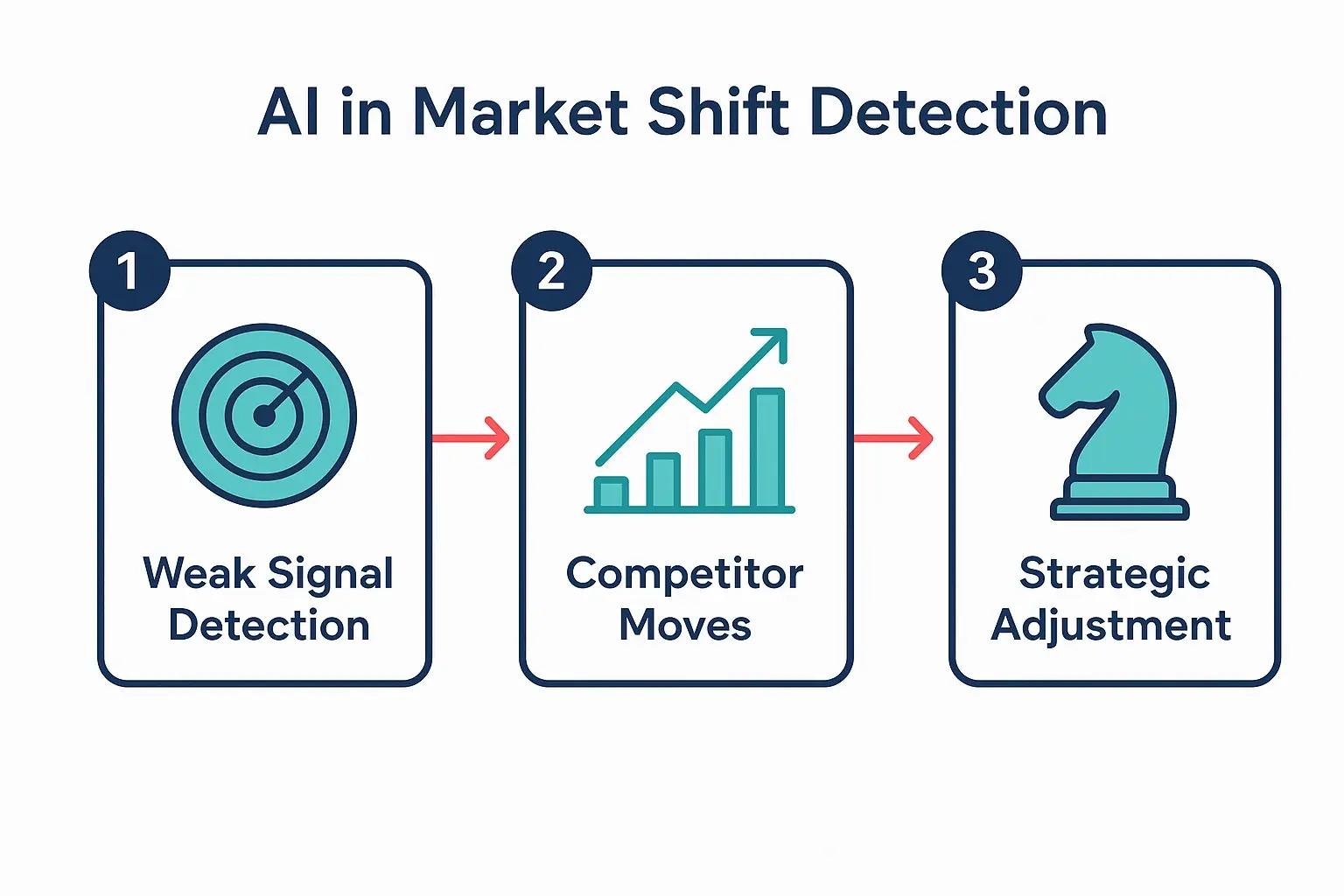
Phase 1: Detecting Market Shifts
AI excels at anomaly detection. By continuously scanning global data lakes, AI tools can identify disruptions in supply chains, shifts in consumer sentiment, or regulatory changes in emerging markets long before they hit the headlines.
For example, an AI system might flag a 300% spike in discussions regarding a specific regulatory standard in the EU. While irrelevant today, this signal could predict a compliance hurdle that will impact your product launch next year.
Phase 2: Anticipating Competitor Moves
This is where predictive modeling comes into play. By analyzing a competitor’s historical behavior, hiring trends, and public investments, AI can build a profile of their likely next moves.
Imagine knowing that when Competitor X hires a specific type of legal counsel, they almost always enter a merger and acquisition phase within six months. AI recognizes these patterns. Accessing this level of insight often requires the guidance found in high-level c level mentoring, where leaders learn to interpret complex competitive landscapes.
Phase 3: Proactive Strategic Adjustments
Data is useless without action. The final phase involves “wargaming” or scenario planning. “Agentic AI”—advanced systems capable of pursuing goals with limited supervision—can run thousands of simulations to test how your current strategy would hold up against various market disruptions.
This allows you to stress-test your strategy in a virtual environment before risking capital in the real world.
The Human Challenge: Governance and Culture
While the technology is powerful, the barrier to success is rarely software—it is organizational culture. A common pitfall is the “Black Box” problem, where executives distrust insights they cannot explain.
Furthermore, integrating these insights requires a team that is agile and responsive. You may need to invest in field coaching to help your frontline managers understand how to act on intelligence rather than just reporting it.
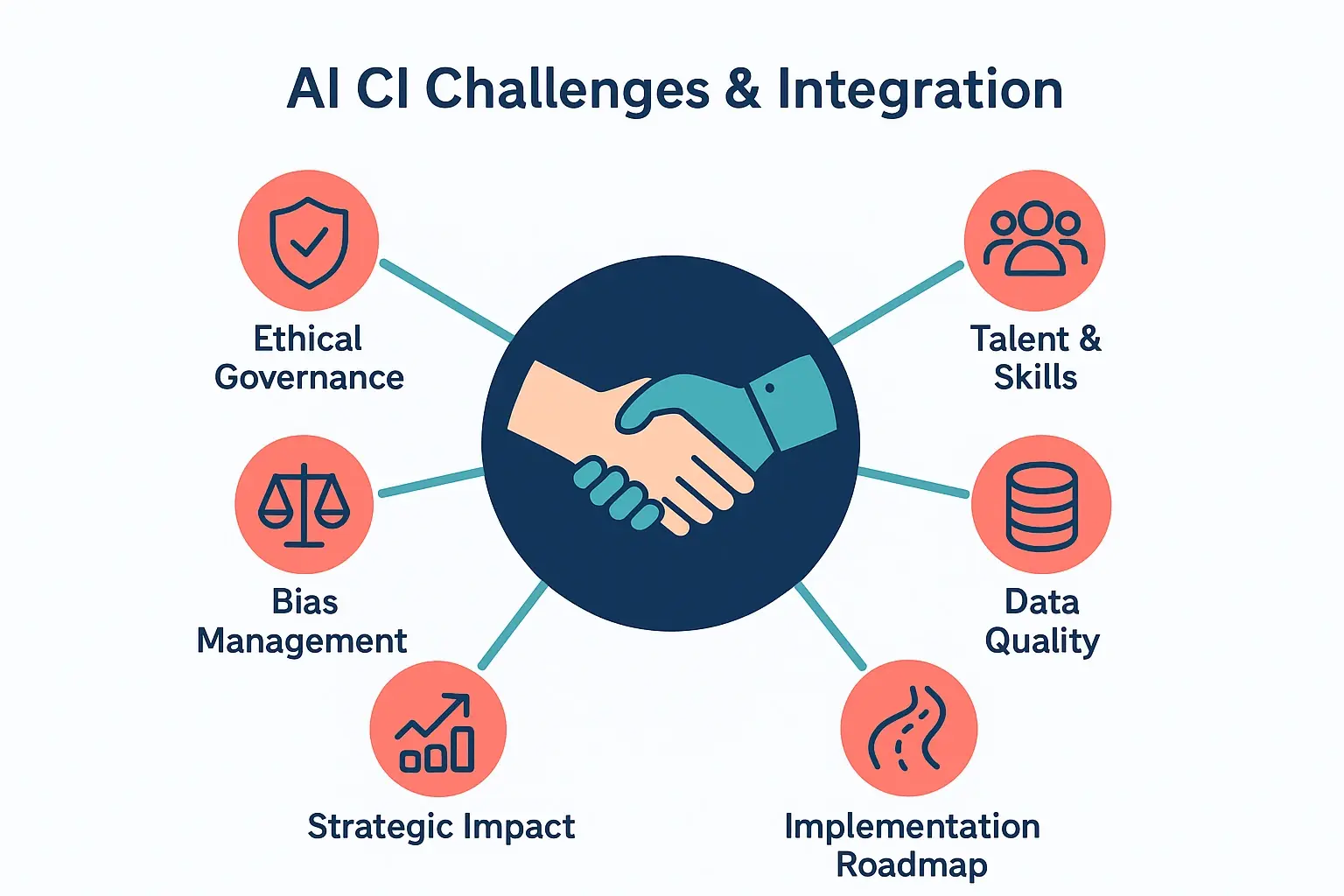
As the framework above illustrates, ethical governance is paramount. AI can scrape data, but should it? Establishing clear boundaries protects your brand reputation. Additionally, the “Talent” component cannot be ignored. Your leadership team must possess the leadership presence workshops skills necessary to communicate these complex AI-driven shifts to stakeholders and employees effectively.
90-Day Pilot Plan for the AI-Ready CEO
If you are ready to move from reactive to proactive, here is a simplified roadmap:
- Days 1-30: The Audit. Identify your “Dark Data.” What internal data are you sitting on that isn’t being analyzed? Simultaneously, map out your top 5 strategic questions (e.g., “Will our pricing model survive a new entrant?”).
- Days 31-60: The Pilot. Select one specific domain—such as competitor pricing or supply chain risk—and deploy a specialized AI tool or partner to monitor it. Don’t try to boil the ocean; focus on one high-impact area.
- Days 61-90: Integration. Review the pilot’s insights against your actual strategic decisions. Did the AI offer a perspective you missed? Begin integrating these insights into your monthly executive reviews.
Frequently Asked Questions
Q: Is AI competitive intelligence only for large tech companies?A: No. While enterprise solutions exist, many scalable tools are available for mid-sized organizations. The cost of not knowing your market is often higher than the investment in these tools.
Q: Will AI replace my strategy team?A: Unlikely. AI replaces the data gathering and initial synthesis. It frees your strategy team to focus on high-level thinking and creative problem-solving rather than spreadsheet maintenance.
Q: How do we trust the data?A: This is why the “Human-in-the-loop” approach is vital. AI provides the probability; human experts provide the validation. Trust is built by verifying AI predictions against outcomes over time.
Q: What about data privacy and ethics?A: This is a critical C-suite responsibility. You must ensure your CI practices comply with GDPR/CCPA and corporate espionage laws. Use AI to analyze public and ethically sourced data only.
Conclusion
The era of “gut feeling” leadership is evolving. While intuition will always play a role in the art of the CEO, the science of leadership now demands better inputs. AI-powered competitive intelligence offers a way to see through the fog of market volatility.
By adopting these tools, you aren’t just buying technology; you are buying foresight. And in business, the leader who sees the furthest usually wins.
To truly transform your organization’s ability to navigate these shifts, it requires more than just data—it requires a culture of excellence and alignment. The integral institute is dedicated to empowering leaders to build exactly that kind of resilient, future-ready culture.
Frequently Asked Questions
What is AI-powered competitive intelligence and how does it benefit CEOs?
AI-powered competitive intelligence uses machine learning to analyze large volumes of data and predict market shifts, enabling CEOs to anticipate disruptions rather than react to them. This approach transforms decision-making by providing clear scenarios and probabilities, enhancing strategic foresight.
How does AI detect early signs of market changes better than traditional methods?
AI excels at identifying “weak signals,” subtle and statistically significant indicators of change that are often invisible to humans. Unlike traditional reactive methods, AI proactively scans diverse data sources to detect anomalies and emerging trends well before they become obvious.
What are the key phases in implementing AI for competitive intelligence?
The implementation involves three phases: detecting market shifts through continuous data monitoring, anticipating competitor moves using predictive modeling, and making proactive strategic adjustments via scenario planning and simulations. This cycle integrates AI insights directly into strategic decision-making.
What role does human leadership play alongside AI in competitive intelligence?
Human leadership remains essential for interpreting AI-generated insights, applying vision and ethics, and making final decisions. Effective use of AI requires cultivating leadership capabilities and fostering a culture that trusts and acts on AI-driven intelligence.
What are the ethical and organizational challenges of using AI in competitive intelligence?
Ethical challenges include ensuring data privacy, complying with laws like GDPR, and avoiding unethical data scraping. Organizationally, success depends on overcoming distrust of AI’s “black box” outputs and building agile teams capable of integrating AI insights into responsive strategies.