

Organizational Innovation Frameworks & Models
You do not need the most admired innovation framework. You need the one your organization can actually govern—one that leaders can own, teams can execute, and the business can scale without turning every new idea into a negotiation.

What Causes Resistance to Personal Change in Work
Resistance to personal change at work is usually not a character problem. It is more often a rational response to perceived risk: uncertainty about what will change, fear of losing competence or status, or low confidence that the new way will actually work.

AI for Enhancing Coaching Practice & Coach Development
You finish a coaching session, your notes are scattered, the follow-up is overdue, and the real risk is obvious: admin noise is stealing attention from the client.

Presence in High-Stakes Leadership Situations
Presence under pressure is the first leadership signal people trust because, in a tense moment, they read your steadiness before they evaluate your strategy. It is not a personality gift.

Cross-Cultural Competence and Intelligence for Leaders
A leader can be technically strong, strategically clear, and still fail across borders. The missing piece is usually not communication polish; it is cross-cultural competence — the measurable ability to read context, adapt behavior, and build trust in ways that travel.

Team Coaching Models Compared
Systemic team coaching , Gestalt team coaching , and integral team development matter here for one reason: they are not different names for the same intervention.

Coaching-Led Culture Programs Driving Business Results
You can train managers in coaching, hear strong reactions in the workshop, and still watch the next quarterly review sound exactly the same.

Digital Transformation Strategy for Leaders
A CEO can approve a digital transformation strategy and still put the business at risk on the same day. That happens when the work is framed as a technology rollout instead of a leadership decision about how to change the business without breaking operations.

Building Resilient & Adaptive Organizations
Building resilient and adaptive organizations boosts agility and long-term success through proven frameworks and leadership strategies.

Why Mental Clarity Matters for Better Decisions
You’re in a tense budget meeting, the clock is running, and everyone wants an answer now. Clear thinking breaks down in exactly these moments because better decisions depend on slowing reactivity long enough to judge options deliberately.

Succession Planning & Talent Pipeline Design
Succession planning fails when it is treated like a replacement list because a vacancy does not test whether names exist on paper; it tests whether leadership continuity can actually hold under pressure.

Trust-Building Communication Strategies
Trust-building communication strategies improve relationships and collaboration by fostering openness and reliability for effective team dynamics.

AI Powered Succession Planning and Leadership Readiness
A critical leader leaves, and the weakness shows immediately: AI-powered succession planning matters because readiness cannot stay a matter of memory, politics, or stale reviews.

Navigating Global Regulatory and Compliance Environments
You are ready to launch in new markets, but the work stalls where global compliance stops being a legal review and starts becoming an operating problem.

Measuring Coaching Effectiveness Beyond Satisfaction Surveys
Coaching effectiveness is not whether people liked the experience; it is whether the coaching changed what they understand, how they act, and what the business gets back.

Positive Psychology Applications in Leadership Development
Positive psychology in leadership development works when it changes how leaders run the day, not when it sits beside the work as a morale initiative.

Aligning Culture with Strategic Vision and Values
Strategy-to-culture alignment sounds straightforward, but what happens when leaders announce a bold strategic vision and the daily signals still reward the old way of working? In meeting after meeting, teams hear one message, experience another, and adjust accordingly.

Agile Leadership Beyond IT for Any Department
What happens when every department is told to be agile, but the business still runs on slow approvals and fixed plans? Agile leadership fails in that environment not because people resist change, but because leaders ask for speed while preserving the conditions that create delay.

AI Enhanced Functional Leadership for Better Decisions
What happens when a decision that looks smart inside one function quietly creates problems everywhere else? That is the real challenge in AI-enhanced functional leadership : speed is easier to buy than judgment, and cross-domain decision making is where the bill comes due.

The Conscious Capitalism Movement and Values-Led Leadership
Conscious capitalism is easiest to spot where it is missing. When a company talks about purpose but people still leave meetings unsure what mattered, trust erodes long before any dashboard shows a problem.

Adaptive organization design for volatile markets
What happens when adaptive organization design is treated as a future-state initiative, but the market is already moving faster than your approval chain?

Designing performance management frameworks for human AI teams
What exactly are you rating when a manager reviews work that AI helped draft, sharpen, or quietly correct? Human-AI performance management breaks down the moment you pretend the answer is still obvious.

Data Privacy and Trust in AI Coaching for Leaders
46% of people worldwide are willing to trust AI —which means most leaders are deploying AI into a trust deficit, not a trust surplus (KPMG, 2025) . In practice, that gap shows up the moment an employee stops testing the system and starts answering honestly.

Levels of Consciousness in Leadership Development
Only 10%–15% of people are actually self-aware, even though 95% believe they are —and that gap should make any executive question the quality of leadership decisions made under pressure ( Harvard Business Review , 2018) .

Understanding Adaptive Leadership in BANI Environments
$8. 8 trillion in productivity is already sitting on the table in the form of disengagement—and BANI leadership is the moment you stop assuming the system will “bounce back” on schedule ( Gallup , 2023) .

AI Coaching Across Business Functions
78% of organizations already use AI in at least one business function —so the real question is no longer whether AI belongs at work, but where coaching support actually improves decisions ( McKinsey , 2025).

Behavioral Change Models in Coaching Practice
Behavioral change models can produce a sevenfold return on coaching investment, yet change still breaks when coaches choose the wrong lever for the problem in front of them (PricewaterhouseCoopers and Association Resource Center, 2024) .

Mindfulness and Stress Management for Leaders and Teams
You do not need mindfulness because leadership is hard; you need it because stress distorts judgment before you notice it.
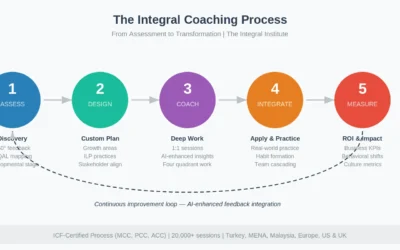
AI Coaching vs Human Coaching: A Complete Comparison for Enterprise Leaders
Enterprises should adopt a hybrid model that combines AI coaching for scalability and 24/7 accessibility with human coaches for complex emotional intelligence and transformational breakthroughs. The data is clear: companies using both achieve 529% ROI on coaching investments.

How to Turn Founder Vision into Early Business Models
Steve Blank’s startup framework is the right place to start: a startup is not a smaller version of a finished company, but a search for a repeatable and scalable business model.

Functional Leadership Excellence Across Domains
70% of leaders say a wider range of behaviors is now important to meet business needs, yet many functional leadership models still reward depth inside the silo first and coordination second ( Harvard Business Publishing , 2024) .
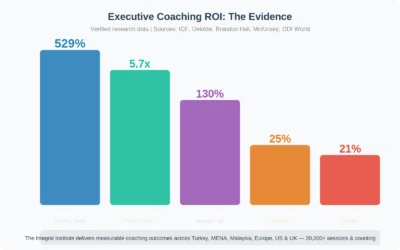
Executive Coaching ROI: The Complete Guide to Measuring Coaching Impact
Executive coaching generates a 529% return on investment according to ICF/PwC research. Learn how to measure coaching impact, establish ROI frameworks, and prove business value to stakeholders.
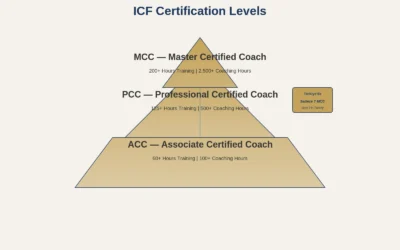
ICF Coaching Certification Guide: MCC, PCC, and ACC Levels Explained
The International Coach Federation (ICF) offers three credential levels—ACC (Associate Certified Coach), PCC (Professional Certified Coach), and MCC (Master Certified Coach)—each requiring progressively higher hours of coach training, client contact hours, and...

Leadership Development for Chief Operating Officers
46% of COOs say talent retention and skill shortages are now a top-three barrier to executing strategy. That shifts COO development out of HR’s training lane and into the core of execution risk management ( PwC , 2025) .
AI Coaching vs Human Coaching: A Complete Comparison for Enterprise Leaders
Enterprises should adopt a hybrid model that combines AI coaching for scalability and 24/7 accessibility with human coaches for complex emotional intelligence and transformational breakthroughs. The data is clear: companies using both achieve 529% ROI on coaching investments.
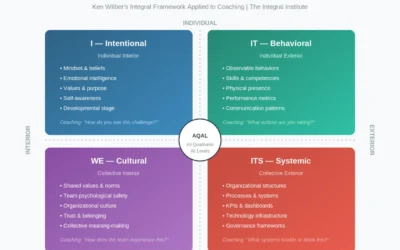
The AQAL Model Explained: Ken Wilber’s Integral Framework for Coaching and Leadership
The AQAL Model (All Quadrants, All Levels) is Ken Wilber’s comprehensive integral framework that maps human development across four simultaneous dimensions. Learn how this framework drives executive coaching effectiveness and organizational transformation.
Integral Team Coaching: Building High-Performance Teams Through Holistic Development
Integral Team Coaching: Building High-Performance Teams Through Holistic Development Integral team coaching is a holistic, systems-based approach to developing teams that addresses individual development, interpersonal dynamics, organizational culture, and external...

Understanding AI and Qualitative Data in Transformative Learning
55% of organizations already use AI in at least one business function. That matters because many teams now assume the same systems can also interpret peak-experience narratives with equal confidence ( McKinsey , 2023) .

How to Adapt Leadership for Different Global Markets
A leadership style that made you credible in one region can quietly stall execution the moment you carry it, unchanged, into the next market. That is where most global leadership models break—not in intent, but in translation.

AQAL Model & Core Integral Theory
You fund the reorg, refresh the incentives, retrain the managers—and six months later the same initiative is quietly losing force. If that pattern feels familiar, the problem may not be weak execution; it may be a change model that sees only one layer of the business.
Blog
Liderlik, takımlar, organizasyonlar ve yapay zeka üzerine içgörüler.
Yükleniyor...