

Why AI coaching becomes a privacy issue the moment people start telling the truth
46% of people worldwide are willing to trust AI—which means most leaders are deploying AI into a trust deficit, not a trust surplus (KPMG, 2025). In practice, that gap shows up the moment an employee stops testing the system and starts answering honestly.
A regional services director has a quarterly review coming up. She opens an AI coaching tool to prepare, then types what she would never put in a performance platform: that she is losing confidence, struggling with a peer, and considering whether her team still trusts her judgment. At that moment, the tool stops being a convenience feature. It becomes a sensitive data environment.
That shift is where many leadership teams get caught flat-footed. They buy on usability, rollout speed, and personalization claims, then discover too late that coaching data is qualitatively different from ordinary workflow data. Goals reveal ambition. Doubts reveal vulnerability. Repeated prompts and responses reveal behavioral patterns over time. What looks like harmless reflection in a demo can become a detailed map of a person’s judgment, stress, and perceived weaknesses in production.
91% of respondents say they would feel more positive about AI if they could see the benefits for society (Edelman, 2024)
That number matters because benefit alone does not settle the trust question. Leaders often assume that if employees get better advice, faster feedback, or more tailored development, adoption will follow. But trust in coaching does not come from personalization by itself. It comes from knowing what is being collected, where it is going, how long it is kept, and who can see it when careers are on the line. Get that wrong, and the cost is not abstract: candor drops, usage becomes performative, and the system fills with safer half-truths instead of useful insight. This article is about how to evaluate that risk before it becomes a culture problem.

Trust starts before the first prompt
This is why AI coaching should be treated first as a governance and trust decision, then as a technology decision. The core question is not whether the model gives decent advice. It is whether the organization understands the data relationship it is creating.
A coaching conversation becomes machine-readable long before most users grasp the privacy tradeoff. Once that happens, every design choice matters—collection, storage, access, retention, and reuse. If leaders cannot explain those choices in plain language, employees will answer the system accordingly.
And that raises the next problem: what, exactly, is the system touching once people begin telling the truth—surface-level inputs, or something much deeper?
What data does AI coaching actually touch, and why does that matter?
88% of Canadians have some level of concern about their personal information being used to train AI systems—so if you assume coaching data is too minor or too anonymized to matter, your workforce likely does not share that view (Office of the Privacy Commissioner of Canada, 2025). If the data looks harmless on its own, how can it still expose a person’s vulnerabilities? And if names are removed, isn’t the risk largely gone?
That is the comforting assumption. It is also usually wrong.
More than notes, less than obvious
Leaders often picture AI coaching data as a neat bundle of session notes: a prompt, a response, maybe a development goal. What the system may actually touch is much broader. It can include raw input such as prompts, free-text reflections, uploaded documents, and chat transcripts; stored output such as summaries, action plans, and progress reports; and inferred insight such as sentiment shifts, recurring themes, hesitation patterns, or likely strengths and risks derived from repeated interactions.
The distinction matters because inference is often more revealing than disclosure. A manager may never type “I am burning out,” yet a pattern of late-night entries, repeated conflict themes, and declining confidence language can point in that direction anyway. In other words, the system does not only record what people say. It can also model what their behavior appears to mean.
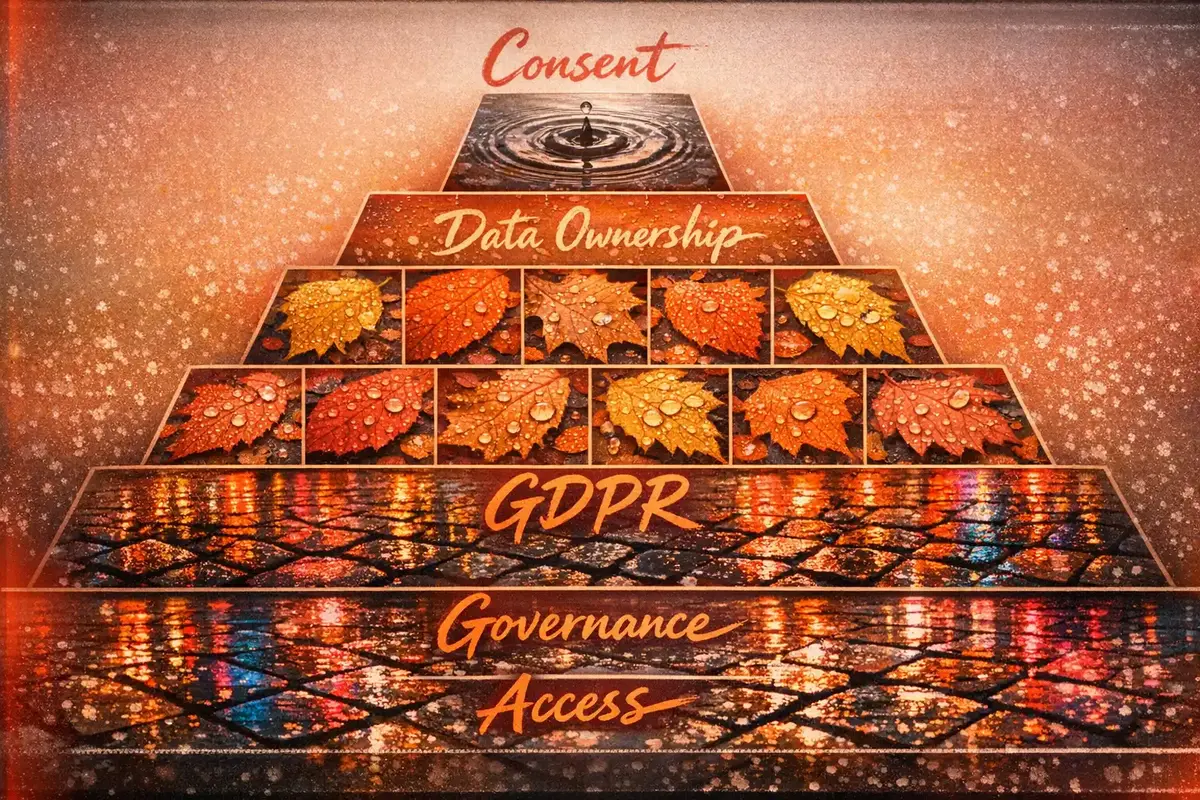
A mid-market manufacturing VP preparing for a team restructure might use an AI coach to rehearse difficult conversations. Over six weeks, the tool sees his goals, his frustration with two plant leaders, his concern about being viewed as indecisive, and the language patterns that show when he is under pressure. None of those entries needs to contain a medical detail or a legal identifier to become sensitive. The pattern is the profile.
Why “anonymous” is often a false comfort
This is where many executives overestimate the protection offered by de-identification. Remove the name, and the record still may contain role, geography, reporting line, timing, conflict history, and business context. In a real organization, that can be enough.
A transcript that mentions “the only regional VP handling the Ohio consolidation” does not need a name attached to be recognizable. Even when a single record looks vague, multiple records over time can re-identify a person through context alone. That is why debates about coaching data ownership are not academic. They determine who can connect those dots—and for what purpose.
70% of Canadians are less willing to share their personal information than they were five years ago (Office of the Privacy Commissioner of Canada, 2025)
That reluctance is rational. The real exposure is not just what was typed. It is what can be inferred, linked, retained, and reused later.
And once you see the data in those three layers—raw input, stored output, inferred insight—the legal question gets sharper fast: which layer is protected, which layer is reusable, and which layer crosses into regulated territory?
How does GDPR change the rules for AI coaching data?
The lawful-basis framework is the right place to start, because it forces a harder question than most organizations ask: not can we collect coaching data, but why this data, for this purpose, for this long? Many teams still treat privacy review as a late-stage approval step. The evidence points the other way: organizations that operationalize responsible AI are further along strategically, not just procedurally—57% say they are at the strategic or embedded stage of Responsible AI (PwC, 2025).
GDPR turns coaching data into a purpose test
That matters because GDPR changes the conversation from technical possibility to justified processing. In coaching terms, every transcript, summary, sentiment tag, and progress note needs a lawful reason for being collected, a clearly defined use, and a retention period that is not simply “until someone asks questions.”
This is where leaders often misread consent. If an employee clicks “I agree” before using an AI coach provided by their employer, that does not automatically settle the issue. Under GDPR, consent has to be freely given, specific, informed, and revocable. In an employment context, that standard gets harder, because power imbalance is real. If the tool is tied to development, promotion visibility, or manager expectations, “optional” can become ambiguous fast.
A regional healthcare director facing a budget cycle might use an AI coach to think through burnout, staffing tension, and whether she is still effective with her team. The legal question is not abstract. If those reflections are stored, who decided the purpose—personal development, product improvement, HR analytics, or all three? If the answer is fuzzy, the risk is already operational.
Access, deletion, and retention are not edge cases
GDPR also gives people access rights and, in many cases, the ability to request erasure. That sounds manageable until you apply it to AI coaching systems built on layered records: raw chat logs, generated summaries, embedded metadata, and downstream models or dashboards. A deletion request is easy to promise and hard to execute if the system was not designed for traceability from day one.
Short version: retention is strategy.
If coaching notes are genuinely useful for a limited developmental purpose, keep them only as long as that purpose holds. If leaders cannot explain why a transcript should exist six months later, they probably should not keep it. The same logic applies to reuse. A note collected to help someone prepare for a difficult conversation should not quietly become training data, performance evidence, or management insight by default.
58% say Responsible AI initiatives improve return on investment and organizational efficiency (PwC, 2025)
That number is useful because it reframes compliance. Done well, privacy discipline is not friction. It is design quality.
Compliance should shape the product, not decorate it
The practical implication is simple: data minimization is not a legal footnote; it is a product decision. Do not collect full transcripts if structured prompts will do. Do not retain free text indefinitely if short-lived summaries meet the need. Do not infer more than you are prepared to govern.
That is the real shift. GDPR does not just regulate what happens after collection—it pressures leaders to collect less in the first place.
And once coaching data exists inside a system, another problem appears. Is the issue still privacy—or has it become something older and more fragile: confidentiality?
Why confidentiality breaks differently in AI-mediated coaching sessions
90% of organizations have expanded their privacy programs—a useful signal that the confidentiality-privacy-security model is no longer optional when coaching moves into AI systems (Cisco, 2026). Without that model, a conversation meant for one trusted listener can quietly become a record that is stored, summarized, routed, and reused.
That is the break leaders often miss. In traditional coaching, confidentiality rests on a professional promise between two people. In AI-mediated coaching, the promise sits inside a workflow.
One conversation, multiple exposures
Consider a regional retail director using an AI coach during a client escalation. She types what she would never say in a team meeting: that she no longer trusts one store leader, is second-guessing her own judgment, and may need to change roles after the holiday season. In a human coaching session, that disclosure is bounded by the coach’s duty. In an AI system, the same disclosure may generate a transcript, a summary, a sentiment label, a product log, and an admin-accessible record.
That does not mean the system is unsafe by default. It means the confidentiality model has changed.
Privacy concerns the person’s rights over data use. Security concerns protection against unauthorized access. Confidentiality is different: it is the expectation that sensitive disclosures stay within the relationship for which they were given. Leaders blur these terms all the time, then wonder why employees still hesitate after hearing that the platform is “secure.”
The practical questions are operational, not philosophical
This is why the real test is access design. Who can see raw session data? Who can see generated outputs? Can HR view summaries if a manager flags a development concern? Does the vendor’s support team have any path to the records? How long do those records remain visible across connected systems—days, months, indefinitely?
Those questions are now board-level reasonable. Cisco reports that 93% of organizations plan to invest more in privacy, and 38% spent at least $5 million on privacy programs in the past year, up sharply from 2024 (Cisco, 2026). Serious companies are spending at that level because trust failures rarely begin with a dramatic breach. They begin with ordinary access, granted too broadly, retained too long, and justified too vaguely.
A secure platform can still violate confidentiality. A private notice can still leave employees exposed. The issue is not only whether outsiders get in. It is whether insiders—manager, HR partner, vendor analyst—can see more than the coaching relationship was supposed to reveal.
That is the decision point. Is this system a coaching space, or a monitoring surface? And before any vendor earns trust, what exactly should leaders ask them to prove?
What should leaders ask before trusting an AI coaching vendor?
A bad vendor decision does not fail quietly. It shows up in lost candor, slower decisions, unwanted attrition, and the kind of internal distrust that spills into customer work.
If a vendor says the system is secure, that tells you almost nothing about whether the data will stay inside the coaching relationship.
Ask who really controls the data
Start with data ownership. Not the marketing version. The contractual one.
A vendor may encrypt data, host it in a reputable environment, and still reserve broad rights to store, analyze, or reuse coaching interactions. Leaders should ask, in plain terms: who owns raw prompts, generated summaries, metadata, and derived insights? If the customer leaves, what is deleted, what is returned, and what remains in backups or internal systems? If the answer depends on reading three appendices and a product FAQ, the governance is not mature enough.
A practical test helps. During a market shift, a mid-market technology founder uses an AI coach to think through layoffs, investor pressure, and doubts about her own judgment. Later, she wants assurance that those reflections will never be used to improve a general model, appear in vendor analytics, or surface in another product context. That is the real question. Not whether the platform is “enterprise-grade,” but whether customer data reuse is tightly prohibited.
Research shows people do not grant trust by default. KPMG found that trust in AI remains limited globally (KPMG, 2025). Edelman’s work points in the same direction: people respond better when benefits are visible, not merely promised (Edelman, 2024). In vendor terms, trust comes from boundaries people can understand.
Ask what the system refuses to do
The next set of questions is about access controls, retention rules, and model training use.
Who can see session-level data inside the vendor organization? Support staff? Engineers? Subprocessors? Can your own HR team access coaching summaries by default, or only through a separate, explicit workflow? Can the system keep coaching records separate from broader talent systems, or does it quietly feed a larger employee profile? This is where trust in AI becomes operational rather than rhetorical.
Then ask what data never enters public or shared tools. That line matters. If employees draft sensitive reflections in one interface but the vendor routes processing through services with broader training exposure, the coaching boundary is already compromised.
Consent deserves the same scrutiny. Do users give informed consent inside the workflow, at the moment sensitive data is created, or is consent buried in procurement paperwork? Good AI governance makes the answer visible to the user, not just acceptable to legal.
Trust is built by limits
The strongest vendors are usually the clearest about constraint. They can explain what they collect, what they do not collect, who can access it, how long it stays, and where reuse stops.
That is the standard. Not polished security language—actual limits.
And once those limits are defined, a harder leadership question appears: how do you give people useful coaching support without collecting more than the relationship can safely bear?
How can leaders build trust without overexposing sensitive coaching data?
The privacy-by-design framework matters here because it changes the leadership question from “Is this tool compliant?” to “Is this coaching environment trustworthy?” Most organizations still buy AI coaching on capability first and add privacy controls later; the evidence suggests the stronger path is the reverse, with 57% of respondents saying their organizations are already at the strategic or embedded stage of Responsible AI (PwC, 2025).
Trust is a design outcome
What would change if leaders treated privacy as part of coaching quality rather than a compliance afterthought?
Quite a lot. Consent, access limits, retention discipline, and plain-language explanation are not administrative extras. They shape whether people will use the system honestly. If an employee cannot tell what the AI is doing with their reflections, who can see them, or when they disappear, the coaching quality drops before the model even responds.
That is why the safest deployments are usually the least ambitious about data capture. They collect enough to support reflection, not enough to build a permanent behavioral archive. They keep human oversight where judgment matters — escalation, wellbeing concerns, boundary cases — and avoid turning every coaching interaction into a reusable organizational asset.
Minimize data, preserve value
Picture a regional finance director during annual planning. She wants help thinking through conflict with a peer and her own uncertainty about a promotion decision. A well-designed system does not need unlimited transcript storage, broad internal visibility, or open-ended reuse rights to be useful in that moment. It needs a narrow purpose, short memory, and clear boundaries.
That is the operating principle leaders should adopt: minimum necessary data, maximum necessary clarity.
Shorter retention periods. Fewer default viewers. More explicit user controls. Better explanations at the point of use, not buried in policy language. Research consistently shows that trust grows when people understand the system and see restraint in how it handles sensitive information.
Privacy is not separate from psychological safety. In AI coaching, it is one of the conditions that makes psychological safety possible.
The closing test is simple: does your deployment help people think more clearly without asking them to expose more than the coaching relationship requires? If not, the next step is not a better feature set. It is a tighter boundary.
Key Takeaways
- AI coaching becomes a privacy issue as soon as people begin sharing honest, sensitive reflections.
- Coaching data can include raw input, stored output, and inferred insight, not just session notes.
- GDPR pushes leaders toward justified processing, limited retention, and data minimization.
- Trust depends on clear limits around ownership, access, reuse, and confidentiality.
Frequently Asked Questions
Why does AI coaching create privacy risks more quickly than other workplace AI tools?
AI coaching becomes sensitive as soon as people share honest reflections about doubts, conflict, stress, or career concerns. Those inputs can reveal not only what someone says, but also patterns of behavior, judgment, and vulnerability over time.
What kinds of data can AI coaching systems collect or infer?
AI coaching can touch raw prompts, chat transcripts, uploaded documents, summaries, action plans, and progress notes. It can also infer sentiment shifts, recurring themes, hesitation patterns, and other behavioral insights from repeated interactions.
How does GDPR affect the use of AI coaching data?
GDPR requires organizations to justify why they collect coaching data, how they use it, and how long they keep it. It also makes consent, access rights, erasure, and data minimization central design and governance issues rather than afterthoughts.
What is the difference between privacy, security, and confidentiality in AI coaching?
Privacy is about a person’s rights over how their data is used, while security is about protecting that data from unauthorized access. Confidentiality is the expectation that sensitive disclosures stay within the coaching relationship and are not broadly exposed through summaries, logs, or internal access.
What should leaders ask before adopting an AI coaching vendor?
Leaders should ask who owns the data, who can access it, whether it is reused for model training or analytics, how long it is retained, and what gets deleted if the customer leaves. They should also verify that consent is clear, access is limited, and the system keeps coaching data separate from broader employee monitoring or talent profiles.