

Why individual KPIs break down the moment AI joins the team
What exactly are you rating when a manager reviews work that AI helped draft, sharpen, or quietly correct? Human-AI performance management breaks down the moment you pretend the answer is still obvious. A services director can look at a strong quarterly review and still have no clean way to separate judgment, prompting, verification, and final accountability. That is the gap: old metrics assume an individual produced the work; the new reality is that a system did.
The cost shows up fast. A team lead praises speed when the real gain came from AI summarizing client history; another flags quality concerns without seeing that the employee spent extra time catching flawed suggestions before they reached a customer. In both cases, the review is wrong in a way that matters — it distorts incentives, hides operational risk, and teaches people to optimize for visible output rather than sound decisions. This article is about redesigning the logic of performance management for human-AI team outcomes, not squeezing AI-shaped work into a human-only scorecard.
Traditional performance systems were built for attribution. Who made the call? Who wrote the analysis? Who owns the result? That logic made sense when most work products could be traced, with reasonable confidence, to a person’s effort and skill.
It makes less sense now.

The unit of analysis has changed
When AI drafts first, suggests options, ranks risks, or compresses research, the meaningful question is no longer “How did this person perform alone?” It is “How did this person work with the tool, and did that arrangement improve the outcome?” The unit of analysis shifts from employee to workflow — from isolated contribution to combined performance.
The moment AI enters the loop, judging the person without judging the system becomes a category error.
That shift is uncomfortable because accountability still sits with humans. A manager cannot tell a client, regulator, or executive committee that the model owns the mistake. Yet evaluating only the person misses the mechanism that shaped the result in the first place.
Better outcomes, safer decisions, clearer accountability
This is the real issue. Not whether AI is productive in the abstract, but whether the human-AI arrangement produces better decisions, fewer avoidable errors, and clearer ownership when something goes wrong. A high performer who uses AI badly can create polished failure. A steady performer who uses it well can raise the quality of an entire team.
In AI-shaped work, speed is easy to see; sound judgment is what keeps the gains.
That is why leaders need a different frame — one that can tell the difference between faster work and better work. And once AI adoption spreads beyond a few early users, how quickly does this stop being a niche measurement problem and become a management problem for everyone?
How fast is AI adoption changing the performance conversation?
46% of organizations expect to use AI in HR in 2026. That number matters because it means the function that owns performance management is now becoming a direct user of the same technology it is supposed to evaluate (SHRM, 2026).
This is no longer an early-adopter story. Gallup found that the share of U.S. employees using AI at work at least a few times a year rose from 40% to 45% between the second and third quarters of 2025, while frequent use climbed from 19% to 23% and daily use moved from 8% to 10% (Gallup, 2025). When usage rises that quickly in one year, the performance question changes from Should we prepare for AI-shaped work? to Why are we still measuring as if it has not arrived?
Adoption changes the management problem before most companies rewrite the management system.
That lag is where confusion starts. In Q3 2025, 37% of employees said their organization had implemented AI technology to improve productivity, efficiency, and quality (Gallup, 2025). Once a company introduces AI for those reasons, managers are no longer judging purely human output; they are judging work that has already been shaped by prompts, summaries, recommendations, and machine-generated first drafts.
A regional healthcare provider offers a familiar example. During quarterly reviews, a department director sees turnaround times improve across patient-facing admin teams after AI is introduced for documentation support. The old scorecard rewards faster completion and cleaner records, but it does not show which gains came from staff judgment, which came from the tool, or where verification effort quietly increased to keep errors out of the workflow.
That is not a niche design flaw. It is an operational blind spot.
The measurement issue is moving into HR itself
The second shift is easier to miss and more consequential. SHRM reports that 39% of organizations already have AI adopted in their HR functions, and another 7% intend to launch it this year (SHRM, 2026). So HR is now in a dual role: steward of the performance framework and participant in AI-augmented work.
That creates a credibility test. If HR uses AI in recruiting, employee support, workforce planning, or review administration, then its own output is becoming a human-AI product too. The people redesigning appraisal systems are now living the same attribution problem as the rest of the business.
This is why AI adoption is not just a technology trend. It is a management architecture problem.
The real risk is not that AI changes work too slowly. It is that performance systems change too late.
And once leaders accept that augmented work is already mainstream, the next question gets harder fast: what, exactly, belongs on a human-AI scorecard — output, judgment, oversight, or all four?
What should a human-AI scorecard actually measure?
The five-layer scorecard is the right place to start. But what if the real metric is not how much work got done, but how well the human-AI system worked together to get it done?
Most leaders still reach first for volume, cycle time, and throughput. That feels practical. It is also too blunt, because a single productivity KPI cannot tell you whether AI improved the work, masked weak judgment, or simply shifted effort from creation to checking.
A useful performance scorecard needs five layers: output, process quality, collaboration quality, learning velocity, and governance risk. Together, they show not just whether work moved faster, but whether the system became more reliable, more scalable, and safer to trust.
| Layer | What it asks |
|---|---|
| Output | Did the team produce more, resolve more, close more, or shorten turnaround time? |
| Process quality | How much rework, correction, or verification sat behind the output? |
| Collaboration quality | Did people and AI divide work well, with AI handling repeatable tasks and people handling judgment? |
| Learning velocity | Are teams getting better at prompting, reviewing, escalating, and refining over time? |
| Governance risk | Are there policy breaches, sensitive-data exposure, or overreliance in decisions that need human scrutiny? |
Output is the obvious layer. Did the team produce more proposals, resolve more tickets, close more cases, or shorten turnaround time? Keep it, but do not stop there.
Process quality asks a harder question: how much rework, correction, or verification sat behind that output? If AI drafts a client response in two minutes but the employee spends twelve minutes fixing tone, facts, and missing context, the speed gain is mostly fictional. Leaders need measures that surface review burden, exception rates, and handoff friction.
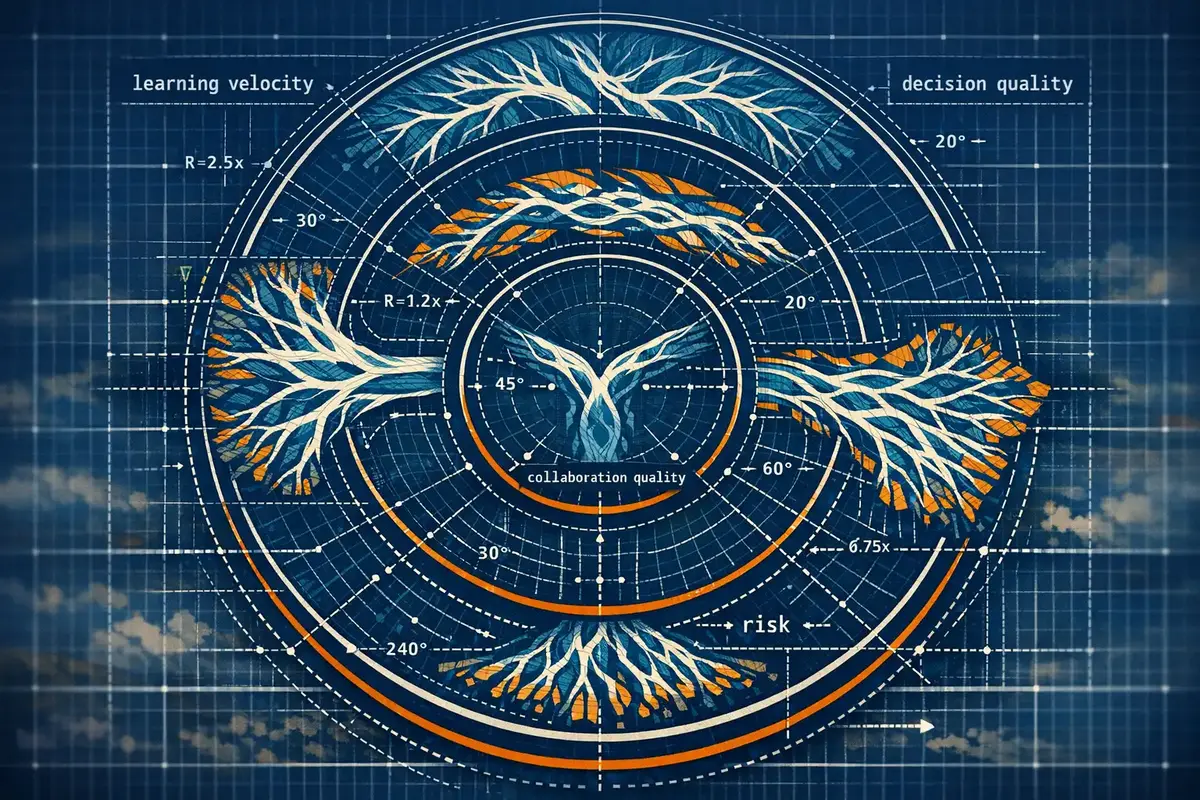
Then comes collaboration quality. This is where many scorecards fail, because they measure the person and the tool separately instead of the interaction between them. Good human-AI collaboration shows up in smart task allocation: AI handles pattern-heavy, repeatable work; people handle ambiguity, escalation, and final judgment. That is a team performance issue, not just an individual one.
Consider a mid-market finance company during a quarterly review cycle. A VP sees analysts producing more credit memos after AI support is introduced and assumes productivity improved. But when the team maps the workflow, it finds that AI is helping with first drafts while senior analysts are quietly spending extra hours validating assumptions before approval. The task allocation improved. The decision quality signal is still unclear.
A scorecard earns its keep when it shows the difference between more activity and better judgment.
That is why learning velocity belongs on the scorecard. Are teams getting better at prompting, reviewing, escalating, and refining where AI adds value? Research consistently shows that capability compounds unevenly; some teams improve their human-AI routines quickly, while others repeat the same avoidable mistakes. A mature scorecard tracks whether the system is learning, not just producing.
The final layer is governance risk. This includes policy breaches, unapproved use cases, sensitive-data exposure, and overreliance in decisions that require human scrutiny. Measurement choices are governance choices because people optimize for what gets rewarded. If you only reward speed, do not be surprised when acceptable AI use drifts.
What you measure becomes permission.
And that sets up the next problem. If a scorecard includes speed, quality, learning, and risk, how should leaders decide when to trust the system more — and when to slow it down?
Why trust calibration matters more than raw speed
87% of employees believe algorithms can give fairer performance feedback than managers (Gartner, 2025). If leaders get that trust wrong, the cost is immediate: bad calls move faster, confidence in reviews erodes, and strong people start looking for exits when pay and recognition feel arbitrary.
That is the tension. Trust in AI is rising, but uncalibrated trust is not the same as sound judgment.
Trust is a performance variable
Trust calibration means people know when to rely on AI, when to question it, and when to override it. In practice, that is what separates a useful system from an expensive source of polished error.
A retail enterprise offers a familiar example. During a year-end compensation cycle, a division VP uses AI-supported performance summaries to speed manager reviews across hundreds of employees. The process finishes days earlier, but several managers quietly accept AI characterizations they would have challenged in a live calibration meeting — especially for employees whose work was less visible. Speed improved. Decision quality did not.
That is automation bias in operational form: people defer to the system because it is fast, consistent, and presented with confidence. Performance management should not just record AI usage rates or time saved. It should measure whether employees used the tool appropriately — where they accepted its recommendation, where they escalated, and where they overrode it with better evidence.
Fast judgment is only an advantage when the judgment is still yours.
The opposite failure matters too. Under-trust looks safer, but it can quietly erase the value of adoption. If managers rerun every AI-assisted draft from scratch, ignore useful pattern detection, or refuse machine-generated summaries on principle, the organization pays twice — once for the tool and again for the duplicated labor.
This is why trust calibration belongs inside the scorecard. Not as a soft cultural measure, but as a hard operating discipline.
Fairness changes the stakes
The fairness issue makes this more sensitive than a normal productivity debate. Gartner found that 57% of employees say humans are more biased than AI in compensation decisions (Gartner, 2025). That belief changes how people read reviews, pay outcomes, and appeals.
If employees think AI is fairer, they may accept machine-supported decisions too easily. If they think managers are hiding behind the system, trust collapses even faster. Either way, leaders need visible rules for when AI informs judgment and when humans must slow down, explain, and own the call — the core work of AI governance.
People do not need perfect systems. They need systems whose judgment they can understand and contest.
So the real question is not whether AI made the review cycle faster. It is whether the system helped people make better decisions, with fewer blind spots. And that raises the next measurement challenge: how do you prove AI is improving the work rather than just accelerating it?
How do you measure whether AI is actually improving work?
87% of respondents in SHRM’s baseline-to-augmentation framework reported slight or significant improvements in efficiency, which tells leaders something simple: if AI is creating value in several dimensions, your measurement system cannot stop at time saved (SHRM, 2026). Without that framework, faster output gets mistaken for better work — and weak decisions hide inside impressive throughput.
That mistake is common because volume is easy to count. Improvement is harder. McKinsey found that 72% of employees using AI say it helps them work more effectively (McKinsey, 2025), while SHRM reports gains not just in efficiency but also in creativity and work quality (SHRM, 2026). If AI changes all three, then a serious evaluation model has to test all three.
Start with a before-and-after comparison
The cleanest method is not complicated. Compare baseline work against augmented work at the team level, using the same workflow, the same output type, and the same quality standard over a defined period.
A manufacturing company’s operations director faces this during a quarterly review. After introducing AI support for maintenance reports and incident summaries, the team closes documentation faster. But the real question is whether reports became more accurate, whether root causes were identified earlier, and whether supervisors spent less time rewriting vague recommendations.
That is the difference between activity measurement and performance measurement.
A useful comparison asks four questions. Did the team produce more? Did the outputs improve? Did decisions get better? Did the team learn to use the system with less friction over time?
If AI improves the draft but not the decision, the system is busy — not better.
This is where many leaders under-measure value. SHRM found that 70% of respondents reported slight or significant improvements in creativity and 75% reported improvements in work quality (SHRM, 2026). Those are not side benefits. They are evidence that AI may be expanding option generation, sharpening first drafts, and improving consistency across human-AI teams.
Measure quality of judgment, not just quantity of work
The strongest metrics show whether AI is improving the system’s decisions. In practice, that means tracking error escape rates, revision depth, approval confidence, exception handling, and the time it takes teams to reach a sound conclusion on recurring work.
It also means watching whether teams get smarter with use. Do prompts become more precise? Do reviewers catch fewer preventable issues? Do managers in human-AI teams spend less time correcting the same failure patterns month after month?
Better work is not just faster work. It is work that needs less rescue.
Once leaders can see baseline versus augmented performance clearly, a harder issue appears: where do you begin without overengineering the scorecard — and without losing manager trust in the process?
Where should leaders start when building a pilot framework?
The pilot-scorecard framework matters here because it keeps leaders from making the most common mistake: trying to measure everything at once. Most organizations begin with tool usage, time saved, and a long list of possible indicators. What the evidence shows is that even HR functions are still early in working out practical AI use, with SHRM surveying 1,908 HR professionals on a landscape that is moving faster than most management systems can absorb (SHRM, 2026).
So start smaller.
Begin with the outcome, not the dashboard
A pilot should begin by defining one team outcome in plain terms: fewer claim-processing errors, faster contract turnaround, better customer-resolution quality. Then map the decisions AI may influence inside that workflow. Not every touchpoint matters equally; some are administrative, others shape judgment.
That distinction is where many pilots go wrong. Leaders jump to metrics before they decide which human responsibilities must remain explicit. Who is allowed to accept an AI recommendation? Who must review exceptions? Where is human sign-off non-negotiable?
If the team cannot name the decision, it cannot sensibly measure the assistance.
In a mid-market services firm during a quarterly review cycle, a director pilots AI support for proposal drafting. The first instinct is to track output volume and drafting time. The more useful move is to identify the decisions inside the work: pricing language, risk commitments, client-specific tailoring, and final approval. Only then can the team see where AI is helping, where it is creating noise, and where accountability still sits firmly with people.
Test a few metrics on one workflow
A good pilot framework is narrow by design. Pick one workflow and test a small number of measures across it — usually one outcome metric, one quality metric, one exception metric, and one role-clarity check.
That last one is often missed. Yet it is the first implementation priority: role clarity. Who approves, who escalates, who overrides, and who owns the final outcome? Without those answers, measurement starts to feel like surveillance because people are being watched before the rules of judgment are clear.
This is also where leaders can connect the pilot to shared success. The point is not to score individual compliance with a tool. It is to learn whether a human-AI arrangement improves the work without blurring ownership.
A pilot should also review exceptions deliberately. Which metrics turned out to be misleading? Which signals created extra administrative burden? Which behaviors changed once people knew they were being measured? That is the real value of early AI adoption: not scale first, but learn what deserves scale.
The first scorecard should answer one question well, not ten questions badly.
Because once a pilot works, a harder issue appears. Did the team improve because the framework was sound — or because a few capable people compensated for a weak system?
The real test of human-AI performance is whether the system gets better over time
Companies do not lose the plot with AI because the tools are weak. They lose it when revenue slips through preventable errors, trust erodes after opaque reviews, and strong people leave because the system rewards visible output over sound judgment.
That is why the closing test is not whether you can produce a neat ranking of individuals. It is whether the human-AI system becomes more capable with use.
Capability is the asset
In a technology startup during a product reset, a founder reviews two engineering managers. One shipped more tickets with heavy AI support. The other shipped less, but built better review habits, clearer escalation rules, and a team routine for catching weak model suggestions before release. If you reward only the first manager, you may get a better quarter. You may also hardwire a weaker system.
That is the contrast leaders need to hold. Performance management in AI-shaped work should judge whether the team learned how to allocate work, challenge outputs, and improve decisions together — not just who looked most productive in a single cycle.
The point of measurement is not to sort people neatly. It is to make the work more dependable next time.
This is where durable frameworks separate themselves. They reward learning, adaptation, and responsible use alongside results. Not as soft extras, but as the behaviors that make strong team performance repeatable under pressure.
Measurement is a design choice
Every metric teaches. It tells managers what to notice, employees what to optimize, and teams what the organization truly values.
If you measure only output, people will protect speed. If you also measure how the system improves, people start documenting better prompts, surfacing failure patterns, and sharing review practices that raise the floor for everyone. That is how trust and fairness become operational rather than rhetorical.
Organizations that understand this treat measurement as part of system design. They use it to shape culture — what gets challenged, what gets explained, what gets owned. If you want a practical place to explore how coaching can support that shift, AI Coach System is one useful starting point.
What you choose to measure becomes the culture people work inside.
So bring this back to your own context. In your next review cycle, budget discussion, or team redesign, are you still scoring individual output — or are you building a system that gets wiser with use?
Key Takeaways
- Individual KPIs break down when AI shapes the work, because the real unit of analysis becomes the workflow.
- A human-AI scorecard should track output, process quality, collaboration quality, learning velocity, and governance risk.
- Trust calibration matters: leaders need to know when to rely on AI, when to question it, and when to override it.
- The best measurement systems reward learning, adaptation, and responsible use so the human-AI system improves over time.
Frequently Asked Questions
Why do individual KPIs break down when AI is part of the work?
Individual KPIs assume one person produced the result, but AI-augmented work is created by a human-AI workflow. Measuring only the person hides judgment, verification effort, and the role the tool played in the final outcome.
What should a human-AI performance scorecard measure?
A strong scorecard should measure output, process quality, collaboration quality, learning velocity, and governance risk. Together, these layers show whether the team is producing more, making better decisions, learning faster, and staying within safe boundaries.
Why is trust calibration important in AI-assisted performance management?
Trust calibration means people know when to rely on AI, when to question it, and when to override it. Without that balance, teams can fall into automation bias and accept polished but wrong recommendations, or underuse AI and duplicate work unnecessarily.
How can leaders tell whether AI is actually improving work?
Leaders should compare baseline work with augmented work using the same workflow and quality standard. They should look beyond time saved and check whether output quality, decision quality, error rates, and team learning all improved.
Where should organizations start when building a pilot framework for human-AI performance?
Start with one clear team outcome and map the decisions AI influences inside that workflow. Then test a small set of measures, such as one outcome metric, one quality metric, one exception metric, and one role-clarity check, before scaling the framework.