

Why Traditional Org Charts Break the Moment Markets Start Moving
What happens when adaptive organization design is treated as a future-state initiative, but the market is already moving faster than your approval chain? The answer is usually visible before it appears on any dashboard: decisions stall, teams wait, and customers sense hesitation long before leaders do.
You see it in a quarterly review. A regional retail VP spots a sudden shift in customer demand after a competitor changes pricing and bundles a service the market did not expect. Product wants to respond, operations wants proof, finance wants a business case, and legal wants sequence. By the time the issue climbs the hierarchy and comes back down, the opportunity has changed shape.
That is the real cost of a rigid organizational structure: not just delay, but distortion. Information gets cleaned up as it moves upward, decisions get narrowed as they move downward, and accountability gets blurred in between. ICAgile makes the point plainly: vertical command-and-control structures block organizations from adapting quickly to changing economic, technological, and market conditions (ICAgile, 2025). This article is about what to redesign when speed exposes those limits.
It Is Not Really About the Boxes
Most executives know the org chart is not the organization. Still, when pressure rises, many companies keep trying to solve a coordination problem with reporting lines alone.
Adaptive organization design is better understood as a set of choices about authority, information flow, and accountability. Who gets to decide without escalation? What information moves directly to the people closest to the signal? Where does ownership sit when work cuts across functions? Those choices matter more in volatile markets than the formal shape of the chart itself.
When markets move, the winning organization is rarely the one with the cleanest hierarchy. It is the one that lets reality travel faster than permission.
A traditional hierarchy is built for control, consistency, and risk management. Those are not trivial strengths. In stable conditions, they often create efficiency.
The Tension Leaders Actually Have to Manage
The problem is not hierarchy by itself. The problem is rigidity when conditions no longer hold still.
Every serious organization needs a stable core: clear standards, financial discipline, role clarity, and governance that prevents chaos. But volatility punishes designs that assume decisions should travel up before action can move out. That is why adaptive design is not a rejection of structure; it is a redesign of how structure works under stress.
The hard question is not whether to choose stability or responsiveness. It is where to keep control tight — and where to loosen it so the business can learn in real time. Most companies still organize work as if that tradeoff were optional. It is not.
Why Most Companies Still Organize Work the Old Way
92% of business leaders say getting organizational redesign right is a top priority, yet only 11% feel confident they can do it with speed and scale (Deloitte, 2026). Without an adaptive organization design model, that gap turns into a familiar failure mode: companies redraw reporting lines, but decisions still queue up in the same places.
That is why so many firms look busy and stay slow.
Legacy Structures Still Dominate
The scale of legacy design is larger than many executives admit. Deloitte reports that 55% of global companies are functionally oriented, and 75% use some form of matrix management (Deloitte, 2026). Those models are not obsolete by definition. They are still useful for specialization, control, and resource sharing.
But they carry an older assumption: coordination happens by escalation, negotiation, and managerial arbitration. In a functional structure, work moves vertically before it moves across. In a matrix, work moves across — but often by adding another layer of alignment meetings, dual approvals, and role ambiguity. A classic hierarchy makes accountability clear inside silos; a matrix spreads accountability across silos. Neither automatically creates fast learning at the edge.
An adaptive organizational structure starts from a different premise. It assumes the organization will face conditions that cannot be fully predicted, so authority, information, and coordination have to move closer to the work rather than back toward the center.
Most reorganizations fail quietly: the chart changes first, and the operating logic never does.
Redesign Is Mainstream. Capability Is Not.
This is no longer a fringe management debate. It is already a mainstream executive agenda.
Deloitte finds that 50% of organizations are in the middle of reorganizing how they work but need more support (Deloitte, 2026). That number matters because it shows the issue is not awareness. Leaders know the old model is under strain. What they often lack is a practical way to redesign decision rights, interfaces, and team boundaries without creating confusion.
Consider a mid-market healthcare provider during annual planning. A division director is told to “work more cross-functionally” after patient demand shifts and labor costs rise. The org chart is updated, a few roles are relabeled, and a steering committee is added. Six months later, frontline managers still need finance, compliance, and operations to sign off before changing staffing patterns. The structure moved. The logic did not.
That is the trap. Companies reorganize around the edges while preserving the same center of gravity.
The Real Inertia Is Managerial Logic
Most firms still organize work the old way because legacy structures are reinforced by budgeting, incentives, risk controls, and leadership habits. The chart is only the visible layer. Underneath it sits a deeper belief: important decisions should rise before action can spread.
That belief feels prudent — until volatility turns prudence into drag. So the real question is not whether to keep the hierarchy or replace it with a matrix. It is simpler, and harder: what exactly makes an organization adaptive in practice?
What Does Adaptive Organization Design Actually Mean?
Adaptive Organization Design sounds like a structure. That assumption is the first mistake. What changes when agility becomes an organizational design choice instead of a team-level experiment?
Many leaders think they already know the answer because they have agile teams, sprint rituals, or a transformation office. But those are local practices. They can improve execution inside a team while the wider business still routes decisions, funding, and priorities through a slow central spine.
In plain language, adaptive organization design means building an organization that can adjust as a system when conditions change. ICAgile defines adaptive organizations as those that enable agility at both the team level and the organizational level (ICAgile, 2025). That distinction matters because a company is not adaptive just because a few teams work in shorter cycles.
More Than a Team Method
A useful test is simple: can teams respond quickly without waiting for the rest of the enterprise to catch up?
A regional financial services firm offers a familiar example. During a quarterly review, a VP sees a sudden rise in client churn in one segment and asks product, service, risk, and pricing leaders to respond within two weeks. The customer-facing teams can diagnose the issue fast. They cannot act fast, because pricing authority sits in one function, risk approval in another, and budget trade-offs in a third. The teams are agile. The organization is not.
Agility inside a team is a capability. Agility across the enterprise is a design choice.
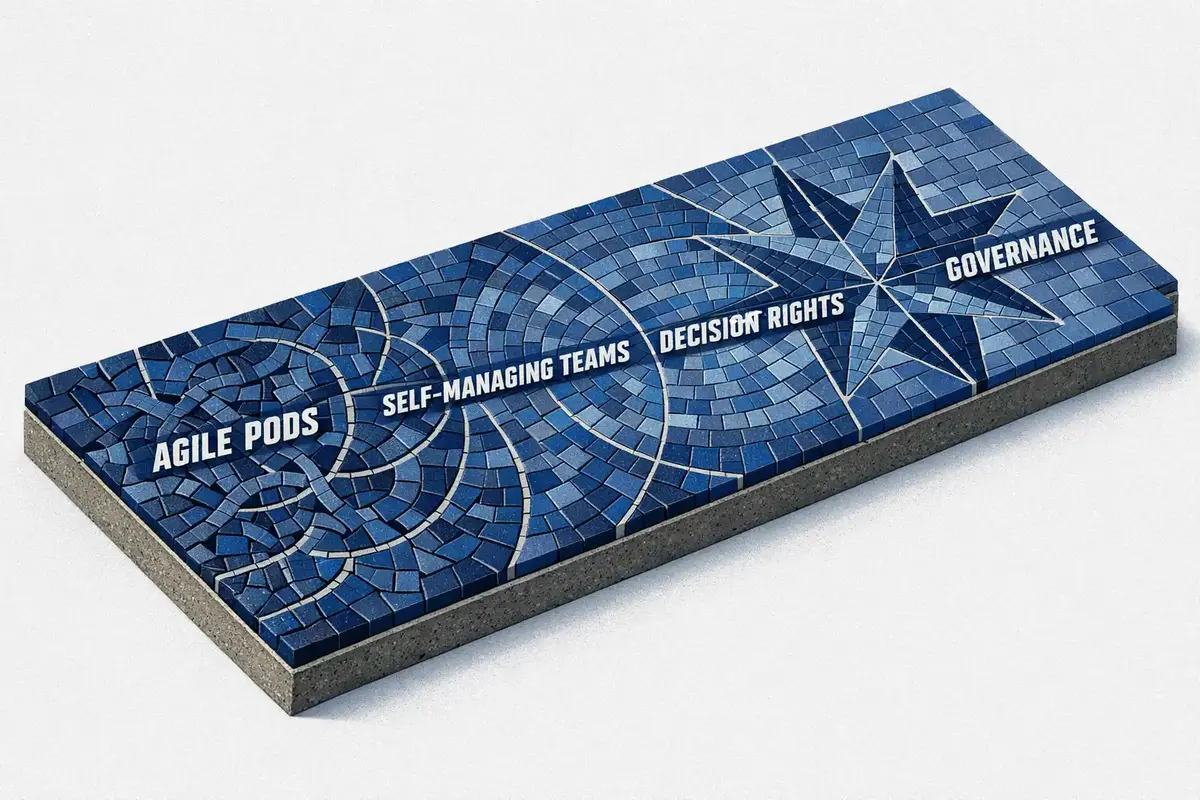
That is why an adaptive organization should not be described as a single model to install. It is a deliberate combination of structures, decision rights, and coordination mechanisms. Structure defines where work sits. Decision rights define who can act without escalation. Coordination mechanisms define how interdependent groups align when speed matters more than perfect sequencing.
The System View Most Reorgs Miss
This is where the buzzwords start to mislead. Agility, transformation, and reorganization are not interchangeable.
Agile team practices usually focus on how a team plans, learns, and delivers. Adaptive design goes wider. It asks whether strategy, governance, talent allocation, and cross-functional interfaces help those teams move — or quietly trap them in dependencies they do not control.
That system view is the real shift. An adaptive design may include functional homes, product teams, shared services, temporary networks, and formal governance all at once. The point is not purity. The point is fit.
The best adaptive designs are not the least structured. They are the least dependent on escalation.
So the executive question changes. Not hierarchy or no hierarchy. Not agile teams or enterprise control. Where should the organization stay standardized — and where must it stay fluid? Until that line is clear, “adaptation” remains a slogan, and the next design problem appears immediately: what should remain stable at the core, and what should flex at the edge?
Why Stable Core and Adaptable Edge Is the Most Useful Mental Model
The stable core, adaptable edge model matters because it gives leaders a practical way to design for volatility without dismantling control. Without it, companies usually swing between two bad responses: centralize every decision until the business slows down, or decentralize so far that standards, risk discipline, and identity start to fray.
The model is simple to picture. Think of the organization as a wheel. The hub stays firm; the rim adjusts to the road.
What Should Stay Stable
The stable core is the part of the organization that should not change every time the market twitches. It holds the company’s identity, economic discipline, legal and risk guardrails, shared standards, and the few enterprise priorities that keep effort from scattering.
That stability is not administrative comfort. It is operating coherence.
A manufacturing enterprise offers a useful example. During a sudden supplier disruption, a plant VP may need local teams to reroute work, adjust schedules, and solve customer issues quickly. But product quality thresholds, safety rules, capital controls, and enterprise margin targets cannot become negotiable just because conditions are tense. If the core moves with every shock, the company does not become adaptive; it becomes inconsistent.
Deloitte’s argument is blunt: the future belongs to organizations that are adaptable, not organizations that are merely busy redesigning themselves (Deloitte, 2026). The implication is often missed. Adaptability only works when people know what is fixed.
People move faster at the edge when they do not have to renegotiate the center.
What Should Stay Fluid
The adaptable edge is where the organization senses change and responds before the center can fully analyze it. This is where teams reconfigure around customer problems, local demand shifts, channel changes, service failures, or emerging opportunities.
In practice, that means some work should be designed for rapid recombination. A regional services company, for instance, may keep finance, compliance, and talent systems stable at the core while forming temporary cross-functional groups at the edge to solve a client retention issue in ten days, not ten weeks. Those groups often rely on lighter interfaces, faster information flow, and more network structures than a classic hierarchy allows.
Not everything should flex. Only the parts closest to changing reality.
Why This Beats the False Choice
This is why the model is so useful. It rejects the lazy debate between rigid hierarchy and total decentralization.
A stable core prevents drift. An adaptable edge prevents delay. Together, they create selective adaptivity — not universal freedom, not universal control.
The goal is not to make the whole company fluid. It is to make the right parts movable.
That sounds clean on paper. It gets harder when multiple edge teams depend on the same people, data, and decisions at once. When work starts flowing through pods, networks, and self-managing teams, how do those pieces actually fit together — and who keeps them aligned without rebuilding the bureaucracy you were trying to escape?
How Do Network Structures, Agile Pods, and Self-Managing Teams Work Together?
71% of organizations moving toward a network-based organization report at least some performance improvement — which tells you this is not a theory problem anymore, but an operating one (Deloitte, 2026). The real question is what keeps those networks from turning into disconnected islands.
A retail operations director usually sees the problem in one ugly week. A pricing issue hits stores, digital conversion drops, customer service hears complaints first, and three capable teams start solving the same problem from different angles because no one designed how expertise should connect across boundaries.
That is where network structures earn their keep. They do not replace the hierarchy; they cut across it. Instead of assuming coordination must travel up reporting lines and back down again, a network structure links people through shared problems, expertise, and fast information paths.
In practice, that might mean a merchandising lead, data analyst, supply planner, and store operations manager can work directly on a demand shift without waiting for each function head to broker every interaction. The hierarchy still matters for talent, standards, and performance management. The network matters for response.
Adaptive organizations do not remove structure. They build more than one path for work to move.
Why Pods Make Networks Usable
A network alone is too loose for execution. People connect, but someone still has to deliver.
That is the role of agile pods: small, cross-functional units formed around a clear outcome. ICAgile notes that teams in adaptive organizations are typically fewer than 10 members (ICAgile, 2025). That size matters because once a team gets too large, coordination costs start eating the speed you were trying to create.

Think of the pod as the execution cell inside the wider network. The network helps the organization find and connect the right expertise. The pod gives that expertise a temporary home, a shared priority, and a short decision cycle.
A mid-market technology company offers a clean example. During a client escalation, the VP of customer success does not need a standing committee of twelve. She needs a pod of seven — product, engineering, support, data, and commercial leads — with one outcome: stabilize the account in 14 days.
What Self-Managing Teams Add — and What They Do Not
Self-managing teams are often misunderstood as leaderless teams. They are not. They are teams given more local authority over how work gets done, within explicit boundaries on budget, risk, service levels, and escalation.
That design choice matters because it moves routine decisions closer to the work. A pod that must ask permission for every trade-off is not adaptive; it is just smaller. But self-management only works when the team knows what it owns, what it cannot change, and how success will be judged.
This is why self-managing teams work best as part of a larger design. Networks connect expertise. Pods focus effort. Self-management increases local decision speed.
Freedom without boundaries creates drift. Boundaries without freedom create delay.
Put together, these are complementary layers — not competing trends. The harder issue comes next: when several pods can act, several networks can influence, and several teams can decide locally, who has the right to make which call — and how does the rest of the organization know?
What Governance, Decision Rights, and Information Flow Must Change First?
Flattening teams changes very little if authority still pools at the top. The real bottleneck is usually not structure, but who gets to decide—and when.
Most organizations believe they are becoming adaptive once they create cross-functional teams, shorten planning cycles, or remove a layer of management. The evidence shows something harsher: if the old escalation logic survives, the new structure simply carries requests upward faster. ICAgile is explicit that vertical command-and-control structures block organizations from adapting rapidly to changing market, technology, and economic shifts (ICAgile, 2025).
Start With Decision Rights, Not Team Labels
This is why decision rights should move before titles do. If a team can diagnose a problem, test options, and still cannot change pricing, reallocate effort, or adjust service levels without senior approval, then the organization has not distributed authority. It has distributed analysis.
A regional healthcare system offers a familiar scene. During a winter capacity crunch, a service-line director can see where patient flow is breaking down and which staffing trade-offs would relieve pressure by the end of the week. But if operations, finance, and compliance each retain veto power on routine adjustments, the director becomes a messenger rather than a manager.
That is the hidden tax of centralization. People closest to the signal do the sensing, while people furthest from the work do the deciding.
Adaptive design fails quietly when local teams own outcomes but not the calls that shape them.
The practical question is not whether every decision should be decentralized. It should not. The question is which decisions must stay enterprise-level, which should sit with business leaders, and which should be made at the edge by default. Until that line is drawn clearly, decision rights remain ambiguous — and ambiguity always creates delay.
Information Flow Is Part of the Design
Teams also cannot adapt on partial context. Information flow is not an internal communications issue; it is a structural choice about who sees what, how fast, and in what form.
In many companies, frontline teams get targets but not trade-offs. They are told what matters, but not how leaders are weighing margin against retention, risk against speed, or local demand against enterprise capacity. That gap forces teams to guess, and guessing produces either hesitation or rework.
An adaptive organization makes context travel with the work. Shared dashboards help, but the deeper shift is transparency around intent: what problem the business is solving, what constraints are fixed, and what signals should trigger action without permission.
Governance Should Enable, Not Re-Centralize
This is where governance matters. Not as a committee habit, but as the mechanism that keeps distributed authority aligned with enterprise priorities.
Good governance sets boundaries, escalation thresholds, and review cadences without pulling every meaningful choice back to the center. It tells teams where they are free to act and where they must coordinate. That is how accountability survives decentralization.
The point of governance is not to slow decisions down. It is to make fast decisions safe enough to scale.
Get this wrong and adaptive design becomes theater — flatter teams, faster meetings, same old bottlenecks. Get it right and a harder challenge appears: how do you redesign authority without triggering confusion, resistance, or a fresh round of organizational chaos?
How Do You Start Designing an Adaptive Organization Without Creating Chaos?
92% of business leaders say getting redesign right is a top priority (Deloitte, 2026). That should worry you, because when redesign is handled badly, the bill shows up fast: missed revenue windows, slower customer recovery, and good operators leaving because every urgent decision turns into a political exercise.
The contrast is sharp. 50% of organizations are already in the middle of reorganizing how they work and still need more support (Deloitte, 2026). So if most companies are already mid-change, what separates a thoughtful redesign from a disruptive one?
Start Where Volatility Hurts Most
Do not begin with the chart. Begin with a diagnosis.
Map where volatility is highest, where customer expectations shift fastest, and where response time has the biggest economic consequence. In one enterprise technology company, the real issue was not that engineering reported into the wrong leader. It was that client escalations during renewal season took 12 days to resolve because product, support, and commercial teams had no pre-agreed authority to act together. The org chart was a symptom. The delay was the design problem.
That diagnosis should be brutally specific. Which decisions stall in a market shift? Which handoffs create rework? Where does local knowledge die in escalation? If you cannot answer those questions, you are not redesigning the organization. You are rearranging it.
Chaos rarely comes from too much change alone. It comes from changing structure before you decide how the work should actually move.
Decide the Boundaries Before You Move the Boxes
The next step is harder and more important: decide what stays centralized, what becomes distributed, and what requires explicit governance.
Some choices belong at the center because consistency matters more than speed. Others should move closer to the edge because delay is costlier than controlled variation. A third category needs clear rules, thresholds, and review points — not because leaders distrust teams, but because interdependence makes ambiguity expensive.
This is where adaptive leadership becomes practical rather than philosophical. Leaders are not just sponsoring change; they are defining where authority sits, how exceptions are handled, and what information must travel with the decision.
Treat Adaptivity as a Sequence, Not an Event
Most failed reorganizations ask the business to absorb too much abstraction at once. New titles. New reporting lines. New language. Same unresolved bottlenecks.
A better approach is sequential. Diagnose the pressure points. Redraw decision boundaries. Set governance for the few calls that truly need coordination. Then change structure to support those choices — not the other way around.
If you are working through this in your own context, even tools from places like AI Coach System can help leaders think through practical coaching questions as they redesign. But the core discipline remains human judgment.
Adaptive design is not a one-time event. It is a continuing set of choices about structure, flow, and authority. So the honest next step is simple: where, in your organization, is speed most valuable — and what are you still forcing to wait?
Key Takeaways
- Traditional org charts break when markets move faster than approval chains.
- Adaptive organization design focuses on authority, information flow, and accountability.
- A stable core preserves standards and control, while an adaptable edge handles change.
- Governance and decision rights must shift before structure changes can work.
Frequently Asked Questions
What is adaptive organization design?
Adaptive organization design is the deliberate shaping of authority, information flow, and accountability so an organization can respond quickly when conditions change. It focuses on how decisions are made, how work is coordinated, and how teams access the context they need to act without unnecessary escalation.
Why do traditional org charts fail in volatile markets?
Traditional org charts often fail because they rely on decisions moving up and down a hierarchy before action can happen, which slows response time and distorts information. In volatile markets, that delay can cause organizations to miss opportunities, react too late to customer shifts, and create confusion about ownership.
What should stay stable in an adaptive organization?
The stable core should include identity, financial discipline, legal and risk guardrails, shared standards, and a few enterprise priorities that keep the business coherent. These elements should not change every time the market shifts, because they provide the control and consistency that make fast local action safe.
What is the difference between a network structure, an agile pod, and a self-managing team?
A network structure connects people across functions through shared problems and fast information paths, while an agile pod is a small cross-functional unit formed to deliver a specific outcome. A self-managing team has more local authority over how work gets done within clear boundaries, but it is not leaderless and still needs governance, standards, and escalation rules.
How should an organization start redesigning for adaptability without creating chaos?
Start by diagnosing where volatility hurts most, which decisions stall, and where handoffs create delay or rework. Then define what stays centralized, what moves to the edge, and what needs clear governance before changing reporting lines or team labels.