

Why Single-Lens Change Keeps Failing Leaders
You fund the reorg, refresh the incentives, retrain the managers—and six months later the same initiative is quietly losing force. If that pattern feels familiar, the problem may not be weak execution; it may be a change model that sees only one layer of the business. This is exactly the gap the AQAL framework exposes: most transformation work still targets the visible layer—process, incentives, structure, messaging—while the real drivers of performance failure sit elsewhere. The scale of the miss is hard to ignore—only 23% of employees are engaged globally, while 62% are not engaged and 15% are actively disengaged (Gallup, 2024). If you are evaluating transformation frameworks, that gap should bother you.
The cost is not abstract.
Low employee engagement costs the global economy US$8.9 trillion, or about 9% of global GDP (Gallup, 2024)
Inside a business, that shows up as slower execution, repeated reorgs, stalled adoption, and leaders who cannot explain why a sensible initiative keeps losing force after launch. Picture a regional healthcare provider in budget season: the COO funds a workflow redesign to reduce delays, managers comply, dashboards improve for one quarter, and then old habits return because the redesign never touched meaning, trust, or capability. This article is for that decision problem: how to diagnose change failure when behavior work, process redesign, or culture efforts each make sense on their own but still underperform.
The failure is usually diagnostic, not motivational
Most leadership teams do not lack effort. They lack a map that distinguishes between what people do, how systems are built, what groups normalize, and how individuals make sense of change. Without that distinction, executives over-attribute failure to resistance or under-attribute it to design.
That is where AQAL earns attention. It is not useful because it is comprehensive in the abstract; it is useful because it helps leaders sort causes before they fund solutions. A team may need new habits. Or clearer governance. Or a shift in shared norms. Or a more mature way of interpreting complexity. Those are not interchangeable problems, and treating them as if they are is why so many change programs feel expensive but inconclusive.
A decision-grade map for framework selection
Executives do not need another philosophy lesson. They need a decision-grade diagnostic map—one that can test whether a framework sees enough of reality to guide action under pressure. AQAL does that by forcing a harder question: are you trying to fix conduct, coordination, culture, or consciousness—or some combination that your current model cannot even name?
That is also why integral leadership keeps resurfacing in serious transformation work. Not because leaders want more theory, but because complexity punishes partial diagnosis.
And once you see that, the real evaluation question changes. Is your current framework simplifying the problem—or hiding half of it?
What Does AQAL Actually Map That Other Frameworks Miss?
AQAL matters here because it asks a harder question than most leadership models do: what if the tool you trust is not wrong, just incomplete? What if the real problem is not weak execution, poor communication, or resistant managers—but a framework that only sees one quadrant? That possibility is easy to dismiss until a sensible intervention works in one layer of the business and fails everywhere else.
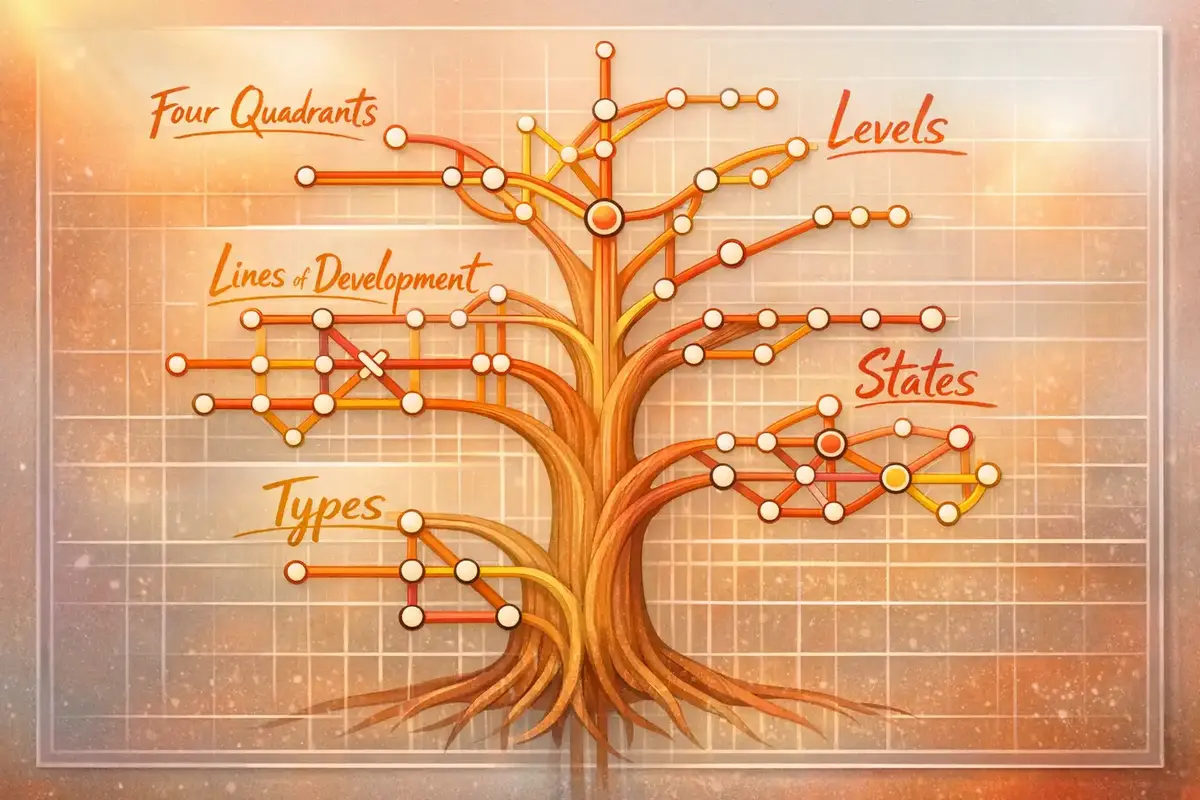
That is the practical value of the AQAL model. It maps four distinct realities leaders routinely collapse into one.
The four quadrants are not abstract—they separate different kinds of truth
Start with the individual. The interior-individual quadrant covers what a person believes, intends, fears, and values. The exterior-individual quadrant covers what that same person does: skills, habits, observable behavior, performance.
Now shift to the collective. The interior-collective quadrant is shared meaning—team norms, trust, informal expectations, what people feel safe saying. The exterior-collective quadrant is the visible system: structure, governance, workflows, incentives, reporting lines.
That distinction sounds simple. In practice, it is where diagnosis gets sharper.
A mid-market manufacturing VP sees quality misses rise during a quarterly review. Training looks like the answer, because operator behavior is the visible symptom. But AQAL forces four checks: do people understand why standards changed, can they perform the task consistently, does the team normalize shortcuts under pressure, and does the production system reward speed over accuracy? Same problem surface. Four different causal paths.
AQAL is a completeness check, not a replacement religion
This is where leaders often misuse frameworks. They treat a behavior issue as a culture issue. They treat a culture issue as a process issue. They treat a systems issue as a motivation issue. AQAL helps prevent that category error by showing that behavior, meaning, culture, and systems are related but not interchangeable.
The point is not to make every decision more theoretical. It is to reduce false confidence in partial diagnosis.
Used well, AQAL does not replace Lean, strategy maps, org design, coaching, or culture tools. It tells you whether those tools are aimed at the right slice of reality—or whether they are solving only the quadrant they know how to see. That is why The Integral Institute keeps the model relevant for practitioners: not as philosophy first, but as a way to test whether your diagnosis is whole enough to trust.
And once leaders accept that, a more difficult issue appears. If two executives can look at the same quadrant and still read it differently, is the gap in the map—or in the stage of mind doing the mapping?
Why Do Developmental Stages Change the Meaning of Leadership?
10,796 leaders across 2,014 organizations is large enough to kill a comforting myth: knowing the business is not the same as being ready to lead in complexity (DDI, 2025). Most organizations still promote for functional strength, then act surprised when capable executives struggle with talent, alignment, and change.
The evidence points to a broader problem. 54% of CEOs rank attracting and retaining talent as their top concern over the next five years (DDI, 2025). If leadership were simply a matter of expertise, that number would not stay this high.
Stage changes what a leader sees
A leader’s developmental stage shapes how they interpret authority, conflict, and ambiguity. At one stage, leadership means control, clarity, and compliance. At another, it means balancing competing truths, reading systems, and working with uncertainty without rushing to oversimplify.
Same meeting. Different meaning.
In a regional financial services firm during a team restructure, a strong divisional VP may read pushback as poor alignment and tighten decision rights. A more developed leader may hear the same objections as signals of hidden risk, identity loss, or cross-functional friction. The external event is identical. The meaning-making is not.
That is why leadership development cannot be reduced to skill building alone. Skills matter. But the mind using the skill matters just as much.
Lines of development explain uneven maturity
This is where many leadership models stay too flat. They assume competence travels as a package — if someone is sharp in strategy, they must also be strong in empathy, ethics, or systems thinking. Real leaders do not develop that neatly.
A founder can be exceptional at market pattern recognition and still be poor at reading the emotional impact of their decisions. A senior operator can be disciplined, fair, and execution-focused, yet struggle to think beyond linear cause and effect. Lines of development help explain that unevenness: people mature in different capacities at different rates.
High performance in one line does not prove maturity across the whole leadership system.
AQAL becomes more useful at exactly this point. It stops leaders from mistaking visible success for whole-person development. It also explains why some executives can run a business unit brilliantly and still create cultural drag, ethical blind spots, or talent loss they do not even recognize.
That raises a harder diagnostic question. If leaders differ not only in behavior but in how they experience pressure, what else is shaping performance — stable personality patterns, temporary states, or the culture around them?
Are States, Types, and Culture the Missing Variables in Transformation?
1.8 times better human outcomes and 1.6 times better business outcomes is not a culture slogan; it is a performance signal for leaders who still treat team climate as secondary (Deloitte, 2024). If two teams receive the same strategy and produce different results, are you looking at execution failure—or at variables your change plan never measured?
That question gets uncomfortable fast. Most leaders assume consistency lives in the plan: same goals, same milestones, same incentives. But the same person can interpret that plan differently on Monday morning under pressure than they do on Friday after reflection. The map is not wrong. The state of the person reading it has changed.
State shifts change judgment before they change behavior
A regional retail director in a holiday trading review can look decisive in one meeting and defensive in the next. Under stress, they narrow options, overread threat, and default to familiar controls. In a calmer state, the same leader can hold ambiguity, hear weak signals from store managers, and make a better call on staffing or inventory. That is not hypocrisy. It is state.
Leaders miss this because state shifts are temporary, not fixed traits. Yet temporary does not mean trivial. A transformation can stall for months because key decisions were made in fatigue, threat, or urgency rather than in a more reflective mode.
Types explain difference without pathologizing it
Then there is type. Two capable executives can face the same client escalation and move in opposite directions for good reasons. One seeks rapid closure, clear ownership, and visible action. Another widens the frame, tests assumptions, and protects relationship quality before forcing a decision.
Both styles can work. Both can fail.
Typologies matter because they stop leaders from confusing difference with deficiency. In practice, that means designing roles, communication, and conflict norms with more nuance. It also makes organizational culture work more credible, because culture is shaped not by one ideal style but by how different styles are interpreted, rewarded, or dismissed.
Culture is the adoption layer
This is where the collective interior becomes decisive. Change rarely dies in the town hall. It dies in side conversations, in what managers signal with tone, in whether local teams believe speaking up is safe, useful, or career-limiting. Deloitte’s work on microcultures is so relevant because it shows that these local meaning systems are not soft residue from strategy; they are part of execution itself (Deloitte, 2024).
Teams that embrace microcultures are 1.8 times more likely to achieve positive human outcomes and 1.6 times more likely to achieve desired business outcomes (Deloitte, 2024)
So when transformation underperforms, what exactly are you seeing—bad strategy, or the wrong tool for the wrong level of reality? And if AQAL can diagnose more than most frameworks, when is that added range actually worth the effort?
When Is AQAL the Right Tool, and When Is It Overkill?
AQAL becomes relevant fast when 85% of employers plan to prioritize upskilling and 59 out of 100 workers will need training by 2030—because without a fuller diagnostic map, leaders can mistake a capability gap for a culture problem, or a culture problem for a design flaw (World Economic Forum, 2025). If organizations are flattening management and racing to reskill, the real question is not whether change is happening; it is which problems actually require a whole-system lens.
Use AQAL when the failure crosses boundaries
AQAL is strongest when the problem refuses to stay in one box. A technology enterprise, for example, cuts layers to move faster, then finds product decisions slowing down anyway. Korn Ferry’s Workforce 2025 research—based on 15,000 global employees—found that 41% of employees said their organization had slashed management layers (Korn Ferry, 2025). That kind of structural shift rarely stays structural for long.
A VP in that environment may see four issues at once: managers no longer know where authority sits, teams interpret “empowerment” differently, informal norms punish escalation, and individuals lack the judgment to make newly decentralized calls. That is not just org design. It is behavior, system, culture, and meaning colliding in one decision arena.
When a problem spans multiple realities at once, a single-method fix usually solves only the part it can see.
That is where AQAL earns its keep. Not as philosophy. As triage.
Skip AQAL when the problem is already clear
Some problems are narrower than leaders want to admit. A warehouse picking error caused by poor barcode scanning discipline does not need a full integral diagnosis. Neither does a pricing dashboard with broken data definitions. If the issue is operational, bounded, and measurable—and a simpler method can isolate the cause—use the simpler method.
This is the mistake smart executives make with broad frameworks: they apply them to decisions that are already well-defined. AQAL is not better because it is bigger. It is better when ambiguity is real, when cross-functional friction keeps recurring, or when identity and culture are shaping adoption in ways the org chart cannot explain.
That is why it sits best alongside, not above, tools like transformational leadership. It is a diagnostic layer, not a universal replacement.
The practical test for fit
Ask three questions. Is the problem crossing functions? Are visible fixes failing to stick? Are people arguing about what the problem is, not just how to solve it? If yes, AQAL is probably useful. If no, it may be overkill.
That sounds simple. In practice, it is where leaders drift into theory theater—using a rich map without changing how decisions get made. So what does disciplined application actually look like under time pressure: real diagnosis, or elegant abstraction?
How Should Leaders Apply AQAL Without Turning It Into Theory Theater?
27% is the performance lift leaders can unlock when they develop direct reports effectively, and those people become 1.5 times more likely to exceed goals (Deloitte, 2024). That matters because AQAL should improve decisions like that one—not become a clever vocabulary layered on top of old habits.
Start with a four-quadrant check, not a favorite solution
The practical move is simple: before choosing an intervention, force a diagnosis across all four quadrants. Ask what is happening in individual interior terms—beliefs, motives, confidence. Then check individual exterior—skills, habits, execution. Add collective interior—trust, norms, shared assumptions. Finish with collective exterior—roles, incentives, process, structure.
That sequence prevents a common executive error: deciding too early that the answer is training, reorg, or culture work.
In a mid-market services firm during a quarterly review, a director sees account teams missing handoff deadlines. The first instinct is coaching. AQAL slows that down. Are team leads avoiding hard conversations? That is a coaching issue. Are teams unclear on who owns the client transition? That is process. Are people protecting their own book of business? That is team dynamics. Is the compensation model rewarding local wins over shared delivery? That is structural.
Different causes. Different actions.
Turn the model into operating questions
AQAL works best when translated into repeatable prompts leaders can use in real forums.
In talent reviews: is this person underperforming because they lack capability, because their manager is not developing them, or because the role design sets them up to fail? Deloitte’s data matters here because better development is not soft support; it is a measurable performance lever (Deloitte, 2024).
In team meetings: what are we not saying, what behavior is actually showing up, and what in the system keeps reproducing it?
In transformation planning: which risks are about adoption, which are about workflow, which are about leadership maturity, and which are about governance?
AQAL becomes useful the moment it changes the question before it changes the plan.
That is the line between diagnosis and theater. And as complexity rises, which leaders will keep asking better questions—while others keep funding partial answers?
Why Holistic Leadership Thinking Matters More as Complexity Rises
US$8.9 trillion is the annual cost of low employee engagement globally — about 9% of global GDP — and that number should reset how seriously leaders treat misdiagnosis (Gallup, 2024). When the problem is read too narrowly, the losses do not stay on a slide: revenue slips, trust thins out, and strong people decide they are done.
If the cost of getting this wrong is so high, what changes when leaders start seeing the whole system instead of the loudest symptom?
Complexity punishes partial sight
The answer is not that leaders become more philosophical. It is that they become less easily fooled.
A single-lens leader sees a missed target and goes straight to accountability. A more holistic leader asks a harder question: what kind of failure is this? Is it weak execution, a broken handoff, a norm nobody will challenge, or a leadership team interpreting the same reality through different assumptions? AQAL is most useful right there — as a disciplined way to see what narrower models routinely miss.
Consider a technology startup in a board-level growth push. The founder sees product delays and replaces a team lead. Deadlines still slip. Why? Because the visible issue was speed, but the full shape of the problem included conflicting priorities, unspoken fear about raising delivery risks, uneven managerial maturity, and a planning system that rewarded optimism over accuracy. One intervention addressed one symptom. The system kept producing the same result.
That is the practical point. AQAL does not win because it is abstract. It wins when it helps leaders choose interventions that actually fit the problem they have.
Better judgment, not bigger theory
Research on microcultures makes this concrete. Organizations that embrace them are 1.8 times more likely to achieve positive human outcomes and 1.6 times more likely to achieve desired business outcomes (Deloitte, 2024). That finding matters because it shows performance is not produced by structure alone. Local norms, shared meaning, and day-to-day interpretation shape whether strategy travels or stalls.
Strategy does not travel on structure alone. It survives or stalls in the everyday conversations where people quietly decide what is really expected of them.
This is where a mature leadership approach separates itself. It reads performance, culture, development, and systems together — not because every decision needs a grand framework, but because complexity rarely announces which layer is driving the failure. The leader’s job is to tell the difference before money, time, and credibility are spent on the wrong fix.
That is also the most grounded way to think about Integral Leadership. Not as a mystical answer. As a way to improve judgment when reality stops fitting neat categories.
For leaders who want practical, low-friction ways to test where an initiative is actually stalling, our sister platform AI Coach System offers AI-guided tools worth exploring.
The real test is simple. In your next stalled initiative, will you treat the loudest symptom — or diagnose the whole pattern? As complexity rises, holistic diagnosis is no longer an academic luxury. It is part of the leadership job.
Key Takeaways
- Single-lens change efforts often fail because they target only one layer of the business.
- AQAL helps leaders diagnose behavior, meaning, culture, and systems as distinct but related realities.
- Developmental stage, state, type, and microculture all shape how change is interpreted and adopted.
- AQAL is most useful when problems cross boundaries and simpler tools cannot explain why fixes do not stick.
Frequently Asked Questions
What is the AQAL model in integral theory?
AQAL is a framework that maps four distinct dimensions of reality: individual interior, individual exterior, collective interior, and collective exterior. It helps leaders see whether a problem is about beliefs and meaning, behavior and skills, shared norms and culture, or systems and structure.
Why do single-lens change efforts often fail?
Single-lens change efforts fail because they target only one visible layer of the organization, such as training, incentives, or process redesign. When the real causes also involve trust, shared meaning, leadership maturity, or system design, the fix may improve one symptom while the broader problem remains.
How does AQAL improve leadership diagnosis?
AQAL improves diagnosis by forcing leaders to check multiple causes before choosing an intervention. Instead of assuming every problem is a training issue or a culture issue, it helps separate behavior, meaning, culture, and systems so the response matches the actual failure mode.
What do developmental stages have to do with leadership effectiveness?
Developmental stage shapes how leaders interpret authority, conflict, ambiguity, and complexity. A more developed leader is more likely to balance competing perspectives and work with uncertainty, while a less developed one may default to control, simplification, or compliance.
When is AQAL the right tool to use?
AQAL is most useful when a problem crosses functions, visible fixes do not stick, or people disagree about what the real problem is. It is usually overkill for narrow operational issues that can be solved with a simpler, more direct method.