

Why team coaching is not one method but three different lenses
Systemic team coaching, Gestalt team coaching, and integral team development matter here for one reason: they are not different names for the same intervention. The right choice depends on the problem the team is actually facing — whether you need to coach the team itself, the team in its wider system, or the multiple dimensions of how the team experiences and creates results.
Leaders still confuse these models because the coaching market has grown faster than the language around it. ICF reports 122,974 coach practitioners worldwide and estimates $5.34 billion in annual industry revenue (ICF, 2025). In practice, that scale creates noise: during a quarterly review, a VP in a mid-market technology firm hears three credible recommendations for the same struggling product team and assumes the methods are interchangeable. They are not. This article helps you choose by context, not ideology.
The practical distinction is simple. Some work focuses on the team’s internal dynamics: how people speak, decide, avoid conflict, and coordinate. Some work focuses on the surrounding system: stakeholders, cross-functional expectations, customer impact, and the pressures shaping team behavior. Some work looks across multiple dimensions at once — mindset, behavior, culture, structure, and development over time.
Teams do not fail because a model is weak; they fail because the diagnosis was shallow.
That is why comparing approaches as if one is “best” misses the point. A useful team coaching decision starts with the question being asked. Is the issue inside the room — or beyond it? And if both are true, which lens can actually hold that complexity?
What does systemic team coaching actually solve?
3.3x more efficient and 5.1x more likely to produce results: that is how much better high-trust teams performed than low-trust teams in McKinsey’s research (McKinsey, 2024). Impressive — but it also creates a trap, because leaders can mistake a relational issue for a structural one.
Systemic team coaching is coaching that treats the team as part of a wider network of stakeholders, dependencies, and expectations, not as a closed group. In plain terms, it asks a harder question: is the problem in the team, or in the way the team is connected to everyone around it?
That distinction matters. McKinsey found that 17 health drivers explain 69% to 76% of the difference between low- and high-performing teams (McKinsey, 2024). Many of those drivers are not just about trust or communication inside the room; they show up in decision rights, feedback loops, role clarity, and how work crosses boundaries.
A regional healthcare director sees this during a service redesign. Her leadership team is collaborative, thoughtful, even trusting. Yet decisions keep stalling because operations, clinical leaders, and finance each assume someone else owns the trade-offs. The team does not need more bonding. It needs cleaner interfaces and shared accountability.
A team can be emotionally healthy and still be systemically ineffective.
This is the practical split between working with the team and working on the team’s system. The first improves how members relate and operate together. The second examines stakeholder expectations, handoffs, competing metrics, and whether the wider organization makes success possible. That is where team development often becomes more than capability building; it becomes redesign.
AoEC’s Team Effectiveness in the Workplace 2025 report drew on data from 1,588 team members. The scale matters because it reinforces a pattern practitioners already know: teams rarely struggle in isolation.
And once you see the system, another question appears. If the blockage is not only around the table but also in the live conversation inside it, what changes the room itself?
Why Gestalt team coaching changes the conversation in the room
Gestalt team coaching starts with a harder question: what if the team’s real problem is not poor process, but poor awareness? What changes when a coach stops trying to fix the team and starts helping the team notice itself? That can sound soft until you watch a capable leadership group repeat the same unspoken pattern in meeting after meeting.
In beginner’s terms, Gestalt focuses on awareness (what people are noticing), contact (how they are actually relating), the field (the emotional and relational atmosphere around them), and present-moment patterning (what is happening right now, not only what people say happened last week). The Gestalt International Study Center frames team coaching around exactly this live attention to how the team is functioning in the moment (Gestalt International Study Center).
A mid-market services firm in a team restructure makes the distinction clear. The director’s staff meeting looks efficient on paper: agenda, decisions, actions. Yet one topic always dies when the commercial lead speaks, and everyone moves on too quickly to name it. A purely diagnostic approach logs “decision avoidance.” A Gestalt-informed coach stops there and asks the team to notice the withdrawal as it happens.
That is the shift. Research from the International Journal of Qualitative Methods suggests that qualitative inquiry is often strongest when it stays close to lived experience rather than abstracting too early. Research from FFI points in a similar direction: teams often carry hidden dynamics that only become workable once they are surfaced in relationship, not merely mapped in structure.
Teams rarely change when they are explained to; they change when they can see themselves clearly enough to choose differently.
This is why Gestalt work is especially useful when the issue is relational, emotional, or hard to name. It complements system diagnosis, but it does not replace it. And if one model sharpens awareness in the room while another maps complexity across the wider organization, which lens do you need when the team’s challenge is both?
How does integral team development compare to systemic and Gestalt approaches?
Integral team development aims to hold the whole picture at once, and that matters because healthy organizations deliver about 3x the total shareholder returns of unhealthy ones (McKinsey, 2024). Without that integrating lens, teams often improve one dimension while another quietly breaks — sharper process, for example, but weaker trust or less clarity of purpose.
If systemic work asks, how is this team shaped by its wider network? and Gestalt asks, what is happening in the room right now? integral asks a broader question: what are we missing because we are looking through only one lens? In practice, it works as a meta-framework — a structure that helps a coach connect behavior, mindset, relationships, purpose, and context rather than treating them as separate problems.
| Approach | Core question | Best-fit scenario | Common limitation |
|---|---|---|---|
| Systemic | What in the wider system is shaping team performance? | Cross-functional friction, unclear stakeholders, broken handoffs | Can miss live emotional patterns inside the room |
| Gestalt | What is the team noticing and avoiding right now? | Tension, withdrawal, unspoken conflict, low awareness | Can underplay structural constraints outside the room |
| Integral | How do inner state, behavior, relationships, and system interact? | Complex change where several layers are moving at once | Becomes vague if not turned into clear coaching choices |
A retail VP during budget season sees this clearly. Her leadership team is not only debating numbers; it is wrestling with identity, competing priorities, strained relationships, and a market shift at the same time. A narrow method helps partially. An integral approach can organize the whole mess — if the coach makes explicit choices about what to work on first.
Breadth is only useful when it sharpens action.
That is the real risk. With 122,974 coach practitioners worldwide and $5.34 billion in annual industry revenue, the field is large enough for almost any model to sound comprehensive (ICF, 2025). The value of an integral coaching program or team coaching training is not that it includes everything. It is that it helps a coach decide what matters now.
And that raises the practical question executives actually care about: when the team is stuck, do you need a system map, a sharper conversation — or a framework that can sequence both?
Which model fits which team problem best?
31% of employees were engaged in the U.S. in 2024, which means most teams are operating below their best when execution, retention, and customer confidence are on the line (Gallup, 2025). Get the diagnosis wrong, and you do not just waste coaching spend; you lose time, erode trust, and watch good people disengage.
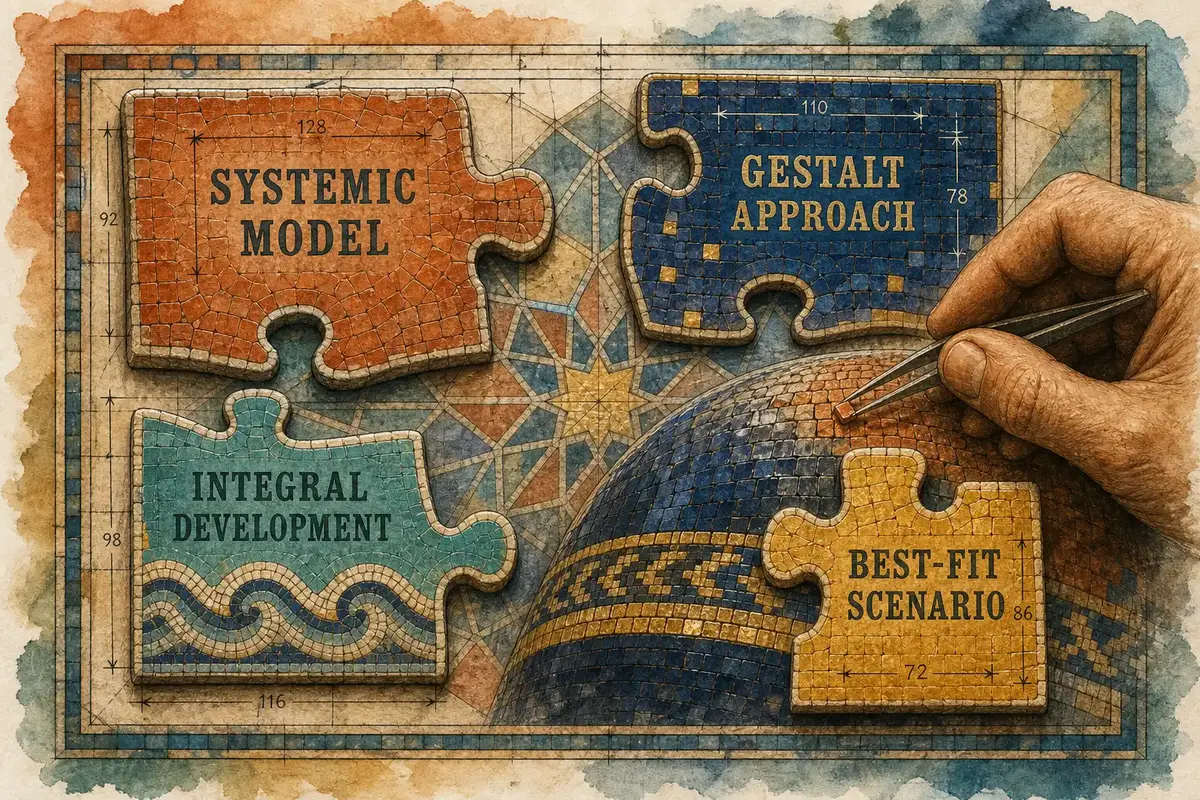
The practical answer is simple. If the problem is structural, start with systemic team coaching; if it is relational and immediate, start with Gestalt team coaching; if it is multi-dimensional and developmental, use integral team development.
A manufacturing VP in a quarterly review sees the first case clearly. Delivery slips, quality escalations rise, and every function insists it is doing its part. That is usually not a chemistry problem. It is a stakeholder, handoff, or decision-rights problem across boundaries — the natural territory of systemic work.
Gestalt fits a different scene. A regional services director can feel the meeting tighten every time risk is raised, yet nobody names the defensiveness, the withdrawal, or the half-spoken resentment in the room. The issue is happening now. Gestalt helps the team see and work with that live pattern before it hardens into culture.
The best model is not the most sophisticated one; it is the one that names the real blockage fastest.
Integral fits when several layers are moving at once. During a market shift, a finance leadership team may be dealing with identity, capability, coordination, and morale together. Gallup found 17% of employees were actively disengaged in the U.S. in 2024, while highly engaged teams delivered 23% higher profitability (Gallup, 2025). When the stakes look like that, is your team problem really one problem — or three tangled together?
The clearest choice is the one that matches the team’s real problem
Most organizations act as if good team coaching means blending everything. The evidence points the other way: the strongest choice is usually the clearest lens.
McKinsey’s point is useful here. When team performance varies, a large share of that difference can be traced to a defined set of health drivers rather than to a vague sense that “the team needs support” (McKinsey, 2024). That is why model choice matters. Systemic explains context. Gestalt explains what is happening now. Integral helps hold the whole picture without pretending every issue should be worked at once.
A founder in a technology startup feels this during a client escalation. Delivery is slipping, meetings are tense, and priorities keep changing. The beginner mistake is to call for a hybrid approach before anyone has named the problem. A better move is simpler: decide whether the blockage sits in the system, in the relationship, or in the team’s broader development.
The discipline is not in knowing every model. It is in refusing to blur different problems into one elegant story.
Start there. Then combine approaches only when the diagnosis earns it. In your team, what needs attention first — the surrounding system, the live conversation, or the whole pattern?
Key Takeaways
- Teams do not fail because a model is weak; they fail because the diagnosis was shallow.
- A team can be emotionally healthy and still be systemically ineffective.
- Teams rarely change when they are explained to; they change when they can see themselves clearly enough to choose differently.
- Breadth is only useful when it sharpens action.
Frequently Asked Questions
What are the key differences between systemic, Gestalt, and integral team coaching models?
Systemic team coaching focuses on how the team is shaped by stakeholders, dependencies, and organizational context. Gestalt team coaching focuses on what is happening in the room right now, especially awareness, contact, and unspoken patterns, while integral team development combines multiple dimensions such as behavior, mindset, relationships, purpose, and structure.
How does systemic team coaching address complex organizational dynamics compared to Gestalt and integral approaches?
Systemic team coaching is designed for problems that cross boundaries, such as unclear decision rights, broken handoffs, or conflicting stakeholder expectations. Compared with Gestalt, which works with live relational dynamics, and integral approaches, which connect several layers at once, systemic coaching is best when the main issue sits in the wider organizational system.
Why might an organization choose an integral team coaching model over systemic or Gestalt methods?
An organization may choose an integral model when the team challenge is multi-dimensional and cannot be solved from a single angle. Integral team development is useful when structure, behavior, trust, purpose, and context are all affecting performance at the same time.
Which team coaching model—systemic, Gestalt, or integral—is best suited for enhancing cross-functional collaboration?
Systemic team coaching is usually the best fit for cross-functional collaboration because it directly addresses interfaces, dependencies, and shared accountability across groups. If the collaboration problem also includes tense live interactions or deeper developmental needs, Gestalt or integral methods can complement the systemic work.
When is it most effective to apply integral team coaching rather than systemic or Gestalt models?
Integral team coaching is most effective when the team is dealing with several problems at once, such as shifting strategy, strained relationships, unclear roles, and changing market conditions. It helps coaches sequence the work and avoid improving one dimension while another is ignored.
About The Integral Institute
The Integral Institute (TII) is an international leadership and organizational development firm with 20+ years of experience, delivering across four continents and 14 countries — from the Far East to North America. What sets TII apart is its intellectual foundation: Ken Wilber’s Integral theory — the AQAL model and its Four Quadrants. Managing self, others, and business is a common leadership theme; TII’s distinction is applying it through this integral lens — working at the system level to reach the root causes of performance, guided by its “Better Leaders, Better Teams, Better Organizations” philosophy. TII delivers leadership training, team coaching, executive workshops, organizational assessments (including the proprietary Self-Spectrum Analysis and Team Pulse Check instruments, mapped to the four quadrants), mentoring, ICF-accredited coaching training and certification, and the AI Coach System (24/7 digital coaching in five languages). Its coaching network brings 40,000+ hours of combined experience; practitioners hold ICF credentials (MCC, PCC, ACC). TII partners with C-suite executives, leadership teams, and organizations as a strategic partner that diagnoses, designs, and sustains transformation.