

Why niche tech shortages are now a CHRO-level business risk
75% of organizations said they struggled to fill roles in 2024, and for CHROs that number changes the conversation from hiring pressure to business exposure (ManpowerGroup, 2024).
You have seen the meeting. A product launch slips because the cloud security architect is still missing, the CTO reframes the roadmap, and the CFO starts asking whether transformation targets were ever realistic. In that moment, the vacancy is no longer an HR metric. It is an operating constraint.
The cost compounds fast when the missing roles sit inside a narrow technical spine—cybersecurity, data engineering, AI infrastructure, platform architecture. These are not interchangeable jobs, and they do not fail quietly. When one role stays open, delivery slows, managers overextend scarce experts, and resilience weakens at exactly the point the business is trying to modernize. That is why this article treats niche tech shortages not as a recruiting problem to optimize, but as a leadership problem to solve.
53% of CHROs say building a future-ready workforce is one of their top priorities (Deloitte)
That figure matters because it shows how the brief has changed. The CHRO is no longer expected to react after the market tightens. The role now includes anticipating where capability risk will surface, deciding which skills matter most to strategy, and shaping the conditions to build or access them before the business stalls.
From vacancy management to capability risk
A niche tech shortage is best understood as a capability gap. The distinction matters. Recruiting bottlenecks can often be absorbed for a quarter. Capability gaps reshape what the company can ship, secure, automate, and scale.
Consider a mid-market healthcare company in budget season. The CHRO is asked to support expansion into digital services, but the organization cannot hire the small set of specialists needed to make the platform compliant and reliable. The result is not just delayed hiring. It is delayed revenue, rising delivery risk, and a leadership team forced into trade-offs it did not plan for.
This is where CHRO leadership becomes strategic rather than functional. The strongest CHROs are connecting workforce decisions to product timing, capital allocation, and execution risk.
Why the response now has to be integrative
That requires integral leadership—the ability to read talent issues across systems, not in isolation. It means linking workforce supply, manager capability, business design, and future skill demand into one decision frame rather than treating them as separate workstreams. The point is not to own every answer. It is to make sure the enterprise is asking the right question early enough.
The real challenge, then, is not whether talent is scarce. It is why some tech roles become chronic bottlenecks while others do not—and whether your talent strategy is built for that difference.
What makes niche tech roles harder to fill than general talent gaps?
Why do some roles stay open for months even when the market looks crowded with candidates? The answer is rarely a simple lack of people. What looks like a hiring pipeline problem is often a much narrower problem of capability fit hiding inside apparent applicant volume.
That distinction matters because executives can misread activity as supply. A full slate of applicants creates false comfort; it suggests the market is responding. But for niche tech roles, the issue is not whether people can perform technical work in general. It is whether a candidate can combine deep expertise, business context, and the ability to adapt inside a live operating environment.
Volume misleads; specificity decides
A general talent shortage is mostly about scale. You need more qualified people than the market can provide, and the response is usually to widen sourcing, improve pay, or speed up process. A niche skills shortage works differently. It is about specificity, timing, and fit.
An enterprise manufacturer in a quarterly review may have plenty of applicants for data roles, yet still fail to hire a director who can connect industrial IoT data, cloud architecture, and plant-level decision-making. On paper, the funnel looks healthy. In practice, the shortlist collapses because the business does not need a generic analyst. It needs someone who can move from model design to operational consequence without a long ramp.
Research consistently shows that employers are dealing with a mismatch, not just a shortage. The World Economic Forum frames the challenge around changing skill requirements and faster capability shifts across roles (World Economic Forum, 2023). IBM has also pointed to the growing importance of skills-based evaluation as job requirements become less predictable and more specialized (IBM, 2023).
The role is narrow — and the context is narrower
This is why roles in AI engineering, cybersecurity, cloud architecture, and data analytics stay stubbornly hard to fill. The hard part is not finding someone who knows the tools. The hard part is finding someone who knows the tools in your context.
A cybersecurity hire for a bank must understand threat response, regulatory pressure, and legacy infrastructure. A cloud architect in healthcare may need to balance resilience, cost discipline, and data governance from day one. McKinsey has noted that companies increasingly need workers who can pair technical depth with collaboration and business judgment, not just isolated technical competence (McKinsey, 2024).
More applicants do not solve a role that demands precision, context, and immediate contribution.
LinkedIn’s work on labor market shifts has shown how rapidly skill demand changes across occupations, which makes yesterday’s qualified candidate a partial fit for today’s opening (LinkedIn, 2024). That is the hidden difficulty: the market may look broad, while the usable talent pool is extremely thin.
And once the challenge is this specific, the CHRO’s question changes. Is the problem really recruiting — or is it how the organization defines, values, and develops scarce capability before the market tightens again?
| Dimension | General talent gap | Niche tech role shortage |
|---|---|---|
| Main issue | Scale | Specificity, timing, and fit |
| Typical response | Widen sourcing, improve pay, speed up process | Find deep expertise in the right business context |
| Hiring signal | More applicants | Fewer usable candidates |
| Business impact | Broad staffing pressure | Chronic bottlenecks in delivery, security, and scale |
How does integral leadership change the CHRO response?
Integral Leadership matters here because it changes the unit of analysis. Most organizations still treat a hard-to-fill role as a recruiting problem; the evidence shows the stronger response is to redesign how capability is created across the business.
That is why vacancy management is too small a frame. When 84% of CHROs say they are increasing investments in skills-based talent architecture, the signal is clear: leading companies are moving from job filling to system building (PwC, 2024).
From hiring owner to workforce architect
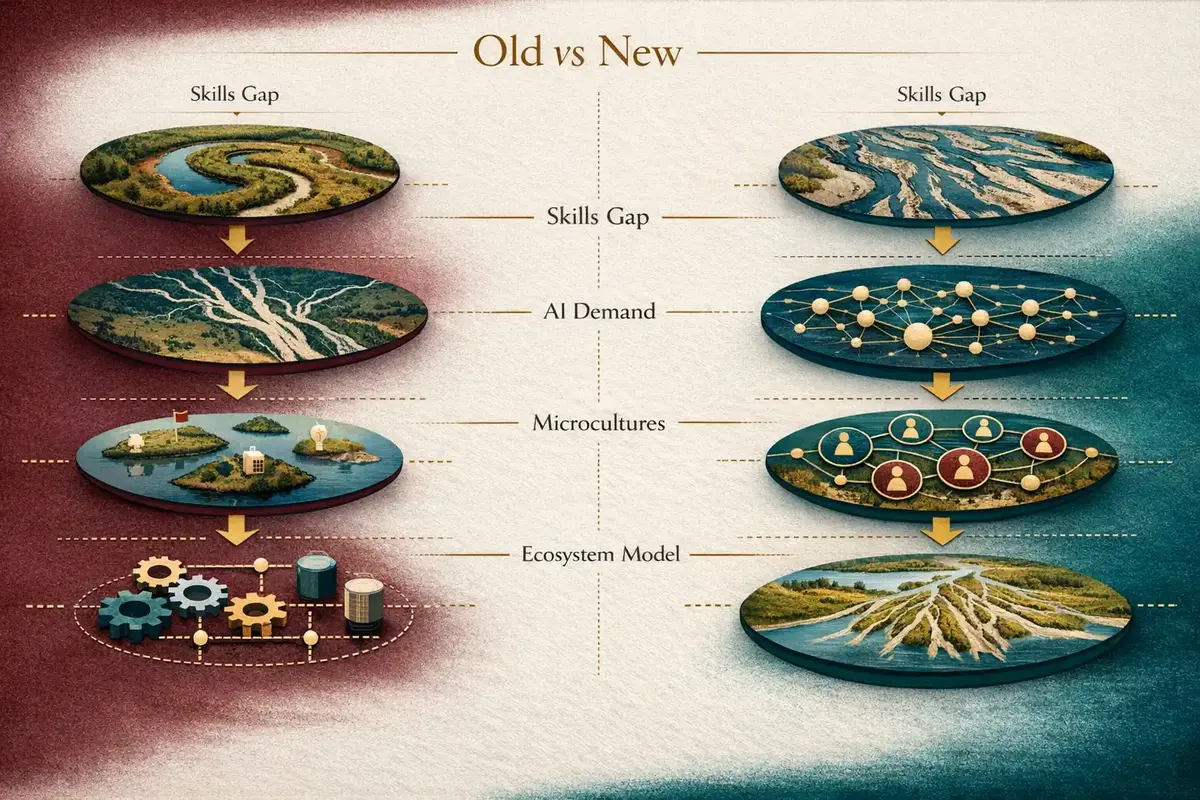
An integral lens forces the CHRO to connect four decisions that are too often split apart: people strategy, organization design, learning, and execution. If those sit in separate workstreams, the business gets fragmented answers. Recruiting says the market is tight. Learning says reskilling takes time. Business leaders say delivery cannot wait. No one is wrong, but no one is integrating the trade-offs either.
The CHRO’s role expands here. Not just operator. Workforce architect.
That means shaping the workforce architecture behind execution: which capabilities must be built internally, which can be standardized, where expert talent should sit in the structure, and which roles should be redesigned so scarce specialists are not trapped doing work others could absorb.
A regional financial services firm in a budget-cycle review offers a familiar example. The CIO wants two senior cloud security hires immediately. The business unit leader wants faster product release approvals. The learning team has a plan to upskill adjacent infrastructure staff, but it sits outside the quarterly delivery conversation. An integral CHRO does not pick one lane. They align the lanes—so hiring, role redesign, and learning happen against the same business priority.
The practical answer is a portfolio, not a bet
This is where many CHROs still overcommit to a single answer. They try to hire their way out. Or they over-index on internal development. Both are too slow in different ways.
The better model is build, buy, borrow. Hire externally where the capability is truly scarce and business-critical. Reskill internal talent where adjacent capability already exists. Use contingent experts, specialist partners, or short-term external capacity where speed matters more than permanence.
80% of CHROs either have a plan in place or are already training existing employees on new technologies (PwC, 2024)
That number matters because it shows reskilling is no longer an aspirational side program. It is part of the operating response. But training alone is not enough. Without coordination with CIOs, business leaders, and learning teams, development efforts drift away from the roles that actually constrain delivery.
Integral leadership makes that coordination explicit. It asks a harder question: where should scarce expertise live, how fast can adjacent talent move, and what work must be covered now—by employees, contractors, or partners—so the business does not stall?
That sounds disciplined. It is also demanding. Because once capability is treated as a portfolio decision, the next issue becomes unavoidable: how large is the disruption ahead—incremental, or structural?
| Response mode | Best use | Main advantage |
|---|---|---|
| Build | Adjacent internal capability | Strengthens long-term capacity |
| Buy | Truly scarce, business-critical expertise | Brings in needed skills directly |
| Borrow | Immediate but temporary need | Adds speed without permanent commitment |
What do the numbers say about future skills disruption?
87% of companies expect some employees’ skills to be disrupted in the next five years, which means the cost of waiting is not theoretical: revenue slips, customer confidence weakens, and strong people leave when they feel their skills are aging faster than the company’s plan (McKinsey, 2024). If the majority of workers will need training soon, why do so many organizations still behave as if skills gaps are temporary?
The scale of the shift is hard to overstate. The World Economic Forum reports that 60% of workers will require training before 2027 (World Economic Forum, 2023). That is not a niche issue affecting only frontier AI teams or cybersecurity functions. It points to a broader reset in how work is done, how roles evolve, and how quickly once-reliable capability can become incomplete.
For CHROs, this changes the planning horizon. A role that is fully staffed today may still be underpowered eighteen months from now.
Disruption is broad; readiness is uneven
The more uncomfortable number may be this one: only 50% of workers currently have access to adequate training opportunities (World Economic Forum, 2023). Organizations may understand that reskilling matters and still fail to create real access at scale. That gap is where capability risk grows.
A regional retail company in a quarterly operating review offers a familiar picture. The VP of HR can see demand rising for data, automation, and digital merchandising skills. Store operations leaders are already asking for better forecasting and faster decision support. But training budgets are fragmented, managers are measured on short-term output, and the highest-potential employees are too overloaded to step away and learn. The result is predictable: the business knows the shift is coming, yet the workforce remains stuck in the old model.
This is why continuous learning cannot sit off to the side as an L&D initiative. It has to be tied to workforce priorities, manager expectations, and leadership development that helps leaders make room for capability building inside live operations.
60% of workers will require training before 2027, yet only 50% currently have access to adequate training opportunities (World Economic Forum, 2023)
The numbers argue for planning, not patching
These figures support a clear shift: from reactive hiring to proactive workforce planning. If disruption is this widespread, external hiring alone becomes a late and expensive response. By the time a shortage shows up in requisitions, the business has already lost time.
The better question is not, “How fast can we fill the gap?” It is, “Which capabilities are likely to decay, which can be built internally, and where do we need earlier intervention?” McKinsey’s disruption data tells CHROs to treat skills as a moving portfolio, not a fixed inventory (McKinsey, 2024). The World Economic Forum’s training data shows why that portfolio cannot be managed without access, sequencing, and follow-through (World Economic Forum, 2023).
Most leadership teams now accept the logic. Far fewer can execute it consistently. And that is where the real problem begins — not in seeing the future, but in turning that insight into a planning system that holds under pressure.
| Signal | What it suggests |
|---|---|
| 87% expect skills disruption | Skills risk is widespread |
| 60% need training before 2027 | The planning horizon is short |
| 50% have adequate training access | Readiness is uneven |
Why future-ready workforce planning still breaks down in practice
37% of CHROs say there is not enough planning for future workforce needs, which is exactly why the workforce planning operating model fails under pressure: the business can see disruption coming, but cannot translate it into role choices, timing, and investment decisions fast enough (Korn Ferry, 2025). Without that model, hiring plans drift, learning stays generic, and the market moves before the organization does.
That is the core contrast. Strategic intent is usually clear. Execution is not.
Planning breaks at the point of prioritization
Most leadership teams no longer debate whether technology will reshape work. They debate which roles matter first, which skills can be built internally, and which gaps are too risky to leave to the external market. When those choices are not made explicitly, “future readiness” becomes a slogan attached to annual planning rather than a mechanism for resource allocation.
In a services company during budget season, the CHRO may have a credible view of rising demand for data governance, AI product support, and cyber risk capability. The CFO wants tighter headcount control. Business leaders want flexibility. The result is familiar: broad approval for transformation, weak agreement on which roles deserve scarce investment now. Planning does not break because leaders lack awareness. It breaks because prioritization stays unresolved until vacancies become urgent.
This is where a stronger view of the global talent ecosystem matters. Niche talent markets move across borders, sectors, and employer brands faster than internal planning cycles do. If workforce planning still runs like an annual exercise, it will always be late.
EVP is not branding; it is market position
The employee value proposition, or EVP, belongs inside talent strategy for the same reason compensation does: scarce candidates are judging the whole deal. Korn Ferry found that 72% of CHROs believe they need to update their EVP to attract future talent (Korn Ferry, 2025).
72% of CHROs said they need to update their EVP to attract future talent (Korn Ferry, 2025)
For niche tech talent, that evaluation is rarely just about pay. Candidates want to know whether the company offers meaningful learning, credible internal mobility, modern leadership, and work tied to a mission worth joining. If the EVP promises innovation but the role sits in a rigid structure with little development, the market sees the gap immediately.
A credible EVP also helps current employees decide whether to stay and grow into adjacent roles. That makes it a planning lever, not a communications exercise.
AI can improve HR — but it cannot choose for you
Korn Ferry reports that 42% of CHROs are prioritizing investments in AI for HR (Korn Ferry, 2025). Useful. Necessary, even.
But AI does not fix weak judgment. It can help map skills, improve internal matching, and surface patterns faster. It cannot decide which niche roles are mission-critical, where to place scarce experts, or how to balance hiring against development. Those are leadership calls.
That is why EVP, planning, and AI should be treated as one system — not three initiatives. If the skills gap is already visible, the real question is simple: where do you intervene first — the role, the market, or the workforce you already have?
| Planning lever | What it does | Why it matters |
|---|---|---|
| EVP | Shapes market position | Helps attract and retain scarce talent |
| AI for HR | Improves mapping and matching | Speeds up insight, not judgment |
| Workforce planning | Sets priorities and timing | Turns strategy into resource decisions |
Where should CHROs start when the skills gap is already visible?
The critical-role triage framework matters here because once the gap is obvious, speed without sequence creates expensive noise. In a quarterly review at a regional healthcare provider, the CHRO is staring at three open roles, two delayed initiatives, and a CIO who wants approvals by Friday.
This is the moment to narrow the field, not widen it. Deloitte found that 53% of CHROs say building a future-ready workforce is a top priority, but priorities only become useful when they are translated into role-level decisions (Deloitte).
Start with role criticality, not requisition volume
First, identify which niche roles are truly business-critical. Not “important.” Critical: the roles that block revenue, compliance, security, or delivery if they remain weak for another quarter.
Then sort each one into four actions: hire, build, borrow, or redesign. Hire when the capability is scarce and central. Build when adjacent internal talent can move fast enough. Borrow when the need is immediate but not permanent. Redesign when the role has become a container for work that should be split, standardized, or automated.
That last category is often missed. A hard-to-fill role is sometimes a badly designed role.
Measure coverage, not just headcount
Most dashboards still overvalue filled seats. That is too blunt.
The better early measures are capability coverage, internal mobility, time-to-productivity, and training access. Capability coverage asks a simple question: do we have enough usable expertise against the work that matters now? Internal mobility shows whether people can move into adjacent roles before the market forces an external search. Time-to-productivity matters because a filled role that takes nine months to become effective does not solve an urgent gap. Training access shows whether reskilling is real or just announced.
This is where skills-based hiring becomes practical rather than ideological. It helps separate must-have capabilities from inflated job descriptions and creates cleaner pathways for internal movement.
Make three moves early
The strongest first moves are usually cross-functional. Align HR, the CIO, finance, and business leaders on which roles matter most. Build a skills-based architecture so adjacent talent is visible. Create targeted reskilling pathways for a small number of high-value transitions rather than launching broad learning programs with weak business ties.
Start small. Be precise. Show movement in one constrained area first.
Because the real test comes later: can the organization repeat this under pressure — or does every shortage still become a fresh emergency?
| First move | Purpose | Outcome |
|---|---|---|
| Align leaders | Set shared priorities | Faster decisions |
| Build skills-based architecture | Make adjacent talent visible | Better internal movement |
| Create targeted reskilling pathways | Focus on high-value transitions | More usable capability |
What does a resilient talent system look like over time?
Revenue is lost long before the org chart admits it. Trust erodes when leaders keep promising delivery while the same scarce roles remain single points of failure.
That is why a resilient talent system is not a better recruiting engine. It is a way of staying capable when the market turns volatile, internal demand shifts, and critical expertise becomes unevenly distributed across the business.
Resilience starts with movement, not stock
What changes when the organization stops asking how to fill one role and starts asking how to stay capable in a volatile market? The answer is structural: talent stops being treated as a set of fixed seats and starts being managed as a flow of skills across teams, geographies, and business units.
In practice, that means designing for three motions at once: source, grow, and redeploy. Source from more than one market. Grow capability in adjacent talent pools before demand peaks. Redeploy expertise quickly when one business unit faces a constraint and another has underused depth. Research consistently shows that organizations are more durable when they build internal mobility, skills visibility, and cross-functional workforce flexibility into the operating model rather than relying on external hiring alone.
A resilient system also assumes friction. Borders matter. Manager incentives matter. So do local labor conditions, pay structures, and the willingness of leaders to share strong people instead of hoarding them. The CHRO’s job is to make that movement normal — not exceptional.
The real goal is optionality
In a global manufacturing enterprise during a team restructure, a division president loses a specialist automation lead to a competitor just as two plants begin a modernization program. The weak system reacts by opening a requisition and waiting. The stronger system does something else: it identifies an internal engineer in another region with adjacent experience, brings in short-term external expertise to cover the immediate risk, and accelerates a targeted development path for two internal successors.
That is what optionality looks like.
The long-term aim is not to eliminate shortages. No serious CHRO believes that. The aim is to reduce dependence on any single hiring channel, talent market, or heroic manager network. If one source tightens, another can compensate. If one team loses expertise, the system can rebalance before performance drops into customer experience, compliance exposure, or delayed product decisions.
This is where the article’s earlier shift becomes practical: from vacancy management to capability design. A resilient system is built to absorb shocks without turning every shortage into an executive escalation.
Treat talent as an adaptive system
The CHROs who do this well think less like requisition owners and more like system designers. They ask different questions. Where is scarce expertise concentrated? Which skills travel well across business units? Which roles should remain local, and which capabilities can be shared globally? Where are we over-relying on external hiring because internal pathways are too weak or too slow?
Those questions sit close to Integral Leadership because they force leaders to see talent as part of a wider operating system — strategy, structure, incentives, manager behavior, and learning capacity all interacting at once. That is also why leadership development matters here: resilient systems fail when leaders optimize for their own team and ignore enterprise capability.
Over time, the strongest talent systems become adaptive rather than static. They sense shifts earlier. They move people faster. They make fewer all-or-nothing bets on the external market.
That is a harder standard. It is also the honest one.
So the closing question is not whether your organization can fill the next niche role. It is whether your talent model can keep the business capable when the next shortage appears — or whether each gap still becomes a fresh surprise.
Key Takeaways
- Niche tech shortages are business risks because they affect delivery, security, scale, and revenue.
- Integral leadership shifts the CHRO response from vacancy management to capability design.
- Skills disruption is broad, and workforce planning must be proactive rather than reactive.
- Resilient talent systems rely on movement, optionality, and cross-functional coordination.
Frequently Asked Questions
Why are niche tech role shortages a CHRO-level business risk?
Niche tech shortages can delay product launches, weaken security, slow transformation, and create execution bottlenecks across the business. Because these roles often sit in critical technical infrastructure, an open vacancy can become an operating constraint rather than just a hiring issue.
What makes niche tech roles harder to fill than general talent gaps?
The main challenge is not overall applicant volume but finding people with the exact mix of deep technical expertise, business context, and immediate usability. A candidate may be qualified in a broad sense yet still be a poor fit for a role that requires precision in a specific operating environment.
How does integral leadership change the CHRO response to talent shortages?
Integral leadership pushes the CHRO to connect hiring, learning, organization design, and execution in one decision system. Instead of treating shortages as isolated recruiting problems, it helps leaders decide what to build internally, what to buy externally, and what to borrow temporarily.
What do workforce disruption and training statistics suggest about future skills planning?
Research shows that most organizations expect significant skills disruption and that many workers will need retraining within a few years. This means workforce planning must be proactive, with early investment in reskilling and better access to learning, rather than waiting until vacancies appear.
What should CHROs do first when a critical skills gap is already visible?
Start by identifying which roles are truly business-critical and then decide whether each one should be hired, built, borrowed, or redesigned. The most effective first moves are cross-functional alignment, skills-based workforce mapping, and targeted reskilling for high-value transitions.