
Why most succession plans fail before the vacancy appears
82% of organizations fail to choose the candidate with the best talent fit for the job—which means many succession decisions are already off track before a role opens (Gallup, 2024). You see the pattern in real time: a business-unit leader gives notice, the quarterly review is two weeks away, and the “successor” list turns out to be a few names no one has pressure-tested.
That is not a bench. It is deferred risk.
The cost shows up fast. Gallup found that only 3% of respondents strongly agreed their organization is excellent at identifying and selecting the right candidate for manager positions (Gallup, 2024). In practice, that means stalled decisions, slower execution, and a business unit that starts protecting the present because it has not prepared for the future. This article addresses that gap: how general managers build a succession pipeline that protects continuity before a vacancy forces the issue.
A weak succession plan usually fails before anyone leaves because it was never designed as an operating system. It was designed as a document. Names were collected, boxes were filled, and the exercise was treated as a periodic HR requirement rather than a live management discipline tied to strategy, risk, and role evolution.
A pipeline is a continuity system, not a replacement list
A succession pipeline is something different. It is a managed system for critical roles, built around future-fit capability, exposure to real operating complexity, and repeated judgment about readiness. Static backup lists assume the role stays the same and the context stays stable. Neither assumption survives contact with an actual market shift, restructuring, or margin squeeze.
In a regional manufacturing business, for example, the next unit leader may need less functional depth than the current one and far more skill in cross-site coordination, customer recovery, and capital allocation. A list built from yesterday’s top performers will miss that. A pipeline asks a harder question: who is becoming able to lead the business the way the business will actually need to be led?
That is why business unit leadership cannot treat succession as a once-a-year naming exercise. The role itself is moving.
Why GM ownership changes the outcome
The general manager is the closest practical owner of continuity because the GM sees three things at once: current performance, operating context, and the changing demands of the role. HR can support process. Senior executives can calibrate standards. But the GM is the one living inside the trade-offs—what the unit must deliver now, where it is exposed, and which leaders can grow into broader accountability without breaking the business on the way there.
That ownership matters because succession is not mainly about replacement. It is about preserving decision quality when pressure rises.
If most plans fail before the vacancy appears, the real question is not who is on the list. It is whether the business has built a system that can see leadership risk early—or whether it is still confusing familiarity with readiness.
What is a succession pipeline in a business unit, really?
The readiness pipeline framework matters here because it forces a sharper question than most teams ask: if succession is more than replacement, what exactly belongs inside the pipeline? Is it a list of promising people, or a managed system tied to the work the business unit must keep doing under pressure?
Most leaders answer too quickly. They assume succession planning and development are the same activity with different labels. They are not.
Two systems, connected but not identical
Succession planning protects continuity. Leadership development builds capability over time. Those systems should inform each other, but they serve different decisions.
A GM needs both. Development asks, how do we help this person grow? Succession asks, if a critical role opens in six months, who can carry the unit without avoidable disruption? That distinction sounds obvious until a quarterly review exposes the gap: several strong managers have completed training, led projects, and earned praise, yet no one can say who is genuinely ready to run pricing, people, and execution in a volatile unit.
That is why a pipeline is not the same as a broad leadership development agenda. Development can be expansive. A succession pipeline is selective by design. It starts with role criticality, then maps the few positions where leadership failure would slow decisions, weaken customer confidence, or create operating drift.
Gallup’s 2023 CHRO Roundtable work, published in 2024, points to the same practical problem: organizations often rely on conventional succession methods that box them into narrow, outdated choices rather than building a more dynamic view of future fit (Gallup, 2024).
Why the business-unit pipeline is narrower — and more useful
Enterprise succession looks across the whole company. A business-unit pipeline is tighter. It is built around one operating context: one P&L, one market reality, one set of execution risks.
In a regional healthcare provider, for example, a director may be excellent at running a stable service line but still be unready for a business-unit leadership role that requires trade-offs across staffing, patient flow, regulatory pressure, and margin. The issue is not talent. It is context. A unit-specific pipeline asks whether someone can make good decisions here, under these constraints, with this mix of stakeholders.
So the pipeline needs stages. Usually simple ones: emerging, viable in time, ready with support, ready now. Those labels matter less than the discipline behind them. Each stage should reflect observed judgment, scope handling, and the ability to absorb more ambiguity without losing operating control.
Gallup’s CHRO Roundtable surveys in 2023 were built around a practical concern: conventional succession methods leave organizations boxed in when leadership needs change faster than the plan does (Gallup, 2024).
What actually qualifies someone for the pipeline
This is where many GMs get sloppy. They confuse strong output with future readiness.
Current performance earns attention. It does not prove leadership potential. A real pipeline looks for signals such as learning speed, range across functions, decision quality in unfamiliar situations, and the ability to influence outcomes beyond formal authority. Those are early indicators of future scale.
And they are harder to judge than last quarter’s numbers. Which raises the next problem: if performance is visible but potential is not, how does a GM identify future leaders without simply rewarding the most familiar high performer?
Why performance alone is a poor predictor of future leadership
64% of CHROs say their companies use the 9-box grid for succession decisions, yet only 9% strongly agree it is effective in their organization (Gallup, 2024). That gap should make any GM pause: why do so many organizations keep using a tool they do not fully trust?
Because performance is visible. Potential is not.
A sales director who beats plan, keeps costs tight, and runs a disciplined team looks like an obvious successor on paper. But business-unit leadership is not a larger version of the current job. It is a different job. The work shifts from managing a function to making trade-offs across functions, absorbing ambiguity, and carrying consequences that do not sit neatly inside one scorecard.
That is where many succession calls go wrong. The organization rewards what it can measure now, then assumes those results will scale.
Strong performance explains today. Leadership potential explains tomorrow.
In a mid-market manufacturing company, this often shows up during the annual budget cycle. A plant leader has delivered three clean quarters, improved throughput, and earned credibility with operations. Then the GM asks that person to weigh margin protection against a customer recovery plan, labor constraints, and a delayed capital request across two sites. The decision quality changes. So does the signal.
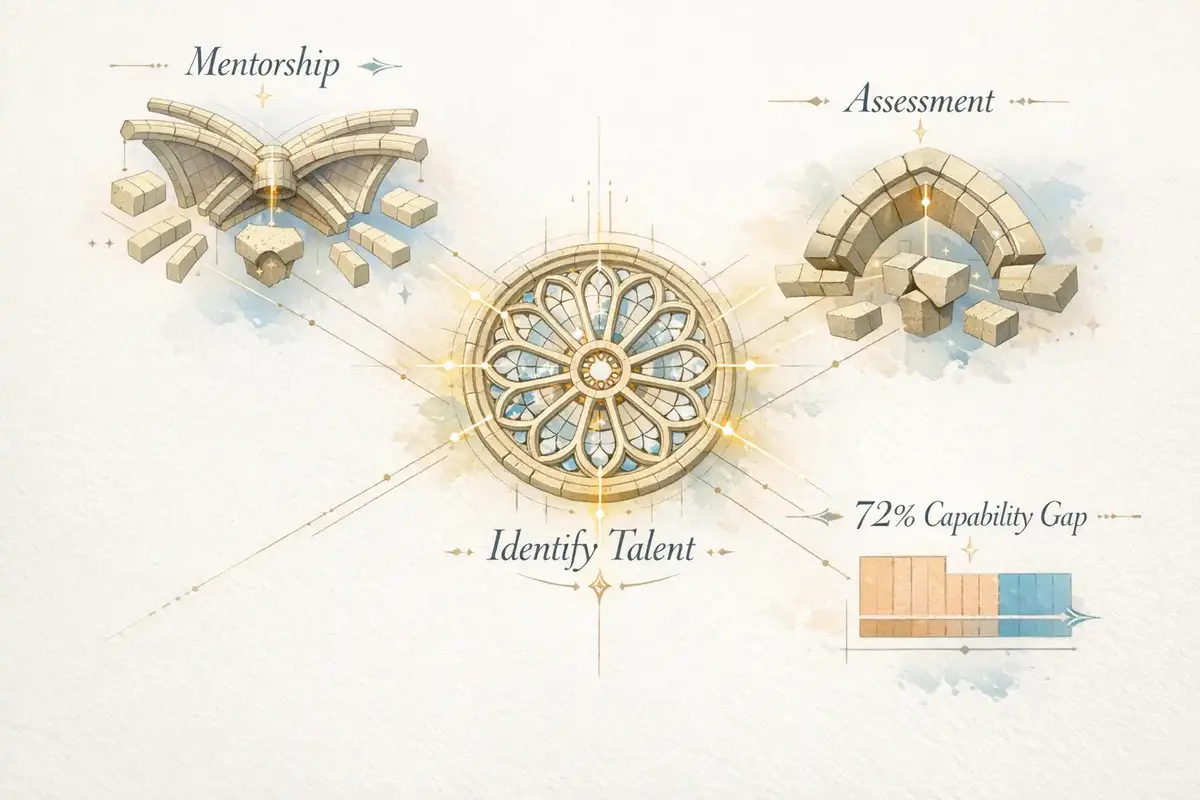
The issue is not whether the person is talented. It is whether their success came from mastery of a known environment or from capabilities that travel into a broader one. A GM should care less about whether someone is the best operator in the room and more about whether they learn fast when the room changes.
That is why labels inside the 9-box so often disappoint. They compress a complex judgment into a neat visual, which feels decisive but often hides weak evidence. If the discussion behind the box is shallow, the box only gives false confidence. Better talent identification starts with observed behavior under stretch, not with a category assigned in a calibration meeting.
What GMs should look for instead
The more useful signals are concrete. Learning agility is one. Does the person improve after first exposure, or do they need repeated cycles in familiar conditions before they perform? Scope fit is another. Can they connect pricing, people, execution, and customer impact without retreating into their home function? Then there is judgment under incomplete information — the real currency of senior leadership.
The top 25% of managers show a 46% greater probability of success, with team engagement 13% higher and financial outcomes 37% higher (Gallup, 2024).
Those numbers matter because they show the cost of getting the call right — and wrong. The gap between a strong manager and an average one is not cosmetic. It compounds through engagement, execution, and results.
So the GM’s task is not to ask, Who is performing best now? It is to ask, Who is becoming reliable at a larger level of complexity? And once bias enters that judgment — familiarity, confidence, similarity — how do you separate real potential from a polished impression?
How do GMs identify high-potential employees without relying on bias?
Only 22% of employees strongly agree their performance is managed in a way that motivates them to do outstanding work (Gallup, 2024). If the day-to-day system for judging contribution is already weak, the cost of guessing at future leadership is predictable: missed revenue, eroded trust, and strong people leaving after watching less-suited colleagues get the nod.
Bias rarely enters succession as open favoritism. It shows up as comfort. The GM trusts the person who communicates like them, handles meetings with confidence, or has been visible in the right moments. That is exactly why bias reduction starts before the talent review — with clearer criteria for what success in the future role will actually require.
Start with the role, not the person
A GM’s first job is translation. Strategy has to become a short list of observable leadership demands.
If the business unit is moving from stable growth to margin pressure, the next leader may need sharper capital judgment, stronger cross-functional trade-off skills, and more resilience with customers under strain. If the unit is entering a new market, the role may demand faster learning, external sensing, and the ability to align teams around incomplete information. Those are not personality traits. They are operating requirements.
In a regional services company during a quarterly review, two directors can look equally strong on paper. One runs a disciplined function and presents crisply. The other has led a messy pricing reset across sales, delivery, and finance, with uneven authority and real resistance. The second profile often looks less polished. It may also be closer to the future job.
That is the point. High potential should mean “fit for larger complexity,” not “impressive in familiar settings.”
Use readiness categories to force cleaner comparisons
Most succession debates become subjective because everyone is arguing from a different definition of promise. Readiness categories solve that by shifting the conversation from vague potential to development stage.
Simple categories work best: emerging, viable in time, ready with support, ready now. The value is not the label itself. The value is the discipline behind it. What evidence places someone in that category? What have they handled? What have they not yet shown?
A GM should insist on evidence from real work: cross-functional decisions, recovery from setbacks, judgment under ambiguity, influence without title, and the ability to absorb broader accountability without creating drag below them. That makes calibration harder in the room — and better for the business.
When only 22% of employees say performance is managed in a motivating way, leaders should assume their raw talent signals are noisy and build more structure into identification decisions (Gallup, 2024).
Calibrate on observed behavior, not executive intuition
This is where many pipelines either mature or collapse. Calibration should not be a meeting where senior leaders defend favorites. It should be a review of observed behavior against future-role criteria.
That means asking sharper questions. What did this person do when the plan broke? Where have they succeeded outside their home function? What changed in the business because of their judgment? Who trusts them when stakes rise?
Without that rigor, “high potential” becomes a status signal. With it, the pipeline becomes more credible — and more fair.
But identification alone does not build readiness. Once a GM sees real future capacity, the harder question arrives: what kind of mentoring actually turns that signal into dependable leadership — and what kind merely flatters it?
What makes mentoring work as a development system, not a nice-to-have?
The readiness contract
The readiness contract is what makes mentoring matter here. Why do so many mentoring relationships feel supportive but fail to change readiness?
Because support is not the same as preparation. A senior leader can give generous advice for a year and still leave the business no closer to a credible successor. Mentoring only starts to work when it is tied to a specific transition: from functional leader to enterprise thinker, from strong operator to P&L owner, from reliable executor to decision-maker under ambiguity.
That is the shift many GMs miss. They treat mentoring as a benefit for promising people rather than as infrastructure for continuity. Research from AIHR points in a practical direction: structured development conversations and manager-led growth plans improve internal mobility and leadership readiness, which is exactly what a succession pipeline needs from mentoring—not inspiration, but movement (AIHR).
A useful mentoring relationship begins with three explicit questions. What role is this person being prepared for? What decisions will that role require? What evidence would show growing readiness? Without those answers, even good mentoring programs drift into career advice.
Stretch work is where judgment gets built
In a mid-market technology company during a team restructure, a VP may mentor a high-performing director for months on stakeholder management and executive presence. Helpful, yes. But the real test comes when that director is asked to lead a messy product-prioritization call across engineering, sales, and finance—with no clean answer and real revenue trade-offs attached.
That is where mentoring becomes developmental. Not in the conversation after the fact, but in the combination of stretch assignment, decision exposure, and disciplined reflection.

Knowledge transfer matters too, but not as a download of war stories. The mentor has to make tacit judgment visible: how they frame trade-offs, what signals they ignore, when they escalate, when they hold. That is how future leaders learn to think, not just how to sound senior.
Mentoring is most effective when it is operationalized through regular feedback, goal setting, and accountability—not left as an informal relationship with vague intent (AI Coach System).
Clear ownership prevents polite stagnation
Strong mentoring has defined ownership on both sides. The mentor opens access, assigns exposure, and gives direct feedback on decision quality. The mentee prepares, applies, and shows what changed in their judgment. Progress should be visible in shorter cycles—quarterly is usually enough—not buried in annual talent reviews.
This is why the best GMs treat mentoring as a managed system, not a side conversation. They connect it to role exposure, operating risk, and observed growth. They also know when to stop calling something mentoring if it produces no new capability.
The harder question comes next: if readiness depends on repeated exposure and disciplined review, how do you build a pipeline that survives when mentors leave, roles shift, and the business keeps moving?
How should a GM build and review a pipeline that survives turnover?
A succession pipeline fails at the exact moment it is treated as complete. That matters because an unexpected departure does not test whether names exist on a slide; it tests whether the business has kept those names current.
Harvard Business Review makes the stakes plain: poorly managed CEO and C-suite transitions have erased close to an estimated $1 trillion in S&P 1500 company market value (Harvard Business Review, 2021). The lesson for a GM is not that every business unit faces public-market scale consequences. It is that transition risk compounds when review discipline is weak.
Build the pipeline into the operating rhythm
In practice, a resilient succession pipeline looks less like an annual workshop and more like a standing management routine. The GM reviews critical roles on a cadence that matches business volatility — often inside quarterly talent discussions, sometimes faster when the unit is restructuring, integrating, or losing key people.
A regional retail business offers a familiar example. During a market shift, a VP leaves with little warning. The GM does not ask HR for the latest org chart and hope for the best. The GM opens a live view of critical roles: who could step in today, who could do it with support, what exposure each successor has already had, and where the unit is thin. That is what continuity looks like under pressure.
The point is simple. Pipeline health is a recurring judgment, not a one-time mapping exercise.
Make successor depth and actions visible
For each critical role, the GM should be able to see three things quickly: likely successors, current readiness, and the next development move. If any one of those is missing, the pipeline is weaker than it appears.
That visibility changes the quality of review. Instead of debating abstract potential, leaders can ask sharper questions: has this director handled cross-functional trade-offs, taken over a customer escalation, or led through a disrupted quarter? If not, what assignment will close the gap before the role opens?
This is also where many common succession planning mistakes show up. Teams document names but not evidence. They record aspiration but not exposure. They mark someone as “ready soon” without defining what has to happen first.
Document enough to guide action — not so much that it freezes judgment
Good documentation is disciplined, not heavy. It should capture readiness, recent evidence, development actions, and the date of last review. That creates continuity when managers move on and prevents the pipeline from resetting every time leadership changes.
But documentation should not pretend the business is static. A successor who looked strong for a stable unit may be a weaker fit after a pricing reset, acquisition, or margin shock. The record needs room for manager judgment and changing context, which is why the best GMs pair written notes with live discussion and revisit both through succession planning mistakes they are actively trying to avoid.
That is the real test: is the pipeline durable when people leave — or only tidy when they stay? And when the system does start working, what does it begin to change in the business over time?
What a healthy succession pipeline changes over time
A weak succession pipeline quietly burns revenue, thins trust, and teaches strong people to leave. If succession is working, what should feel different inside the business unit six months from now?
The business stops treating continuity as an emergency
In a regional finance business during a client escalation, a VP resigns just as renewal conversations tighten. In a weak system, the GM scrambles, peers protect turf, and high performers start reading the situation as a signal: this place does not really know how leadership transitions happen here. The damage is not only operational. It is interpretive. People decide what the company believes by watching who gets trusted when pressure rises.
A healthy succession pipeline changes that. Continuity stops meaning “who can cover the seat on Monday” and starts meaning “who has already been prepared to carry the work, the judgment, and the relationships.” Internal mobility becomes more credible because movement is tied to evidence, not visibility. Development becomes more serious because stretch assignments are no longer favors for a few people; they are part of how the unit protects itself over time.
That is a different management philosophy.
The GM becomes a talent architect
At that point, the general manager is no longer just reviewing names. The GM is designing a system that connects strategy, readiness, and knowledge transfer.
That role is more demanding than most leaders admit. It requires seeing where the business is heading, which capabilities will matter next, and what tacit judgment must be passed on before a role changes hands. The best GMs do not separate operating reviews from talent reviews too cleanly, because the business keeps showing them what future leadership will require. A margin squeeze, a market entry, a customer recovery effort — each one reveals who is learning to think at the next level.
This is why the pipeline itself becomes a source of managerial intelligence. Repeated use improves it.
The system gets smarter each time it is used
The strongest pipelines are not static charts. They are living systems that become more accurate as leaders test readiness, compare outcomes, and revise their assumptions. A person marked as “nearly ready” either grows under broader scope or does not. A stretch role either builds judgment or exposes a gap. Over time, the GM learns which signals travel and which ones flatter.
That is the real shift from replacement planning to managed continuity. You are not maintaining a backup list. You are building a business unit that can keep transferring leadership before loss forces the lesson.
So look at your own unit. When the next critical move happens, will your pipeline reveal accumulated judgment — or just accumulated names?
Key Takeaways
- Most succession plans fail because they are treated as documents, not live operating systems.
- A succession pipeline is a continuity system built around role criticality, readiness, and future-fit capability.
- Performance alone is not enough; GMs should judge learning agility, scope fit, and judgment under ambiguity.
- Mentoring and regular review only help when they are tied to real role transitions and visible evidence of growth.
Frequently Asked Questions
What is a succession pipeline in a business unit?
A succession pipeline is a managed system for identifying and preparing people for critical leadership roles before a vacancy occurs. It focuses on future-fit capability, readiness, and the ability to lead under the business unit’s real operating conditions, not just on replacing a person who leaves.
Why does performance alone not predict future leadership readiness?
Strong current performance shows that someone can succeed in a known role, but it does not prove they can handle broader complexity, ambiguity, or cross-functional trade-offs. Future leadership readiness is better indicated by learning agility, judgment under pressure, and the ability to influence outcomes beyond one function.
How can general managers identify high-potential employees more objectively?
General managers should start with the future role’s requirements and look for observable evidence such as decision quality, scope handling, learning speed, and performance in stretch assignments. Using clear readiness categories and calibrating against real behavior helps reduce bias and avoids confusing familiarity with readiness.
What makes mentoring effective for succession planning?
Mentoring works best when it is tied to a specific leadership transition and includes stretch assignments, feedback, and accountability. The goal is not just advice, but measurable growth in the mentee’s ability to make decisions, handle broader scope, and operate with greater judgment.
How should a GM keep a succession pipeline current and resilient?
A resilient pipeline is reviewed on a regular cadence, with clear visibility into likely successors, their readiness level, and the next development step for each critical role. It should be updated as business conditions change so the organization can respond quickly to turnover, restructuring, or market shifts.