

Why Ethical AI Matters More in Coaching Than in Ordinary Software
45% of U.S. employees now use AI at work at least a few times a year. That changes the decision in front of you: AI in coaching is no longer a pilot question, but a governance question (Gallup, 2025).
Picture a regional healthcare provider in quarterly review season. A director opens a coaching platform to help a newly promoted manager reflect on conflict, confidence, and decision quality—and within minutes the system is not just organizing thoughts, but shaping which thoughts feel valid.
That is the line executives often miss. Ordinary software helps people finish tasks; coaching systems can influence how people interpret themselves.
In the workplace, adoption is already broad enough that this is not a fringe design issue. Gallup found that 37% of employees said their organization has implemented AI technology to improve productivity, efficiency, and quality (Gallup, 2025). Deloitte reports that 94% of respondents indicated GenAI is in development, testing, or use at their organization (Deloitte, 2024). The cost of treating coaching AI like any other enterprise tool is simple: you import productivity logic into a domain where the real stakes are judgment, agency, and human development. This article is about how to design for that difference.
Coaching AI Does More Than Assist
A coaching prompt can redirect attention. A pattern summary can harden into a label. A recommendation can quietly become a norm.
That is why the ethical bar is higher here. When a system supports email drafting or meeting notes, the main question is whether it saves time without creating obvious risk. When it participates in developmental work, it may affect identity, confidence, values, and behavior. The system is no longer adjacent to the person’s growth; it is inside the reflective process itself.
Research on ethical AI leadership development and the practical limits of AI coaching vs human coaching points to the same conclusion: usefulness is not the same as legitimacy. A system can feel insightful while still overreaching.
The Real Standard Is Developmental Restraint
The most useful definition of ethical AI in coaching is not maximum personalization. It is developmental restraint.
That means knowing what the system should not infer from a vulnerable disclosure, what it should not nudge when a user is uncertain, and what it should not optimize when the metric starts competing with the person. In coaching, the failure mode is rarely dramatic at first. It is subtle: premature certainty, false intimacy, overconfident interpretation.
So the central question is not whether AI can coach. It is narrower, and harder: where must it stop—before support becomes steering, and before insight becomes intrusion?
What Does Ethical AI Mean When the Product Is Human Growth?
UNESCO’s Recommendation on the Ethics of Artificial Intelligence gives leaders a useful starting point: if the global baseline for AI ethics is already defined, why do coaching platforms still need a different design logic?
Because that baseline does not do the design work for you. It tells you what must be protected in principle, not how a system should behave when a person is reflecting on conflict, self-doubt, ambition, or identity. In coaching, the product is not output quality. It is human development under conditions of uncertainty.
UNESCO’s framework matters precisely because it is broad. It sets out ten core principles for a human-rights-centered approach to AI and stands as the first global standard adopted across UNESCO’s 194 member states (UNESCO, 2021). But once you translate that into coaching language, the ethical test becomes sharper: does the system protect agency, confidentiality, and psychological safety—or does it quietly trade them away for engagement, prediction, or behavioral compliance?
Ethics in Coaching Is a Design Discipline
A mid-market technology company in a team restructure offers a concrete example. A VP uses an AI coaching platform to help managers process resistance, morale issues, and role ambiguity. The system can easily sound helpful while doing something riskier: turning provisional reflections into fixed narratives about who is “adaptable,” who is “defensive,” and who needs correction.
That is not a compliance failure first. It is a design failure.
An ethical coaching system should make room for uncertainty, avoid overstating interpretation, and protect the boundary between reflection and surveillance. It should be built so users can pause, decline, revise, and withhold. In practice, that means ethics is not a policy layer added after launch. It is the product logic itself.
This is where psychological safety stops being a culture slogan and becomes a systems requirement. If users suspect that vulnerable disclosures may be over-interpreted, retained too broadly, or routed into performance contexts, candor collapses long before any formal breach occurs.
Integral Theory Prevents Reductionism
Integral Theory adds a discipline many AI teams lack: it treats development as multi-perspective rather than single-channel. Inner experience matters. So do observable behaviors, relationships, and the wider system around the person. The AQAL model and core integral theory is useful here because it reminds designers that no single data stream captures growth.
That changes the core question. Not can the model generate a response, but should it respond in this moment—and on what basis?
A person may need challenge. Or silence. A prompt may deepen reflection—or foreclose it. Once responsible AI enters developmental work, the issue is no longer technical adequacy alone. It becomes a trust problem: when the system speaks, does the user experience support, or subtle control?
Why Responsible AI Becomes a Trust Problem in Developmental Interventions
58% of respondents say Responsible AI improves ROI and organizational efficiency. That tells executives something important: responsible AI is no longer a side conversation for legal or ethics teams; it is being treated as operating discipline (PwC, 2025).
That shift sounds reassuring. If responsible AI is already producing business value, many leaders assume the trust question is largely solved.
The evidence says otherwise. PwC also found that 61% of organizations are now at either the strategic or embedded stage of Responsible AI maturity (PwC, 2025). Mature, in other words, does not mean trustworthy in every context. It can mean the organization has policies, review processes, and governance language—while still deploying systems that feel opaque when a user is reflecting on conflict, failure, or self-doubt.
That distinction matters most in developmental interventions. A finance enterprise may have a solid model-risk framework and still mishandle an AI coaching interaction during year-end review season, when a director uses the platform to help high-potential managers process burnout, ambition, and strained peer relationships. The system may be compliant. It may even be well-documented. But if it summarizes emotional disclosures with unwarranted certainty, or nudges the user toward a narrow definition of “effective leadership,” trust erodes fast.
Enterprise Maturity Is Not Developmental Sensitivity
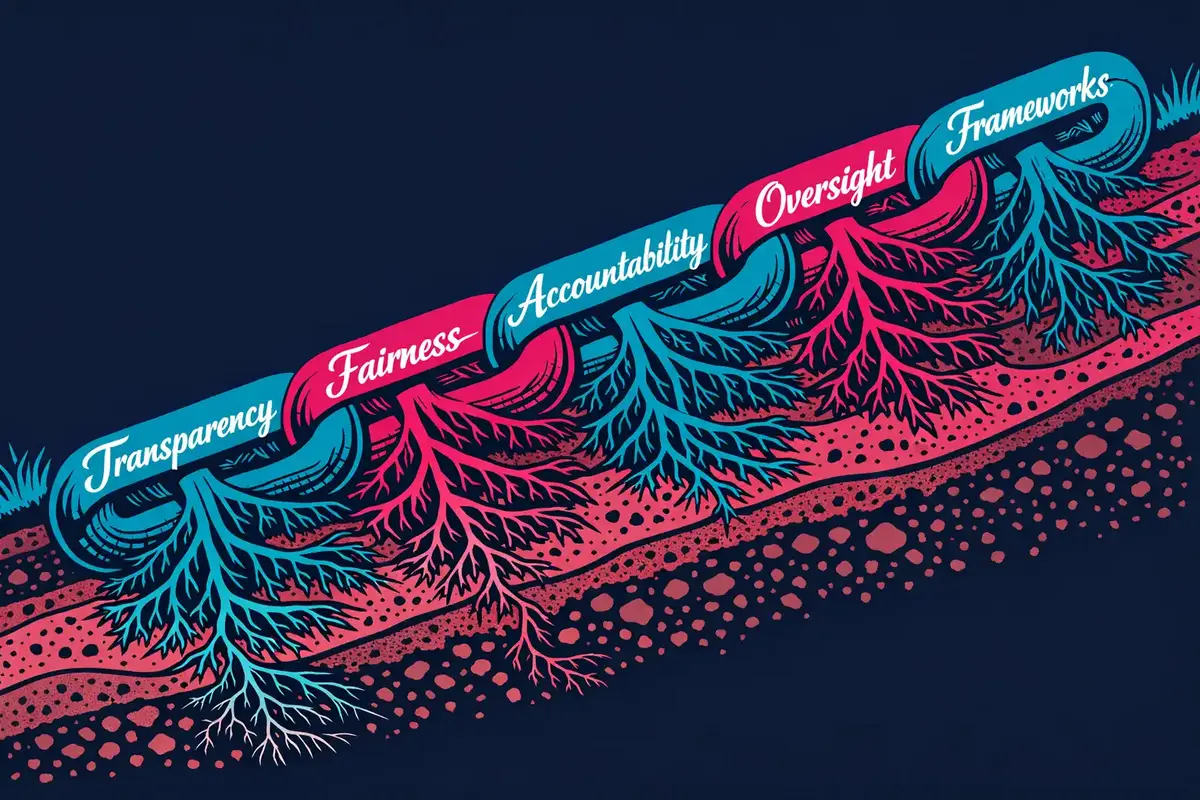
This is the gap many teams miss. Responsible AI in enterprise settings often centers on fairness, security, explainability, and oversight. Necessary, yes. Sufficient for coaching, no.
Coaching asks a different question: what does the system feel like from the inside of a vulnerable moment? A platform can satisfy governance requirements and still create the impression that the machine “knows” the person better than it does. That is where trust breaks—not because the model failed technically, but because it crossed a human boundary it was never entitled to cross.
This is why ethical decision-making and responsible governance has to extend beyond controls into interaction design. It is also why ethical AI leadership development cannot be reduced to safer prompts or cleaner audit trails.
The Real Test Happens Under Emotional Load
In coaching AI, the core issue is not deployment. It is trustworthiness under pressure.
The business case for Responsible AI is now clear, but the coaching case is harder: value at scale does not guarantee legitimacy in moments of uncertainty (PwC, 2025).
When a user is calm, the system can seem helpful. When the user is ashamed, defensive, or stuck, every design choice becomes ethical: what is inferred, what is remembered, what is suggested, and what is left unsaid.
So the real question is no longer whether your organization has responsible AI. It is sharper than that. When autonomy, consent, and privacy come under strain—does the system protect the person, or the platform?
Where Do Autonomy, Consent, and Privacy Break Down in AI Coaching?
AI coaching fails ethically long before a breach report is filed. It fails when trust thins, candor drops, and good people stop using the system—or leave the company convinced that “development” was a pretext for extraction.
Consider a mid-market manufacturing firm during a client escalation. A plant director opens the coaching platform late at night and answers a reflective prompt about frustration, self-doubt, and conflict with a peer. The system responds smoothly. It offers a pattern summary, suggests a next step, and stores the exchange. Nothing looks dramatic on screen. But this is exactly where the boundary can break: the user disclosed in a coaching frame, while the platform may be operating with product, analytics, or managerial interests in the background.
Consent Is Not a Startup Screen
In coaching, consent is not a one-time agreement buried in onboarding. It is ongoing permission for a system to participate in moments that change in sensitivity from one prompt to the next.
A user may be comfortable getting help with meeting preparation and completely unwilling to have the same system infer emotional patterns from a journal entry. Those are not equivalent acts. Treating them as if they were is how platforms drift from support into overreach. The practical standard is simple: ask again when the context changes, make the choice specific, and make refusal easy.
That is not just good manners. It is risk control. Deloitte found that cognitive technologies were seen as posing the most severe ethical risks among emerging technologies (Deloitte, 2024). In coaching, that risk shows up less as spectacle and more as quiet misalignment—the system keeps going after the user would have said stop, if asked clearly.
Consider a scenario where a user, initially consenting to AI support for scheduling, is later prompted for deep personal reflections. If the platform assumes blanket consent, it risks violating boundaries and eroding trust. Instead, granular consent—prompted at moments of increased sensitivity—empowers users to decide, in real time, how much of themselves they wish to share.
Privacy Has to Be Legible
Privacy-by-design in developmental systems means collecting less, retaining less, and repurposing less. It also means the user can tell, without legal interpretation, where their reflections go and where they do not.
If a platform keeps sensitive disclosures for model improvement, manager dashboards, or cross-context personalization, the burden is on the product to make those boundaries explicit. Vague assurances are not enough. Users need to know what is private, what is reviewable, and what is excluded from organizational visibility. That is a precondition for psychological safety, not a feature add-on.
The same applies to systems built around AI personalized learning journeys. Personalization becomes ethically unstable when the user cannot see which parts of themselves are being turned into training logic.
For example, if a coaching platform uses anonymized journal entries to improve its algorithms, but fails to communicate this clearly, users may feel betrayed if they later discover their private reflections were used for purposes beyond their immediate development. Legible privacy means dashboards or notifications that transparently show data flows, retention periods, and sharing policies—enabling users to make informed choices.
Autonomy Lives in Friction
Autonomy is preserved through deliberate friction: reject this suggestion, pause memory, skip this line of inquiry, show me why you asked, tell me what you cannot know.
Those controls matter because coaching systems are persuasive by design. A fluent prompt can feel earned when it is only probable. A confident summary can sound intimate when it is only patterned. The ethical question is sharp: when a user is vulnerable, does the system create room to think—or pressure to comply?
That pressure gets stronger under emotional load. And when the user is not just reflective but distressed, uncertain, or ashamed, restraint is no longer enough. What should the system do then—stay engaged, or step back?
Practical autonomy requires more than opt-out buttons. It means surfacing system limitations, explaining the reasoning behind suggestions, and allowing users to slow down or redirect the process. For instance, a “pause and review” function lets users halt data processing and inspect what the AI has inferred so far. This not only builds trust but also reinforces the user’s sense of agency—critical for genuine developmental work.
In sum, ethical AI coaching is not defined by the absence of breaches, but by the presence of clear, actionable safeguards for consent, privacy, and autonomy at every step.
How Should AI Behave When a User Is Vulnerable, Stuck, or Emotionally Activated?
94% of organizations already have GenAI in development, testing, or use. That means the real design question is no longer adoption; it is how to stop a system from sounding authoritative precisely when authority is the wrong move (Deloitte, 2024).
A regional services firm is in the middle of a client escalation. A team lead opens the coaching platform after a difficult call, types that she feels trapped, angry, and unsure whether she is the problem or the pattern around her.
This is where weak systems become dangerous. Not because they say something offensive, but because they say something plausible too quickly.
Deloitte reports that 54% said cognitive technologies posed the most severe ethical risks among emerging technologies (Deloitte, 2024). In coaching, that risk shows up when the model interprets distress as a pattern, values conflict as a bias, or emotional activation as a prompt to keep probing. The system may sound calm. It may even sound wise. That is exactly the problem.
Deference Is a Product Behavior
Human oversight should not mean a compliance statement in the footer. It should mean the system knows when to defer.
When a user is emotionally activated, the platform should shift from interpretation to containment: shorter responses, more clarification, less inference. If the issue involves grief, identity, moral conflict, possible harm, or a high-stakes decision, the right move is often to slow down and route toward human judgment—not generate one more elegant paragraph. This is the practical boundary highlighted in any serious comparison of AI coaching vs human coaching: fluency is not competence.
The Best Systems Refuse Well
A coaching platform should be designed to recognize when it is outside its competence. That means explicit escalation logic: “I may not be the right support for this,” “This sounds high stakes,” “Would you like to pause and speak with a qualified person?” Refusal, in this context, is not failure. It is ethical performance.
The same is true when users are simply stuck. Good human coaches use silence, timing, and judgment—skills that sit at the center of advanced coaching skills for leaders. AI should not imitate that depth where it does not possess it. It should clarify, narrow, and hand off.
The safest systems are rarely the most talkative. They pause, ask less, and sometimes stop. Which raises the build question most teams avoid: what are the first design moves that make that restraint real—before scale makes overreach automatic?
What Are the First Ethical Design Moves for Teams Building Coaching AI?
Boundary-first design is where ethical coaching AI starts. If the principles are already clear, why do so many teams still build systems that overreach in practice?
Because most teams begin with capability. They ask what the model can generate, classify, or personalize. They ask too late what it should refuse, what it cannot know, and when it must step aside.
That sequence is backwards. UNESCO’s human-rights-centered framework is useful precisely because it forces a harder translation task: principles only matter once they become product constraints (UNESCO, 2021).
First move: define the system’s competence boundary
A coaching platform needs an explicit scope of competence before it needs better prompts. Write down three things: what the system is for, what it is not for, and the conditions that trigger deferral to a human.
In a retail startup during a funding slowdown, a founder may use the platform to reflect on team tension and decision fatigue. Safe use: helping structure reflection, surface options, and clarify tradeoffs. Unsafe use: inferring mental state, diagnosing motives, or pushing the user toward a “best” leadership style because similar users responded well. The line is not technical. It is ethical.
This is where many teams confuse maturity with readiness.
61% of respondents say their organizations are at the strategic or embedded stage of Responsible AI — but that does not tell you whether a coaching product knows when to stop (PwC, 2025).
Second move: turn values into product rules
Transparency, consent, data minimization, and human accountability should show up as interface behavior, not policy language.
Transparency means the system explains why it asked a question and what it will do with the answer. Consent means a user can approve one kind of support without opening the door to broader inference. Data minimization means reflective content is not retained by default just because storage is cheap. Human accountability means there is a named owner for escalation logic, review thresholds, and failure handling — not just a general commitment to ethical decision-making and responsible governance.
The same discipline should shape ethical AI leadership development: if a team cannot explain a design choice in plain language, it probably should not automate it.
Third move: test with a safe-versus-unsafe lens
Before launch, run use cases through a simple screen: does this feature support reflection, or does it steer behavior? Does it widen judgment, or narrow it? Does it leave the user more agentic — or more compliant?
That is the practical bridge from ethics to build. And it leads to the uncomfortable question most product teams postpone: if optimization makes the system more persuasive, more sticky, and more effective on paper, should you still do it?
Why the Best Ethical AI Systems Know When Not to Optimize
Bad coaching AI does not just create product risk. It burns trust, drives good people out of the process, and can turn a development investment into a quiet source of reputational damage.
That is why the strongest systems are defined as much by what they refuse to do as by what they can do. What if the highest form of ethical AI is not better prediction, but better restraint?
Restraint Is a Capability
Picture a regional healthcare leader in annual planning. A VP uses the platform to help senior managers reflect on burnout, role strain, and succession pressure. The product team may be tempted to optimize for more engagement, deeper disclosure, and sharper personalization. On paper, that looks like progress.
In practice, it can become extraction.
A coaching system earns credibility when it knows that not every pause is friction, not every ambiguity is a signal, and not every disclosure should become a model input. The point is not to make the machine more intimate. It is to make the experience more trustworthy.
This is where ethical maturity starts to look different from ordinary product maturity. In most software, optimization is assumed to be good until proven harmful. In coaching, the burden should run the other way. If a feature increases persuasion, memory, or behavioral steering, teams should have to show why that added power serves the user’s development rather than the platform’s goals.
Integral Design Respects What the Model Cannot Know
Integral design is useful here because it resists reduction. Human development is not one data stream, one stage label, or one behavioral pattern. It includes inner experience, observable action, relationships, and context — the broader view captured in the AQAL model and core integral theory.
That matters because machine interpretation is always partial. A system may detect language patterns. It cannot fully grasp meaning, history, or moral weight. UNESCO’s global AI ethics standard is valuable precisely because it anchors design in human rights and dignity rather than technical ambition (UNESCO, 2021).
So the real mark of a serious platform is not that it sounds wise. It is that it leaves room for human judgment.
The Standard Is Human Complexity
The best coaching AI supports reflection without collapsing complexity. It preserves dignity by avoiding false certainty. It protects autonomy by declining to over-direct. It strengthens development by making space for a person — and, when needed, a human coach or leader — to do the meaning-making.
That is the deeper promise behind ethical AI leadership development. Not smarter influence. Better boundaries.
If this system became more effective tomorrow, would it also become more respectful — or just more convincing? That is the question worth taking back to your next product review.
Key Takeaways
- Coaching AI affects identity, confidence, values, and behavior, so it needs a higher ethical bar than ordinary software.
- Ethical AI in coaching means developmental restraint: knowing what to infer, what to avoid, and when to stop.
- Consent, privacy, and autonomy must be ongoing, legible, and built into the product experience.
- The best systems defer well, refuse well, and leave room for human judgment.
Frequently Asked Questions
What are ethical AI design principles for coaching platforms?
Ethical AI design for coaching platforms means building systems that support reflection without manipulating, over-interpreting, or surveilling the user. The core principles are developmental restraint, transparency, consent, privacy, autonomy, and human accountability.
Why does AI in coaching require a higher ethical standard than ordinary software?
Coaching AI can influence identity, confidence, values, and behavior, not just task completion. Because it participates in human development, it must be designed to avoid false certainty, intrusive inference, and subtle steering.
What does developmental restraint mean in AI coaching?
Developmental restraint means the system knows what not to infer, what not to optimize, and when to stop. Instead of pushing for more disclosure or stronger personalization, it preserves space for the user’s own judgment and reflection.
How should consent and privacy work in an AI coaching platform?
Consent should be ongoing and specific, not a one-time agreement hidden in onboarding. Privacy should be legible through clear data-use boundaries, minimal retention, and explicit explanations of what is collected, stored, shared, or used for improvement.
When should an AI coaching system defer to a human?
An AI coaching system should defer when the user is distressed, the issue is high stakes, or the model cannot reliably understand the context. In those moments, the safest behavior is to slow down, reduce inference, and route the person toward qualified human support.