

AI-powered multi-dimensional integral analysis is an approach that uses artificial intelligence to simultaneously process quantitative metrics, qualitative narratives, and behavioral patterns—providing a holistic view of organizational health that no single data source can deliver alone. PwC estimates that AI could contribute up to $15.7 trillion to the global economy by 2030, with organizational intelligence and leadership development emerging as high-impact application areas. By integrating Ken Wilber’s AQAL framework with machine learning, organizations gain the capacity to see patterns across all four quadrants of experience. According to DDI World research, only 14% of CEOs believe they have the leadership talent needed to drive growth—making structured leadership development a strategic imperative, not a luxury.
Integrating AI for multi-dimensional analysis across the Integral Four Quadrants means using artificial intelligence to collect, correlate, and interpret data from subjective (I), objective (It), intersubjective (We), and interobjective (Its) perspectives. This approach is for professionals and organizations seeking holistic insights that go beyond surface-level metrics. By the end of this article, you’ll understand how AI can be mapped to each quadrant of the AQAL model, what challenges and opportunities this integration presents, and how to move from fragmented data toward truly comprehensive understanding. Deloitte research shows that organizations with strong coaching cultures report 21% higher profitability, demonstrating the direct business impact of investing in people development.
What Is the Integral Four Quadrants (AQAL) Model and Why Does It Matter?
The AQAL model—short for “All Quadrants, All Levels”—is a comprehensive framework developed by Ken Wilber to map any phenomenon across four fundamental perspectives: the individual-interior (“I”), individual-exterior (“It”), collective-interior (“We”), and collective-exterior (“Its”). Each quadrant represents a different dimension of reality:
- Upper-Left (I): Subjective, interior experience—thoughts, feelings, intentions
- Upper-Right (It): Objective, exterior behaviors—actions, physiology, observable data
- Lower-Left (We): Intersubjective, shared meaning—culture, values, group norms
- Lower-Right (Its): Interobjective, systems—structures, processes, environments
This model is widely used in leadership, coaching, and organizational development because it surfaces blind spots that single-perspective approaches miss. For example, a drop in team performance might be explained by individual burnout (I), workflow inefficiencies (It), toxic culture (We), or broken incentives (Its)—and often, it’s a combination.
The AQAL (All Quadrants, All Levels) model maps phenomena across four interconnected quadrants—individual-interior, individual-exterior, collective-interior, and collective-exterior—while incorporating developmental levels, lines, states, and types for holistic understanding (Scrum.org).
If you’re new to the AQAL model or want a deeper dive, you’ll find foundational theory and practical context in the Integral theory and AI foundations for human development resource.
Why Is AI Integration Across All Quadrants So Challenging?
Most organizations today use AI for what it does best: crunching numbers, identifying patterns, and automating repetitive tasks. These strengths shine in the objective (It) and interobjective (Its) quadrants—think of AI analyzing sales data or optimizing supply chains. But what about the subjective (I) and intersubjective (We) realms, where meaning, motivation, and culture live?
Here’s the thing: Most teams assume AI is inherently objective and can be trusted to deliver “the truth.” But research consistently shows that AI lacks the interpretive intelligence to synthesize AQAL’s subjective, objective, intersubjective, and interobjective dimensions without human oversight (QDAS). This means that, left unchecked, AI can reinforce “quadrant bias”—overemphasizing what’s easy to measure (like behaviors or system metrics) and undervaluing what’s hard (like personal meaning or shared values).
The implication? If we want AI to support real organizational transformation, we need to design our data strategies and workflows to intentionally balance all four quadrants. Otherwise, we risk missing the very insights that drive sustainable change.
For a foundational look at how quadrant bias can distort analysis and how the AQAL model helps clarify these blind spots, see the AQAL model core integral theory resource.
How Can AI Collect and Interpret Data from Each Quadrant?
Let’s break down how AI can be mapped to each quadrant, what kinds of data are relevant, and what methods are emerging.
Upper-Left (I): Subjective Experience
- Data Types: Self-reports, journal entries, open-ended survey responses, voice notes, emotional check-ins
- AI Methods: Sentiment analysis, natural language processing (NLP), topic modeling, emotion recognition
- Example: An AI tool scans employee reflections to identify emerging themes of burnout or inspiration, offering leaders a window into the lived experience of their teams.
The challenge here is that subjective data is nuanced and context-dependent. AI can surface patterns, but human interpretation is needed to make meaning of them. For a deeper exploration of how AI can support qualitative and subjective analysis, see AI qualitative peak experiences.
Upper-Right (It): Objective Behavior
- Data Types: Attendance records, performance metrics, physiological data (e.g., wearables), task completion rates
- AI Methods: Predictive analytics, anomaly detection, behavioral modeling
- Example: AI tracks productivity patterns and flags deviations that may signal disengagement or workflow bottlenecks.
This is where AI excels—turning raw data into actionable insights. But without connecting these findings to the other quadrants, we risk treating people as data points rather than whole humans.
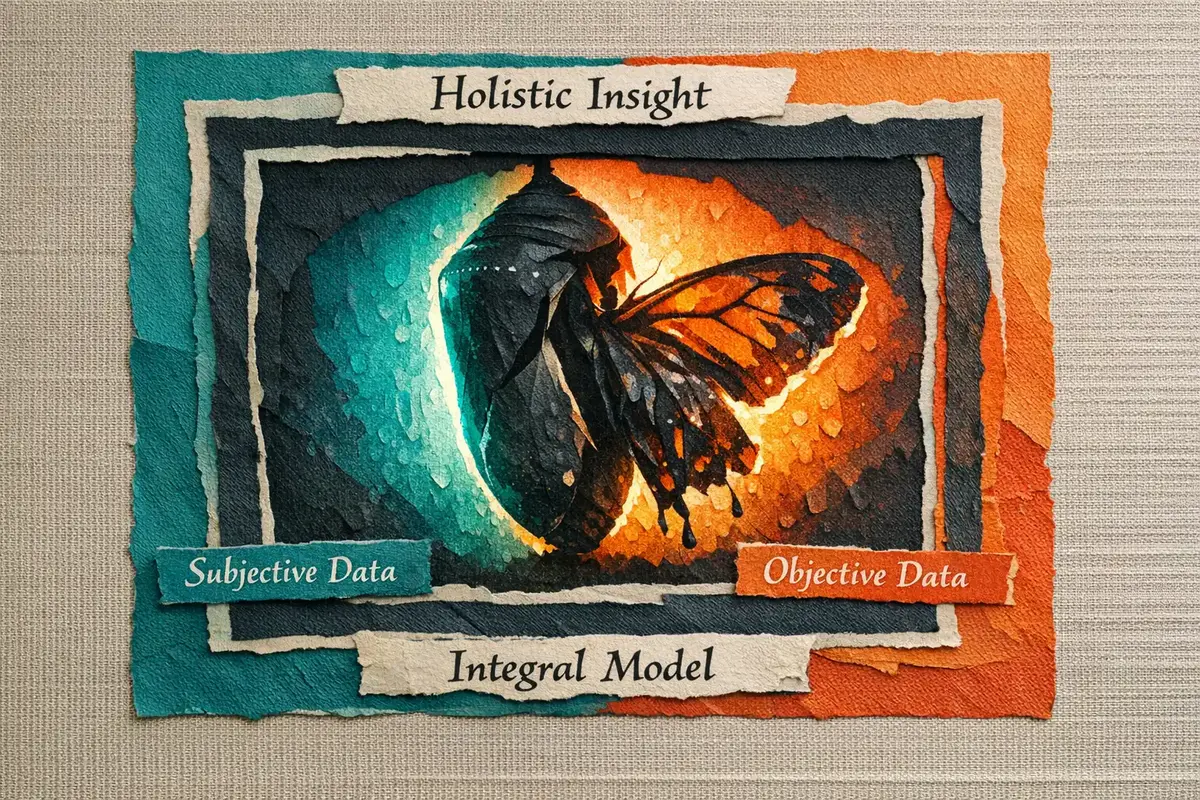
Lower-Left (We): Intersubjective Culture
- Data Types: Team meeting transcripts, chat logs, shared stories, cultural assessments
- AI Methods: Discourse analysis, social network analysis, cultural mapping
- Example: AI analyzes patterns in team conversations to surface implicit norms, shared values, or sources of misunderstanding.
Most teams assume culture is too “soft” for AI to analyze. But recent advances in NLP and social analytics are making it possible to map the invisible threads of group meaning, provided we use these tools with sensitivity and context.
Lower-Right (Its): Interobjective Systems
- Data Types: Organizational charts, process maps, workflow diagrams, policy documents
- AI Methods: Systems modeling, process mining, network analysis
- Example: AI identifies inefficiencies in cross-departmental workflows, suggesting structural changes to improve collaboration.
Here, AI can reveal the hidden architecture of organizations—how systems, processes, and structures shape outcomes. But again, these insights are only part of the story.
What Does a Multi-Quadrant AI Workflow Look Like in Practice?
Let’s imagine a practical workflow for integrating AI across all four quadrants, drawing on TII’s two-decade integral methodology:
- Define the Inquiry: What’s the core question or challenge? (e.g., Why is team engagement declining?)
- Map Data Sources: Identify which data streams correspond to each quadrant.
- Collect Data: Use surveys, sensors, transcripts, and system logs as appropriate.
- Apply AI Methods: Match the right AI tool to each data type (sentiment analysis for “I”, predictive analytics for “It”, etc.).
- Synthesize Insights: Correlate findings across quadrants—look for patterns, contradictions, and reinforcing dynamics.
- Interpret Holistically: Bring together human judgment and AI outputs to generate actionable understanding.
- Design Interventions: Develop strategies that address all four quadrants, not just the easiest to measure.
In a systematic review, AI systems in education were found to distribute across four quadrants of the Human-Centered AI (HCAI) framework, but required human intervention for interpretability and holistic insight (ScienceDirect, 2024).
For leaders interested in how these workflows support real-world leadership development, the leadership development and AI integration resource provides practical examples.
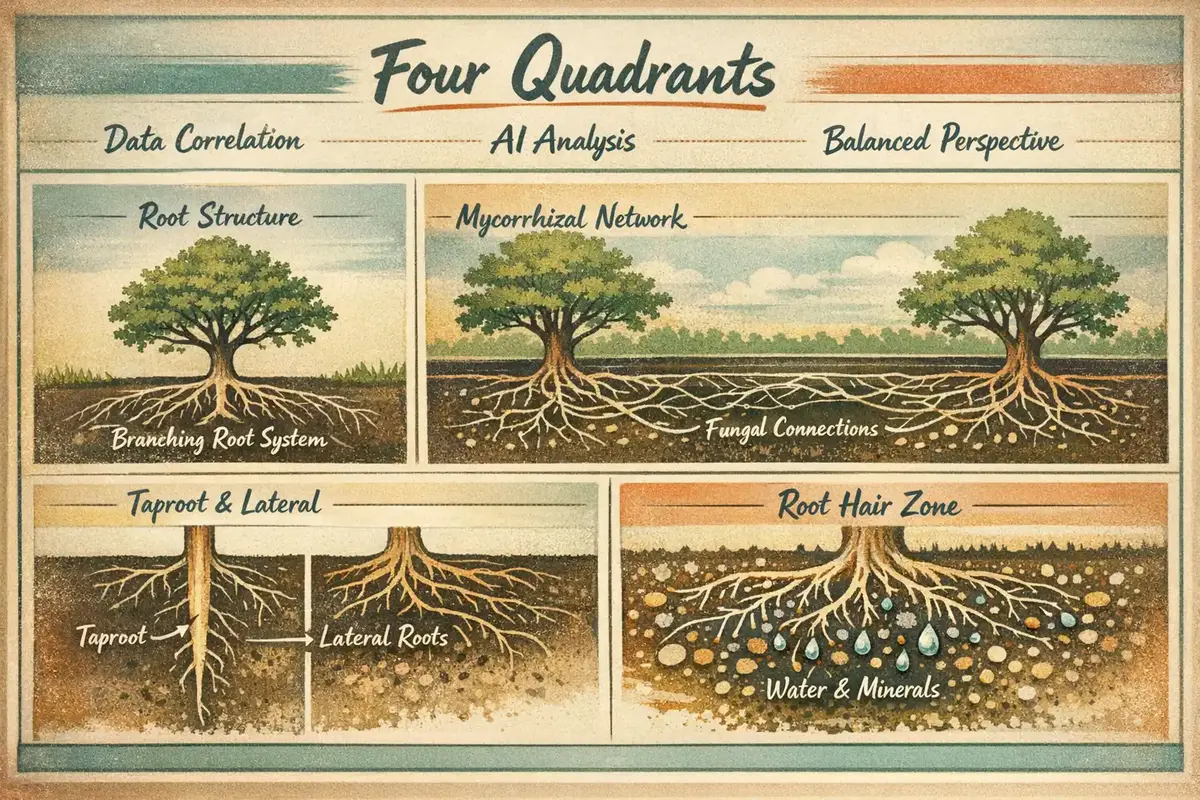
How Can We Avoid Quadrant Bias and Ensure Holistic Insight?
Most organizations, even those with advanced analytics, unconsciously gravitate toward the data that’s easiest to collect—usually from the objective and interobjective quadrants. This is known as quadrant bias: the tendency to overemphasize what’s visible and quantifiable, while neglecting the subjective and cultural dimensions that drive real change.
But research shows that when AI analysis is unbalanced, the resulting insights are incomplete and can even be misleading (QDAS). For example, a dashboard may show rising productivity (It), but if employees feel disconnected (I) and the culture is eroding (We), the apparent gains may be unsustainable.
To mitigate quadrant bias, practitioners can use a simple checklist:
- Are all four quadrants represented in the data collection plan?
- Is there a balance between quantitative and qualitative data?
- Are AI outputs interpreted in light of human context and meaning?
- Are interventions designed to address interior and exterior, individual and collective dimensions?
For more on how to recognize and address quadrant bias, the AQAL model core integral theory resource is invaluable.
What Are the Limitations of AI in Multi-Dimensional Analysis?
Despite its power, AI has clear limitations when it comes to holistic, multi-perspective frameworks like AQAL. Here are a few to keep in mind:
- Interpretive Intelligence: AI can process vast amounts of data but lacks the lived experience and contextual awareness needed to make sense of subjective and cultural nuances.
- Data Quality: Subjective and intersubjective data are often messy, ambiguous, and hard to standardize—making them challenging for AI to analyze without bias.
- Ethical Considerations: Privacy, consent, and transparency become especially important when collecting sensitive interior data.
- Over-Reliance: There’s a temptation to let AI “decide” rather than using it as a tool for human insight and action.
AI lacks the interpretive intelligence to synthesize AQAL’s subjective (upper-left), objective (upper-right), intersubjective (lower-left), and interobjective (lower-right) dimensions, requiring human oversight to balance quadrants and avoid bias in multi-dimensional synthesis (QDAS).
This is why the most effective organizations use AI as a partner—augmenting, not replacing, human wisdom.

How Can AI Support Developmental Growth, Not Just Static Analysis?
Most analytics tools offer a snapshot—a moment in time. But the AQAL model is inherently developmental, tracking growth and transformation across levels, lines, states, and types. So, how can AI help us see not just where we are, but how we’re evolving?
By designing longitudinal data streams and using AI to track changes over time, organizations can:
- Map individual growth (e.g., emotional intelligence, resilience)
- Track team development (e.g., trust, collaboration)
- Monitor cultural shifts (e.g., values alignment, psychological safety)
- Assess system maturity (e.g., process optimization, adaptability)
Industry evidence suggests that when AI is used to support developmental analytics, organizations gain a dynamic, real-time view of progress and pitfalls—enabling more responsive, adaptive leadership.
For leaders interested in how AI-augmented workforces can support this kind of growth, organizational leadership and AI-augmented workforces offers practical frameworks.
What Does Human-AI Collaboration Look Like in Integral Practice?
It’s easy to fall into the trap of thinking AI will “solve” complexity for us. But the reality is more nuanced. The most effective approach is a partnership: AI brings speed, scale, and pattern recognition; humans bring empathy, context, and meaning-making.
In hybrid teams, for example, AI might surface patterns of disengagement, but it’s up to team leaders to interpret these signals, facilitate open dialogue, and design interventions that honor both data and lived experience. This kind of collaboration is explored in depth in spinning success in hybrid teams.
Drawing on the Integral Model’s multi-level framework, organizations that intentionally design for human-AI collaboration are better equipped to navigate uncertainty, foster innovation, and build cultures of trust.
FAQ: Integrating AI for Multi-Dimensional Analysis Across Integral Four Quadrants
What are the four quadrants of the AQAL model?
The four quadrants are: Upper-Left (I) for subjective, individual experience; Upper-Right (It) for objective, individual behavior; Lower-Left (We) for shared culture and meaning; and Lower-Right (Its) for systems and structures. Together, they provide a holistic map for understanding complex human and organizational phenomena.
How does AI collect data from subjective and intersubjective quadrants?
AI collects subjective data using tools like sentiment analysis and natural language processing on self-reports or open-ended responses. For intersubjective data, AI analyzes group conversations, meeting transcripts, and cultural assessments to identify shared values or norms. However, human interpretation remains essential for context and meaning.
Can AI really understand emotions and culture?
AI can identify patterns in language or behavior that suggest emotional states or cultural norms, but it doesn’t “understand” them in the human sense. It can surface signals, but the richness of emotion and culture requires human sense-making and contextual awareness to interpret accurately.
What is quadrant bias and why does it matter?
Quadrant bias is the tendency to focus on data from just one or two quadrants—usually the objective ones—while neglecting subjective or cultural perspectives. This leads to incomplete or misleading insights. Balanced analysis across all quadrants is essential for holistic understanding and effective action.
Are there risks in using AI for multi-dimensional analysis?
Yes. Risks include over-reliance on AI outputs, misinterpretation of subjective data, privacy concerns, and ethical issues around consent. The key is to use AI as an augmentation tool, not a replacement for human judgment, and to maintain transparency and ethical standards throughout the process.
How can organizations start integrating AI with the AQAL model?
Begin by mapping your key questions or challenges to the four quadrants, identifying relevant data sources, and selecting appropriate AI tools for each. Ensure that human interpretation and ethical considerations are built into your workflow. Start small, iterate, and expand as your team gains confidence.
What’s the future of AI in holistic organizational development?
The future lies in deeper integration of AI and human wisdom—using AI to surface patterns and possibilities, while relying on human insight for context, empathy, and ethical decision-making. As AI tools become more sophisticated, the need for intentional, multi-quadrant frameworks like AQAL will only grow.
By integrating AI with the Integral Four Quadrants, organizations and leaders move beyond fragmented data toward a genuinely holistic understanding of people, teams, and systems. The journey isn’t about replacing human insight—it’s about amplifying it, using technology to reveal connections and possibilities that would otherwise remain hidden. When we bring together the best of AI and the wisdom of integral frameworks, we unlock new levels of clarity, alignment, and transformative potential.


