

Picture this: You’re at a quarterly review, spreadsheet glowing with red and green cells, P&L scoreboard under the spotlight. As you confidently explain a recent margin win, someone from the board leans in, brow furrowed: “Great quarter, but what’s our bet on next year’s growth? Have we really done enough to build the future?”
It’s a familiar crossroad for general managers. In fast-moving markets, the tension between short-term profits and long-term investments isn’t a sign of mismanagement—it’s the very heart of modern business leadership. Yet while this balancing act sits at the center of a GM’s day-to-day reality, most guidance is either intensely theoretical or so tactical you can’t see the forest for the trees.
“Failing to reconcile profit pressures and future investments isn’t just a technical error—it’s the number one reason high-performing business units lose their edge.”
— (Source: FP&A Trends, 2024)
So how do leading GMs transform this tension into a superpower? What separates those organizations that run out of steam for lack of investment from those quietly compounding value beneath the surface?
Let’s break through the noise, bust a few myths, and equip you with the advanced playbook for mastering both the numbers and the narrative.
Foundational Concepts: Why Profit and Progress Often Clash
To go further, let’s first anchor definitions:
- Short-Term P&L means your immediate profit and loss statement: the real-time pulse of costs, revenues, and margins.
- Long-Term Strategic Investments cover funding for R&D, talent pipelines, digital infrastructure, new market entry, and leadership development—the building blocks of future growth.
- The Balancing Act is the recurring dilemma: How much resource do you allocate to today’s targets versus planting seeds for tomorrow?
Why does this dual focus matter so profoundly? Because optimizing for short-term results often competes directly with funding aspirational, long-term bets. When margin pressures spike, it’s tempting to defer or cut initiatives whose payoff seems distant. Yet research reveals that companies sacrificing strategic investment for quick wins see diminishing returns, lost talent, and—eventually—eroding value (Source: FP&A Trends, 2024).
“Organizations that maintained innovation spending during downturns emerged 10%–30% ahead of laggards after recovery.”
(Source: Harvard Business Review, 2022)
The Interdependence Principle
Here’s the first ‘aha moment’: Short-term profits and long-term investments aren’t rivals—they’re two sides of the same value coin. Today’s profit funds tomorrow’s possibilities. Today’s investments shape tomorrow’s profits.
Take R&D cuts, for instance. They often deliver an immediate boost on the P&L, but this “success” is an illusion. Six to twelve months later, as the innovation pipeline dries up or competitors leap ahead, the consequences land hard.
The Myth of “Either-Or” Binary
A common misconception: Either you hit profit now or you invest for later. In reality, world-class GMs use frameworks that force both mindsets to co-exist—allocating, measuring, and communicating carefully to mitigate risk and maximize compounded returns.
For those seeking to explore how these priorities can be managed side by side, Balancing Short-Term P&L and Long-Term Strategic Investments offers additional depth on creating equilibrium between immediate returns and sustainable growth.
Standing on the Edges: Risks, Biases, and Real-World Pitfalls
Let’s get practical: What can go wrong, even with the best intentions?
The Cost of Delay: An Unseen Drag
One of the most underestimated risks is the “cost of delay”—the opportunity lost when a strategic investment is postponed, not canceled:
- Deferring a market expansion may let competitors lock in key accounts.
- Delaying talent upgrades allows culture to stagnate, undermining agility.
- Pausing digitization or infrastructure upgrades means higher catch-up costs and potential security exposures.
Advanced financial leadership isn’t just about cost; it’s about rigorously modeling these delays and their downstream impacts. A powerful technique is the “Present Value of Vision” model: Convert future project value into present terms, then weigh that against the erosion caused by deferral. This isn’t theory—you’re putting a visible price tag on “wait and see.”
Incentive Alignment Gone Wrong
Many general managers discover too late that misaligned KPIs and incentives drive short-termism at every level. Teams rewarded for quarterly metrics may unconsciously under-resource strategic bets or resist projects whose payoff won’t show up in the next review cycle.
- This misalignment is especially acute in matrixed organizations.
- For family businesses or legacy firms, the dynamic intensifies if personal KPIs conflict with generational strategy or long-horizon family vision.
For an in-depth look at aligning incentives, particularly for non-family executives tasked with stewardship, Engaging Non-Family C-Suite in Family Business dives into aligning metrics and motivation when balancing stewardship with immediate results.

Frameworks for the Modern GM: From Gut Feel to Executive Playbook
Now, let’s pivot from theory to actionable models.
The “Organization as a Portfolio” Approach
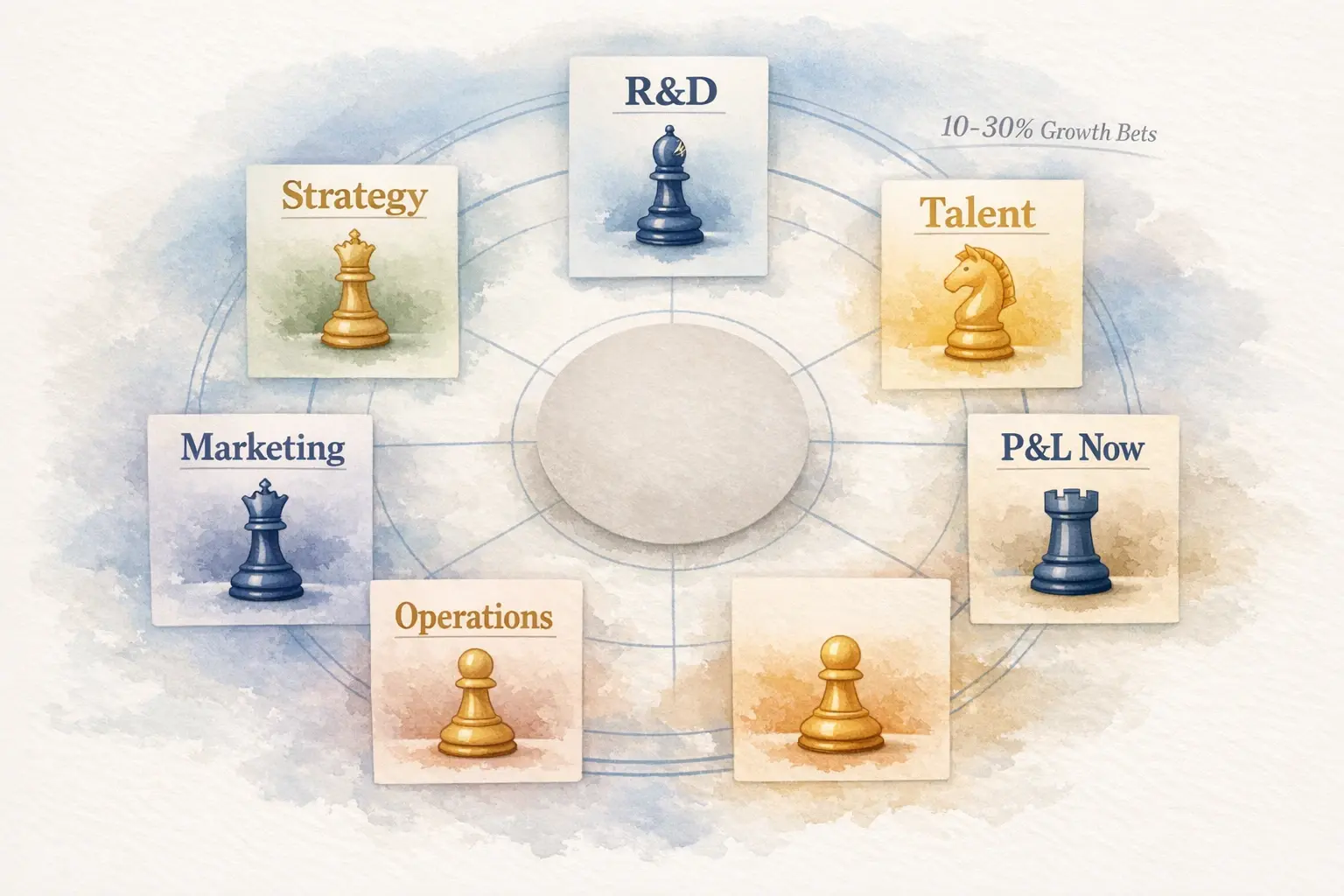
Borrowing from portfolio management, savvy GMs treat their business unit like an interlocking set of asset classes:
- Liquidity investments: Low-risk, fast-return (e.g., operational tweaks, pricing changes)
- Growth equities: High potential, medium-term payback (e.g., adjacent market pilots)
- Futures/Options: Big bets—R&D moonshots, AI-enabled transformation—higher risk, outsized future gains
By visually mapping where each initiative sits (“portfolio heatmap”), you create instant clarity on risk, expected return, and time horizon. Each class gets tracked via its own dashboard, but the sum reflects your overall strategic posture—are you overexposed to today, or amply seeded for tomorrow?
Rolling Strategy Cascade: Blending Horizons
World-class organizations excel using rolling forecasts and strategy cascades:
- Set 3–5 year transformational goals (e.g., new digital revenue).
- Break these into annual milestones.
- Translate milestones into quarterly operational targets (P&L, projects, KPIs).
This rolling structure means short-term achievements are meaningful only if they serve as stepping stones toward the long-term vision.
Blended KPI Dashboards
Ditch the “all-or-nothing” mentality of quarterly profit at the expense of big bets. Modern dashboards layer:
- P&L margin
- Pipeline value for next 18 months
- Innovation index (patent filings, new launches)
- Talent engagement/sentiment (pulse scores, retention)
GMs can “see” the health of both present and future—a kind of organ transplant for traditional views of financial leadership.
For more, Balancing Short-Term P&L and Long-Term Strategic Investments explains how to operationalize dual-horizon dashboards in real-world contexts.
Incentive Alignment Decoded: The Real Engine of Balanced Strategy
At the heart of persistent “profit vs. progress” struggles lies the hard truth: humans do what they’re paid—and recognized—for.
Mapping Incentive Mismatches
It’s one thing to say “align KPIs with strategy.” It’s another to actually trace misalignment:
- Product teams lauded for cost reduction may slash innovation capacity.
- Sales leaders incentivized only for quarterly revenue may avoid customer relationships that would pay off over years.
- HR with siloed metrics may underinvest in future leadership pipelines.
A practical mapping exercise: For every team, list top-three incentives and how those tie (or clash) with long-term goals. Where they diverge, document the risk: “Short-term gain, long-term pain.”
A cautionary tale—one global manufacturer’s cost-cutting bonus scheme incentivized managers to defer maintenance and trim training budgets. Profits ballooned for two years…until system failures and churn triggered an expensive fire drill, erasing gains and then some.
The Give/Get Equation
Advanced financial leadership requires total clarity on the dual “give/get”: What immediate profit do we give up for what future gain? This is where rigorous scenario planning, stress testing, and peer review—hallmarks of world-class GMs—come into play.
For GMs looking to motivate teams for both today and tomorrow, Silver or Gold: The Most Valuable Investment for Leaders explores how leadership investments in listening and presence pay off across both financial and cultural metrics.
Advanced Scenarios: Executing the Balance Under Fire
What do the best GMs do when the pressure is on—when a downturn, regulatory shock, or competitor play triggers urgent trade-off decisions?
“Resilience-First” Planning: Stress-Testing the Portfolio
World-class GMs run scenario-based stress-tests:
- “What if our main revenue stream dips by 25% next quarter?”
- “How would a regulatory change impact both P&L and future-focused investments?”
- “If our R&D budget is halved for a year, what’s the cost to our innovation pipeline by Y+3?”
The discipline here isn’t in the spreadsheet. It’s in having the intellectual honesty and team courage to put even favorite projects at risk, and to document both short-term survival and long-term consequences.
For further strategies on risk anticipation and scenario planning, Mitigating Business Unit Risks provides actionable frameworks built for the complexities GMs actually face.
Communicating with Boards and Skeptical Teams
Bridging the financial and vision gap isn’t just about analysis. It’s a leadership and communication challenge.
Advanced GMs:
- Present narrative scenarios: “If we reduce project X now, these are the likely cost and customer impacts in two years…”
- Use blended-measure scorecards as visual proofs, not wishful thinking.
- Invest in executive presence and transparent, candid dialogue with teams and boards.
For actionable insights on enhancing influence and buy-in at the highest levels, see Executive Presence, Influence & Communication.

Talent and Leadership Development: The Under-Estimated Strategic Asset
It’s often said that “people are our biggest asset.” But, in practice, talent development budgets are the first on the chopping block when P&L pressures mount. This is a miscalculation that the best GMs avoid.
The Case for Compounding Talent
Research shows that organizations investing consistently in people outperform peers by >20% in total shareholder return across five years
(Source: McKinsey, 2023). Why? Because these investments fuel adaptability, culture, and the leadership pipelines critical for surviving and thriving beyond quarterly targets.
Connect the dots: team engagement, upskilling, and leadership coaching translate to higher resilience, faster pivot capacity, stronger innovation muscles—and ultimately to next year’s profits.
Looking for guidance on fostering sustainable leader motivation? 10 Magical Steps for Personal Motivation offers a practical lens for integrating talent and leadership development into the long-term playbook.
Leadership Mindset: Continuous Learning vs. Defending the Status Quo
The ultimate differentiator isn’t the dashboard, but the mindset of leaders. Those who see learning as a constant—who are both stewards and entrepreneurs—are attuned to balancing today’s realities with tomorrow’s dreams.
If you’re curious about transformative personal and team leadership journeys, A Journey Into Leadership: Be Better explores leadership growth as a lived, adaptive process.
A Self-Assessment: Where Are You on the Balance Spectrum?
Set aside your latest operating report and reflect:
- Are your best people incentivized to care about 3-year outcomes—or are their rewards disconnected from the future?
- When a trade-off is necessary, how does your team debate and document both the immediate P&L and the “future cost” of waiting?
- Does your dashboard show both present numbers and leading indicators of long-term health (innovation, talent mobility, engagement)?
- How honestly do you tell the “balance story” to teams and boards?
The reality: There’s no permanent, perfect state—balancing short-term and long-term is a verb, not a noun. Each decision is a new iteration.
FAQ: Balancing Short-Term P&L with Long-Term Strategic Investments
What’s the core difference between short-term P&L and long-term strategic investment?
Short-term P&L reflects the immediate profitability of your business unit—what comes in and goes out on a quarterly or annual basis. Long-term strategic investments are resources committed to initiatives like R&D, market entry, or talent that may not pay off for several years but are vital for future competitiveness and growth.
Why is balancing both critical for sustainable success?
Because over-focusing on immediate wins usually sacrifices future growth, while ignoring short-term viability can risk organizational survival. Sustainable success demands generating today’s profits while constantly investing in future capabilities and opportunities—creating a flywheel effect where present results fund tomorrow’s innovation.
How do I start blending short- and long-term metrics in my management approach?
Begin by mapping your business unit initiatives as portfolio classes: quick wins, core growth, and future bets. Develop a reporting dashboard that tracks key metrics in each class—like P&L margin, innovation index, and engagement scores—at least quarterly. Align KPIs and bonuses to both sets of results.
What’s the biggest practical barrier for GMs in achieving this balance?
Most often, it’s incentive misalignment: KPIs, bonuses, and visual scoreboards that reward short-term wins at the expense of longer-horizon bets. Lack of transparent scenario planning and dashboarding can also obscure future risks, making it harder to defend investments when under P&L pressure.
How can I communicate the value of long-term investments to skeptical stakeholders?
Use scenario-based storytelling—demonstrate with clear forecasts and credible case examples what happens when investments are cut or delayed. Visual aids like blended KPI dashboards and “present value” calculations help make the future tangible. Regular communication focused on both the logic and emotional payoff can shift mindsets over time.
Is there a way to “stress test” our current balance?
Yes—simulate negative scenarios (e.g., sudden market shocks, loss of a key account, regulatory changes) to see which long-term initiatives might be cut and calculate both immediate and future costs/savings. Factor in impacts on innovation pipeline, team retention, and market reputation. Use these insights to refine resilience planning.
As a general manager, you steward more than this quarter’s earnings—you are shaping an organization’s ability to thrive for years. The nuance, discipline, and courage required to truly balance short-term P&L with strategic investments is as much about mindset and communication as it is about frameworks and metrics. The best step now? Reflect with your team, challenge assumptions, and continue learning—because the art of the balance is the true craft of modern leadership.
Continue Your Leadership Journey
- Balancing Short-Term P&L and Long-Term Strategic Investments — A comprehensive resource on aligning today’s profits with tomorrow’s growth.
- Silver or Gold: The Most Valuable Investment for Leaders — Explore what advanced financial leadership strategies mean for leaders seeking sustainable impact.
- 10 Magical Steps for Personal Motivation — Fresh thinking for developing motivation and leadership resilience in yourself and your teams.
- Mitigating Business Unit Risks — Frameworks every GM can use to anticipate and plan for both P&L pressures and long-term uncertainty.