

Leaders today face a paradox. Every board meeting, virtual town hall, or cross-functional sprint demands clear-cut authority and gravitas—yet the “room” they must influence is often everywhere and nowhere at once. Executive presence isn’t just a matter of wearing the right suit or speaking with confidence anymore. In a landscape redefined by digital transformation, flattened hierarchies, and relentless disruption, presence and influence have become measurable disciplines—not soft skills.
You’re here, likely, because you’re comparing solutions or frameworks to help your organization’s top leaders cultivate genuine influence and resilience. You want more than anecdotal advice. You want data-backed insights and field-tested practices to distinguish real executive presence from well-rehearsed posturing.
This piece delivers exactly that—and it won’t tell you presence is “innate.” Instead, you’ll see why it’s a trainable, assessable, and ultimately strategic asset in shaping trust and performance across hybrid, multi-generational teams.
Executive Presence in 2026: Redefining the “It Factor”
The concept of executive presence often gets reduced to charisma, communication poise, or simply “looking the part.” But this caricature misses what leaders wrestle with daily: how to project calm in uncertainty; how to ensure their message lands, even through a screen; how to catalyze action among skeptical or disconnected stakeholders.
Presence is now less about occupying physical space and more about aligning intention, emotion, and action—especially under pressure. The demand goes beyond being “polished.” What’s required: an ability to anchor others in complex, anxious, and ambiguous (BANI) conditions, where every misjudged cue can trigger cascading impact.
Only 8% of senior executives today are rated as strong at leading change. Yet those who invest in high-quality development are 5.6x more effective at adapting to disruption and uncertainty.
(Source: DDI Global Leadership Forecast, 2026)
Presence also has leverage effects most leaders underestimate. Employees, at all levels and ages, report they want leaders who show up—literally and figuratively—with clear direction, emotional steadiness, and authentic engagement. In fact, 55% of teams prefer internal, face-to-face channels over digital blasts, even in hybrid settings (Source: Ketchum, Leadership Presence Survey, 2026).
Most telling, in-person leader presence can accelerate trust and organizational decision-making by up to 40% over asynchronous or solely virtual communication (Source: McKinsey, 2026).
So, why hasn’t every leader mastered this? Because surface traits aren’t the issue—it’s the unseen misalignments, blind spots, and lack of robust practice that sabotage even the most technically capable executives.
The Science of Executive Presence
The market is saturated with high-level “models” for executive gravitas, but few link these with psychometric measurement or hold leaders accountable for authentic alignment. Here’s where the research stands apart from myth.
What is Executive Presence, Really?
According to leading frameworks, especially the “ABC’s” model adapted from Brown University:
- Appearance—how you show up communicates readiness and respect, but is least predictive of long-term influence
- Boldness—the courage to speak up, challenge norms, and handle pushback
- Communication—mastery in conveying complex ideas simply and powerfully
But the science goes further. Tools like Bates ExPI™ and 360-degree multi-rater feedback consistently reveal that self-perception in presence is regularly misaligned with how peers, managers, and teams experience a leader’s influence (Source: ATD, Executive Presence Measurement, 2025). This “blind spot gap” is the Achilles’ heel of even the most experienced senior leaders.
Deep dive:
- Nearly every leader overestimates where they stand on presence; empirical assessment surfaces discomfort but also creates opportunities for focused development
- Scientific assessment models quantify feedback across layers—managers, peers, direct reports—helping close not just skills gaps but crucial perception gaps
What’s often overlooked? The need to adapt presence to new work modalities. Hybrid, distributed, and AI-enabled settings mean “commanding the room” is as much about digital confidence and calibration as it is about walking into a boardroom.
The Alignment Edge: Internal Belief Meets External Perception
At the heart of sustainable credibility is alignment—the visible harmony between a leader’s self-concept, intentions, and observable behaviors under stress. Counterintuitively, it’s often not the loudest or most extroverted leaders who convey the most trust or gravitas. It’s those whose presence feels congruent—steady, values-driven, and consistent—especially in moments of challenge or ambiguity.
“Your presence is your culture’s mirror. Micro-behaviors in senior leaders become organizational performance drivers.”
(Practice insight, The Integral Institute)
A persistent danger for executives is emotional dissonance: believing you’re inspiring trust while sowing confusion or anxiety through non-verbal cues or mixed messages. That’s why feedback mechanisms—360 tools, peer shadowing, and structured reflection—are not “nice to haves.” They’re critical in closing the intention-perception gap.
- Leaders must ask: Is my intended impact the same as my actual impact?
- Regular feedback, not annual reviews, is the spine of recalibrating alignment
- Blind spots uncovered often relate to over-projecting confidence, under-listening, or failing to signal vulnerability in credible ways
In a world where leaders are scrutinized as much for how they listen as how they direct, alignment emerges as the new x-factor for lasting influence.
Influence Beyond the Room: High-Impact Communication in Hybrid Organizations
Even senior leaders who have honed their in-person authority often struggle when the “room” is a mosaic of remote screens and chat threads. High-impact communication becomes exponentially harder when attention is fractured, non-verbal context is lost, and misunderstandings propagate effortlessly.
In-person presence accelerates trust and execution by up to 40% versus asynchronous/video channels.
(Source: McKinsey, 2026)
The implication: communication rituals, not just message content, matter. In distributed or hybrid teams, presence must be designed into the culture.
What separates leaders who continue to wield influence outside traditional settings?
- Redundancy of message: repeating priorities and vision through varied channels and modalities
- Micro-leadership: seizing “moments that matter”—impromptu check-ins, celebrating small wins, addressing setbacks rapidly
- Ritualizing accessibility: setting structured Q&A, open-door hours, or immediate feedback mechanisms beyond their physical location
In this environment, digital body language is real. Leaders who intentionally master non-verbal cues (eye contact via video, posture, gestures, micro-expressions) project authority and warmth even virtually.
Crucially, leaders must inspect where asynchronous communication is eroding trust, and proactively compensate with catalytic moments of real-time connection. The currency of influence is paced and paced again—not assumed after one all-hands or slide deck.
Micro-Practices for Building Presence, Influence, and Credibility
Theory doesn’t shift perception—practice does. Where most articles give leaders a list of surface-level tips, evidence reveals that deliberate, repeated micro-practices anchor and amplify executive presence over time, even for the most seasoned leaders.
-
Managing Energy, Not Just Time: Leaders who govern their “emotional temperature” set the tone, especially in volatile or anxious moments. Simple rituals—pausing before big decisions, practicing “grounding” breaths before calls, visibly reflecting during tense exchanges—reinforce calm authority.
-
Feedback as a Daily Ritual: Soliciting in-the-moment input, not waiting for scheduled reviews. High-impact leaders ask after meetings: “What landed for you? What didn’t connect?” This signals openness, rapidly recalibrates presence, and invites trust.
-
Micro-Signals of Decision Clarity: Consistently using language that telegraphs direction (“Here’s what will happen next…,” “This is what’s at stake…”) helps teams, especially remote or hybrid, align and act decisively.
-
Non-Verbal Cues: Strategic use of posture, pauses, and facial expressions can be deliberately practiced, video-reviewed, and iterated upon. Non-verbal cues carry meaning even before verbal content is absorbed.
-
Self-Reflection and Alignment Check: Weekly reflections on high-tension moments (“Did I show up as I intended? If not, how will I adjust next time?”) turns insight into muscle memory.
Notably, these practices are effective not because they are performative, but because they foster authentic alignment and signal to teams that their leaders are fully present—across every medium and interaction.
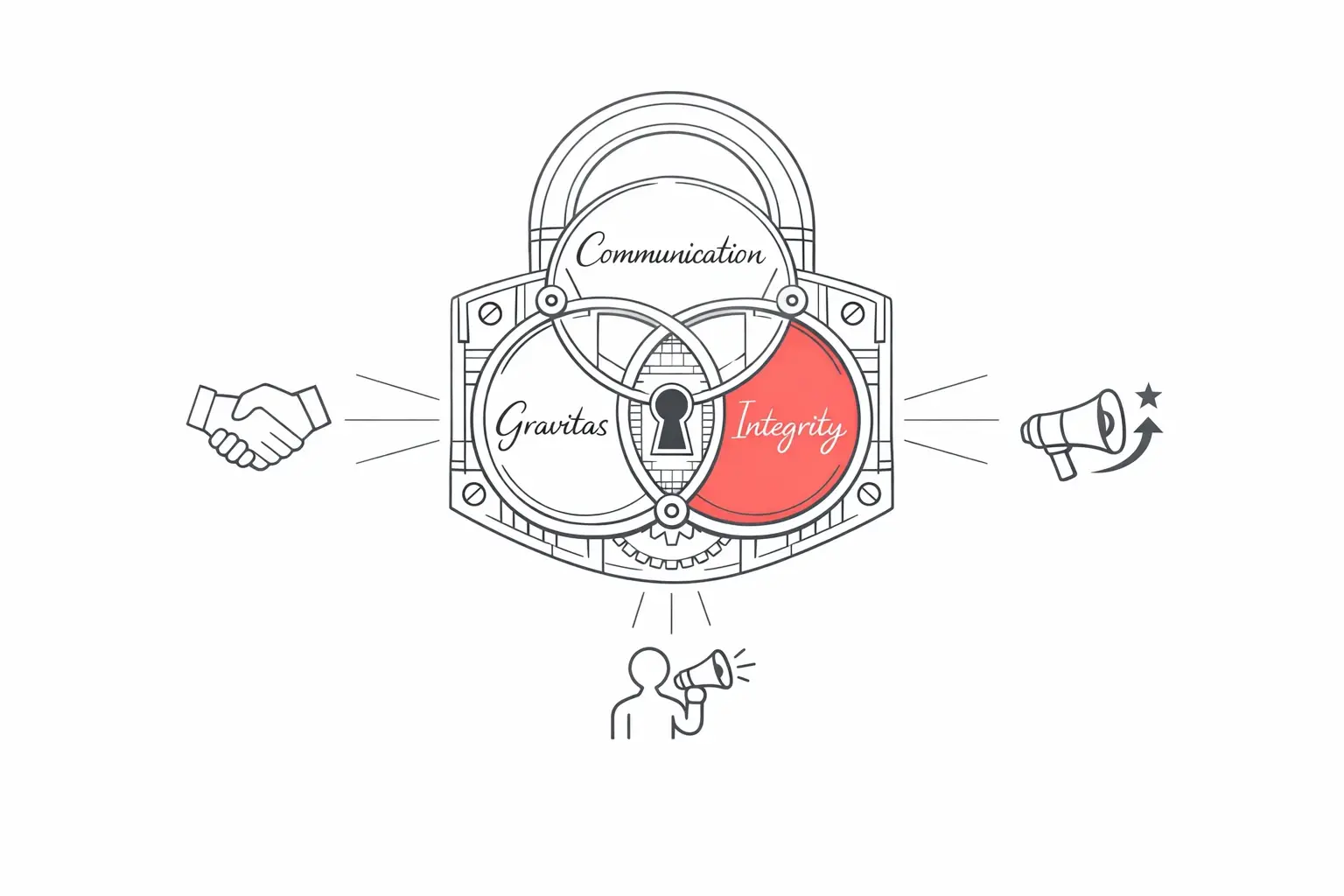
Diagnosing Your Executive Presence: A Multi-Rater Approach
Traditional self-assessment tools for presence are riddled with optimism bias. Leaders tend to view their own presence through a lens of intention, not impact.
“Why your self-perception is failing you: The science of executive presence calibration.”
(Original Insight)
To truly track progress, best-in-class leaders rely on scientific, multi-rater feedback:
-
360 Degree Assessments: Draw input from direct reports, peers, and superiors. What you think you project can be radically different from what’s experienced by others. This also checks for “perception drift” as teams become more diverse or distributed.
-
Bates ExPI™ and Other Psychometric Tools: Measure drivers such as composure, clarity, assertiveness, and empathy across work contexts, providing a data-driven roadmap for improvement.
-
Feedback Loops with Accountability Partners: Peer shadowing or formal “reflection partners” introduce real-time, honest check-ins: “Am I living what I preach in this moment?”
-
Self-to-Organizational Alignment: Structured debriefs comparing feedback with organizational culture audits help leaders see not just how they’re perceived, but how that perception fuels or frustrates team purpose.
This diagnostic approach, while sometimes uncomfortable, is central to sustained executive growth. The leaders who recalibrate fastest are often those who most quickly close the gap between intended and perceived impact.
Building a Development Roadmap: Feedback, Coaching, and Peer Loops
If presence could be shifted by consuming another article or attending a one-off leadership retreat, the world would be brimming with magnetic executives. The reality is that sustained growth is rooted in systems—deliberate, feedback-rich environments and practiced accountability.
- Peer and 360 Feedback Models: Deploy tools on a quarterly basis to keep perception gaps in check. Make this process routine, not remedial.
- Coaching for the Few, Not the Many: Reserve tailored coaching for high-leverage leaders—those whose presence multiplies across teams and functions.
- Reflection and Accountability Partners: Pairing with a trusted peer, inside or outside the organization, for monthly check-ins builds commitment and accelerates behavioral change.
These anchors transform the development journey from a vague aspiration (“I should be more assertive”) to a trackable, behavior-anchored improvement plan.
Organizations that embed such routines see stronger retention at the top, sharper decision alignment, and—perhaps most importantly—teams who feel seen and inspired by their leaders’ presence.
Visionary Storytelling and Crisis Communication
In high-stakes moments, presence is on full display. Whether rolling out a bold new vision or navigating an organizational crisis, leaders are scrutinized not just for their words, but for their composure, logic, and ability to light a path through uncertainty.
Strategic Storytelling—Turning Data Into Shared Purpose
The most credible leaders are also the best storytellers—not because they weave fiction, but because they connect facts to shared values. Strategic storytelling isn’t about waxing poetic; it’s about structuring narrative arcs that:
- Make the vision tangible
- Acknowledge present anxieties without amplifying them
- Sequence facts and emotion for maximum resonance with both the rational and intuitive parts of listeners
Regularly rehearsing and refining these narratives, with feedback, ensures a leader’s vision travels far beyond their immediate circles.
Crisis Leadership—Navigating the “Edge” Together
When the stakes are existential, crisis leadership demands a blend of empathy and decisive communication. Leaders must excel at:
- Naming the reality: Confronting facts head-on, not sugarcoating
- Modeling vulnerability: Admitting uncertainty when needed, while showing commitment to navigate through
- Creating emotional safety: Using language and tone that invites questions and acknowledges anxiety
Studies consistently show that organizations with leaders skilled in crisis communication recover faster and retain trust, even when outcomes are ambiguous.
Case Study Vignettes: What True Presence Looks Like
Vignette 1 – Failing Forward
A global technology COO, famously quick with answers, discovered through 360 feedback that her rapid-fire decisions were intimidating junior staff. She began weekly sessions pausing before responding and asking teams to voice alternative scenarios. The outcome? Engagement surveys reflected a double-digit rise in perceived psychological safety—and later, a 15% increase in innovation metrics over the next two quarters (Source: Practice observation).
Vignette 2 – Hybrid Influence
A CEO leading an international financial firm faced declining morale in hybrid teams. Pivoting, he opened each week with unscripted video check-ins narrating both priorities and personal challenges. Feedback loops signaled employees felt “seen, not just managed”—resulting in a measurable uptick in discretionary effort and internal net promoter scores.
Vignette 3 – Crisis Reframing
After a high-profile data breach, a regional health executive used daily standups and candid Q&A to share what was known, what was not, and which team voices would shape the recovery. Rather than defensiveness, this transparency fostered a sense of shared mission—driving both resilience and trust.
These vignettes remind us: executive presence isn’t glamorous. It’s built in daily discipline, courageous feedback, and an ability to align visible action with embedded values—even (and especially) when the cameras are rolling.
Beyond the Individual: How Executive Presence Shapes Culture and Performance
The ultimate miscalculation is assuming executive presence is a solo act. In truth, it serves as the gravitational center for team cohesion, innovation, and organizational trust.
Teams attuned to credible, present leaders display stronger alignment to purpose, faster decision-making, and, time and again, superior performance on complex projects. Senior leadership presence doesn’t just unlock doors for a select few—it ripples out as a multiplier in talent attraction, cultural resilience, and external stakeholder confidence.
When organizations strategically invest in practical, scientific development of presence and influence, they are not upgrading “soft skills.” They are architecting the culture and performance capacity that their future depends on.
FAQ: Executive Presence, Influence & High-Impact Communication
Why do so many senior leaders misjudge their own executive presence?
Most executives evaluate themselves based on intention, not external perception. Without scientific, multi-rater assessments or regular feedback loops, blind spots remain hidden—especially as leaders gain seniority and receive less candid input from teams or peers.
How is executive presence measured scientifically?
Validated frameworks like the Bates ExPI™ and multi-rater 360-degree feedback assess specific behaviors—such as composure, clarity, assertiveness, and empathy—across various roles and scenarios. This approach quantifies impact, highlights blind spots, and creates actionable roadmaps for authentic improvement.
What are the most effective micro-practices for enhancing influence in hybrid or remote environments?
Deliberate practices include: soliciting immediate post-meeting feedback, using clear directional language, practicing grounding techniques before high-stakes exchanges, intentionally signaling engagement through video (eye contact, posture), and scheduling regular, transparent “open channels” for candid dialogue.
How does executive presence relate to organizational performance and trust?
Presence shapes cultural norms. Leaders who model alignment, credibility, and emotional safety foster psychological safety—which research links directly to innovation, accountability, and measurable performance gains. Conversely, visible gaps between stated values and action erode trust and pull down team outcomes.
What is the key difference between ethical influence and manipulation in leadership?
Ethical influence is grounded in transparency, alignment with shared goals, and respect for stakeholders’ autonomy. Manipulation distorts facts or leans on fear/guilt. High-trust leaders use influence channels that are auditable and open to challenge—reinforcing credibility rather than undermining it.
Is strategic storytelling really different from typical organizational messaging?
Yes—strategic storytelling shapes organizational identity, ties disparate data points to shared purpose, and actively incorporates both logical and emotional levers. It requires structure, rehearsal, and real-time iteration based on audience feedback, far beyond traditional top-down announcements.
What role do practical training and workshops play in developing leadership presence?
Targeted leadership presence workshops combine simulated high-stakes scenarios, peer and coach feedback, non-verbal mastery, and vision communication practice—bridging theory to applied capability and accelerating sustainable, measurable shifts in executive gravitas.
How can organizations cultivate trust as a foundation for high-impact communication?
Building trust hinges on visible leader actions: consistent transparency, reframing mistakes as learning moments, regular check-ins with teams to solicit honest input, and structured debriefs to surface and address failures constructively.
In closing, the discipline of executive presence and influence is, at its core, about alignment, accountability, and intentional practice. Whether you’re charting your own leadership evolution or shaping a culture where every leader is prepared to inspire and steer through disruption, the next step starts with honest feedback and micro-adjustments—made visible every day. If you’re ready to explore these dynamics further, consider where your own presence lands on both the intention and perception curve.
Continue Your Leadership Journey
- Executive presence — Explore measurable frameworks, micro-signals, and organizational impact for presence in your environment
- Leadership presence — Practical workshops designed to build presence, persuasion, and high-stakes communication through simulation and feedback
- Crisis leadership — Learn strategies for leading authentically and empathically through uncertainty and organizational crises
- Building trust — Create psychological safety and challenge negative patterns by championing trust in every interaction