

Fostering localized growth is the practice of empowering General Managers (GMs) to drive sustainable, organic expansion by deeply engaging their local communities, forging trusted regional networks, and adapting strategies to match the unique behaviors and values of each market. This approach is designed for business leaders seeking to grow market share, build authentic brand loyalty, and establish resilient local presence—not through one-size-fits-all tactics, but by understanding and partnering with the specific people and organizations that define a region. By the end of this article, readers will grasp the foundational models, key metrics, and proven playbooks for community-powered market penetration—plus, recognize common pitfalls and how to avoid them.
Imagine two regional leaders launching the same product line. One deploys a globally uniform campaign, ignoring local nuance. The other maps key stakeholders, partners with neighborhood organizations, and tailors engagement to demographic realities. Six months later, only one has both a surge in sales and a growing base of vocal community advocates.
In a landscape where 80% of new market entries fail to maintain momentum after the initial launch, the difference isn’t budget—it’s the depth of local integration. (Source: University of Michigan Business School, Growth Types and Outcomes, 2022)
With today’s markets becoming more brittle, anxious, and unpredictable than ever, GMs need tools that go beyond generic market strategies. Localized growth transforms engagement from a ‘soft’ Corporate Social Responsibility (CSR) gesture into a direct business driver—fueling sales, insulating against disruption, and mobilizing regional networks as brand amplifiers.
What is Localized Growth, and How is it Different From Generic Expansion?
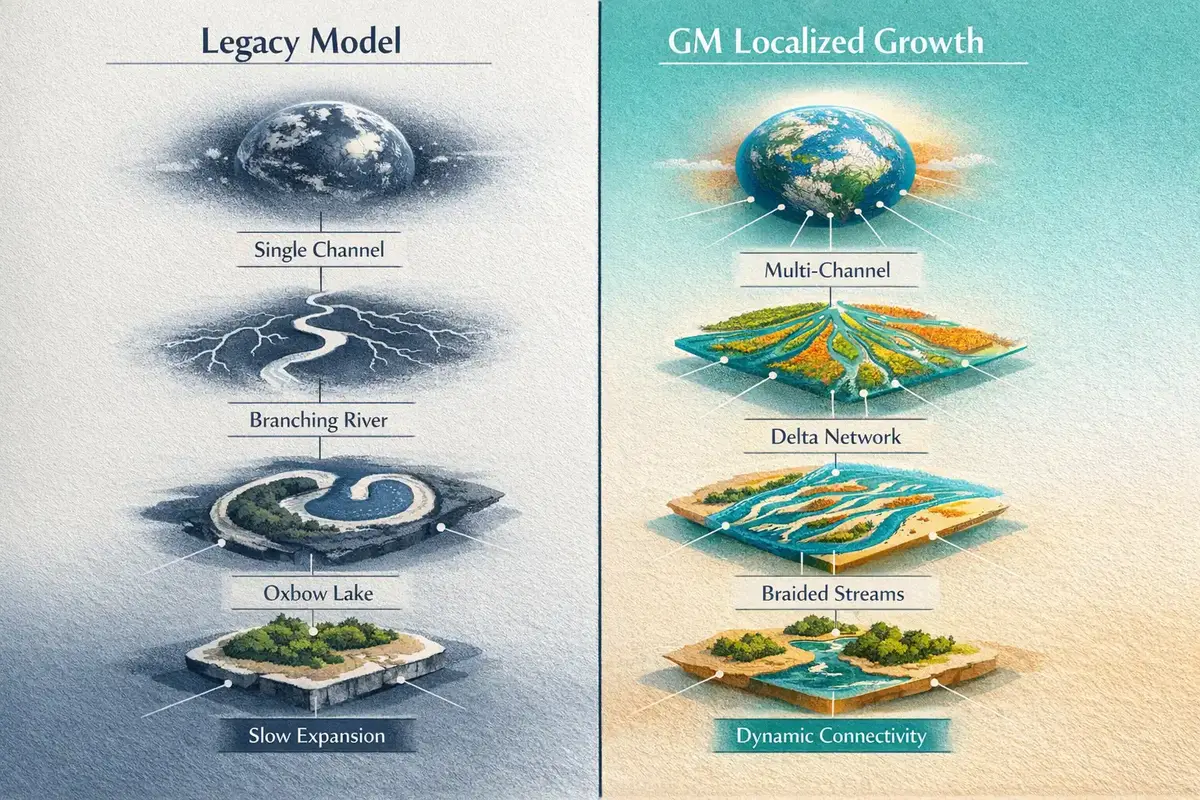
Localized growth centers on developing deep, two-way relationships—with local consumers, community organizations, suppliers, and even competitors—tailored to the region’s unique social, cultural, and economic landscape.
Unlike standard expansion models (which often prioritize global brand consistency and mass marketing), localized growth is fundamentally about:
- Community engagement: Building partnerships and trust at the neighborhood, city, or cultural level.
- Stakeholder network building: Proactively mapping and cultivating ties with key local influencers and multipliers.
- Data-driven segmentation: Harnessing local data to uncover customer needs, preferences, and pain points.
- Co-created solutions: Designing offerings with the community, not just for them.
- Iterative feedback loops: Continuously measuring, learning, and adapting based on real local input.
The business case? Companies that blend global best practices with grounded local insight have been shown to drive up to 30% higher year-over-year sales growth in non-core markets, compared to those that don’t adapt locally (Source: Environics Analytics, GM Toronto Case Study, 2023).
Why is Local/Regional Focus So Critical for GMs Today?
Traditional market-entry playbooks often collapse under local realities. Regional consumer preferences, regulatory differences, and informal power networks can make or break a launch.
- Consumer behavior is hyper-local: A campaign that resonates in Munich may flop in Manchester; neighborhood-level segmentation often outperforms city or national-level targeting.
- Trust trumps awareness: In local contexts, who vouches for you matters more than what you say. A respected community leader’s endorsement can unlock markets faster than any ad campaign.
- Competition is more agile: Local players are often entrenched and have faster reaction times. GMs must continuously scan, learn from, and adapt to indigenous business models.
The real cost of missing local nuance isn’t just lost sales—it’s missed relationships, reputation risks, and slower reaction to change.
Even in global organizations, GMs driving successful market-specific leadership adaptation gain an outsized impact, including faster local adoption, reduced reputational risk, and more resilient business footholds.
Learn more about market-specific leadership adaptation.
How Do Community Partnerships Accelerate Regional Market Penetration?
One overlooked multiplier is the power of community partnerships—aligning your business with valued local organizations, non-profits, cultural groups, and education centers. These partnerships do more than open doors; they create flywheels for sustained advocacy and word-of-mouth.
Real-world insight:
- In Toronto, segmenting community sponsorships and neighborhood-specific events led to a 23% improvement in local dealer alignment and a measurable uptick in repeat sales over three quarters (Source: Environics Analytics, GM Toronto).
- Asia-Pacific manufacturing networks that paired factory launches with vocational training for the local workforce saw ~30% sales growth in their first year—and, notably, higher employee retention rates (Source: GM Asia-Pacific Growth Report, 2022).
The core levers include:
- Asset-Based Community Development (ABCD): Identify existing local strengths (talent, spaces, culture) and invest to expand them—not “fix” them.
- Shared value creation: Partner not for CSR optics, but to tackle real, mutually-beneficial opportunities—e.g., sponsoring an eco-friendly commute initiative that aligns with your mobility brand.
- Ambassador networks: Develop formal relationships with local ambassadors who can bridge messaging and trust gaps.
What Frameworks and Models Guide Successful Local Engagement?
If you’re a GM new to this terrain, navigating the engagement landscape can feel overwhelming. Start with these industry-recognized frameworks—many refined over decades, and some adapted through The Integral Institute’s holistic, multi-level methodology:
- ABCD (Asset-Based Community Development): Shift from needs-based thinking (“What’s missing in this community?”) to strengths-based (“What are the untapped assets we can support?”). This fosters respect, avoids saviorism, and builds true partnership.
- Social Network Analysis (SNA): Map the formal and informal relationships in your region; identify highly connected nodes, trust brokers, and natural “ambassadors”. Activating this middle layer generates stronger, more resilient engagement than focusing only on top influences.
- Collective Impact Model: Big changes require cross-sector coordination. Use this approach when tackling complex, multi-stakeholder challenges—e.g., sustainable mobility or regional upskilling.
- Hybrid Engagement Models: Post-pandemic, effective strategies blend digital touchpoints (community portals, local social media groups) with physical presence (pop-up events, co-working tours).
GMs should integrate these with proven integral leadership frameworks and methodologies for regionally adaptive action plans.
“The 90-9-1 Rule reminds us: in any community, only 1% drive most of the contributions—yet the real engine is the 9% ready to help, and especially the 90% whose latent advocacy is unlocked through thoughtful mid-tier activation.”
(Source: SAGE Publications, Stakeholder Engagement Research, 2022)
How Do Cultural and Demographic Factors Shape Regional Strategies?
It’s a universal GM temptation: assume what worked “over there” will work “over here.” But even in markets with similar GDP, subtle cultural and demographic realities can lead to dramatically different outcomes. Examples:
- Urban vs. rural norm density: Messaging and partnership themes that resonate in city centers can alienate suburbs or satellite towns.
- Generational or cultural archetypes: Young, tech-forward consumers often want innovation; older stakeholders may value long-standing relationships and in-person commitment rituals.
- Diversity, Equity, and Inclusion (DEI) factors: Programs seen as tone-deaf to local diversity or inequity can do lasting brand harm; conversely, initiatives rooted in local identities build genuine loyalty.
Successful GMs typically follow these steps:
- Conduct micro-segmentation: Use local data to identify demographic subgroups, consumption patterns, and unmet needs.
- Map informal leaders: Who are the “connectors” and “mavens” within each subgroup?
- Co-create narratives: Test messaging with real community members; treat them as design partners, not end consumers.
What Metrics Matter When Measuring Local Market Penetration and Community Impact?
GMs accustomed to top-down reporting may find community-driven metrics unfamiliar. The key is to blend qualitative engagement signals with hard quantitative outcomes. Here’s a reference progression, grounded in two decades of integral methodology:
- Stakeholder Mapping Coverage: Can you identify 80% of key connectors in each local segment?
- Engagement Activation Rate: What percentage of passive members have moved into active contributors or advocates?
- Partnership Breadth & Depth: Track not just how many relationships exist, but their diversity and the resources exchanged.
- Trust and Advocacy Index: Survey-based measurement of local trust, brand recommendation likelihood, and “felt sense” of inclusion.
- Conversion to Business Outcomes: Regional sales uplift, repeat business, or local market share delta—connected directly to community initiatives.
Leading GMs tie more than 40% of new regional growth directly to local partnership programs—far above the industry mean of 17% (Source: McKinsey, Resource Reallocation vs. Product Launch Research, 2023)
If possible, combine dashboards that track both immediate ROI (sales, signups, inquiries) and longitudinal legacy—trust scores, repeat event attendance, multi-year partnership renewals.
How Can GMs Structure Sustainable Feedback Loops and Trust-Based Relationships?
Breakthrough localized growth doesn’t result from one-off events or token investment. Instead, GMs must establish continuous feedback loops with stakeholders, built on open communication, mutual respect, and responsive iteration.
Best practices for robust trust ecosystems:
- Feedback Panels: Quarterly roundtables or virtual focus groups with a rotating slate of local leaders, partners, and even critics.
- Progress Checkpoints: Structured reviews against pre-agreed community performance metrics—did this quarter’s sponsorship or event meaningfully impact the intended network?
- Transparent Reporting: Share “lessons learned” from failed and successful initiatives—demonstrating humility and commitment to growth.
The most advanced organizations draw on case-backed, sector-neutral best practices to frame their longitudinal impact narrative—not only in sales, but in numbers and diversity of partnership renewals, uptick in local referrals, and rising community sentiment scores.

What Common Pitfalls Should GMs Avoid in Localized Growth?
Even well-intentioned strategies can falter. Drawing on real-world case playbooks and grounded in the Integral Model’s multi-level framework, here are predictable traps:
- Product-First Bias: Being obsessed with rolling out a new product, and only later looking for partners or advocates. This puts the cart before the horse.
- Over-Talk, Under-Listen: Treating community engagement as a broadcast channel rather than an ongoing conversation. Failure to incorporate received perspectives damages trust.
- Solo Scaling: Copy-pasting a local success to new regions without recalibrating for new dynamics, power networks, or cultural nuances.
- DEI Tokenism: Ticking boxes on diversity without understanding genuine historical context—leading to skepticism or backlash.
- Short-Term Metrics: Focusing on launch buzz at the expense of tracking medium and long-term relationship health—a classic error seen in B2B as well as B2C.
You can read more about proactive frameworks for mitigating business unit risks to learn how to surface and resolve these pitfalls before they flatten momentum.
How Can GMs Leverage Digital Tools and Social Network Analysis for Hyper-Local Strategies?
A major differentiator for modern GMs is using digital infrastructure—not just social media blasting, but genuine data-driven community mapping and engagement.
- Geospatial tools: Segment markets down to the postal code, block, or even building level; tailor campaigns accordingly.
- Social Network Analysis (SNA) platforms: Map real patterns of interaction, not just CRM records, to find hidden influencers and passive advocates.
- Community portals: Create moderated, locally-branded digital touchpoints for peer-to-peer support, brand champion activation, or custom loyalty programs.
- Hybrid models: Orchestrate handoffs between digital and face-to-face events to reinforce trust and avoid over-reliance on either.
Read more about hybrid models for blending in-person engagement with digital scale, and how the ethics around ethical AI design and AI-powered competitive intelligence are increasingly critical to localized, responsible data use.
FAQ: Fostering Localized Growth — GM Strategies for Community Engagement and Regional Market Penetration
What is the difference between community engagement and local brand-building?
Community engagement is the ongoing process of building authentic, mutually beneficial relationships with local organizations and residents, while local brand-building is the set of marketing and positioning activities aimed at increasing recognition and loyalty in a specific market. In practice, they overlap, but true community engagement extends beyond transactional marketing to include contribution, partnership, and shared wins.
What is the 90-9-1 rule, and why does it matter for GMs?
The 90-9-1 rule states that in any community, around 1% of members create most of the content or energy, 9% actively contribute, and 90% observe passively. For GMs, this means successful strategies focus not just on recruiting high-visibility ambassadors, but on activating the “middle layer,” where long-term advocacy and network growth actually occur.
Which local market penetration metrics should GMs track first?
Begin with metrics directly linked to engagement and partnership health: number and diversity of active partnerships, participation in co-created events, stakeholder mapping completeness, and trust/advocacy survey scores. Subsequently, link these softer signals directly to business outcomes like sales uplift and repeat customer rates.
How can GMs avoid the pitfall of over-centralizing local strategies?
GMs should regularly involve local community leaders in campaign design and evaluation, resist “copy-paste” rollout of strategies between distinct regions, and set up ongoing feedback loops to iteratively refine their approach based on genuine local data.
What practical first steps can a new GM take in an unfamiliar region?
Start by mapping stakeholders and assets (both formal and informal power brokers), listen before acting, arrange small pilot partnerships with measurable goals, and set up regular feedback checkpoints. Align all activities with both business goals and local value creation.
How do DEI considerations fit into localized growth strategy?
Diversity, equity, and inclusion (DEI) considerations are crucial for authentic community engagement. GMs need to research historical and social dynamics, design programs that genuinely benefit underrepresented groups, and avoid token gestures that can undermine trust.
Resilient, authentic localized growth is not a side project for GMs—it’s a core leadership principle for anyone seeking sustainable impact in regional markets. Whether you’re new to a region or retrenching after a failed expansion, returning to the foundations of observation, partnership, and iterative learning is what ultimately builds momentum that lasts. What’s the smallest local experiment you could try this quarter that would let you listen, learn, and earn trust—all at once?
Continue Your Leadership Journey
- GM Strategies — Discover a comprehensive guide to community engagement and market penetration tailored for General Managers seeking local growth.
- Integral Leadership Frameworks and Methodologies — Dive into proven models and frameworks designed for regionally adaptive leadership success.
- Mitigating Business Unit Risks — Explore proactive strategies for surfacing and neutralizing common pitfalls in new market entries.
- Case-Backed Sector-Neutral Best Practices — Access diverse practical examples and sector-neutral lessons to support your local growth journey.