

Leadership Development Is Now a Workforce Design Problem
51% of CHROs ranked leadership and manager development among their top three priorities for 2025—that is the signal from SHRM’s current priority set, and it tells you this is no longer an HR-side initiative but an operating model issue (SHRM, 2025). The framework that now matters is human-AI work design; without it, leadership development keeps producing better-trained managers inside workflows that no longer fit the work.
That mismatch is already expensive. Korn Ferry reports that 42% of CHROs are prioritizing AI investments for HR, while only 5% of HR teams feel ready to implement it effectively (Korn Ferry, 2025). In practice, that means organizations are funding new capability while leaving decision rights, role boundaries, and manager expectations unresolved. During a budget-cycle review, a regional services company can approve AI tools in one meeting and still spend the next two quarters debating who owns judgment, escalation, and quality control. This article addresses that gap: not how to coach leaders harder, but how CHROs should redesign work so leadership can actually function in an AI-enabled enterprise.
Leadership development, in other words, has changed categories.
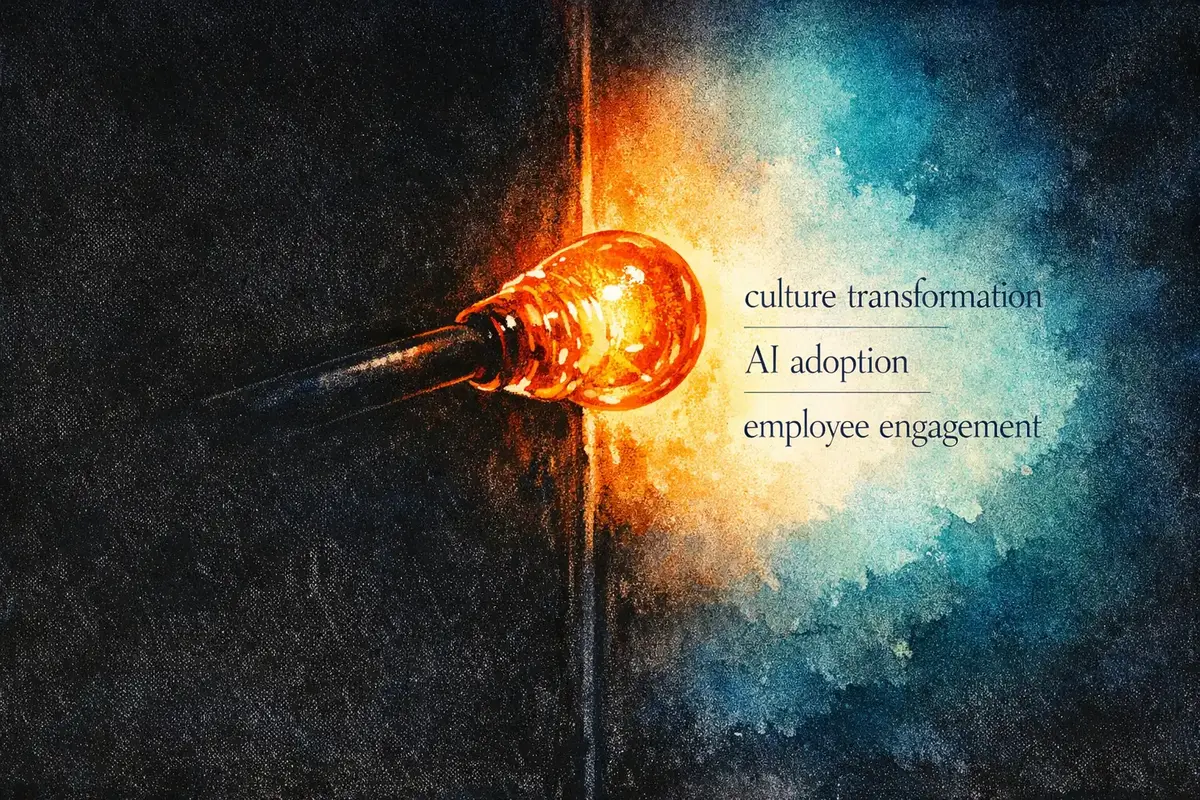
From leader capability to work system design
The old assumption was simple: build stronger individual leaders and the organization will adapt. That logic breaks when work is being redistributed across people, automation, and AI agents at the same time. A manager’s effectiveness now depends less on personal style alone and more on whether the surrounding system makes good decisions visible, repeatable, and governable.
This is why leadership development can no longer sit apart from job design, spans of control, workflow architecture, and accountability. If AI drafts, recommends, routes, predicts, or monitors, then leaders need more than interpersonal skill. They need clarity on where human judgment starts, where machine output stops, and who is answerable when the two conflict.
42% of CHROs are prioritizing AI investments for HR, while only 5% of HR teams feel ready to implement it effectively (Korn Ferry, 2025)
Why CHROs have to think like enterprise architects
For CHROs and CPOs, the practical shift is this: treat leadership development as enterprise architecture, not as a standalone learning program. The question is no longer just, “How do we prepare better leaders?” It is, “What kind of work system are we asking leaders to run?”
That distinction changes everything. It moves the conversation from course catalogs to operating principles, from competencies to coordination, from manager training to redesigning how humans and AI collaborate inside the business. SHRM’s data shows the priority is already established at the top table (SHRM, 2025). The harder question is whether organizations are facing the real constraint: not a shortage of leadership content, but a widening gap between leadership expectations and the way work is now structured.
And if that gap is the real issue—is the problem talent, or is it readiness?
Why the Leadership Readiness Gap Is Bigger Than the Talent Gap
Only 20% of CHROs say they have leaders ready to fill many or almost all critical business roles. That is not a pipeline issue at the margins; it is a direct warning that succession depth is too thin for AI-era volatility (DDI, 2025).
The contrast matters. Organizations can call leadership a priority all year and still discover, at the first real shock, that their bench is built for continuity rather than change. A ready leader is not simply promotable. A ready leader can absorb ambiguity, make decisions across human and AI workflows, and hold performance together while roles, tools, and expectations shift underneath them.
Priority is high. Readiness is low.
McKinsey found that 69% of respondents believe there is a significant human capital or capability gap in their organizations (McKinsey, 2024). Read that alongside DDI’s readiness figure and the pattern is hard to ignore: the problem is broader than a few weak successors in a few functions. The enterprise is signaling that capability risk is already systemic.
69% of respondents believe there is a significant human capital or capability gap in their organizations (McKinsey, 2024)
This is why the familiar debate about whether to invest in leadership development is mostly over. The real decision is sharper: which gaps matter enough to change enterprise performance, and which are merely visible because they are easy to measure?
In a quarterly review at a mid-market manufacturing company, a VP may look strong on traditional succession charts—solid tenure, good engagement scores, credible operator. Then a planning disruption hits: forecasting tools change, frontline decisions move faster, exception handling becomes more complex, and cross-functional tradeoffs multiply. Suddenly the issue is not experience. It is whether that leader can run a system where judgment is distributed, not centralized.
The wrong diagnosis wastes time
Too many organizations still treat this as a talent shortage when it is often a readiness failure. Talent asks, “Do we have capable people?” Readiness asks, “Can those people perform in the conditions the business is actually creating?” Those are different questions, and they lead to different investments.
That distinction should change how CHROs evaluate the pipeline. Instead of asking who is high potential, ask where the business is most exposed: decision quality, role handoffs, manager adaptability, or leadership capacity during redesign. Research from DDI and McKinsey suggests the bigger risk is not that organizations lack promising people. It is that they have not defined the capabilities that matter under pressure (DDI, 2025; McKinsey, 2024).
And if that is true, what exactly should a CHRO redesign before sending one more cohort through leadership training?
What Does a CHRO Need to Redesign Before Coaching More Leaders?
The Leadership-System Fit framework matters here because coaching fails when the system around leaders is misbuilt. Without it, organizations ask managers to absorb change through judgment and influence while structure, norms, and decision rights keep producing friction.
The framework is simple: assess leadership capability, organizational design, culture, and diversity & inclusion as one operating system. Not four workstreams. One system.
That distinction is overdue. McKinsey reports that the average employee now experiences 10 planned change programs a year, up from about 2 a decade ago (McKinsey, 2024). In that environment, leadership development cannot be judged by course completion, promotion rates, or manager confidence alone. It has to be judged by whether leaders can run work that people can actually absorb.
The average employee experiences 10 planned change programs a year, up from about 2 a decade earlier (McKinsey, 2024)
A CHRO should start with three questions. Does the structure place decisions close enough to the work? Are decision rights explicit when human judgment and AI recommendations diverge? Do the norms reward escalation, challenge, and coordination—or quiet compliance?
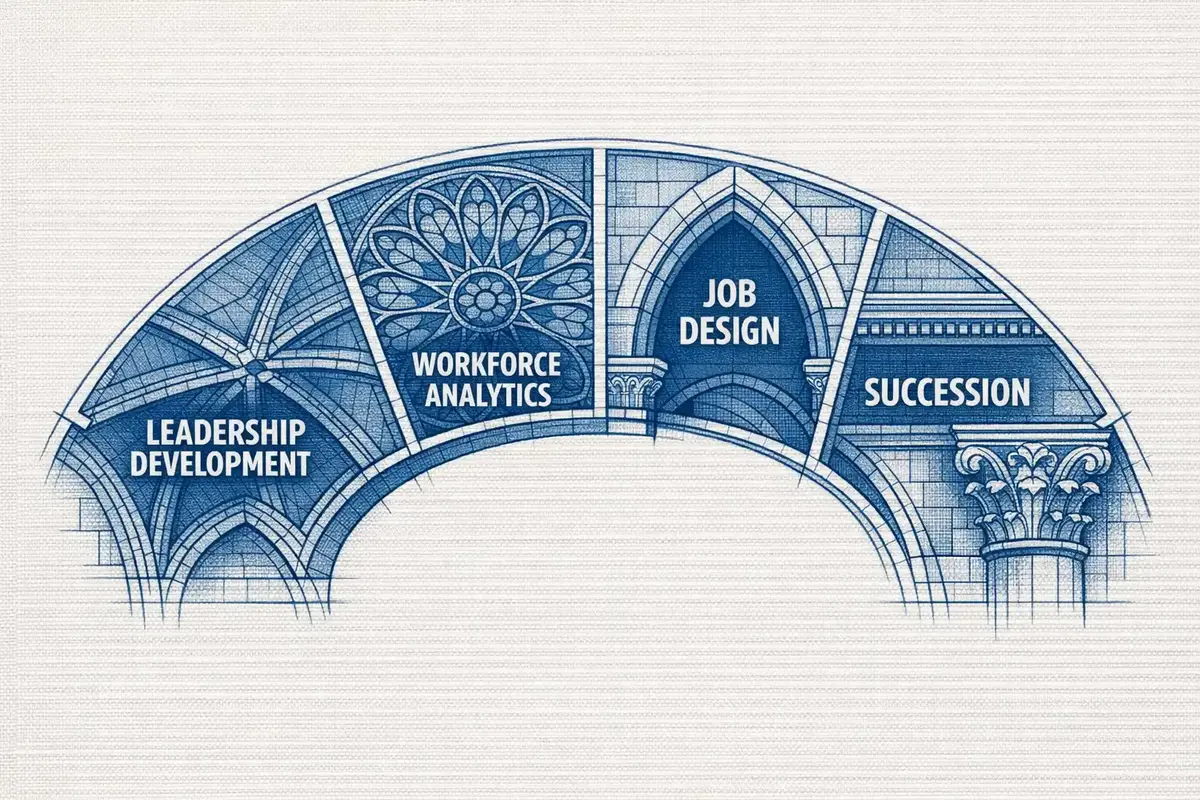
Culture and inclusion are execution systems
This is where many leadership programs drift into abstraction. Culture transformation is not a messaging exercise; it is the mechanism by which people learn what behavior is safe, fast, and rewarded under pressure. Diversity & inclusion is not a parallel initiative; it determines whether the organization hears weak signals early, surfaces dissent, and avoids narrow decision loops when change accelerates.
Gallup’s finding that global employee engagement fell in 2024 should concern any CHRO trying to scale transformation (Gallup, 2024). Lower engagement is not just a morale issue. It is a capacity issue. When people disengage, change takes longer to land, manager load rises, and leadership quality appears weaker than it is because the system is fighting itself.
The test is fit, not intent
In an enterprise healthcare system during a team restructure, a division VP may look underpowered because decisions stall and managers hesitate. The easy diagnosis is weak leadership. The harder—and often correct—diagnosis is mismatch: too many approvals, unclear authority, and cultural norms that punish challenge in the name of alignment.
That is the real evaluation standard. Not whether the leadership model sounds modern, but whether it matches the structure, decision rights, and norms the business now needs.
And before a CHRO interprets any readiness gap, one question remains: what does the data actually say about where AI-era capability risk is concentrated—skills, adoption, or something deeper?
How Should CHROs Interpret the Data on AI Readiness and Future Skills?
42% of CHROs are prioritizing AI investments for HR, while only 5% of HR teams feel ready to implement them effectively. That is not an adoption story. It is an execution gap hiding inside a strategy narrative (Korn Ferry, 2025).
Most organizations still read AI readiness data as a technology signal: buy tools, train users, move fast. The evidence points somewhere else. Readiness is less about whether the enterprise believes in AI and more about whether it can translate that belief into role design, operating discipline, and managerial judgment at scale.
The skills market is moving faster than internal planning cycles
The labor market is already telling CHROs what many internal capability models still miss. AI and big data are the fastest-growing skills, and employers expect 39% of key skills to change by 2030 (World Economic Forum, 2025). That should change how leaders interpret “future skills” conversations. This is not a catalog problem. It is a rate-of-change problem.
Employers expect 39% of key skills to change by 2030 (World Economic Forum, 2025)
In a quarterly review at a regional retail company, a C-suite team may see stable headcount and assume capability risk is manageable. Then the pressure shows up elsewhere: merchandising decisions rely on new forecasting tools, store managers are asked to act on machine-generated recommendations, and HR is still planning development around yesterday’s role definitions. The organization has not run out of talent. It has run out of time.
That is why workforce planning has to move closer to business model planning. If skills are changing this quickly, annual planning cadences are too slow.
Compensation pressure is a strategic signal, not just a recruiting issue
PwC adds the harder edge to the picture. AI-skill wages carry a 56% premium, and skills in AI-exposed roles are changing 66% faster than in less exposed roles (PwC, 2025). Those numbers matter because they show where value is concentrating — and where workforce risk will compound first.
AI-skill wages carry a 56% premium, while skills in AI-exposed roles are changing 66% faster (PwC, 2025)
| Attribute | AI-exposed roles | Less exposed roles |
|---|---|---|
| Wage pressure | 56% premium | Not stated |
| Skill change pace | 66% faster | Slower than AI-exposed roles |
Too many CHROs will read that as a hiring challenge. It is broader than that. Wage premiums raise the cost of buying capability externally, while faster skill turnover lowers the shelf life of static job architectures internally. The implication is clear: redesign work so scarce expertise can be multiplied, not merely acquired.
That raises the next practical question. If capability is shifting this fast, what should an AI-era role actually specify — tasks, judgment, escalation, or all three?
What Would an AI Worker Job Description Actually Need to Include?
An AI worker without a job description is not innovation; it is unmanaged labor. In a budget meeting at a regional bank, the CHRO watches a lending leader praise a new AI assistant for speeding credit memos—then pause when asked who owns an error, who can override it, and when a human must step in.
That pause is the real design problem. Korn Ferry’s finding that many CHROs are funding AI while few HR teams feel ready to implement it shows why vague role language is now a governance risk, not just a capability gap (Korn Ferry, 2025).
A usable AI worker job description should read less like software documentation and more like a role charter. It needs purpose, defined tasks, clear decision rights, approved data access, required human oversight, explicit risk controls, and named handoff points. If the system drafts responses, scores candidates, flags anomalies, or recommends actions, the document should state what it may do independently, what it may suggest, and what it must never finalize.
That is where most organizations are still too loose.

Role clarity is the control system
In a mid-market healthcare provider, a director may introduce AI to summarize patient-service issues before escalation. The tool works. Complaints move faster. But within weeks, supervisors start treating summaries as conclusions, not inputs. No one intended to shift accountability; it shifted anyway because the role was never specified.
Human-AI collaboration only works when ownership is unmistakable. The AI can produce options, surface patterns, and route work. The human owns judgment, exception handling, and final accountability. If that line is blurred, managers either over-trust the system or duplicate its work—both expensive, both common. This is why human-AI collaboration has to be designed into the role, not left to local habit.
Job architecture changes before culture catches up
The World Economic Forum notes that AI and big data are the fastest-growing skills and that employers expect key skills to keep shifting through the decade (World Economic Forum, 2025). The implication is practical: job families, spans of control, team norms, and manager expectations will not hold their old shape.
Role design now has to specify not just who does the work, but how work moves between human judgment and machine output.
CHROs should expect manager roles to become more supervisory and more forensic. Teams will need norms for challenging AI output, documenting overrides, and escalating edge cases without stigma. The hard question is no longer whether AI belongs in the workforce. It is where accountability sits when performance improves—or when it fails.
Which Leadership Investments Actually Improve Enterprise Outcomes?
The Outcome Chain framework matters here because it asks a harder question than most leadership budgets ever face: how do you tell the difference between development that feels useful and development that changes outcomes? Most organizations still assume the answer sits in participation, satisfaction, or competency scores. It usually does not.
The real test comes later — in whether managers help the business absorb change faster, make better calls under pressure, and execute across functions without adding drag.
The board-ready lens: what to measure instead
Center for Creative Leadership offers a useful proof point. 82% of leaders were more effectively contributing to organizational success after development interventions (Center for Creative Leadership, 2025).
82% of leaders were more effectively contributing to organizational success (Center for Creative Leadership, 2025)
That statistic matters because it shifts the conversation from learning activity to enterprise contribution. But CHROs should still push one step further. “Contributing to success” becomes operationally meaningful only when it is tied to a small set of business-facing indicators: adoption, retention, engagement, decision speed, and execution quality.
This is where many programs fail the investment test. A leadership academy can earn strong reviews and still leave the enterprise slower at implementing new workflows, weaker at resolving cross-functional conflict, and more dependent on escalation. If the program does not improve how work moves, it is not yet a strategic investment.
Invest where managers change the system
In a quarterly review at an enterprise technology company, the CHRO may hear that a leadership program was “well received” by directors. Then the COO asks a sharper question: did product, operations, and customer teams adopt the new process faster this quarter than last quarter? That is the right question.
The strongest investments sit closest to manager capability, because managers convert strategy into daily behavior. They shape whether teams trust change, whether priorities stay clear, and whether friction gets solved early or pushed upward. That is why leadership development should connect directly to employee engagement and to the organization’s ability to turn human potential into coordinated performance.
A practical scorecard is simple. Did decision cycles shorten? Did adoption improve without retention damage? Did cross-functional work require fewer executive interventions? Did execution quality rise while change load stayed high?
Those are enterprise outcomes. Not training outputs.
And they expose the final issue CHROs cannot avoid: if leadership investment works, where exactly does that new capacity become competitive advantage — in individuals, or in the system they now know how to run?
The Real Test Is Whether CHROs Can Turn Human Potential Into Strategic Advantage
When CHROs get this wrong, the losses show up fast: stalled decisions, avoidable exits, weaker execution, and a slow erosion of trust between leadership and the workforce. The cost is not abstract. It lands in missed revenue, delayed transformation, and managers who spend their time absorbing friction instead of creating value.
That is why the future agenda is bigger than leadership development. It is the orchestration of human potential, AI collaboration, and organizational adaptability as one management task.
Resilience comes from legibility
In a client escalation at a regional services firm, the problem rarely starts with the tool. It starts when nobody can say, plainly, who decides, who reviews, who overrides, and who answers for the outcome. Work becomes opaque. Teams hedge. Managers escalate too early or too late. Trust drops before performance data catches up.
The organizations that handle this well make work legible. Roles are explicit. Handovers are visible. Leadership accountability covers both people and technology — not as separate domains, but as one operating reality.
That matters because the workforce is already under strain. Gallup reports that employee engagement in the U.S. remained low in 2024 (Gallup, 2024). McKinsey shows that employees are also carrying a far heavier load of formal change than they were a decade ago (McKinsey, 2024). If engagement is fragile and change is constant, resilience will not come from asking leaders to communicate better inside a confusing system. It comes from redesigning the system so people can do good work without guessing.
Shape the change — or inherit the consequences
This is the real strategic test for a CHRO. Not whether AI will reshape the enterprise. It will. The question is whether HR will shape that redesign intentionally — with clear roles, clear judgment, and clear accountability — or inherit a patchwork of local decisions after the risks are already embedded.
That is the closing thesis of this article. CHROs are no longer just stewards of talent. They are stewards of capability inside an AI-shaped operating model.
So the honest next step is simple: where, in your organization, is work still too ambiguous for leaders to run well?
Key Takeaways
- Leadership development is now a workforce design issue, not just an HR training issue.
- CHROs need to assess leadership capability, organizational design, culture, and inclusion as one system.
- AI-era roles require clear decision rights, oversight, and handoff points.
- The real measure of leadership investment is enterprise outcomes such as adoption, decision speed, and execution quality.
Frequently Asked Questions
Why is leadership development becoming a workforce design issue for CHROs?
Leadership development is becoming a workforce design issue because managers now operate in systems where people, automation, and AI share work. If decision rights, role boundaries, and accountability are unclear, even well-trained leaders will struggle to perform effectively.
What is the difference between leadership readiness and leadership talent?
Talent asks whether capable people exist in the organization, while readiness asks whether those people can perform under the conditions the business actually creates. Readiness is a stronger test because it measures whether leaders can handle ambiguity, change, and human-AI workflows in real operating conditions.
What should CHROs redesign before investing in more leadership training?
CHROs should redesign leadership capability, organizational structure, culture, and inclusion as one system. They should clarify where decisions are made, who owns judgment when AI is involved, and whether norms support escalation, challenge, and coordination.
What should an AI-era job description include?
An AI-era job description should define purpose, tasks, decision rights, data access, human oversight, risk controls, and handoff points. It should clearly state what the AI can do independently, what it can only recommend, and where human accountability begins and ends.
How should CHROs measure whether leadership development is working?
Leadership development should be measured by enterprise outcomes, not just course completion or satisfaction scores. Useful indicators include adoption, retention, engagement, decision speed, and execution quality, because these show whether leaders are improving how work gets done.