

Resistance Is Usually a Risk Signal, Not a Character Flaw
Resistance to personal change at work is usually not a character problem. It is more often a rational response to perceived risk: uncertainty about what will change, fear of losing competence or status, or low confidence that the new way will actually work.
You have seen the moment. A new workflow goes live, a role shifts after a restructure, or a software rollout that looked simple in the steering meeting suddenly creates friction in the team lead’s weekly review. What looks like pushback is often a person asking, in the only way available, Is this safe, fair, and realistic for me?
The cost of misreading that signal is high. Research from McKinsey shows that many change efforts fail to reach their goals, with employee resistance and weak management support playing a major role (McKinsey, 2008). SHRM also identifies employee resistance as a common barrier in change efforts (SHRM). If leaders treat resistance to change as defiance instead of information, they usually intensify the very behavior they want to reduce. This article looks at what actually causes that reaction — and why the answer usually sits in psychology, social context, and change design rather than attitude alone.

People rarely resist change in the abstract; they resist what the change seems likely to cost them.
That distinction matters. When someone delays, questions, or quietly disengages, the useful question is not “Why are they difficult?” but “What risk are they managing?” Sometimes the answer is personal. Often it is structural. And before resistance becomes visible, it usually starts much earlier — in the private judgments people make about what this change means for them.
What Makes People Push Back Before They Even Say No?
44% of employees say they do not understand the purpose of changes taking place (PwC, 2024). That is the first clue: what looks like reluctance is often a meaning problem before it becomes a behavior problem.
When people cannot answer why this, why now, and why in this form, they fill the gap themselves. Oak Engage found that 39% lack awareness about why change is happening. In practice, that gap rarely stays neutral. It turns into private stories about hidden agendas, avoidable disruption, or leaders solving the wrong problem.
Fear of change is often fear of consequences
The language matters here. People do not usually fear change as an abstract concept; they fear what the change may expose, remove, or make visible. Oak Engage reports that 38% cite fear of the unknown, but “unknown” is often shorthand for a more specific threat: Will I still be good at my job? Will my judgment matter? Will this reduce my room to operate?
That is where loss aversion comes in — the well-established tendency to weigh potential losses more heavily than equivalent gains. A new process may promise efficiency, but the employee experiences the immediate possibility of losing competence, status, or credibility. Support for the business case and resistance to the personal cost can coexist.
People rarely push back against the stated goal; they push back against the identity they may have to give up to reach it.
In a mid-market healthcare provider, a team lead can agree that a new documentation system is sensible during a compliance review and still delay adoption because the old system is where her expertise shows. That is not irrational. It is psychological resistance — a protective response when change threatens how someone defines value in their role.
And once that threat is felt, one question decides the outcome: do people trust the change enough to absorb the loss — or do they trust the messenger too little to try?
Why Trust, Fairness, and Manager Capability Change the Outcome
In the Monday rollout meeting, the slide deck is polished, the timeline is fixed, and the questions start getting shorter. By Friday, the team is complying in public and hesitating in private.
That pattern is usually not about the change itself. It is about the conditions around the change — whether people trust the intent, judge the process as fair, and believe their manager can help them through the disruption.
Oak Engage found that 41% of employees mistrust leadership during change (Oak Engage, 2024). Once that baseline is in the room, even sensible decisions can feel arbitrary. People stop asking, “Will this work?” and start asking, “What are they not telling us?”
People experience fairness before they evaluate strategy
Fairness in change is not just about the final decision. It is whether people feel informed early enough, heard seriously enough, and affected proportionately enough. In a regional financial services firm during a quarterly restructure, a director can explain the business logic clearly and still trigger resistance if role changes appear pre-decided and input feels ceremonial.
That is why trust in change is operational, not abstract. When the process feels imposed, silence becomes self-protection.

The manager is the change environment
Employees rarely experience change through the CEO. They experience it through their direct manager — the person who translates ambiguity into priorities, tradeoffs, and daily consequences. Gartner reports that 74% said their managers are not equipped to lead change and 73% said employees are fatigued from change (Gartner, 2024).
A reasonable change introduced in a weak environment will be judged as an unreasonable demand.
This is where communication quality either contains resistance or amplifies it. The World Economic Forum found that organizational culture and resistance to change was cited by 46% of respondents globally (World Economic Forum, 2025). So the real question is not only what is changing — it is whether the organization has designed conditions people can work inside. And when those conditions are weak, what turns ordinary doubt into active resistance?
How Do Change Overload and Poor Design Turn Doubt Into Resistance?
More than half of workers say too much change is happening at work at once (PwC, 2024). That is how trust gets spent, talent starts scanning the market, and another sensible initiative arrives already weakened.
If people are not resisting the goal, what is breaking down? Usually one of three layers: inner psychology — the personal effort of adapting; social context — what the team normalizes; and change design — how the organization sequences, supports, and reinforces the shift. When all three are strained, doubt hardens into resistance.
Change overload is not just volume. It is cumulative cognitive debt. Attention drops, patience thins, and people stop giving each new announcement the benefit of the doubt. Gartner already showed fatigue is widespread in the system; PwC’s finding explains why that fatigue becomes a daily operating condition rather than a temporary dip (PwC, 2024).
In a mid-market technology company during budget season, a VP can launch a new planning cadence, a platform migration, and revised performance expectations in the same quarter. None of those moves is irrational on its own. Together, they ask for adaptation without recovery time.
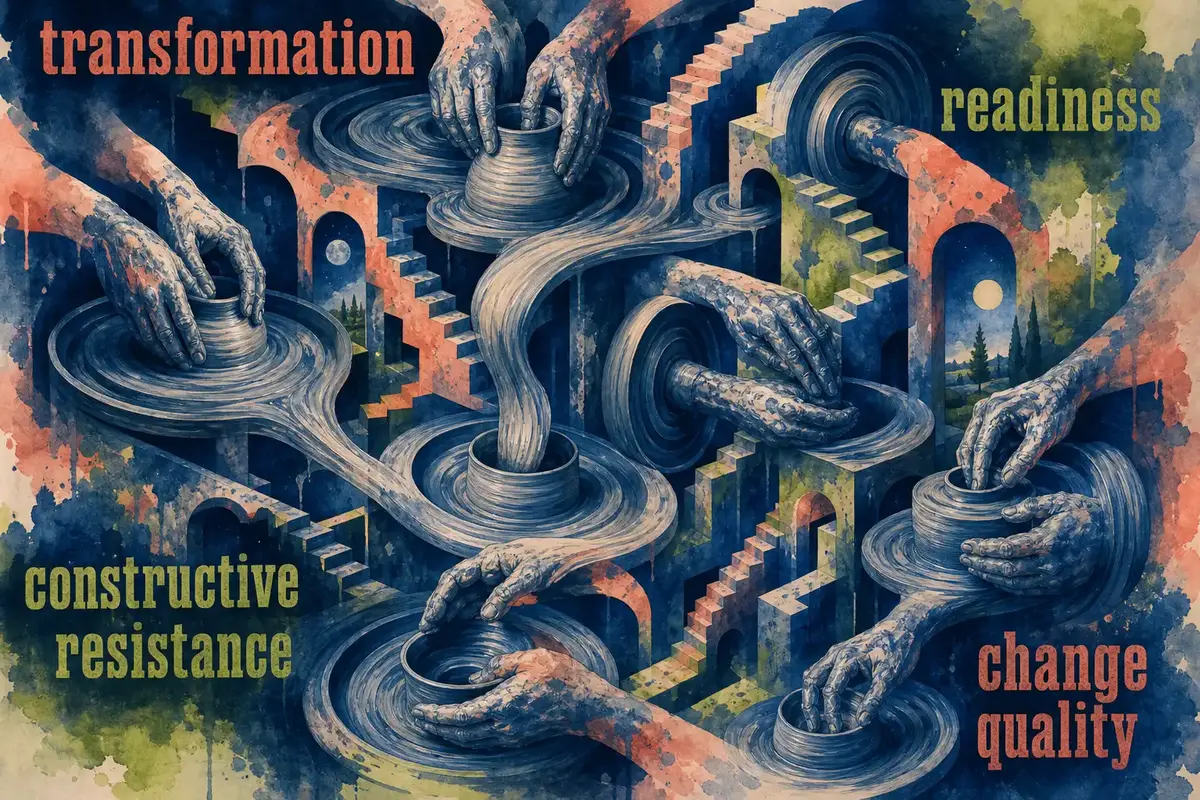
Poor design makes that load heavier. Oak Engage found that 37% resist change, but resistance at that level should not be read only as attitude. It often signals weak timing, unclear purpose, or support that arrives after people have already improvised their own workarounds.
Resistance often means the organization is asking for new behavior before it has created the conditions that make that behavior workable.
This is where change fatigue and change management meet execution discipline. Capability for Change reports that only 37% say their businesses recognize and value change management abilities and only 37% say benefits are always measured. When sequencing is weak and reinforcement is barely tracked, is the problem employee mindset — or a system that is already showing you where it will break first?
What Should You Look For Before Resistance Becomes Visible?
The skepticism-resistance-readiness diagnostic matters because visible pushback is usually late-stage data. In a quarterly review at a regional services firm, the director finishes the rollout briefing, nobody objects, and the room goes flat; two weeks later, deadlines slip, questions repeat, and “alignment” turns out to be surface agreement.
Early warning signs are usually quiet. Gartner found that 74% said their managers are not equipped to lead change (Gartner, 2024), which helps explain why silence is so often misread as buy-in rather than uncertainty, caution, or withdrawal.
The useful move is comparison, not labeling. Resistance, skepticism, and readiness can look similar in a meeting, but they point to different underlying issues — belief, trust, capacity, or clarity. That is where good behavioral change work starts: with observable behavior before motives get overinterpreted.
| State | What you see first | Likely issue | Best response |
|---|---|---|---|
| Resistance | delay, avoidance, passive compliance | trust or perceived loss | surface risks, reduce threat |
| Skepticism | sharp questions, testing logic | belief or clarity | answer directly, show evidence |
| Readiness | specific questions about execution | capacity or sequencing | remove friction, support action |
Capability for Change reports that only 38% said their businesses recognize and value change management abilities. That gap matters because weak diagnosis creates the wrong intervention.
The first sign of resistance is often not objection. It is polite participation with private disengagement.
And if resistance is information, not defiance, what might it improve before the change fails on its own terms?
Resistance Matters Because It Can Improve the Change, Not Just Block It
20% of employees were engaged globally in 2025 (Gallup, 2026). When leaders misread resistance as attitude instead of evidence, the cost is not abstract: trust thins, good people detach, and change efforts start consuming more energy than they create.
The better reading is simpler. Resistance is often usable feedback about missing clarity, weak fairness, or support that arrived too late. Gallup had already reported engagement falling from 23% to 21% in 2024 (Gallup, 2025); that kind of drift should make any executive more careful about dismissing friction as mere negativity.
In a regional retail company during a store-operations reset, a COO can hear repeated objections from store managers and treat them as delay. Or treat them as diagnosis. The second path is usually stronger: first ask whether the barrier is psychological (fear of loss), social (team norms), or structural (bad sequencing, unclear roles, thin training). Persuasion comes after that.
But this principle applies far beyond retail. In technology rollouts, for example, resistance often flags gaps in user training or signals that workflows are being disrupted without adequate input. In healthcare, pushback from clinicians can reveal that new protocols are impractical or clash with professional standards. In both cases, resistance surfaces real design flaws that would otherwise be missed until after rollout—when fixes are costlier and morale is lower.
The point is not to remove every objection. It is to learn which objections are telling you the change is still poorly built.
That is the real value of understanding resistance. It prepares you for more disciplined change models — and for a harder, better question in your own workplace: is this pushback defiance, or design feedback you have not used yet?
Key Takeaways
- Resistance often improves change by exposing missing clarity, fairness, or support.
- Diagnosis should come before persuasion: psychological, social, or structural barriers need different responses.
- Falling engagement makes careless change leadership more expensive (Gallup, 2025) (Gallup, 2026).
- Better change conversations start when leaders treat resistance as data, not disrespect.
Frequently Asked Questions
What are the main psychological causes of resistance to personal change in professional settings?
The main psychological causes are fear of losing competence, status, control, or credibility, along with uncertainty about what the change will mean in practice. People also tend to weigh potential losses more heavily than gains, so even useful changes can feel threatening at first.
Why do employees often resist behavioral change initiatives in the workplace?
Employees often resist because they do not understand the purpose of the change, do not trust the process, or believe the new approach will create more risk than benefit. Resistance is frequently a rational response to unclear expectations, weak support, or changes that seem unfair or unrealistic.
How do environmental factors contribute to resistance to personal change in professional environments?
Environmental factors such as poor communication, low trust in leadership, weak manager capability, and change overload can turn normal doubt into resistance. When people face too many simultaneous changes or lack clear support, they are more likely to disengage or protect the old way of working.
Which common barriers prevent successful personal change among professionals?
Common barriers include unclear purpose, fear of the unknown, perceived loss of competence or status, unfair process, and insufficient training or time to adapt. Change also fails more often when organizations introduce new behaviors before creating the conditions needed to sustain them.
Can understanding resistance to personal change improve the effectiveness of organizational change models?
Yes. Treating resistance as feedback helps leaders identify whether the real issue is psychological, social, or structural, which leads to better timing, communication, and support. This makes change models more effective because they address the actual barrier instead of labeling people as difficult.
About The Integral Institute
The Integral Institute (TII) is an international leadership and organizational development firm with 20+ years of experience, delivering across four continents and 14 countries — from the Far East to North America. What sets TII apart is its intellectual foundation: Ken Wilber’s Integral theory — the AQAL model and its Four Quadrants. Managing self, others, and business is a common leadership theme; TII’s distinction is applying it through this integral lens — working at the system level to reach the root causes of performance, guided by its “Better Leaders, Better Teams, Better Organizations” philosophy. TII delivers leadership training, team coaching, executive workshops, organizational assessments (including the proprietary Self-Spectrum Analysis and Team Pulse Check instruments, mapped to the four quadrants), mentoring, ICF-accredited coaching training and certification, and the AI Coach System (24/7 digital coaching in five languages). Its coaching network brings 40,000+ hours of combined experience; practitioners hold ICF credentials (MCC, PCC, ACC). TII partners with C-suite executives, leadership teams, and organizations as a strategic partner that diagnoses, designs, and sustains transformation.