

Why BANI Leadership Starts Where Resilience Playbooks Stop
$8.8 trillion in productivity is already sitting on the table in the form of disengagement—and BANI leadership is the moment you stop assuming the system will “bounce back” on schedule (Gallup, 2023). You’re in the quarterly review, staring at a plan that still looks coherent on slides, while the frontline is signaling something else entirely.
In that meeting, the tension isn’t whether your strategy is smart. It’s whether your operating model can recover when the next break isn’t a temporary dip but a structural shift—supplier failure, regulatory whiplash, model drift, talent flight—stacking faster than your governance can metabolize.
The cost shows up before the crisis does. Gallup reports 59% of employees are “quiet quitting” (not engaged) and 18% are “loud quitting” (actively disengaged) (Gallup, 2023). That means many organizations are entering brittle, anxious conditions with a workforce already conserving energy, withholding discretionary effort, or actively resisting change. If disengagement is already this large, what happens when brittle systems, anxiety, and model failure hit at the same time? This article gives you a practical evaluation guide to decide what to stabilize, what to experiment with, and what to redesign—before the system forces those decisions on you.
BANI Isn’t “Worse VUCA”—It’s a Different Contract With Reality
Most resilience playbooks quietly assume recoverability: a disruption occurs, you absorb it, and you return to baseline. In BANI conditions, that assumption becomes the first liability. The system may not return; it may reconfigure—customers change thresholds, regulators change definitions, platforms change rules, and yesterday’s “normal” becomes an artifact.

In practice, this is why “be more resilient” advice often fails experienced leaders: it optimizes for endurance, not adaptation under non-repeatable conditions. The leadership task shifts from protecting the plan to protecting the organization’s ability to notice and respond—without overreacting to noise or clinging to outdated assumptions.
The Leadership Shift: From Managing Plans to Managing Signals
In BANI environments, your advantage is rarely a better forecast. It’s response speed with discipline: how quickly you detect meaningful change, test what you believe, and update decisions without destabilizing the whole enterprise.
That requires a different posture:
- Treat signals (customer behavior, operational anomalies, talent sentiment, risk indicators) as first-class management inputs—not anecdotes.
- Make assumptions explicit so they can be challenged early, not defended late.
- Design decision pathways that reduce latency—fewer handoffs, clearer thresholds, tighter feedback loops.
If you want a practical starting point, connect this to how you already think about adaptive leadership: not as inspiration, but as an operating discipline for ambiguity—where learning is a deliverable, not a byproduct.
The uncomfortable question is what VUCA framing lets you keep believing—about predictability, control, and “returning to normal”—that BANI conditions no longer permit. Are you optimizing for stability, or for learning speed—when you can’t have both at full strength?
What Changes When VUCA Thinking No Longer Explains the System?
VUCA is useful precisely because it tempts you to believe you’re still in a world where better sensing and faster planning will close the gap. If VUCA still feels familiar, how do you know when it has stopped being enough to guide decisions? And more uncomfortably: what if the problem isn’t the environment’s volatility—but your system’s fragility under it?
Most leadership teams don’t notice the transition in a dramatic “before/after” moment. They notice it in the quality of surprises: small issues that cascade, decisions that create second-order failures, and teams that become cautious not because they lack grit, but because the system punishes initiative.
A Practical VUCA → BANI Comparison (What You Misread, What Changes)
Here’s the evaluative shift I use with executives when the language of “uncertainty” starts to feel like an excuse rather than a diagnosis:
| Lens | What leaders tend to assume | What breaks in practice | Operating posture that changes |
|---|---|---|---|
| Volatility (VUCA) | “Swings are temporary; we’ll normalize.” | Variance becomes structural, not cyclical. | Stop optimizing for return-to-baseline; optimize for reconfiguration. |
| Uncertainty (VUCA) | “More data will reduce ambiguity.” | Data arrives late—or misleads—because the system shifts underneath it. | Treat forecasts as hypotheses; shorten decision half-life. |
| Brittleness (BANI) | “We can absorb shocks if we buffer enough.” | The system doesn’t bend; it fractures at hidden constraints. | Identify single points of failure; redesign load paths, not just buffers. |
| Anxiety (BANI) | “People need reassurance.” | Anxiety is a signal of conflicting demands and unclear thresholds. | Make trade-offs explicit; reduce interpretive burden on teams. |
| Nonlinearity (BANI) | “Small changes produce small effects.” | Minor triggers create outsized outcomes—good or bad. | Run bounded experiments; monitor leading indicators, not lagging KPIs. |
| Incomprehensibility (BANI) | “If we explain it better, it will make sense.” | Causality is opaque; narratives overfit. | Build sensemaking discipline; separate story from decision. |
Why Resilience Playbooks Fail When Systems Fracture
Traditional resilience playbooks often assume elasticity: stress increases, performance dips, then recovery follows. In BANI conditions, the failure mode is different—phase change. A process doesn’t degrade; it flips. A supplier delay becomes a compliance breach; a model tweak becomes a customer trust event; a staffing gap becomes a safety incident.
Consider a mid-market manufacturing VP in a quarterly review: the plan says “increase throughput 6%,” but the real constraint is a brittle quality gate plus a single experienced technician who’s one resignation away from stopping the line. The “resilience” response is to push harder and add overtime. The BANI response is to redesign the dependency—cross-train, simplify the gate, or change the product mix—because pressure is what reveals brittleness.
The Boundary Condition: When BANI Is the Right Lens (and When It’s Not)
BANI is the right lens when local fixes repeatedly trigger system-level side effects, when risk is coupled across functions, and when explanations multiply while predictability declines. If the issue is ordinary execution—unclear owners, slow approvals, weak follow-through—calling it “complexity” is a way to avoid accountability.
A clean test: are you facing unknown outcomes despite competent execution, or known outcomes that aren’t being delivered? If it’s the first, you need an adaptive leadership posture—learning speed as a managed capability. If it’s the second, fix the basics before you redesign the universe.
The harder question is what you do when cause-and-effect can’t be proven in time—do you wait for certainty, or act on signals and accept you might be wrong?
How Do You Make Sense of Nonlinear Systems Without Pretending They Are Predictable?
OODA Loop thinking matters here because nonlinear systems punish leaders who confuse speed with clarity. Most organizations still behave as if the right dashboard and a few more weeks of data will restore a stable narrative. What the evidence actually shows is that performance improves when managers shift from “explaining the system” to learning with the system—using structured conversations and tight feedback loops rather than post-hoc certainty. In one six-week test of a minimally invasive intervention focused on how managers run one-on-ones, teams improved conditions that underpin speaking up and surfacing issues earlier (MIT Sloan Management Review, 2023).
Picture a regional healthcare provider where a director is in the monthly capacity review: patient volumes look stable, call-center complaints are spiking, clinician overtime is up, and no single metric “proves” what’s happening. The failure mode isn’t bad judgment; it’s waiting for certainty that never arrives—while the system keeps moving.
A Sensemaking Routine That Doesn’t Require a Perfect Story
You need a sensemaking routine with three artifacts and a cadence—lightweight enough to survive real weeks, strict enough to prevent narrative drift.
Start with weak-signal scanning: a 15-minute weekly sweep where each function brings two anomalies—something that changed, and something that didn’t change when it “should have.” The goal is not consensus; it’s coverage.
Then run a hypothesis board: 5–8 active hypotheses written as “If X is true, we should observe Y within Z days.” Assign an owner, a disconfirming test, and a decision date. This is where teams practicing sensemaking as a team discipline stop arguing about interpretations and start competing on test quality.
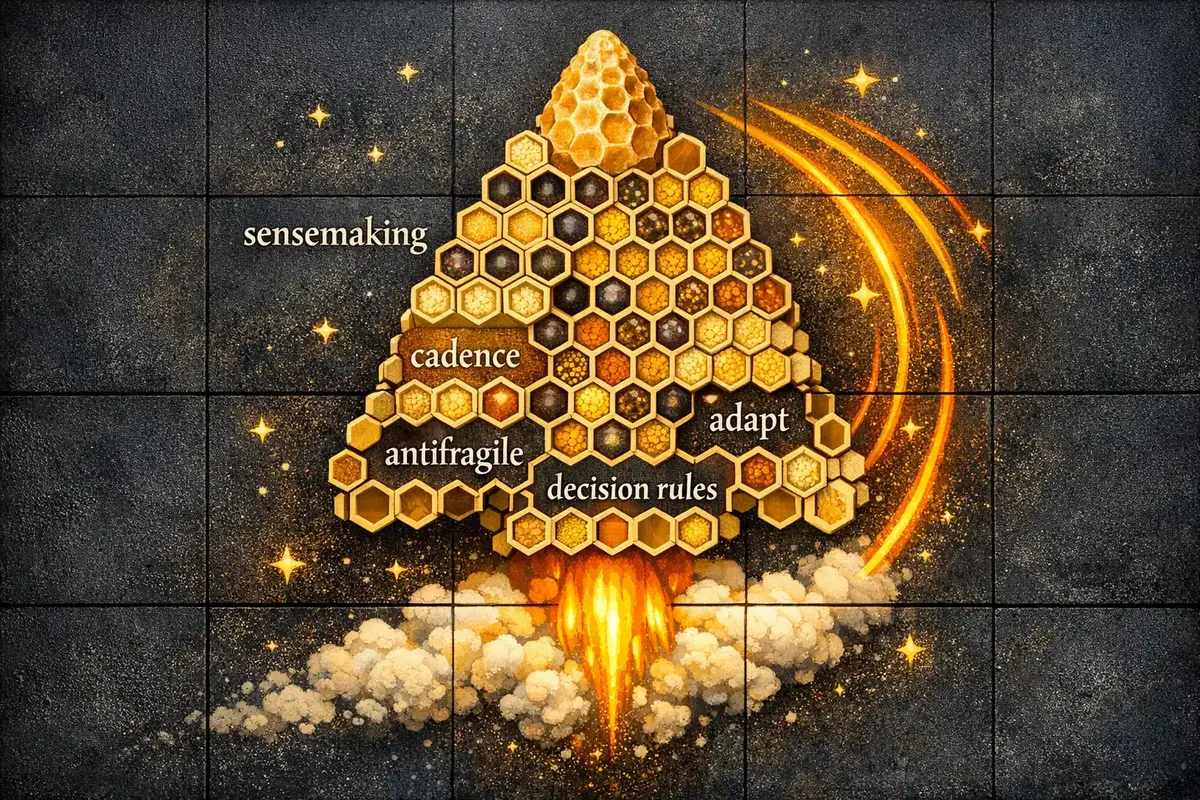
Finally, enforce short feedback loops: two-week “probe cycles” with pre-committed check-ins. If the probe can’t produce a directional signal in two weeks, it’s probably too big—or too vague.
Signal vs. Noise When Small Inputs Create Big Outputs
In nonlinearity, the trick is to stop treating every spike as meaning and every calm period as safety. Use three filters.
First, persistence: does the anomaly repeat across two cycles, or was it a one-off? Second, cross-correlation: does it show up in two independent places (e.g., patient no-shows and pharmacy backlogs), or only in one metric? Third, reversibility: can you roll back the action quickly if you’re wrong? If not, you’re not experimenting—you’re gambling.
Translate this into team practice with shared assumptions (“what must be true for this plan to work”), explicit decision rules (“if overtime exceeds X for two weeks, we pause new intake”), and a recurring “what the system taught us” review. That last ritual is where leaders earn trust: not by being right, but by updating in public.
The uncomfortable question is whether your teams are anxious because they’re fragile—or because they’re seeing signals you haven’t made discussable. Are you optimizing for certainty, or for learning—when the system won’t give you both?
Why Anxiety Is a Systems Signal, Not a Personal Weakness
52% of workers reported feeling stress a lot of the day yesterday—which means your “people issues” are already a material operating condition, not a side conversation (Gallup, 2023). When leaders misread that stress as individual fragility, the costs show up fast: revenue leaks through slow decisions, trust erodes through inconsistent calls, and your best operators leave because they can’t predict what “good” looks like anymore.
Here’s the contrast most executives miss: stress is often treated as a remote-work artifact or a personal resilience gap, yet engagement has 3.8 times as much influence on stress as work location (Gallup, 2023). If that’s true, it quietly redefines the manager’s real job. Not “keep people happy,” but reduce avoidable threat signals created by the system—especially unclear priorities, unpredictable communication, and perceived loss of control.
Anxiety as an Emergent Property of the Operating Model
Anxiety isn’t only a private experience; it’s also a collective output of how work is designed and led. The World Health Organization estimates 4.4% of the global population currently experience an anxiety disorder, and only 27.6% receive any treatment (World Health Organization (WHO), 2025). In organizational terms, that’s a reminder to stop assuming “support resources” will catch what your operating model keeps generating—many people won’t access care, and even when they do, the workplace can continue to re-trigger the same threat response.
A scenario I see in enterprise finance: a director enters budget cycle with three competing messages—“cut run-rate,” “invest in automation,” and “don’t miss service levels.” Leadership updates priorities in fragments (a Slack note here, a town hall there), and approvals arrive late. The director’s team doesn’t become anxious because they’re weak; they become anxious because every choice risks being punished later under a different interpretation. The hidden tax is time: hours spent pre-aligning, documenting defensively, and waiting for “one more confirmation” before acting.
The Leadership Levers: Clarity, Bounded Autonomy, Predictable Rhythms
Reducing anxiety starts with clarity that is operational, not inspirational: “These are the three priorities, this is the trade-off order, and this is what we will not do this quarter.” Then add bounded autonomy: define decision rights with thresholds (“You can approve up to X,” “Escalate when Y happens”), so control is shared without becoming chaotic.
Finally, install predictable communication rhythms. Teams can tolerate bad news; they struggle with randomness. A simple cadence—weekly priorities, midweek risk check, end-of-week decisions—lowers interpretive burden and prevents rumor from becoming the default sensemaking engine. This is where adaptive communication becomes a leadership discipline rather than a style choice (adaptive communication).
Psychological Safety Isn’t Soft—It’s the Container for Hard Truth
Psychological safety enables candor, but candor without intellectual honesty becomes comfort theater—people speak, nothing changes, and cynicism grows. The leader’s move is to pair safety with hard edges: name the real constraints, surface the real disagreements, and make decisions visible even when they disappoint. Done well, safety isn’t “be nice”; it’s “we can tell the truth here” (psychological safety).
If anxiety is a systems signal, the question becomes sharper: will you keep buffering people from reality—or redesign the organization so it can absorb reality without breaking?
Which Design Choices Make an Organization More Antifragile?
An organization optimized for efficiency will break in the place it can’t see. That matters because the first failure is rarely the headline event—it’s the quiet loss of options that makes every later decision feel urgent and expensive.
If a system is optimized for efficiency, what exactly breaks first when conditions turn brittle? Most leaders assume it’s a process, a vendor, or a piece of technology. The more uncomfortable possibility is that what breaks first is choice: the ability to reroute work, revise commitments, and learn without triggering a cascade.
Antifragility starts as a design stance: you don’t try to predict shocks; you build optionality so shocks have somewhere to go.
Resilience vs. Antifragility: Absorb, Adapt, or Redesign
Resilience is about absorbing stress and returning to a workable state. Antifragility is about getting better because stress reveals what to simplify, split, or stop. Leaders need the distinction because it changes the decision you make in the moment: do you absorb (stabilize), adapt (reconfigure), or redesign (change the load-bearing structure)?
A practical way to decide is to classify the pressure you’re seeing:
- If the stressor is temporary and the system is fundamentally sound, standardize the response—clear playbooks, clear thresholds.
- If the stressor is recurring and the system keeps improvising, modularize—separate components so one failure doesn’t contaminate the whole.
- If the stressor is novel and the cost of being wrong is high, leave flexible—small reversible moves, fast learning, and explicit “kill criteria.”
This is where an adaptive leadership toolkit earns its keep: not as theory, but as a way to keep redesign decisions from turning into political debates.
The Structural Choices That Create Optionality
Optionality is built from four structural choices, each with a tradeoff leaders must name out loud.
Modularity: design teams, systems, and suppliers so work can be rerouted without rewriting everything. Modularity often looks “inefficient” on a spreadsheet because it duplicates interfaces and adds coordination overhead. In practice, it prevents local failures from becoming enterprise incidents.
Redundancy: keep more than one way to deliver the critical outcome—skills, vendors, environments, decision-makers. Redundancy is not hoarding; it’s insurance against single points of failure that only show up under load.
Slack: protect time and capacity for recovery and improvement. Without slack, every surprise becomes overtime, and overtime becomes error, and error becomes rework—the most expensive kind of “efficiency.”
Fast feedback loops: shorten the distance between action and learning. Feedback loops are a design choice—where you place sensors, how quickly you review anomalies, and whether teams can change course without permission theater.

Where “Brittle Optimization” Hides Risk
In a mid-market retail chain, a VP of Operations enters a budget cycle under pressure to “take cost out.” They centralize inventory decisions, reduce store labor buffers, and lock replenishment into a tighter algorithmic cadence. For a quarter, the numbers look clean. Then a supplier disruption hits and local managers can’t flex ordering, can’t add hours, and can’t substitute products without approvals—so shelves go empty, customer complaints spike, and the team spends weeks in manual workarounds.
That’s brittle optimization: efficiency gains that quietly remove the buffers needed for recovery and the slack needed for learning. The system doesn’t fail because people didn’t try; it fails because the design made adaptation non-permissible.
The real question is whether your Monday-morning cadence creates options—or consumes them—because when the next shock arrives, will you standardize fast, or improvise slowly?
What Does a Monday-Morning BANI Operating Cadence Look Like?
More than 1,000 teams and 7,000 individuals were included in a randomized controlled trial at Sandoz (a Novartis division)—which matters because it shows small, repeatable manager routines can scale without turning into a culture campaign (MIT Sloan Management Review, 2023). If leaders cannot measure adaptive capacity, how will they know whether the system is actually getting better?
Most organizations still treat “adaptation” as a project: a transformation program, a reorg, a new tool. The evidence points in a less glamorous direction: micro-interventions in how managers run the week can change what teams surface, how fast they learn, and how early risks become discussable—without waiting for a new strategy cycle (MIT Sloan Management Review, 2023).
The Cadence: Weekly Sensing, Monthly Scenario Refresh, Quarterly Stop/Scale/Redesign
A Monday-morning BANI cadence is not “more meetings.” It’s a decision rhythm that keeps the organization’s attention aligned with reality.
Weekly sensing (45 minutes, same agenda): one page, four questions.
- What changed that could break us in 30–90 days?
- What didn’t change that should have (stalled demand, stuck defects, frozen pipeline)?
- Where did we make a decision last week that created downstream cleanup?
- What do we need to decide this week—and who owns it?
Monthly scenario refresh (60–90 minutes): update three scenarios, not ten. The deliverable is a short list of trigger thresholds (if X happens, we do Y) and the assumptions you’re no longer willing to fund. This is where the operating model stops being a diagram and becomes a living set of decision rules.
Quarterly stop/scale/redesign (half-day): treat it like portfolio management for uncertainty.
- Stop: work that consumes attention but doesn’t change outcomes.
- Scale: practices that shortened learning cycles or reduced rework.
- Redesign: constraints that repeatedly force heroics (handoffs, approvals, single points of expertise).
Minimum Viable Routines (Adaptive Without Meeting Overload)
In an enterprise technology company, a VP in a QBR realizes the real bottleneck isn’t roadmap quality—it’s decision traffic: product, security, and legal each “review” work, but nobody can say when a review becomes a decision. The fix isn’t another steering committee. It’s three routines: a weekly sensing huddle, a single monthly scenario refresh, and a quarterly stop/scale/redesign where leaders remove constraints instead of adding priorities.
Keep it minimal:
- One sensing meeting replaces three status meetings.
- One decision log replaces five follow-up threads.
- One experiment review replaces post-mortems that arrive after the window closes.
This is consistent with what scaled interventions look like in practice: small changes in manager behavior, applied consistently, can move system conditions across many teams (MIT Sloan Management Review, 2023).
Metrics That Make Adaptive Capacity Visible
If you can’t measure it, you’ll manage vibes. Track four adaptive capacity metrics:
- Decision latency: median days from issue surfaced → decision made.
- Rework rate: percentage of work reopened due to late changes or misunderstood requirements.
- Experiment cycle time: days from hypothesis → signal → decision (continue/kill/iterate).
- Escalation frequency: number of escalations per week, split into “clarity gaps” vs. “risk events.”
When these move in the wrong direction, your system isn’t “busy”—it’s stuck. The real test is what happens next: will your cadence produce learning under pressure—or produce compliance under stress?
The Real Test of Adaptive Leadership Is Whether the System Learns Faster Than It Breaks
When leaders treat a failing model as a temporary glitch, they don’t just lose revenue—they spend trust like it’s renewable and then act surprised when talent walks. This matters because in BANI conditions, the hidden cost isn’t the shock; it’s the compounding fragility created by delayed learning.
I’ve watched this play out in a regional services firm during a client escalation that should have been containable. A director kept defending the delivery plan because it had been “approved,” while the frontline kept flagging that the client’s definition of value had shifted. The immediate damage was obvious—missed renewals, late nights, reputational drag—but the deeper damage was cultural: people learned that surfacing reality creates friction, while protecting the narrative earns safety. That’s how you end up with a system that looks calm right until it breaks.
BANI Leadership Is Model Management—Not Plan Defense
The practical synthesis of everything in this article is simple: BANI leadership is model management. Your “model” is the bundle of assumptions you’re funding—about customer behavior, operational capacity, risk tolerance, and what trade-offs the organization will accept without escalation.
In stable environments, leaders can afford to defend plans because the environment cooperates often enough to make persistence look like competence. In BANI environments, persistence without updating becomes a liability: it turns yesterday’s logic into today’s constraint. The adaptive leader’s job is to keep the organization oriented to what is still true—and to retire what is no longer true without turning it into a political loss.
This is where anxiety regulation stops being a wellness sidebar and becomes a core leadership act. If people can’t tell what “good” looks like, they will either freeze, over-escalate, or quietly disengage. The leader’s move is not to manufacture certainty; it’s to reduce interpretive burden—clear decision rights, explicit trade-offs, and visible updates when assumptions change.
The Evaluation Lens: Can You Sense, Decide, and Adapt Before Fragility Compounds?
A useful closing test is a contrast, not a slogan: when the model fails, what matters more—having the right answer, or having a system that can keep learning?
Ask three questions that cut through theater:
- Sense: Do inconvenient signals travel fast, or do they get “cleaned up” as they move upward?
- Decide: When reality changes, do decisions happen where the information lives—or only where permission lives?
- Adapt: Can teams make small, reversible moves without triggering governance antibodies—or does every adjustment require a justification campaign?
If any one of these is weak, antifragility stays theoretical. Stress won’t make you better; it will simply reveal where you’ve removed options—through over-centralization, brittle dependencies, or a culture that confuses alignment with agreement.
The goal, in the end, isn’t control. It’s coherence—shared priorities, bounded autonomy, and disciplined sensemaking—even while conditions remain unclear. So here’s the honest next step: where is your organization still defending the plan—when it should be updating the model?
Key Takeaways
- BANI leadership shifts the focus from recovering to baseline to noticing, responding, and reconfiguring under structural change.
- VUCA thinking can miss brittleness, anxiety, nonlinearity, and incomprehensibility when systems start to fracture.
- Sensemaking routines, short feedback loops, and explicit decision rules help teams learn faster than the system breaks.
- Antifragility comes from optionality: modularity, redundancy, slack, and fast feedback built into the operating model.
Frequently Asked Questions
What is adaptive leadership in a BANI environment?
Adaptive leadership in a BANI environment is the practice of helping an organization notice change early, test assumptions quickly, and adjust decisions before small disruptions become system-wide failures. It focuses less on returning to a previous normal and more on reconfiguring the operating model so the organization can keep learning under brittle, anxious, nonlinear, and hard-to-interpret conditions.
How is BANI different from VUCA for leaders?
VUCA assumes leaders can improve sensing and planning to manage volatility and uncertainty, while BANI highlights deeper conditions such as brittleness, anxiety, nonlinearity, and incomprehensibility. In BANI settings, the system may not bounce back or become clearer with more data, so leaders must redesign dependencies, shorten feedback loops, and manage signals rather than defend old plans.
What practical routines help teams make sense of BANI conditions?
Useful routines include weekly weak-signal scanning, a hypothesis board with testable assumptions, and short probe cycles with clear decision dates. These practices help teams separate signal from noise, update beliefs in real time, and avoid waiting for perfect certainty before acting.
How can leaders reduce anxiety in a BANI operating model?
Leaders reduce anxiety by making priorities, trade-offs, and decision rights explicit so people are not forced to guess what matters most. Predictable communication rhythms, bounded autonomy, and psychologically safe candor lower uncertainty and help teams act without constant fear of being punished later.
What design choices make an organization more antifragile?
Antifragility comes from building optionality through modularity, redundancy, slack, and fast feedback loops. These choices let the organization absorb shocks, reroute work, and learn from stress instead of becoming more brittle when conditions change.