

Why Most Founder Visions Stall Before They Become Businesses
Steve Blank’s startup framework is the right place to start: a startup is not a smaller version of a finished company, but a search for a repeatable and scalable business model. Miss that, and founder vision turns into premature execution — product roadmaps harden, hiring starts, and cash gets committed before the business has earned the right to scale (Steve Blank).
That is where most first-time CEOs get trapped. They are not short on conviction; they are short on a model for reducing uncertainty. In practice, that means months spent refining features, brand language, and operating plans when the harder question is still unanswered: who will buy, why now, and under what economics? The cost is not abstract. It shows up in wasted build cycles, confused teams, and a market window that narrows while the company is still arguing with its own assumptions. This article is about how founders turn vision into something testable before they turn it into something expensive.
A startup, in Blank’s formulation, is “an organization formed to search for a repeatable and scalable business model” (Steve Blank). That single sentence corrects a common early-stage mistake: treating the business as if it already exists. It does not. Early on, what exists is a hypothesis set — about customer pain, willingness to pay, channel access, delivery cost, and timing. The founder’s job is not to defend those assumptions. It is to expose them.
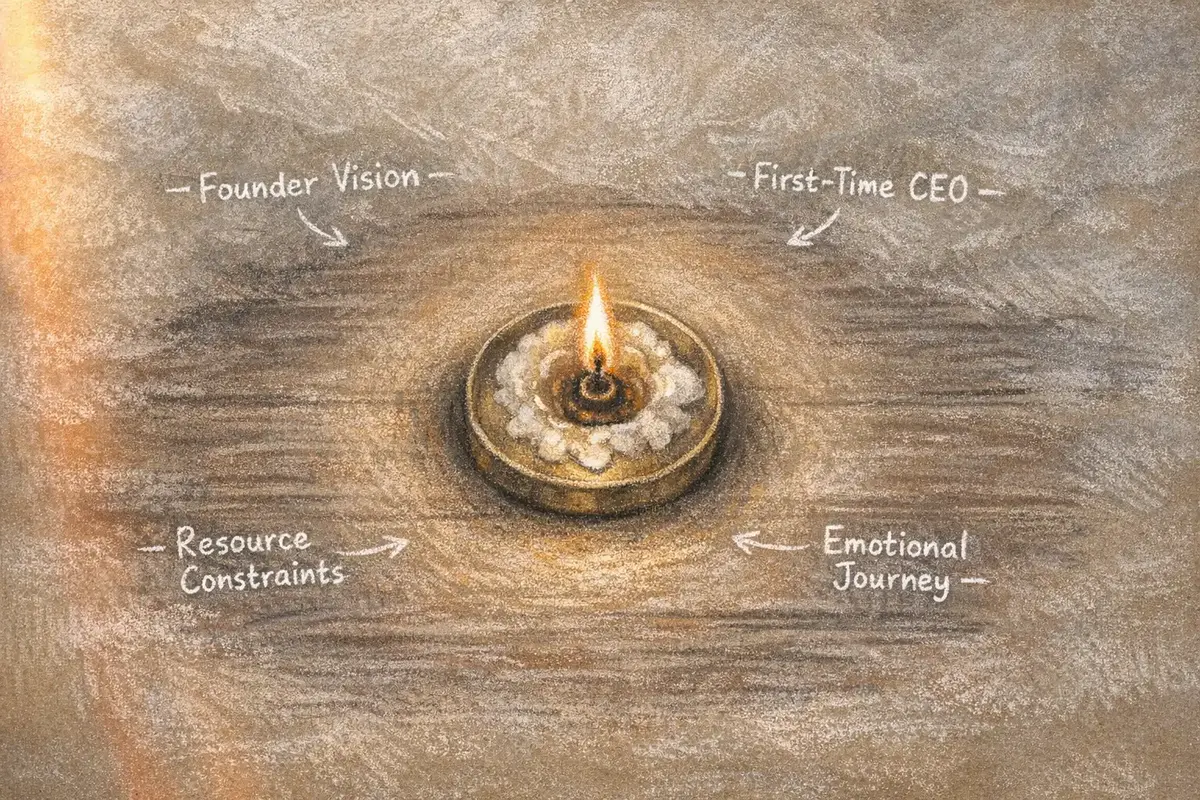
The Real Failure Mode Is Overbuilding
Consider a technology startup led by a first-time founder during a quarterly budget review. The team has a polished demo, a growing feature backlog, and strong internal belief. What they do not have is evidence that the same customer problem appears often enough, hurts enough, and can be solved at a margin that supports growth. So they keep building.
That pattern is common because inspiration feels like progress. Execution theater feels like momentum. But adding product before proving the model usually makes learning slower, not faster. Every new feature creates more to maintain, more to explain, and more reasons to avoid the uncomfortable work of testing demand directly.
This is why first-time founder CEOs need a different mental model. The early task is not to look established. It is to learn faster than the burn rate.
Vision Matters — But Only If It Can Survive Contact With Reality
Vision still matters. It sets direction, attracts talent, and gives the company a reason to exist beyond short-term tactics. But vision alone cannot tell you whether you have a business, a product idea, or simply a compelling story.
That distinction matters more than most founders expect. If a startup is a search, then the next question is unavoidable: what exactly are you searching for — a vision, a business model, or a plan?
What Is the Difference Between a Vision, a Business Model, and a Business Plan?
Business Model Canvas thinking matters here because it forces a distinction most first-time CEOs blur: are you describing the future you want, the logic of how the company works, or the document you will show other people? Why do so many founders write a plan before they understand the model that the plan is supposed to describe? And why does that confusion survive even in smart teams?
Because the three terms sound adjacent. They are not.
Three Layers, Three Jobs
A vision describes a future state. It answers: what change should exist if this company succeeds? It is directional, not operational. Good vision creates coherence. It helps a founder recruit, decide what not to do, and stay anchored in purpose-driven leadership. But vision does not tell you, on its own, who pays, how you reach them, or what must be true for the company to survive.
A business model does that work. It explains how value is created, delivered, and captured. In plain terms: for whom are you solving a problem, through what offer, via which channel, with what revenue logic and cost structure? Steve Blank’s definition is useful precisely because it strips away the theater: a startup exists to search for a repeatable and scalable business model, not to admire its own ambition (Steve Blank).
If the vision is the destination, the business model is the engine.
A business plan is different again. It is an artifact — a planning and communication document. It organizes assumptions into forecasts, milestones, budgets, and narratives that investors, lenders, or internal teams can review. Useful, sometimes necessary. But still downstream from the model. A plan can be well written and still rest on a weak business model.
Where Founders Usually Get It Wrong
In a regional healthcare startup, a founder reaches the annual budgeting cycle with a polished 24-page plan, hiring assumptions, and a launch calendar. The board asks a simpler question: which customer segment will adopt first, and why will they switch now? Silence. The plan was detailed; the model was still vague.
That is the practical test. If your answer depends on aspiration, you are talking about vision. If it depends on spreadsheets, you may be talking about a plan. If it explains the causal mechanics of demand, delivery, and economics, you are finally in business-model territory.
This is also why MVP strategy belongs at the model layer. An MVP is not a smaller product for its own sake. It is a test of the riskiest assumptions inside the model — demand, behavior, pricing, channel response, retention signal — before full buildout locks in cost and complexity.
Founders who miss this sequence do not just waste money. They learn the wrong lessons from the wrong evidence. So which assumptions deserve to be tested first — the ones that sound urgent, or the ones that can kill the model fastest?
Which Assumptions Should First-Time Founders Test First?
Most founders test what is easiest to build, not what is most likely to break the business. That mistake matters because early-stage failure rarely comes from lack of effort; it comes from protecting the wrong assumptions for too long.
In most organizations, the first debate is about features, launch timing, or the roadmap. The evidence from startup practice points somewhere else. If a startup is a search for a repeatable and scalable business model, the first job is to identify the assumptions that can invalidate that search fastest (Steve Blank).
Start With the Assumptions That Can Kill Demand
Three assumptions usually sit at the top of the list: customer need, willingness to pay, and channel logic.
Customer need sounds obvious, which is why founders often skip past it. They hear interest and infer urgency. They hear compliments and infer demand. But a problem can be real and still not be painful enough to change behavior. The useful question is not whether prospects “like” the idea. It is whether they will interrupt current habits to solve the problem now.
Willingness to pay is different again. Founders often treat it as a pricing question to answer later. In practice, it is a signal about value now. If a buyer will not commit money, time, or procurement attention, the issue is usually not price optimization. It is that the problem is still optional.
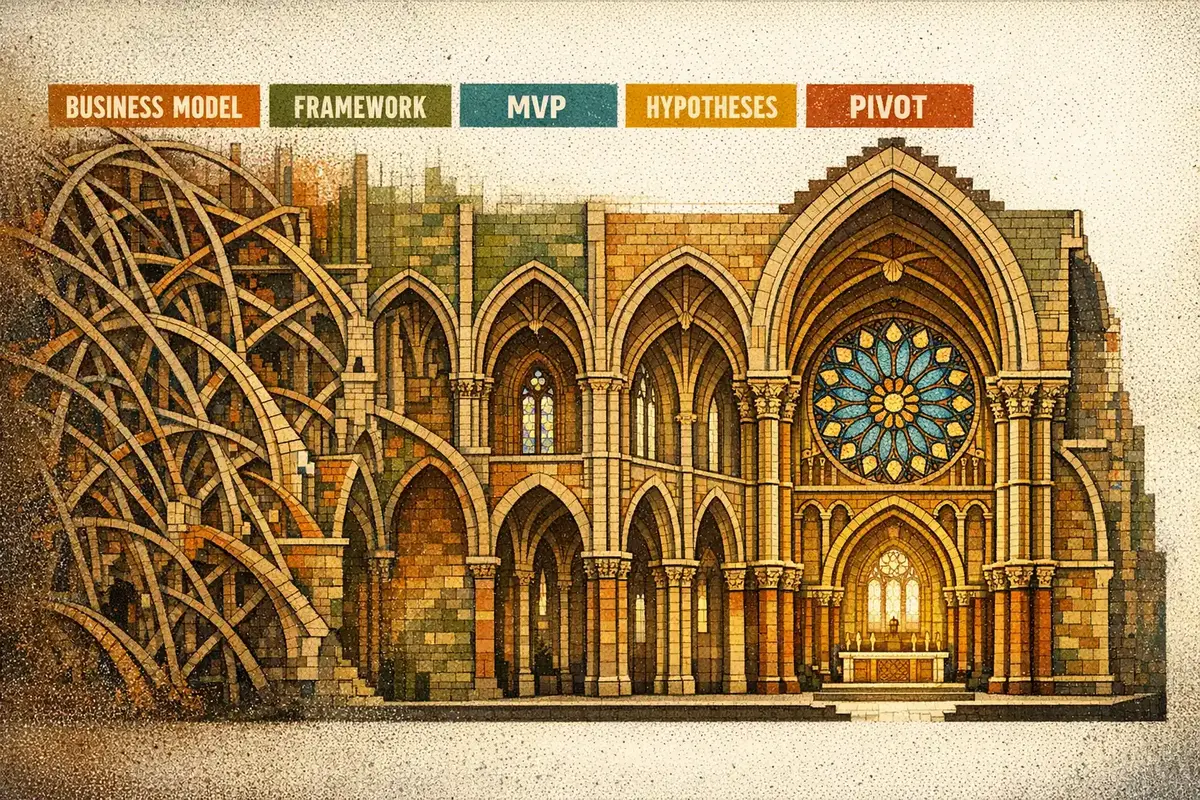
Channel logic is where many first-time CEOs get surprised. They assume the path to customers will work because it makes sense on paper: outbound sales, partnerships, content, founder-led networks. Then the real market pushes back. Access is slower, gatekeepers are stronger, or the buyer sits in a different function than expected. A strong offer with weak distribution is still a weak model.
Turn Vision Into Hypotheses, Not Beliefs
At a quarterly review inside a services startup, the founder faces a familiar choice: approve another build sprint or pause and test why deals keep stalling after strong first calls. That is the decision moment. Not inspirational — operational.
A founder vision becomes actionable only when translated into testable hypotheses: We believe this buyer has this problem, will act in this context, and will buy through this path. That framing changes the work. Teams stop defending the idea and start examining the conditions under which it becomes true.
This is also where integral leadership helps. It asks leaders to hold conviction and inquiry at the same time — enough belief to move, enough discipline to let reality correct them.
Let Scarcity Do Its Job
Scarcity is not just a constraint. It is a filter.
Limited time, money, and attention force founders to rank assumptions by consequence. Which unknown, if false, makes the rest irrelevant? Test that first. Then the next one. This is the discipline of not building too much, too soon — and it is closer to leadership than many founders realize.
The best early tests do not confirm the vision. They expose whether the business deserves to exist in its current form.
That raises the harder question. If founders should test before they build, what does the research actually say about how much learning that sequence creates — and what it saves them from?
What Does the Research Say About Testing Before You Build?
A/B testing improved startup performance by 30% to 100% after a year, according to Harvard Business Review — a result that should change how first-time CEOs think about validation from day one (Harvard Business Review, 2024). Without a structured testing discipline, founders do not just risk building the wrong product; they harden the wrong business model.
That is the real point. If a simple testing discipline can change outcomes this much, why do so many founders still rely on instinct alone?
Testing Is Not a Growth Tactic First
Many founders hear A/B testing and think landing pages, ad copy, or late-stage conversion work. Too narrow. In the earliest stage, the same logic applies to the model itself: which message gets a response, which buyer segment books a second call, which pricing frame creates real commitment, which channel produces qualified demand rather than polite interest.
Research consistently shows that experimentation works best when it is treated as a decision tool, not a marketing trick. The value is not the test artifact. It is the reduction of uncertainty.
In a retail startup during a quarterly review, the founder faces a familiar choice: approve another six weeks of product work, or pause and run two simple tests on offer positioning and checkout friction. One path produces more code. The other produces evidence. Only one of those helps answer whether demand is weak, the message is off, or the buying process itself is the problem.
Structured Tests Beat Founder Intuition
Founder instinct matters. It helps teams move before the data is complete. But instinct is weakest where founders are closest to the idea — especially when customer enthusiasm gets mistaken for purchase intent.
This is where a validation system matters. Not one test. A sequence.
A useful system asks the same question repeatedly at different points: what must be true for this model to work? Then it designs small tests around those conditions. Message. Offer. Price. Channel. Onboarding. Retention signal. Each test is modest on its own, but together they show whether the business is becoming more repeatable or merely more elaborate.
Startups that test systematically are not just optimizing faster; they are learning which parts of the business model deserve to survive (Harvard Business Review, 2024).
That has leadership implications too. A founder who can explain why the team is testing — and what decision each test will inform — projects more than confidence. They project judgment, which is a core part of executive presence.
Validation Has to Become Operating Rhythm
The strongest early-stage companies do not “do validation” once and move on. They build a cadence around it. Weekly review, explicit hypotheses, clear stop-or-scale decisions. That is how testing becomes part of execution rather than a side exercise.
And that creates the next challenge. If testing tells you which assumptions are holding, how do you assemble those signals into something more durable than an MVP — a minimum viable business model, or just a pile of encouraging experiments?
How Do You Build a Minimum Viable Business Model, Not Just an MVP?
Minimum Viable Business Model is the framework that matters here. What if the smallest viable business is more useful than the smallest viable product?
Most first-time CEOs assume the MVP is the main milestone. It is not. A product can be minimally functional and still sit inside a broken commercial system. That is why so many early wins fail to compound: the demo works, the economics do not, and the path from interest to revenue remains improvised.
Steve Blank’s definition is the anchor: a startup is searching for a repeatable and scalable business model, not merely shipping an early product (Steve Blank). The MVP is a learning device inside that search. The minimum viable business model is broader: the smallest coherent system that can create value for a specific customer, deliver that value reliably enough, and capture enough value in return to justify continuing.
Build the First Loop, Not the Full Machine
The first model should be simple enough to explain on one page and concrete enough to survive contact with buyers. Five elements have to connect in one loop: customer, problem, value proposition, revenue logic, and delivery method.
If one of those elements floats free, the model is not viable yet. A strong value proposition without a believable delivery method creates operational drag. Revenue logic without a painful problem creates polite conversations and stalled deals. Delivery without a defined customer turns the team into a custom shop.
In a manufacturing startup, the founder reaches a quarterly review with a working prototype and encouraging pilot feedback. The decision on the table is whether to fund another three months of engineering. The harder question is better: who exactly buys this, through what process, at what price point, and can the company deliver without bespoke effort every time? That is the moment the conversation has to move from product confidence to model coherence.

Coherence Under Scarcity
The goal is not completeness. It is coherence under scarcity.
Early-stage founders do not need a finished org chart, a mature pricing architecture, or channel diversification. They need one working loop that does not depend on heroics. One customer type. One urgent problem. One offer people understand. One way to get paid. One delivery path the team can execute repeatedly, even if imperfectly.
The first viable model is not the most ambitious version of the business. It is the simplest version that holds together.
This is where teams often need discipline more than creativity. Left alone, smart people add options. They create tiers, segments, exceptions, and feature branches. The better move is subtraction. Fewer moving parts make it easier to see what is actually working and easier to align the team around it — which is why integral team coaching becomes practical, not philosophical, once the model starts to take shape.
A founder can tolerate ambiguity in the market for a while. The team cannot tolerate ambiguity in direction for long. When the first model begins to work, a new risk appears — not confusion about the offer, but confusion about leadership. Is the company scaling a model, or just stretching founder energy past its limit?
Why Does Leadership Clarity Matter as Much as the Idea Itself?
70% of the variance in a team’s engagement is influenced by the manager (Gallup). For a first-time CEO, that means execution risk does not sit only in the market or the model; it sits in how clearly the founder leads while the model is still being discovered.
If the founder is unclear, how can the team execute a business model that is not finished yet? They cannot. They fill the gap themselves — with assumptions, side priorities, and local decisions that may be reasonable in isolation but destructive in combination.
Clarity Is an Operating Mechanism
In an early-stage finance startup, the founder walks into a quarterly review with three live debates: push enterprise sales, simplify onboarding, or add a feature requested by the loudest prospect. The team is capable. The problem is not talent. The problem is that nobody knows which tradeoff governs the quarter.
That is where leadership clarity stops being a soft topic. It becomes an operating mechanism. A founder has to make three things explicit: what matters now, what can wait, and what the next test is meant to prove. Without that, the company does not have alignment; it has parallel interpretations.
Startups feel this faster than larger firms because the team is small and the work is tightly coupled. One vague priority from the founder can distort product, sales, hiring, and customer conversations in the same week. Research from Gallup is useful here not because it flatters managers, but because it assigns responsibility. If manager behavior explains most of the variation in engagement, then founder behavior is part of the business model’s success conditions, not a separate people issue (Gallup).
In a startup, unclear leadership is not just demotivating. It is expensive.
Small Teams Magnify Leadership Quality
Gallup also found that employees who know and use their strengths are nearly 6x more engaged, 7.8% more productive, and 3x more likely to report an excellent quality of life (Gallup). In a ten-person company, those gains are not cultural decoration. They change throughput.
A strengths-based approach does not mean indulging preferences or avoiding hard work. It means assigning critical work with more precision: the person best at discovery leads customer interviews; the operator who creates order runs implementation; the teammate with strong judgment handles ambiguous client issues. That kind of role clarity reduces drag when everyone is already overloaded.
This is also where market-specific leadership adaptation becomes practical. The founder’s job is not to lead in the abstract. It is to adjust clarity, cadence, and decision style to the market they are actually facing. Over time, even predictive HR analytics can help show where overload, misfit, or leadership bottlenecks are starting to slow execution.
A weak idea can fail quickly. A strong idea under unclear leadership fails slowly — and usually costs more. So when the first model starts to work, what should the founder stabilize first: the product, or the company’s ability to repeat what just worked?
What Should Founders Do After the First Model Starts to Work?
Only 20% of startups launch successfully in the sense of reaching product-market fit and scaling up (McKinsey). That gap is where revenue gets left on the table, early customer trust gets strained, and good people start wondering whether the company is building a business or just chasing momentum.
Treat Early Traction as Evidence, Not Proof
When the first model starts to work, the temptation is obvious: call it validation, add headcount, widen the roadmap, and push for growth. That is often the moment founders become least accurate. A working model is not a final answer. It is a live hypothesis that has survived a first round of contact with the market.
In a regional services startup, the founder walks into a quarterly review after three strong months. A few clients have renewed. Referrals are starting. The team wants to hire two more people and expand the offer set. The harder question is simpler: what exactly is working? Is it the segment, the timing, the founder’s personal selling, the pricing, or a temporary market condition? If you cannot name the mechanism, you are not ready to scale it.
Early traction is valuable. Misreading it is expensive.
Watch the Signals That Actually Matter
Founders need a short list of signals that tell them whether to refine, pivot, or scale.
Refine when demand is real but delivery is messy — customers buy, but onboarding is slow, margins are thin, or retention depends on founder intervention. Pivot when interest stays high but conversion stalls, usage is inconsistent, or the buyer you expected is not the one moving the deal forward. Scale only when the same type of customer is buying for the same reason through a process the team can repeat without improvising every step.
This is where discipline matters more than optimism. Research can tell you how few startups make the jump to fit and scale (McKinsey). It cannot make the judgment call for you. That still belongs to the founder.
Stay Close to Learning, Protect Strategic Clarity
The durable move is not endless flexibility. It is structured learning inside a clear direction.
That means staying close to customers, reviewing what changed in the last ten conversations or ten deals, and separating noise from pattern. It also means protecting the core logic of the company so the team does not reinterpret every new signal as a strategy change. This is where purpose-driven leadership earns its keep: not as inspiration, but as a way to keep adaptation from turning into drift.
The founder’s job now is more mature than before. Learn fast. Narrow carefully. Scale late enough that the model deserves it.
If your first model is working, good. Now ask the harder question: are you seeing a repeatable business — or just a promising exception?
Key Takeaways
- Founder vision matters, but it must be translated into a testable business model before it becomes expensive.
- Vision, business model, and business plan are different layers with different jobs.
- First-time founders should test the assumptions most likely to break demand, not the easiest features to build.
- Early traction is evidence, not proof; founders should refine, pivot, or scale based on repeatable signals.
Frequently Asked Questions
What is the difference between a founder vision and a business model?
A founder vision describes the future change the company wants to create, while a business model explains how the company will create, deliver, and capture value. Vision is directional; the business model is operational and shows who pays, why they buy, and how the economics work.
Which assumptions should early-stage founders test first?
The highest-priority assumptions are customer need, willingness to pay, and channel logic. These are the fastest ways to learn whether the problem is painful enough, whether buyers will commit, and whether the company can actually reach customers efficiently.
Why is testing before building so important for startups?
Testing before building reduces uncertainty and prevents teams from locking in the wrong product or business model. Structured experimentation can reveal whether demand is real, pricing is viable, and the buying process works before major time and money are spent.
What makes a minimum viable business model different from an MVP?
An MVP is the smallest product used to test a specific assumption, but a minimum viable business model is the smallest complete system that can create, deliver, and capture value. It includes the customer, problem, offer, revenue logic, and delivery method working together.
What should founders do after the first business model starts working?
Founders should treat early traction as evidence, not proof, and identify exactly what is repeatable before scaling. The next step is to refine weak parts of the model, pivot if the wrong customer or channel is driving results, or scale only when the same outcome can be repeated reliably.