

Why Strategic Thinking Becomes a Performance Discipline in Uncertain Systems
4.2 times more likely to be healthy: if leaders who act decisively create that kind of performance gap, what are you really measuring when you assess strategic thinking in complexity? Not intelligence. Not planning quality. The harder question is whether your leaders can make coherent choices when ambiguity rises, speed compresses, and trade-offs stop staying inside one function. That gap matters because uncertainty does not usually break strategy first; it breaks decision behavior (McKinsey, 2024).
The cost shows up fast. In a quarterly review at a mid-market healthcare company, a VP can defend margin, service quality, and hiring discipline individually—yet still leave the room with a portfolio of choices that cannot all be true at once. Teams then spend weeks translating mixed signals into local priorities, reworking plans, and escalating conflicts that should have been resolved upstream. Over time, that is not just friction. Healthy organizations deliver 3x TSR over the long term versus unhealthy ones (McKinsey, 2024). This article addresses the real issue: how leaders think strategically when competing priorities, incomplete information, and organizational complexity collide.
Strategic Thinking Is a Decision Capability, Not a Calendar Event
Many executives still treat strategic thinking as a planning exercise—something that happens offsite, gets documented, and then gets handed to the business. In practice, it is a performance discipline. It determines whether a leadership team can hold multiple truths at once: near-term pressure and long-term positioning, local optimization and enterprise value, speed and reversibility.
That is why strong strategy work often looks less dramatic than people expect. It is visible in cleaner choices, fewer contradictory messages, and sharper sequencing. It also depends on whether leaders have built the habits and leadership development needed to think across systems rather than defend functions.
The Executive Test Is Simpler Than It Looks
The real evaluation question is not whether complexity exists. It does. The question is whether your current decision habits reduce confusion, preserve alignment, and improve execution under pressure.
That standard is unforgiving. If your meetings produce motion without clarity, if priorities multiply faster than resources, or if teams need repeated interpretation before they can act, the issue is not effort. It is strategic coherence. In environments shaped by organizational complexity, that coherence becomes a competitive asset.
And once priorities begin to compete openly—cost against growth, autonomy against consistency, speed against control—what worked as planning starts to fail as leadership.
Why Traditional Planning Breaks Down When Priorities Compete
63% of employers say skill gaps are a major barrier to business transformation (World Economic Forum, 2025). That should change how leaders read a polished strategic plan: the problem is often not ambition, but whether the organization can keep converting shifting conditions into usable decisions.
Planning Assumes Stability. Complexity Removes It.
Traditional planning works best when inputs are stable enough to forecast, sequence, and control. Demand holds. Constraints are known. Stakeholders want roughly the same thing. In that world, a plan is a coordination tool.
Complex environments do not offer that courtesy. Inputs move while decisions are being made. A cost target collides with a customer promise. A hiring freeze lands in the middle of a growth push. Regulatory pressure changes the timing of an investment that looked sensible three weeks earlier. The issue is not that leaders failed to think. It is that the logic of a linear plan cannot absorb competing priorities fast enough to stay useful.
That is why the gap between strategic planning and strategic thinking matters. Planning asks, “What is the path?” Strategic thinking asks, “What must remain true if the path changes?”
The Breakdown Usually Looks Rational at First
In a regional manufacturing company during budget season, the COO pushes for throughput, the CFO defends cash discipline, and the commercial lead wants faster customization for key accounts. Each position is reasonable on its own. Together, they create a plan that asks operations to increase output, reduce inventory risk, and expand product variation at the same time.
No one is being careless. The failure is structural.
DDI found that leaders identified setting strategy and managing change as their two greatest skill gaps (DDI, 2025). That finding matters because it points to capability, not intent. Many executive teams still treat uncertainty as a temporary disruption to be planned around, when it is increasingly the operating environment itself.
When leaders rely on plans built for stable conditions, they often confuse internal consistency with external readiness.
Overconfidence is the real trap. A detailed roadmap can create the feeling of control long after the assumptions underneath it have started to move. Teams then spend cycles defending milestones, escalating exceptions, and rewriting priorities instead of making better trade-offs.
Build a Decision System, Not Just a Plan
The better question is not whether the annual plan is complete. It is whether the organization has a decision system that can survive incomplete information, changing constraints, and competing stakeholder demands.
That requires different executive discipline: clearer trade-off rules, faster escalation paths, and shared criteria for what gets protected when everything cannot. So when priorities collide, what helps most — a more detailed plan, or a framework for deciding which truth matters now?
Which Decision Framework Helps Leaders Act Without Oversimplifying Reality?
The OODA loop—observe, orient, decide, act—works in complexity because it treats decision-making as a live cycle, not a one-time answer. Without a framework like it, leaders either freeze while waiting for certainty or force a false simplicity that hides the real trade-offs.
What makes OODA useful in executive settings is not speed alone. It is structure. Observe asks what has changed externally and internally. Orient tests what that change means across functions, not just inside one leader’s remit. Decide narrows the choice to what must be resolved now. Act turns that choice into a visible commitment, with the expectation that the next loop may revise it.
CCL’s research is clear on the capability underneath this: strategic leadership requires making sense of ambiguous conditions and acting despite ambiguity, complexity, and chaos (CCL, 2024). That is why the framework matters. It gives leaders a way to move without pretending the environment is fully knowable.
Use the Framework to Sort Signal From Noise
In a fast-growing enterprise software company, a product VP enters a quarterly review facing three simultaneous pressures: a major client escalation, rising implementation costs, and a competitor’s new pricing move. The weak response is to treat all three as equally urgent. The better response is to use the loop to separate signal from noise.
Signal changes the decision. Noise changes the emotional temperature.
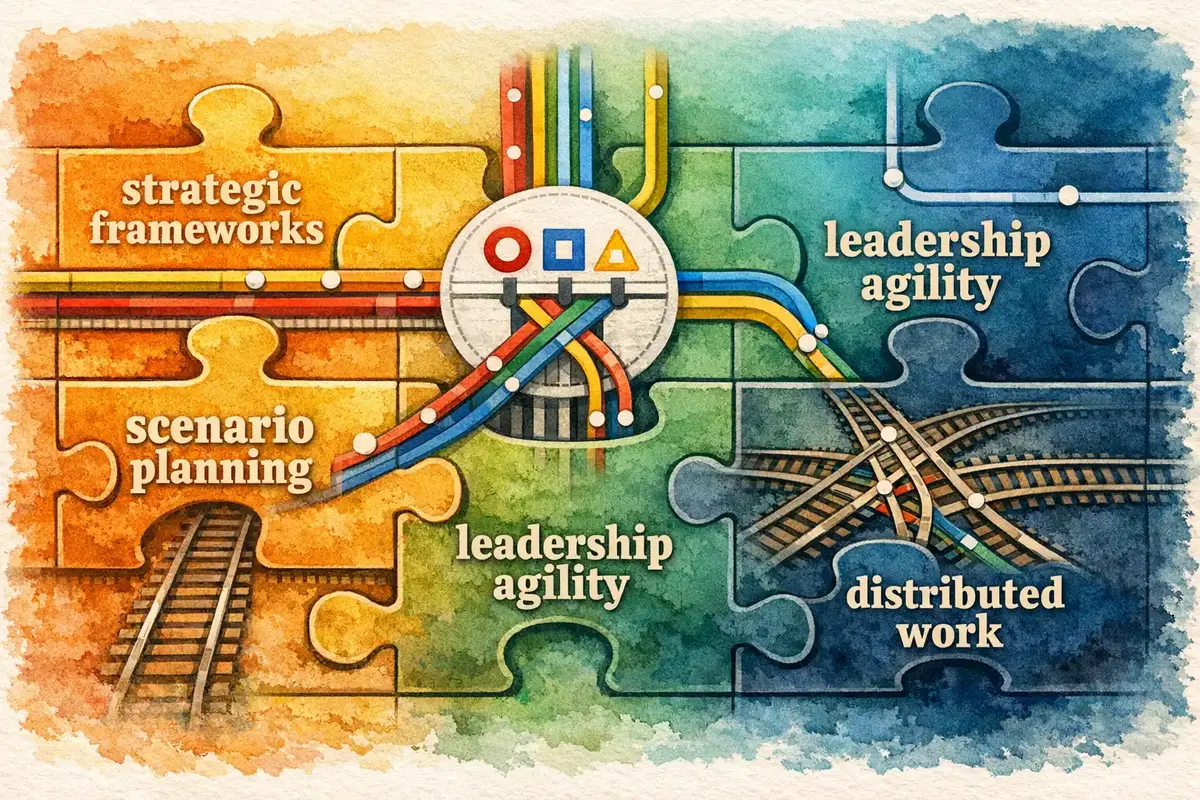
That distinction is where many leadership teams fail. They spend time debating every new input instead of asking which inputs alter resource allocation, timing, risk exposure, or customer value. A useful framework should force that discipline. If a new fact does not change one of those four, it may deserve monitoring—not immediate escalation.
7 in 10 business leaders say being fast and nimble will be their primary competitive strategy over the next three years (Deloitte, 2026)
Fast and nimble, though, does not mean reactive. It means knowing which decisions are reversible, which are expensive to unwind, and which can wait for better information.
Judge the Framework by Outcomes, Not Elegance
The test of a decision framework is brutally practical. Does it improve alignment, because functions can see the same logic? Does it improve speed, because teams know what is decided now versus later? Does it improve adaptability, because commitments can be revisited without looking like failure?
Neat models often impress in workshops and collapse in operating reviews. The right one survives contact with competing incentives.
That creates the next leadership challenge. Once a team can make sharper decisions under uncertainty, can it build enough shared understanding for the rest of the organization to execute them—or does clarity still stop at the top?
How Do Leaders Build Alignment Before They Ask for Execution?
78% more motivated: that is the advantage employees report when they feel aligned with leadership goals (PwC, 2025). Most organizations still treat alignment as a communication task at the end of strategy work, when the evidence suggests it is part of the work itself.
Alignment Is the Operating Mechanism, Not the Memo
What if the real execution problem is not resistance, but that teams never fully understood what mattered most?
Leaders often believe a decision is aligned once the executive team agrees in the room. It is not. Alignment begins when people across functions can interpret the same priority in the same way, make compatible trade-offs, and act without waiting for repeated clarification. Until then, strategy remains intent. It has not yet become coordinated action.
That distinction matters because ambiguity does not stay abstract for long. It turns into local optimization. Sales protects revenue. Operations protects capacity. Finance protects cost. Each team behaves rationally. The enterprise does not.
In a regional financial services firm during a budget reset, the C-suite announced three priorities within the same week: improve client responsiveness, tighten expense discipline, and simplify internal controls. A division director heard “move faster.” A compliance lead heard “reduce risk.” A service manager heard “do more with fewer people.” Within a month, approval times had stretched by 12 days because every team was honoring a different version of the strategy.
No one was ignoring leadership. They were interpreting it.
Shared Meaning Comes Before Speed
The strongest leaders do something less visible before they ask for faster execution. They translate strategy into shared meaning.
That means naming what takes precedence when goals collide. It means defining which metrics matter most this quarter, which trade-offs require escalation, and which tensions teams are expected to manage on their own. This is the practical work of executive alignment: not getting leaders to agree in principle, but getting the organization to act from the same logic.
Employees who feel most aligned with leadership goals are 78% more motivated (PwC, 2025)
Motivation, in this context, is not a soft variable. It affects pace, judgment, and discretionary effort. When people know what matters most, they stop burning time decoding mixed signals. They commit earlier. They escalate less. They execute with fewer collisions.
This is why alignment should be tested before launch, not after slippage appears. Can three different leaders explain the priority stack the same way? Can a frontline manager tell which goal wins when resources tighten?
If the answer is no, pushing for speed only scales confusion. And once alignment exists, a harder question appears: how do leaders prepare for futures where today’s shared priorities may need to change—gradually, or all at once?
Why Scenario Planning Is the Executive Discipline That Reduces Surprise
85% of employers plan to prioritize upskilling, which tells you most leadership teams already know volatility is not temporary (World Economic Forum, 2025). Yet in too many quarterly reviews, the surprise is the same: the market moved, a dependency failed, a customer segment shifted, and the executive team is still arguing about whether this is noise or a real change in the game.
That gap is why scenario planning matters. Not because it predicts what comes next, but because it trains leaders to recognize patterns earlier and respond with less hesitation when conditions start to bend.
Harvard Business Publishing found that 40% of organizations are putting more emphasis than last year on building a change-ready organization (Harvard Business Publishing, 2025). Useful. But change-readiness without disciplined foresight often becomes a slogan. Teams invest in capability, then still get caught flat-footed because no one has pressure-tested the assumptions underneath the strategy.
The Real Value Is Pattern Recognition Under Pressure
In a national retail enterprise, a C-suite team enters a holiday planning cycle expecting margin pressure, stable supplier lead times, and moderate promotional intensity. Six weeks later, freight costs jump, a competitor cuts prices aggressively, and consumer demand softens in two regions. The issue is not that leaders lacked data. It is that they had not worked through which signals would matter together, or which moves would still make sense across more than one plausible future.
That is what scenario planning should do. It forces executives to test assumptions before reality does it for them.
The practical questions are sharper than most workshops allow. Which assumptions are load-bearing? What weak signals would tell us our base case is eroding? Which investments are robust across three different futures — and which only work if today’s conditions hold?
The point is not to name the future correctly. The point is to avoid being strategically late.
Use Scenarios to Strengthen Decisions, Not Add Theater
Done badly, scenario work creates more planning theater: polished narratives, color-coded matrices, no effect on capital allocation or operating choices. Done well, it improves strategic resilience. Leaders identify trigger points in advance, define contingent responses, and protect options that preserve room to maneuver.
This also connects directly to capability building. If 85% of employers are prioritizing upskilling, the question is what they are upskilling for (World Economic Forum, 2025). In complex environments, one answer is judgment: the ability to interpret weak signals, revisit assumptions, and adapt without panic. Harvard Business Publishing’s emphasis on change-ready organizations only becomes real when that judgment is built into leadership routines, not reserved for offsites (Harvard Business Publishing, 2025).
And even that is not enough. An organization can prepare for multiple futures and still exhaust its people trying to respond to all of them at once — so what separates resilient change leadership from institutional burnout?
What Separates Change Leaders From Organizations That Burn Out?
51% of CHROs now rank leadership and manager development among their top three priorities. So why do so many transformation efforts still drain energy faster than they build capability (SHRM, 2025)?
Most executives assume burnout during change is a communication problem or a resilience problem. It often is neither. The deeper issue is that organizations try to move faster than their systems can absorb, then mistake visible activity for real progress.
That is where the contrast begins.
Change Fails on Pace Before It Fails on Intent
In a mid-market services company during a team restructure, a VP launched a new operating model, updated performance metrics, and rolled out a manager training program inside one quarter. On paper, the plan looked disciplined. In practice, managers were still learning one set of expectations when the next one arrived. Within eight weeks, decision turnaround slowed by 10 days because basic approvals kept getting rechecked.
The problem was not resistance. It was sequencing.
Strong change leaders understand that transformation is not a test of how many initiatives the organization can survive at once. It is a test of pacing—what must change now, what can wait, and what the business has the managerial bandwidth to absorb without degrading execution. That is why change management is less about launch energy than about load management.
Organizations with leaders who take decisive actions and commit to them are 4.2 times more likely to be healthy (McKinsey, 2024)
Commitment matters here because half-decisions are exhausting. Teams can carry a hard change. What wears them down is reversal, overlap, and the constant reopening of choices that were supposedly settled.
Adoption Is the Real Leadership Outcome
Many transformation programs still treat adoption as a downstream implementation metric. That is too late. If people do not understand what is changing, why it is sequenced this way, and which old behaviors are no longer required, leaders have not completed the job. They have only announced it.
This is why SHRM’s finding matters beyond HR priorities (SHRM, 2025). Manager quality determines whether change gets translated into workable routines or into daily friction. The strongest leaders protect organizational stamina by narrowing the number of active priorities, holding the line on decisions already made, and watching for fatigue as closely as they watch milestones.
Momentum is fragile. Exhaustion spreads faster.
And once leaders see that clarity, pacing, and commitment are inseparable, a final question remains: how do you reduce confusion decisively—without pretending the future has become predictable?
The Strongest Strategic Leaders Reduce Confusion Without Pretending Certainty
Bad strategy in complexity rarely fails quietly. It shows up in delayed deals, frayed trust, and strong people deciding they are done translating mixed signals for one more quarter.
When the environment keeps changing, durable strategic leadership does not look like confidence theater. It looks like disciplined judgment — seeing the system clearly enough to act, without flattening it into a story so simple that the organization loses room to adapt.
Clarity Is Not the Same as Certainty
In an enterprise technology company during a market shift, the executive team cut spending in one division while pushing aggressive growth targets in another. The message sounded decisive. A month later, product leaders were slowing hiring, sales leaders were discounting to protect pipeline, and customer teams were escalating exceptions because no one could tell which trade-off actually governed the business. The problem was not ambiguity in the market. It was confusion inside the firm.
The strongest leaders reduce that confusion by naming what is true now, what is being watched closely, and what would cause a decision to change. That is a harder discipline than projecting certainty. It requires leaders to hold a line and keep it permeable.
This is where judgment matters most. Not as instinct. As a repeatable executive practice of interpreting signals, choosing with intent, and revisiting assumptions without making the organization feel whipsawed.
Companies that improved organizational health saw higher EBITDA after one year (McKinsey, 2024)
That finding matters because health is not an abstract culture score. In practice, it reflects whether people can understand priorities, trust decisions, and keep moving when conditions shift.
One Operating Rhythm, Not Three Separate Jobs
Weak leadership teams split the work into separate buckets: foresight at the offsite, alignment at the town hall, execution in the operating review. Strong teams connect them into one operating rhythm.
They scan for change, translate implications quickly, and turn choices into usable direction. Then they watch what execution is teaching them. That loop is the work.
This is the real advantage in complexity. Not prediction. Not perfect plans. The ability to keep making better decisions as reality keeps moving.
If you are leading through competing priorities now, the honest test is simple: does your organization need repeated interpretation before it can act — or can people make sound decisions from the same logic? Your next step may be less about adding strategy and more about removing confusion.
Key Takeaways
- Strategic thinking is a decision capability that helps leaders act coherently under uncertainty.
- Traditional planning breaks down when priorities compete and conditions keep changing.
- Alignment, scenario planning, and change pacing are essential to execution in complex systems.
- Strong strategic leaders reduce confusion without pretending certainty.
Frequently Asked Questions
What is strategic thinking in organizational complexity?
Strategic thinking in complexity is the ability to make coherent decisions when priorities compete, information is incomplete, and conditions keep changing. It focuses on choosing what matters most, preserving alignment, and adapting without losing direction.
Why does traditional planning break down in uncertain environments?
Traditional planning assumes stable inputs, clear constraints, and predictable cause-and-effect. In complex environments, those assumptions fail because priorities collide, conditions shift quickly, and a linear plan cannot absorb trade-offs fast enough to stay useful.
What decision framework helps leaders act without oversimplifying reality?
A useful approach is the OODA loop: observe, orient, decide, act. It helps leaders continuously update their understanding, separate signal from noise, and make timely choices without pretending the situation is fully knowable.
How do leaders build alignment before asking for execution?
Leaders build alignment by creating shared meaning across functions, not just by announcing priorities. People need to understand what takes precedence when goals conflict, which trade-offs are acceptable, and how decisions should be interpreted in practice.
What separates effective change leadership from burnout during transformation?
Effective change leadership manages pacing, sequencing, and organizational load instead of launching too many initiatives at once. It protects adoption by holding decisions steady, reducing overlap, and matching the speed of change to the organization’s capacity to absorb it.