

Why AI-Augmented Workforces Are a Leadership Design Problem, Not a Tech Rollout
Up to 30% of current hours worked could be automated by 2030. That is not mainly a technology forecast; it is a leadership stress test for any CHRO deciding how work, accountability, and judgment should be redesigned (McKinsey, 2023).
You have seen the scene. In a quarterly review, a business unit leader asks why one team is experimenting with AI tools while another has banned them, legal is worried about risk, and managers are quietly rewriting expectations without any shared model for performance. The issue on the table looks like software adoption. It is actually operating design.
The cost of getting that wrong compounds fast. If a meaningful share of work can shift, but leadership still treats AI as a tool rollout, the organization creates uneven workflows, confused role boundaries, and a credibility gap between executive ambition and frontline reality. That gap is already visible: only one in five executive respondents say HR owns the future of work strategy in their organization today (IBM, 2024). This article addresses that gap by showing why AI workforce readiness starts with leadership architecture, not procurement.
The Shift Starts Smaller Than Most Leaders Think
AI rarely transforms an enterprise in one move. It changes work first at the task level: drafting, summarizing, searching, coding, scheduling, triaging. Once enough tasks move, the role changes — what a manager reviews, what an analyst owns, what expertise still matters, what speed now becomes normal.
Only after those two shifts does the deeper challenge appear. Leadership assumptions start to break. How do you define good judgment when machines can generate options instantly? What should employees escalate, and what should they decide alone? Which work still creates meaning, mastery, and trust?
That is why this is not just a systems question. It is an organizational transformation question.
CHROs Are Designing More Than Adoption
The practical job for the CHRO is to frame AI as organizational redesign across people, process, and meaning. People: which capabilities, decision rights, and manager habits now matter most. Process: where work should be re-sequenced, simplified, or governed differently. Meaning: how the organization explains fairness, contribution, and growth when work is redistributed between humans and machines.
This is where many AI programs stall. The technology works well enough, but the surrounding system does not. Incentives still reward old behaviors. Managers are not equipped to lead mixed human-machine workflows. Employees hear efficiency language and infer disposability.
The real leadership question is sharper than “Where can we deploy AI?” It is this: when tasks move, which roles must evolve — and does your organization know how to lead that transition before culture absorbs the shock?
What Does an AI-Augmented Workforce Actually Mean for CHROs?
Thirty-nine percent of workers’ core skills are expected to change by 2030. If the workforce is shifting that fast, what exactly should CHROs prepare for: fewer jobs, different jobs, or a different logic for organizing work itself? The answer matters, because leaders who collapse those possibilities into one vague “AI strategy” usually train the wrong people for the wrong changes (World Economic Forum, 2025).
The labor-market signal is not simply contraction. The World Economic Forum projects 170 million new jobs and 92 million displaced jobs by 2030, a net gain that tells you the real issue is not whether work survives, but how work is reassembled (World Economic Forum, 2025).
Three Terms CHROs Need to Separate
Start with plain language.
Automation means the system does the task with minimal human involvement. Think invoice matching, meeting transcription, or first-pass document classification. The human role shrinks around exception handling.
Augmentation means the human still owns the outcome, but uses AI to move faster or see more. A recruiter drafts outreach with AI, then adjusts tone and judgment. A service agent gets suggested responses, but decides what to send. The task remains human-led; the machine changes speed, range, or consistency.
Job redesign is broader. It happens when enough tasks shift that the role itself must be redefined: what the person is accountable for, what decisions they make, what skills now distinguish strong performance. This is where many CHROs underestimate the change. They fund training for tools when the business actually needs new role architecture.
| Term | Plain-language meaning | What changes most |
|---|---|---|
| Automation | The system does the task with minimal human involvement. | Human role shrinks around exception handling. |
| Augmentation | The human still owns the outcome, but uses AI to move faster or see more. | Speed, range, or consistency changes. |
| Job redesign | Enough tasks shift that the role itself must be redefined. | Accountability, decisions, and skills change. |
AI-Augmented Does Not Mean Less Human
In a regional healthcare provider during annual planning, a VP of operations may find that AI can summarize patient communications, draft follow-up notes, and flag scheduling gaps. None of that removes the need for human work. It changes where human effort should go — less time on administrative throughput, more on escalation judgment, patient trust, and cross-functional coordination.
That is the practical meaning of an AI-augmented workforce: not fewer people by definition, but more deliberate task allocation. Machines take pattern-heavy, repeatable work. Humans concentrate on ambiguity, accountability, and relationship-rich decisions. Done well, this is a redesign of the future of work, not a simple efficiency program.
170 million new jobs and 92 million displaced jobs by 2030 — a labor-market reshuffle, not a one-way reduction in work (World Economic Forum, 2025)
AI Literacy Is Not One Thing
Employees need working literacy: what the tool can do, where it fails, when to verify, and what data should never be entered.
Managers need something harder. They need supervisory literacy: how to allocate tasks between people and systems, how to evaluate output quality, how to spot overreliance, and how to reset performance expectations when cycle times drop. That is not software training. It is management redesign.
And once management changes, a bigger question appears. If skills are shifting, but roles and workflows stay untouched, where does the value actually come from — better tools, or a better operating model?
Why Operating-Model Transformation Beats Skills-Only Thinking
Organizations that focused on operating-model transformation outperformed skills-focused peers 44% more frequently—that is the core logic of the operating-model transformation framework, not a side note (IBM, 2024). Without that frame, companies build training catalogs faster than they redesign decisions, workflows, and accountability—and the gains stall where work actually happens.
What if the real advantage is not who trains fastest, but who redesigns work most intelligently?
Skills still matter. But skills alone are downstream of design. If a service organization teaches prompt writing, for example, yet keeps the same approval layers, the same fragmented handoffs, and the same manager expectations, employees may produce drafts faster while customers experience no meaningful improvement. The bottleneck was never capability in isolation. It was the system around the capability.
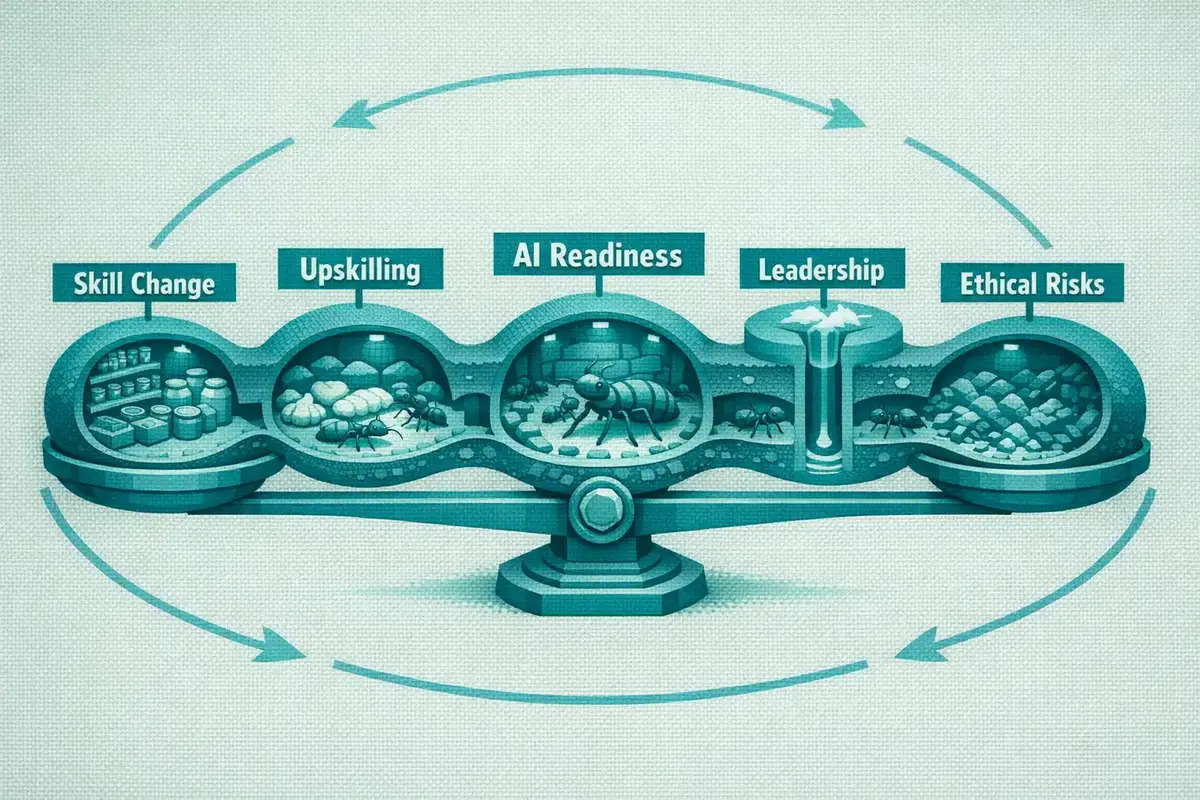
The progression is usually predictable. Tasks change first: summarizing cases, drafting responses, surfacing anomalies. Then roles change: the analyst spends less time compiling and more time interpreting, the manager reviews exceptions instead of every transaction. Only then do the harder shifts arrive—leadership behaviors and governance. Who decides when AI output is good enough? What requires human review? Which errors are tolerable, and which are unacceptable?
The Real Return Comes From Redesign
A mid-market manufacturer in budget season offers a familiar example. The operations director funds AI training for planners, expecting faster scheduling and fewer stockouts. Three months later, planners are indeed using the tools. But plant managers still override recommendations informally, procurement still works from separate data, and no one has clarified who owns the final call when machine suggestions conflict with local judgment. Adoption happened. Performance did not.
That gap explains why executive outcomes are showing up unevenly. PwC reports that 56% of CEOs say GenAI has created efficiencies in how employees use their time, while about 32% report increased revenue and 34% increased profitability (PwC, 2025). Time savings are easier to capture than enterprise value because efficiency can come from a tool; revenue and margin usually require coordinated redesign.
56% of CEOs report employee time efficiencies, but only around one-third report revenue or profitability gains (PwC, 2025)
Human Value Often Rises, Not Falls
This is the part many leadership teams miss. As AI handles more pattern-heavy work, the premium on human judgment, empathy, and coordination often goes up. Someone still has to resolve edge cases, explain tradeoffs, calm a client, and align functions when the model output is technically plausible but operationally wrong.
That is why workforce transformationis not mainly a reskilling agenda. It is a redesign agenda—roles, decisions, controls, and manager habits first; training in service of that design. And once you accept that, a sharper question appears: what kind of leadership model can hold both machine scale and human discernment without letting either dominate?
How Does Integral Leadership Become the Operating System for AI Adoption?
Integral leadership matters here because AI adoption fails at the seams—between strategy and execution, between tool use and managerial judgment, between local experimentation and enterprise control. Most organizations still treat those seams as separate workstreams; the evidence shows HR often has not yet claimed the integrating role, with only one in five executive respondents saying HR owns the future-of-work strategy today (IBM, 2024).
That gap is exactly where a CHRO can either become central or stay administrative.
A Practical Definition CHROs Can Use
In practice, integral leadership is not a philosophy exercise. It is a management framework that connects four things leaders usually handle in isolation: strategy, culture, learning, and governance.
Strategy asks where AI should change value creation. Culture determines whether people trust the change enough to use judgment rather than hide behind compliance. Learning builds the capability to work differently. Governance sets the boundaries—what must be reviewed, what can be delegated, what data cannot move, what accountability stays human.
If those four are not designed together, the organization sends mixed signals. It tells managers to innovate, then punishes variance. It asks teams to use AI, then gives them no clear standard for acceptable risk. It funds training, but leaves decision rights untouched.
Integral leadership gives the CHRO a way to hold the whole system at once.
Aligning the Individual, Team, and Enterprise
Consider a retail enterprise during a holiday planning cycle. A regional operations VP wants store managers using AI for labor scheduling and demand forecasting. Store managers want speed. Finance wants consistency. Legal wants tighter controls. HR is asked to “support adoption,” which usually means training after the real decisions are already made.
That is too late.
An integral approach starts on three levels. At the individual level, leaders define what capability now includes: not just tool fluency, but discernment, verification, and escalation judgment. At the team level, they redesign coordination: who reviews AI-generated outputs, how exceptions move, where handoffs change. At the enterprise level, they clarify decision architecture: which choices are local, which are standardized, and where governance overrides convenience.
This is why leadership development has to change. In AI-augmented organizations, leaders are not only coaching people. They are supervising a mixed system of humans, models, workflows, and controls.
Judgment, Ethics, and Systems Thinking Are Now Core Leadership Work
The old leadership curriculum is too narrow. Communication and change management still matter, but they are no longer enough.
Leaders now need judgment—when to trust a machine suggestion and when to slow the process down. They need ethics—how to think about fairness, transparency, and accountability when outputs affect hiring, scheduling, pay, or customer treatment. They need systems thinking—the ability to see how one local AI use case changes workload, incentives, and risk somewhere else.
That is the operating system shift. Not better messaging, but better integration.
And once a CHRO accepts that role, a harder issue appears: if leadership must now govern judgment across people and machines, what exactly should be measured before scale creates invisible risk—or false confidence?
What Should CHROs Measure Before They Scale AI Across the Workforce?
Only 23% of employees are engaged globally, which means many CHROs are trying to scale AI into workforces that are already psychologically thin on energy, trust, and commitment (Gallup, 2024). In a Monday staff meeting, a service team manager is explaining why AI will now draft first responses to clients while trying to read the room—who feels relieved, who feels watched, and who has already decided to keep using the old process quietly.
That is why readiness cannot be measured by adoption dashboards alone. Yes, usage matters. But a workforce can log in every day and still be unready in the ways that matter most: low trust in outputs, unclear accountability when errors happen, and weak coordination between teams now sharing human-machine workflows.
23% of employees overall are engaged globally (Gallup, 2024)
A practical scorecard should test three things before scale. First, trust quality: do employees understand where AI is reliable, where it is not, and when they are still expected to challenge it? Second, accountability clarity: when AI contributes to a decision, does everyone know who owns the final call? Third, coordination quality: are handoffs between managers, specialists, and systems getting cleaner—or just faster and more confusing?
Engagement Is a Leading Indicator, Not a Soft Metric
In a regional healthcare system during a team restructure, leaders may see solid tool uptake and assume the change is landing. Then exception rates rise, supervisors spend more time correcting AI-assisted work, and employees stop surfacing concerns because they do not want to sound resistant. The problem was not adoption. It was disengagement under pressure.
This is where employee engagement becomes operational, not cultural decoration. If people do not feel informed, respected, and safe to question outputs, your model of human AI collaboration will look efficient on paper and brittle in practice.
Governance Belongs in Readiness
PwC reports that 56% of CEOs say GenAI has created efficiencies in how employees use their time (PwC, 2025). Useful signal. But time efficiency is not the same as organizational readiness.
Before scale, CHROs should ask blunt governance questions: Which decisions require human review? What triggers escalation? Where do managers override the system—and how is that documented? Those are not compliance footnotes. They are the control points that make human AI collaboration durable.
If those answers are vague, scale will amplify confusion—not capability. So where should a CHRO begin when the ambition is real, but the operating discipline is not yet there?
Where Should a CHRO Start in the First 90 Days of AI Workforce Readiness?
Almost 12 million occupational transitions may be needed in the U.S. by 2030. So why do many first-90-day AI plans still begin with tool access, pilots, and training calendars rather than a harder question: which work should remain unmistakably human (McKinsey, 2023)?
That question unsettles people for a reason. It forces the CHRO to slow down before the organization speeds up. And in most companies, that feels backward.
Start With Work, Not Roles
The first move is a task inventory. Not a job architecture refresh. Not a capability taxonomy. A grounded look at what people actually do in the flow of work: repetitive tasks that AI should automate, judgment-heavy tasks it should augment, and sensitive tasks that should stay human-led.
In a mid-market finance company during a quarterly review, the COO may want AI rolled into underwriting, service, and internal reporting at once. But once the work is decomposed, the picture changes. Drafting credit memos and summarizing case files may be good candidates for augmentation; final lending decisions and exception handling are not. That distinction is where trust begins.
This is also where the future of workbecomes practical. You are not forecasting abstract disruption. You are deciding, task by task, where speed helps and where human accountability must stay visible.
Build Managers Before You Scale Tools
The second move is a manager capability plan. If 39% of workers’ core skills are expected to change by 2030, managers cannot remain calibrated to the old model of supervision (World Economic Forum, 2025).
They need three things fast: better judgment about when AI output is usable, stronger coaching to help teams work through ambiguity, and tighter cross-functional coordination when legal, risk, operations, and HR all shape the same workflow. This is not generic upskilling. It is frontline operating discipline.
Sequence Governance and Culture With Capability
Do not wait to “add governance later.” That is how adoption outruns trust.
As teams learn new tools, leaders should define review thresholds, escalation rules, and where human sign-off is non-negotiable. At the same time, they need a cultural signal: questioning AI output is good performance, not resistance. Without that sequence, early wins create hidden fragility.
And that is the real 90-day test—is the organization getting faster, or just less careful? When scale arrives, that difference becomes strategy.
The Future of Work Will Reward Leaders Who Can Hold Both Human Judgment and Machine Scale
170 million new jobs and 92 million displaced jobs by 2030 is not a distant labor-market headline. It is the cost of getting leadership wrong in real time—talent walking out, trust thinning, and performance slipping while the organization argues about tools instead of redesigning work (World Economic Forum, 2025).
That forecast is drawn from over 1,000 employers representing more than 14 million workers across 22 industry clusters and 55 economies. In other words, this is not a niche signal from one sector. It is a broad operating reality that CHROs now have to translate into decisions about work, management, and accountability (World Economic Forum, 2025).
Integration Is the Real Leadership Test
The future of work is not a choice between protecting people or scaling AI. That framing is too shallow. The real challenge is integration: how to let machines expand speed and range without hollowing out judgment, responsibility, or meaning.
In a regional technology company during annual planning, a CHRO may face a familiar split. The product organization wants faster output. The legal team wants tighter controls. Managers want clarity on what good performance now looks like. Employees want to know whether AI is changing expectations, careers, or both. None of those concerns are irrational. They are signals that the organization is moving from experimentation into design.
This is where weak leadership defaults to trade-offs that do not hold. More scale, less trust. More automation, less ownership. More efficiency, less commitment. Those are not inevitable outcomes. They are signs that capability, governance, and culture were managed separately.
What Durable Performance Actually Requires
The CHROs who will matter most in this next phase are not the ones who sponsor the most pilots. They are the ones who connect capability, governance, and culture into one management logic.
Capability answers whether people and managers can work well in mixed human-machine systems. Governance answers who decides, who reviews, and who remains accountable when outputs are wrong. Culture answers whether people feel safe enough to question the machine, surface risk, and keep human standards visible under pressure.
That is the practical value of Integral Leadership. It gives leaders a way to run organizational transformation without reducing it to software adoption or change messaging. It helps organizations stay adaptive while preserving the conditions that make adaptation sustainable: trust, clarity, and shared purpose.
170 million new jobs and 92 million displaced jobs by 2030 — a reshaping of work that will reward leaders who can redesign systems without stripping out humanity (World Economic Forum, 2025)
The question for your context is not whether AI will change work. It already is. The better question is simpler—when speed rises, what will you protect on purpose: output alone, or the human judgment that makes performance worth scaling?
Key Takeaways
- AI-augmented workforces are a leadership design problem because tasks, roles, and accountability shift together.
- CHROs need to distinguish automation, augmentation, and job redesign before scaling AI.
- Operating-model transformation, not skills training alone, is what turns AI into enterprise value.
- Readiness depends on trust, governance, manager capability, and human judgment.
Frequently Asked Questions
What does an AI-augmented workforce mean?
An AI-augmented workforce is one where people still own the outcome, but AI helps them work faster, see more, or handle repetitive tasks more consistently. It is different from full automation because human judgment, accountability, and escalation still matter.
Why is preparing for AI in the workforce a leadership design problem rather than a technology rollout?
Because AI changes tasks, roles, decision rights, and accountability at the same time, not just the tools people use. If leaders do not redesign how work is governed, the organization can end up with confusion, uneven performance, and weak trust.
What is the difference between automation, augmentation, and job redesign?
Automation means the system performs a task with minimal human involvement. Augmentation means AI supports a human who still owns the result, while job redesign means enough tasks have shifted that the role itself, including responsibilities and skills, must be redefined.
Why is operating-model transformation more important than skills training alone?
Skills training helps only if the surrounding workflows, decision rights, and accountability are also updated. Research shows organizations that focus on operating-model transformation outperform skills-only approaches more often because value is created by the system of work, not training in isolation.
What should CHROs measure before scaling AI across the workforce?
CHROs should measure trust in AI outputs, clarity about who owns final decisions, and the quality of coordination between people and systems. They should also check manager capability and governance readiness, because adoption without clear controls can increase confusion instead of performance.