

Why family values fail when they stay unmeasured
Over 3,000 enterprising families have worked with The Family Business Consulting Group since 1994—so ask yourself: if family values are so central, why do they still fail so often in leadership transitions? The usual answer is that the next generation lacks commitment. In practice, the deeper problem is harsher: families ask 2nd and 3rd generation leaders to honor values that were never turned into standards, and then judge them as if the standards were obvious (The Family Business Consulting Group).
That ambiguity is expensive. In a quarterly review, a third-generation VP in a mid-market manufacturing firm is told to “lead like the family built this place,” yet her actual scorecard tracks only margin, delivery, and headcount. When she makes a tough staffing decision, one branch calls it disciplined leadership; another calls it disloyal. The issue is not values versus metrics. It is legitimacy versus ambiguity—whether a leader can prove they are carrying the family’s intent, not merely claiming it. This article shows how to turn values into something leaders can be measured against without stripping them of meaning.
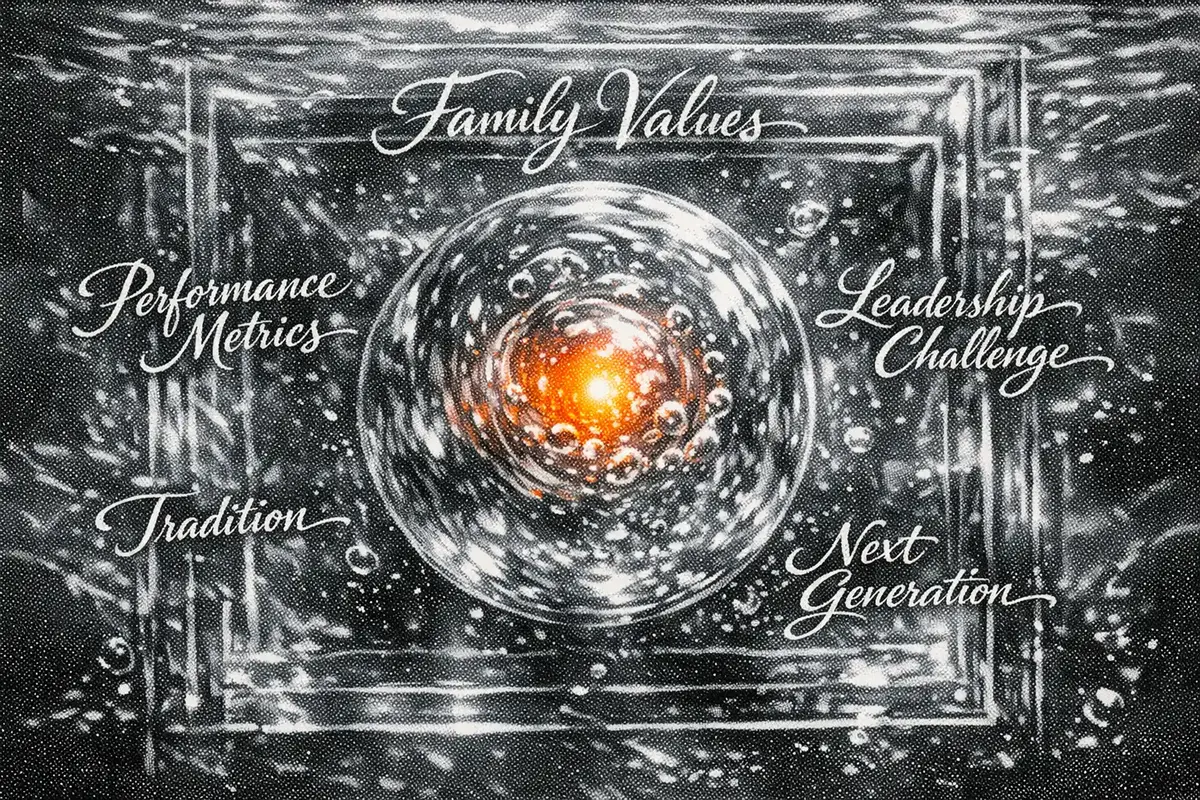
Values do not guide leadership until they become observable
A family value like stewardship sounds clear until a real decision tests it. Does it mean preserving cash, protecting jobs, investing through a downturn, or refusing a risky acquisition? Unless the family has translated that word into visible behaviors, decision rules, and performance expectations, it remains a story people invoke selectively.
That is why values often feel strongest in speeches and weakest in succession. Leaders cannot develop against abstractions. They develop against expectations they can see, practice, and be assessed on. Research on next-generation leadership points in the same direction: a shared vision has a strong effect on the leadership effectiveness of next-generation family leaders. The implication is practical, not sentimental. Shared values matter because they reduce interpretive drift when authority changes hands.
A shared vision for the family business has a strong effect on the leadership effectiveness of next-generation family leaders.
The first leadership test is credibility
For rising family leaders, the hardest question is rarely “Do I believe in the family’s values?” It is “What, exactly, will count as evidence that I am living them?” Without that answer, every performance discussion becomes political. Results are questioned. Motives are guessed at. Merit gets blurred by family interpretation.
This is where many families lose capable successors. Not because the values are wrong, but because the values stay unmeasured. Once that happens, values stop functioning as governance inputs and start behaving like moving targets.
And if a value cannot survive translation into leadership expectations, was it ever a standard—or only a sentiment?
What do family values actually mean in a leadership system?
The compass model is the right place to start, because it explains why values matter only when they help leaders choose direction under pressure. Most organizations assume values already do that work. The evidence from The Family Business Consulting Group shows something stricter: families need a common understanding of what counts as “north,” or the same value will be used to justify opposite decisions (The Family Business Consulting Group).
That is why the question is not whether a family has values. Almost every family business says it does. The real question is whether those values function as a leadership operating system or just as language people quote after the fact.
Values are decision rules, not slogans
In plain terms, family values are the principles that define what matters, what gets protected, and what behavior is acceptable when trade-offs are real. They are not wall statements. They are the rules people use when growth conflicts with control, when loyalty conflicts with accountability, or when a high-performing executive violates the way the family wants power exercised.
A regional healthcare company offers a familiar example. During budget season, a second-generation COO pushes to centralize support functions to improve margins and reduce duplication. One family branch calls it disciplined stewardship; another says it breaks the company’s commitment to local autonomy. Both sides claim to be defending the family’s values. The disagreement is not emotional weakness. It is a system failure: the family never defined how those values should rank when they collide.
This is where family values become practical. If a value cannot tell a leader what to do in a hard call, it is not yet usable.
Shared purpose turns tradition into a leadership standard
A shared family purpose gives values their shape. It answers a harder question than “What do we believe?” It answers “What are we trying to build together, and what kind of leadership does that require now?”
That matters more in second- and third-generation systems, where tradition is remembered differently by each branch, age cohort, and operating role. The Family Business Consulting Group makes the point well: values work like a compass only when the family agrees on direction, not just on vocabulary (The Family Business Consulting Group).
Durability comes later. Values become real when they are built into recruiting, onboarding, performance reviews, board recruitment, and family council routines—not treated as a speech for annual gatherings (The Family Business Consulting Group).
That is the threshold. Once values enter the system, they stop being symbolic. But one hard problem remains: how do you create enough shared vision to make those standards credible across generations—alignment, or polite drift?
Why shared vision predicts next-generation leadership effectiveness
65% of first-generation leaders in First Bank’s 2024 Family Business Survey define success primarily as business profitability—but that drops to 50% for second-generation leaders and 43% for third generation and beyond. What if the biggest succession risk is not conflict, but agreement that feels healthy because nobody has tested what “success” actually means across generations (First Bank, 2024)?
That is the trap. A family can look aligned at dinners, retreats, and board meetings while still holding three different ideas about purpose, authority, and acceptable tradeoffs. Harmony, in that case, is not proof of readiness. It is often proof that the hard questions have been deferred.
Shared vision reduces interpretive drift
Research is unusually clear on this point: a shared vision for the family business has a strong effect on the leadership effectiveness of next-generation family leaders (NIH, 2024). Not because vision is inspiring language. Because it gives people a common basis for judging decisions when outcomes are mixed and tradeoffs are real.
In a regional financial services firm, a third-generation director enters the annual budget cycle with a mandate to modernize client onboarding. She cuts a legacy reporting process, reallocates headcount, and speeds approval time. One side of the family sees overdue discipline. Another sees disrespect for long-serving employees. If the family has not agreed whether the business exists to maximize profitability, preserve employment, protect reputation, or balance all three in a defined order, her performance review becomes a referendum on interpretation—not execution.
That is why shared vision is a practical asset. It aligns expectations about what authority a next-generation leader actually has, what outcomes matter most, and which compromises are acceptable when no option is clean.
Harmony is not the same as readiness
Many families overrate leadership readiness because the next generation gets along. That is understandable. Conflict is visible; weak standards are not.
But First Bank’s generational split on the meaning of success should make any family pause. When one generation reads success through profitability and the next reads it through a broader lens, evaluation becomes unstable unless the family explicitly reconciles those definitions (First Bank, 2024). A calm room can still produce unfair judgments.
This is where leadership development becomes more credible. Development plans work when the family agrees on the standards that define readiness—decision quality, scope of authority, financial accountability, people leadership—not when candidates are coached against shifting expectations.
A successor cannot prepare for a role the family itself has not defined. And once legacy must become performance, what exactly should count—intent, results, or both?
How do you turn legacy into measurable performance without losing meaning?
45% of family businesses with high legacy scores say they outperform competitors on business performance. If your family cannot show where legacy creates value, you risk treating it as heritage theater while revenue slips, trust thins, and strong non-family talent walks out the door (KPMG, 2024).
That is the real test behind the rhetoric: can legacy be measured through results, or is it only a story told after the fact? In practice, you rarely measure legacy directly. You measure its effects. Better decision consistency. Stronger stakeholder confidence. More disciplined reinvestment. Fewer tradeoffs that damage the business in order to protect someone’s interpretation of tradition.
Measure the footprint, not the slogan
A regional retail company offers a familiar case. During a market slowdown, the third-generation CEO delays a margin-improving supplier switch because it would weaken long-term local relationships that the family says define its identity. If that choice leads to stronger retention among key partners, steadier service levels, and healthier recovery six quarters later, legacy has shown up as performance—not sentiment.
That distinction matters. Legacy should not be scored as nostalgia, family tenure, or ceremonial participation. It should be assessed through outcomes that reflect whether the family’s stated purpose improves how the enterprise performs over time. Business health still counts. So does continuity of trust.
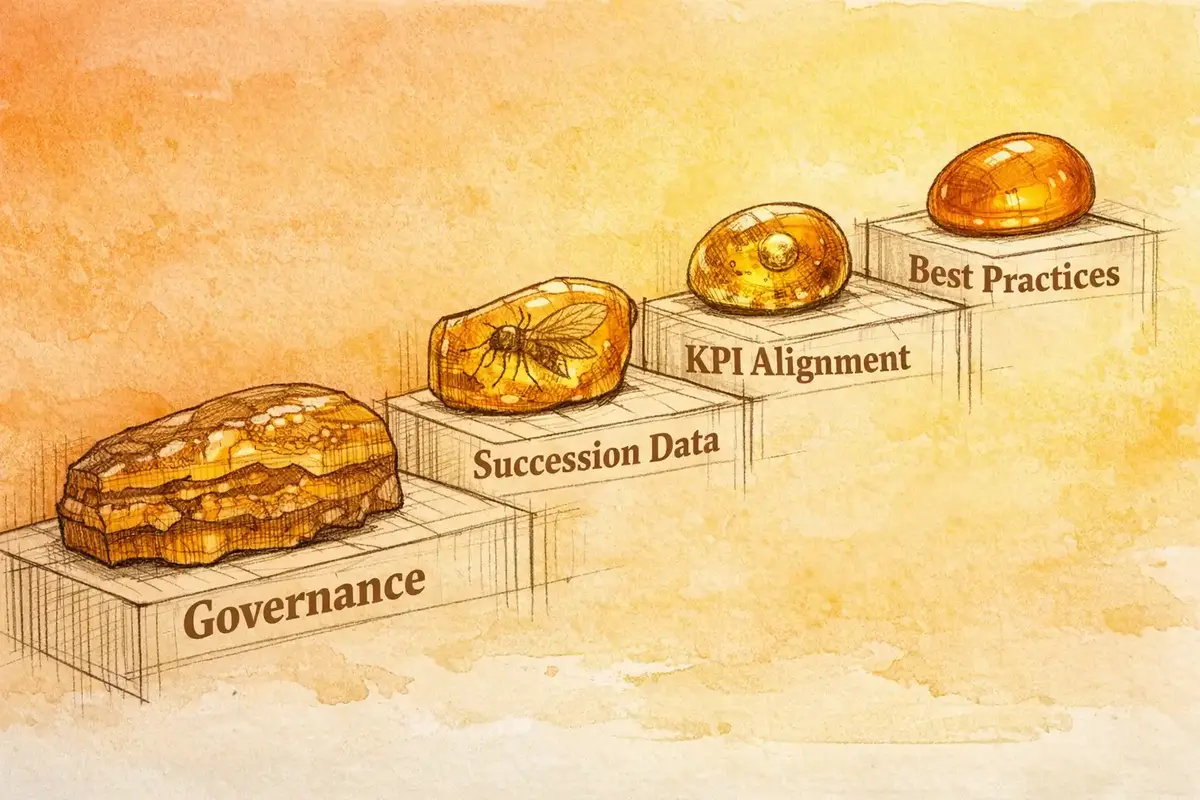
KPMG’s 2024 Global Family Business Survey makes this harder to dismiss. High-legacy firms are not merely preserving identity; they are often producing stronger outcomes.
53% of high-legacy firms reported high sustainability results (KPMG, 2024)
That should change the conversation. The question is no longer whether values dilute performance. The evidence suggests that, when legacy is translated into disciplined choices, it can reinforce both competitiveness and resilience (KPMG, 2024).
Choose metrics that honor purpose and protect the business
This is where many families overcorrect. They either track only financial outputs, which strips values of operational meaning, or they create soft cultural indicators with no link to enterprise results. Both approaches fail.
A better approach is to pair purpose-linked indicators with core business measures. If the family says stewardship matters, track reinvestment quality, balance-sheet discipline, and leadership bench strength. If community trust is part of the legacy, track customer retention, employer reputation, or partner stability alongside margin and growth. The point is not to make values vague enough to survive. It is to make them specific enough to govern.
Done well, performance metrics become a translation layer between family intent and executive accountability. Done poorly, they become a scoreboard for only half the job.
And that raises the harder design question: which measures belong on the same page so leaders are judged fairly—business first, or balance by design?
What should a balanced scorecard for family leadership development include?
The balanced scorecard matters here because it answers the question most families avoid: if a family member is promoted because they are trusted, how do you know they are actually ready to lead? Most firms still assume readiness will reveal itself in the role. The evidence from FFI suggests something tougher: performance evaluation is not just an accountability tool; it is a fairness system that protects credibility for both the individual and the family enterprise (FFI, 2024).
That changes the design brief.
Four categories belong on the same page
A workable scorecard for family leadership development should track four things at once: business results, leadership behaviors, family alignment, and succession readiness. Leave one out, and the review becomes distorted.
| Category | What it captures |
|---|---|
| Business results | Revenue growth, margin quality, cash discipline, operating execution |
| Leadership behaviors | Decision quality, talent development, cross-functional collaboration, conflict handling |
| Family alignment | Communication across family branches, respect for governance boundaries, reduced ambiguity |
| Succession readiness | Evidence of preparedness for broader authority and future leadership responsibility |
Business results are the easiest part. Revenue growth, margin quality, cash discipline, operating execution. Necessary, but incomplete. A next-generation leader can hit numbers while damaging trust, confusing authority, or failing to build a bench.
Leadership behaviors show whether results are being produced in a way the organization can scale. Think decision quality, talent development, cross-functional collaboration, and how conflict gets handled under pressure. Family Business Magazine has long emphasized that succession assessment fails when families confuse good intentions with demonstrated management capability (Family Business Magazine, 2024).
Family alignment is different from family harmony. That distinction matters. The knowledge gap matrix is useful precisely because it shows how easily families mistake low visible conflict for real organizational health; a calm family system can still be underperforming, and a high-performing business can still be carrying unresolved family risk. A scorecard should therefore ask: does this leader communicate clearly across family branches, respect governance boundaries, and reduce ambiguity rather than amplify it?
Fairness is the hidden function
In a regional technology company, a second-generation director is reviewed after a difficult team restructure. Product delivery improves within one quarter, but two cousins argue she has become “too corporate.” Without a defined scorecard, the review turns into a debate about style. With one, the family can separate discomfort from evidence.
That is why evaluation systems protect legitimacy. They give family members a way to say, we may not all like every decision, but we agreed in advance how leadership would be judged. FFI makes this point clearly: assessment creates procedural fairness, and procedural fairness is what keeps merit from being rewritten after outcomes are known (FFI, 2024).
Role clarity keeps the standards clean
The scorecard also has to distinguish ownership, governance, and management. An owner should not be judged by operating KPIs they do not control. A manager should not be rewarded for family diplomacy alone. A board member should not be assessed like a department head.
This is where strong family business governance and real professionalization stop being abstract ideals. They define which hat a family member is wearing before anyone starts scoring performance.
Otherwise the review system creates a new problem: not unfairness by neglect, but unfairness by confusion. And when a family finally wants merit without losing identity—where, exactly, do they begin?
Where do families start when they want merit without losing identity?
66% of family business employees said they experienced more change in the past year than in the year before (PwC, 2024). When families handle that change with vague promotion logic, the cost shows up fast—good operators leave, trust thins, and growth plans start slipping under the weight of private resentment.
The place to start is not with the next promotion decision. It is with non-negotiable values and the behaviors that prove them. If a family says it values stewardship, what does that look like in practice: challenging weak capital requests, developing successors, protecting customer trust during a rough quarter? If it says humility matters, does that mean taking feedback from non-family managers, or simply avoiding public conflict? Until those behaviors are named, merit will always feel selective.
In a mid-market services company during budget season, a third-generation VP was passed over for a larger role after two years of strong operating results. The stated reason was “not quite the right fit for how this family leads.” Three months later, one high-performing non-family director resigned, and two family members stopped speaking directly. The damage did not come from the decision alone. It came from the fact that nobody could point to the standard behind it.
Set the rules before the role opens
Families that want merit without identity loss need promotion and development criteria in place before succession pressure turns every discussion personal. That means defining what experience is required, what performance thresholds matter, what leadership behaviors are expected, and what evidence will count.

That is not bureaucracy. It is protection. 74% of family businesses expected growth in 2024 (Family Enterprise USA, 2024), and growth exposes weak talent systems quickly. A family that waits until a key seat opens is usually not evaluating readiness; it is negotiating emotion under deadline.
Use governance to make hard calls discussable
This is where governance forums earn their keep. Family councils, boards, and talent committees create a place to separate loyalty from assessment without pretending loyalty does not matter. The point is not to remove feeling. The point is to stop feeling from acting as the only evidence.
First Bank’s 2024 survey found that employee engagement and satisfaction rose 12 percentage points, moving from the sixth to the third-highest priority (First Bank, 2024). That shift is telling. Families are starting to see that people watch how advancement decisions get made—not just who wins them.
From there, development plans become concrete: operating rotations, external experience, board exposure, coaching, and timed reviews against agreed criteria. Not symbolic preparation. Real proof.
Because once values start functioning through governance, the final question gets sharper: are those values actually steering the enterprise—or are they still being used to soften difficult truths?
Why the healthiest family businesses treat values as governance, not sentiment
The compass model becomes real in the quarterly review where a regional manufacturing C-suite team has to decide whether a cousin with strong numbers but weak people judgment is truly ready for broader authority. In that room, nobody is arguing about values in theory; they are deciding whether values will constrain power or merely decorate it.
The Family Business Consulting Group has long framed values as a shared understanding of what counts as “north” — a compass, not a slogan. That distinction is decisive. When families stop asking whether values or metrics matter more and start asking how each protects the other, the whole leadership system changes (The Family Business Consulting Group).
Governance is where values earn trust
The strongest family businesses do not choose between identity and accountability. They build rules, reviews, and succession criteria that make both visible over time.
Research also shows that a shared vision has a strong effect on the leadership effectiveness of next-generation family leaders (NIH, 2024). Not because vision creates harmony. Because it gives managers, boards, and family owners a common basis for judging hard calls after the emotion of the moment has passed.
That is what governance does. It converts values into decision rights, evaluation standards, and consequences.
Durable cultures do not depend on perfect agreement
Healthy family enterprises still disagree. They disagree about timing, risk, talent, and even what loyalty requires. The difference is that they do not settle those questions through memory, hierarchy, or family volume.
They use governance. Over time, values gain credibility when they shape who gets promoted, how performance is judged, and what succession requires. Metrics gain meaning when they are tied to family purpose rather than treated as neutral math.
That is the closing test for your own business: are your values guiding decisions when the stakes rise — or only explaining them afterward? The durable answer is usually the same one: operationalize the values, then let the metrics prove whether the purpose is being carried forward.
Key Takeaways
- Family values fail when they stay vague; they need observable behaviors, decision rules, and performance expectations.
- Shared vision reduces interpretive drift and helps next-generation leaders be judged more fairly.
- Legacy should be measured through its business effects, not nostalgia or ceremony.
- A balanced scorecard should include business results, leadership behaviors, family alignment, and succession readiness.
Frequently Asked Questions
What does it mean to balance family values and performance metrics in family leadership development?
It means turning family values into clear leadership standards that can be observed, practiced, and evaluated alongside business results. When values and metrics are aligned, next-generation leaders are judged on both what they achieve and how they achieve it.
Why do family values often fail in 2nd and 3rd generation leadership transitions?
Family values often fail when they remain vague, symbolic, or open to different interpretations across branches of the family. Without defined behaviors and decision rules, leaders are evaluated against expectations that were never made explicit.
How can family values be translated into measurable leadership expectations?
Start by defining the behaviors, decision rules, and outcomes that prove a value in action, such as stewardship, humility, or accountability. Then connect those standards to performance reviews, governance processes, and succession criteria so leaders know what evidence counts.
What should a balanced scorecard for family leadership development include?
A balanced scorecard should include business results, leadership behaviors, family alignment, and succession readiness. This helps families evaluate both operational performance and the ability to lead in a way that supports long-term family purpose.
How can a family business preserve identity while still promoting merit?
By defining non-negotiable values and promotion criteria before a role becomes available, families can make advancement decisions more objective and fair. Governance forums, clear standards, and development plans help ensure that merit is recognized without losing the family’s identity.