

Why ethical systems fail first in the culture leaders ignore
The behavior-reporting-governance model starts with an uncomfortable fact: 76% of U.S. workers reported experiencing or witnessing incivility in the past month, and without a model like this, decision quality degrades long before compliance alarms sound (SHRM, 2024). That is the gap most leaders miss. They review policies, hotline volumes, and training completion rates while the real system failure is already spreading through everyday interactions—who gets challenged, who stays quiet, and which risks never make it into the room.
The cost is not abstract. SHRM estimates U.S. organizations lose more than $2.7 billion per day from reduced productivity and absenteeism caused by incivility (SHRM, 2024). In practice, that means a regional healthcare VP enters a quarterly review believing the ethics program is stable because no major cases have surfaced, while directors have already learned that raising concerns slows careers and complicates budget approvals. By the time a formal issue appears, the organization is not facing a single lapse; it is dealing with months of distorted judgment, muted challenge, and avoidable operational drag. This article is about how to evaluate ethical decision-making systems before that hidden damage becomes the visible story.
76% of U.S. workers reported experiencing or witnessing incivility in the past month (SHRM, 2024)

What leaders usually measure—and what they miss
Most ethical breakdowns do not begin with fraud, harassment claims, or regulatory action. They begin with weaker signals: selective candor, defensive meetings, tolerated disrespect, and decisions made under social pressure rather than disciplined challenge. Research consistently shows that when people do not trust the environment, they do not stop seeing problems; they stop surfacing them in ways leadership can use.
That is why ethics should be assessed as a system, not a statement. The useful question is not whether leaders can articulate values. It is whether those values shape conduct under pressure—during restructures, target resets, client escalations, and performance reviews. Real ethical leadership is visible in the quality of dissent an organization can absorb without punishing the messenger.
A defensible way to evaluate the system
A defensible model connects three things. First, behavior: what people normalize in daily interactions. Second, reporting trust: whether concerns can be raised without predictable retaliation or futility. Third, governance outcomes: how boards and executives interpret those patterns before they become legal, financial, or reputational events.
Miss one link and the whole picture distorts. Strong policies with weak reporting trust create false reassurance. High reporting volume without behavior change signals process without credibility. Clean dashboards in a fearful culture are not evidence of health—they are often evidence of silence.
The hard question is not whether your organization has values, but whether its governance can detect when culture has already started editing the truth. Values on paper, or governance that changes behavior?
What separates values statements from governance that actually changes behavior?
The values-rules-governance framework matters here because it exposes a question many leadership teams avoid: if your values are clear, why do decisions still bend under pressure? Why do so many organizations sound principled in town halls, then become inconsistent in budget cuts, target resets, or client escalations?
The answer is usually not bad intent. It is missing structure.
Values describe what the organization says it stands for. Rules define minimum boundaries. Governance determines how real decisions are reviewed, escalated, challenged, and corrected when incentives pull in the opposite direction. That distinction is where symbolic ethics ends and operational ethics begins.
A simple test: intent, boundaries, or control?
A regional manufacturing company can publish a strong code, train managers, and still fail the moment a plant director is pushed to hit quarter-end output after a safety incident. In that meeting, values do not govern the choice. The operating system does. Who has authority to pause production? Who must be consulted? What gets documented? What happens if a leader overrides the process?
That is why effective governance controls are not administrative detail. They are the mechanism that turns principle into repeatable conduct.
If values answer what matters and rules answer what is prohibited, governance answers who decides, based on what evidence, with what review, and with what consequence. Without that layer, ethics depends too heavily on personality. A strong leader may do the right thing. A pressured leader may not. Systems should not rely on mood.
What operational ethics looks like in practice
A defensible ethics system assigns roles, decision rights, and accountability across layers. Frontline managers need clarity on what they can resolve. Functional leaders need escalation thresholds. Executives need review forums that surface tradeoffs early, not after damage is done. Boards need evidence that corrective action is tracked, not merely announced.
This is where many compliance systems stop too soon. They document policy ownership but leave ambiguity in cross-functional decisions—the exact place where ethical failures often grow. When sales, operations, legal, and HR each assume someone else owns the hard call, delay becomes a governance choice.
The strongest organizations embed ethics into routines: approval workflows, risk reviews, promotion decisions, incentive design, post-incident learning. Not separate. Built in.
Governance changes behavior when it makes the right action easier to execute—and harder to bypass.
A values statement can inspire. A governance system can withstand scrutiny. The real question is sharper: when someone sees a problem, do they know not just that it matters, but where it goes and who must act—or does the issue die in the gap between good intentions and personal risk?
Why ethical leadership is measured by what people feel safe to say
Companies with the strongest ethical cultures outperform those with weaker ethical cultures by 50%. That should end the lazy debate about whether culture is “soft” or secondary to execution (Diligent, 2024; LRN, 2024).
Most organizations still act as if integrity is proven by the existence of a code, a training module, or a CEO message. The evidence points somewhere else. People decide whether ethics is real by watching what happens when someone raises an inconvenient fact, questions a favored leader, or names a risk that could slow the quarter.
The real test happens in the manager layer
This is why ethical leadership is measured less by what leaders say than by what employees believe is safe to say back. If leaders invite candor in public but punish friction in private, the organization learns the script quickly. Values become ceremonial. Silence becomes rational.
In a mid-market technology company during a product launch review, a director asks whether a known customer-data issue should delay release. The executive team says they want “honest input.” Her manager cuts in, reframes the concern as lack of commercial judgment, and moves the meeting forward. No policy was violated on paper. But everyone in the room just received the real instruction: raise risk carefully, or pay for it socially.
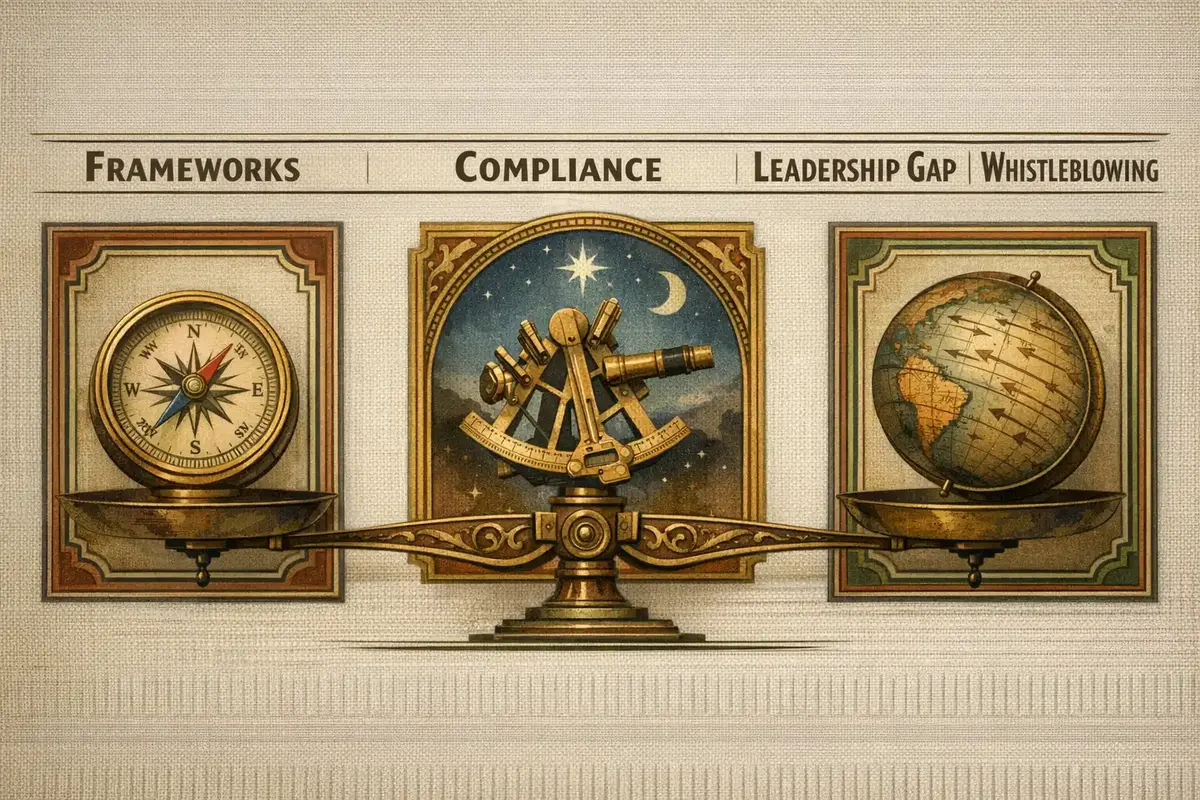
That is why psychological safety matters operationally, not cosmetically. It is a leading indicator. When people trust that challenge will be heard fairly, leaders get earlier warnings, better assumptions, and cleaner decisions. When they do not, the first loss is not morale. It is information.
Why inconsistency does more damage than weak messaging
Manager inconsistency is especially corrosive because it edits reality at the point of contact. A written code can set expectations once a year. A manager sets them every day — in staffing calls, one-on-ones, promotion debates, and client escalations. One dismissive response can undo months of formal messaging because employees believe observed consequences faster than stated principles.
This is where a true speak-up culture either forms or fails. Not at the policy level. At the moment someone tests whether candor is career-limiting.
Strong ethical culture is associated with 50% better performance than weak ethical culture (Diligent, 2024; LRN, 2024)
If that gap is real, then silence is not a cultural side issue. It is a governance risk. The harder question follows: when people do speak, is there a system they trust — or just a process that exposes them?
How do you design a speak-up system people trust before retaliation becomes the story?
24,980 whistleblower tips, complaints, and referrals reached the U.S. Securities and Exchange Commission in FY 2024. That number should concern any executive who still treats reporting as a side process, because when people believe internal channels are unsafe, risk leaves the building and shows up in regulators, litigation, attrition, and lost trust (U.S. Securities and Exchange Commission, 2024).
What happens when employees believe reporting is possible in theory but dangerous in practice? They do the math. Speak, stay silent, or escalate.
Trust is built in the handling, not the policy
A trusted speak-up system rests on three things: confidentiality, independence, and visible follow-through. Miss one, and the rest weaken fast. Employees do not need a perfect process; they need a credible one — one that protects identity where possible, separates fact-finding from line management pressure, and shows that concerns lead to action rather than containment.
In a regional financial services firm during year-end target pressure, a VP flags questionable sales reporting tied to incentive payouts. The hotline exists. The policy is current. But the intake is routed through leaders who depend on the same revenue numbers, updates disappear for weeks, and the VP starts getting cut out of planning calls. That is the moment the system stops being a reporting channel and becomes a warning to everyone watching.
This is why whistleblowing should be assessed as an operating control, not a legal formality. The real test is whether the process can withstand power.
Retaliation risk rises when fairness looks doubtful
Retaliation often begins before any formal adverse action. It shows up as exclusion, credibility attacks, stalled promotion discussions, or sudden scrutiny that others do not face. Once employees expect inconsistent handling, they stop asking whether a concern is valid and start asking whether raising it is survivable.
The enforcement signal matters here. The U.S. Securities and Exchange Commission brought 11 enforcement actions in FY 2024 against entities and individuals who acted to impede whistleblowers (U.S. Securities and Exchange Commission, 2024). That is not a technical footnote. It is evidence that interference itself is a governance failure.
The U.S. Securities and Exchange Commission awarded over $255 million to 47 individual whistleblowers in FY 2024 (U.S. Securities and Exchange Commission, 2024)
A reporting system people trust is not defined by hotline volume alone. It is defined by response time, case ownership, consistency across seniority levels, and whether employees believe the same rules apply to high performers and powerful leaders. That is the practical foundation of a real speak-up culture.
If your reporting channel is active but your culture still teaches people to self-protect, what exactly is the system proving — integrity, or fear with documentation? And if that is unclear, what should an ethical audit actually test?
What should an ethical audit actually test beyond policy compliance?
2,714 individuals and 794 organizations underwent integrity due diligence through The Global Fund’s Ethics Office in 2024 — which should force a harder question than most audits ask: if an audit only confirms that policies exist, how would it reveal whether integrity is actually being managed? A policy review can tell you what the organization intended. It cannot tell you how decisions travel when pressure rises, who gets bypassed, or whether escalation works when the issue is commercially inconvenient.
That is the gap. And it is where most so-called ethics assurance stays too shallow.
A serious ethical audit is a leadership diagnostic, not a document exercise. It should test three things: decision pathways, escalation patterns, and whether governance controls hold when incentives push the other way. In practice, that means tracing a real issue from first signal to final resolution: who saw it, who hesitated, who intervened, what evidence was recorded, and where the process slowed or bent. That is very different from checking whether the right policy owner signed off on an annual review.
What mature audits examine in the real system
Due diligence is one of the clearest indicators of maturity because it shows whether the organization screens risk before relationships harden into commitments. The Global Fund’s volume — 2,714 individuals and 794 organizations — points to governance that treats integrity review as an operating discipline, not a late-stage legal formality (The Global Fund, 2024). The question for leaders is not whether they run due diligence. It is whether the findings actually shape approvals, vendor choices, appointments, and exceptions.
Case management matters just as much. The Global Fund Ethics Office opened 39 new SEAH cases in 2024 (The Global Fund, 2024). That number is not useful as a headline alone. What matters in an audit is handling quality: intake speed, independence, interim protections, repeat-pattern detection, and whether lessons change controls upstream. Mature ethical audits look for that connective tissue.
Where audit findings become operationally useful
Picture an enterprise retail company during a store portfolio review. A regional operations director raises concerns about labor practices at a fast-growing supplier, but the issue stalls because procurement wants continuity, legal wants more evidence, and commercial leaders do not want disruption before peak season. A weak audit records that the concern was logged. A strong one tests why it sat unresolved for six weeks — and what that delay exposed.
That is the standard. Audit findings should connect leadership behavior to operational risk: delayed escalation, selective exceptions, weak case ownership, and inconsistent consequence management. If your governance controls cannot show where judgment degrades under pressure, are they controls at all — or just paperwork with signatures? And if boards cannot read that pattern early, what exactly are they waiting to see?
Why boards should read ethics data as an early warning system
760 enforcement actions in fiscal year 2024 produced more than $8.2 billion in penalties. Boards should read that not as distant regulatory noise, but as proof that weak judgment, weak controls, and weak escalation still become expensive facts in public view (Diligent, 2024).
The mistake is to treat ethics data as a lagging compliance report. It is not. Used well, it is an early read on climate, control effectiveness, and leadership consistency — the three conditions that determine whether bad news travels upward in time.
What the board should see in the pattern
A single metric rarely tells the truth. Hotline volume alone can mean trust, fear, confusion, or all three at once. Case closure speed can signal discipline, or superficial handling. Low retaliation claims can reflect healthy management, or a workforce that has concluded reporting is pointless.
Boards need to read the pattern across reporting, enforcement, and concentration. The U.S. Securities and Exchange Commission received about 24,980 whistleblower tips, complaints, and referrals in FY 2024, yet more than 14,000 were attributable to just two individuals (U.S. Securities and Exchange Commission, 2024). That concentration matters. It shows why raw volume without context can mislead. A spike may indicate stronger accountability — or a system already under strain.
The board question is sharper: what does this data say about how decisions are being made before they become allegations?
Reading ethics data like operating risk
Take a global services company in a year-end budget cycle. An executive committee sees rising substantiated misconduct cases, longer investigation times, and repeated concerns clustered in two business units. If directors read those as separate issues, they miss the signal. If they read them together, they see a governance problem: local leadership may be applying standards unevenly, and the control environment may be slowing when commercial pressure rises.
That is where board oversight earns its keep. Directors should ask whether ethics data aligns with performance pressure, management turnover, incentive design, and exception approvals. They should also test whether compliance systems are producing usable intelligence or just documenting activity after the fact.
Ethics data becomes useful at board level when it explains not only what happened, but how leadership behavior and control design allowed it to happen.
A board that waits for a headline has already accepted delayed governance. The real work is earlier — reading weak signals while they are still reversible. If the data suggests deteriorating decision quality, will leaders confront it while the issue is internal, or only after outside scrutiny makes denial impossible?
Responsible governance is proven in the moments leaders would rather avoid
Revenue slips quietly before misconduct becomes visible. Trust erodes faster than leaders expect, and by the time strong people start leaving, the organization is usually paying for decisions it told itself were temporary.
If integrity only appears in policy language, the next ambiguous complaint, conflict, or exception request will expose it. That is why ethical decision-making becomes credible only when leaders build systems that bring risk forward early, then respond with the same discipline whether the issue is minor, politically awkward, or attached to a high performer.
The proof is in the response, not the statement
Consider a regional healthcare provider in the middle of a team restructure. A department head raises concern about how patient access targets are being pushed onto already strained staff. The issue is not cleanly legal, not clearly malicious, and not easy to classify. This is where weak governance starts bargaining with itself: wait for more evidence, handle it informally, avoid escalating until the reorganization settles.
That instinct is expensive.
A durable system does the opposite. It gives managers a clear path for escalation, protects the person raising the concern from being isolated, and requires leaders to explain their reasoning in a way others can review later. Research and enforcement patterns across SHRM, the U.S. Securities and Exchange Commission, Diligent, LRN, and The Global Fund all point in the same direction: organizations fail less often when signals travel early, handling is consistent, and accountability does not bend around status or convenience (SHRM, 2024) (U.S. Securities and Exchange Commission, 2024) (Diligent, 2024) (LRN, 2024) (The Global Fund, 2024).
Alignment is what makes governance hold
The strongest governance models do not rely on controls alone. They align three things that too many companies manage separately: leadership behavior, team climate, and formal controls.
When those elements reinforce each other, people know what to do under pressure. A manager does not have to improvise fairness. A reporting channel does not depend on personal courage alone. A board does not have to guess whether silence means health or fear.
When they do not align, the gaps show immediately. Leaders ask for candor but punish friction. Teams sense risk but keep it local. Controls exist but are bypassed in the name of speed. On paper, the organization still looks governed. In practice, it is asking employees to trust discretion where process should carry the load.
Integrity is tested most seriously in ambiguity — when facts are incomplete, incentives are live, and no option feels clean. In those moments, responsible governance is visible in how leaders behave under pressure and scrutiny, not in how confidently they describe their values.
So look at your own context. When the next uncomfortable issue arrives, will your system surface it and handle it fairly — or will it ask people to absorb the risk in silence?
Key Takeaways
- Ethical systems fail first in everyday culture, not in formal policy documents.
- Governance matters when it turns values into repeatable decisions under pressure.
- Speak-up systems work only when people trust confidentiality, independence, and follow-through.
- Boards should read ethics data as an early warning signal, not a lagging report.
Frequently Asked Questions
What is ethical decision-making in responsible governance?
Ethical decision-making in responsible governance is the practice of making choices through systems that combine clear values, enforceable rules, and accountable review. It focuses on whether people can raise concerns, challenge decisions, and correct problems before they become legal, financial, or reputational failures.
Why do ethical systems often fail before formal compliance problems appear?
They usually fail first in everyday culture, where incivility, silence, and fear reduce the quality of judgment long before a policy breach is visible. When people stop challenging risky decisions or worry about retaliation, organizations lose the information needed to govern well.
What makes a speak-up system trustworthy?
A trustworthy speak-up system protects confidentiality, operates independently from conflicted line management, and shows visible follow-through on concerns. Employees trust it when reporting leads to fair action rather than delay, exclusion, or retaliation.
How is an ethical audit different from a policy compliance review?
An ethical audit tests how decisions actually move through the organization, including escalation paths, case handling, and whether controls hold under pressure. A policy review only confirms that rules exist, while an ethical audit asks whether those rules change behavior in practice.
What should boards look for in ethics data?
Boards should read ethics data as an early warning system for culture, control effectiveness, and leadership consistency. The most useful patterns show whether concerns are being raised, handled fairly, and resolved before they turn into external enforcement or public harm.