

Why leadership development is now a business risk, not a training add-on
Only 20% of employees worldwide were engaged in 2025. If you are deciding what to fund in leadership development, that number changes the conversation from learning activity to operating risk.
You have seen the scene before. A regional services VP enters a quarterly review with open roles, uneven managers, and a succession chart that looks stable on paper but fragile in practice. Performance is not collapsing. It is drifting — slower decisions, weaker accountability, more manager-dependent execution.
That drift is expensive because it compounds quietly. Gallup reports that just 20% of employees worldwide were engaged in 2025, which means most organizations are trying to execute strategy through workforces that are not fully connected to their roles, teams, or managers (Gallup, 2026). Then the more uncomfortable finding: 70% of the variance in team engagement is determined by the manager (Gallup, 2025). If manager quality drives engagement at that scale, leadership development is not a cultural extra. It is a direct control point for productivity, retention, and execution. This article is built to help CHROs and L&D leaders evaluate that problem with more rigor — and decide what kind of leadership development is actually worth building.
The real issue is managerial throughput
Many leadership programs still assume the main question is exposure: who attended, who completed, who liked the session. That is the wrong unit of analysis.
The business question is whether your managers can create consistent performance through other people. Can they set direction, coach clearly, handle tension early, and prepare someone credible to step into bigger scope? When they cannot, the organization pays twice: once in current team output, and again when the internal pipeline fails to produce ready leaders.
70% of team engagement variance sits with the manager, not the slide deck (Gallup, 2025).
That is why bench strength matters. Not as a succession slogan, but as an operating capability. A company with weak manager quality does not just have a development gap; it has a scaling problem.
Read this as a decision guide
The rest of this article is designed for evaluation, not inspiration. It will help you judge which leadership development investments build real managerial capability, which program models fit different leadership gaps, how development should shift by level, and how to tell whether your pipeline can actually fill key roles from within.
The hard question is no longer whether to invest. It is whether your current approach builds stronger leaders — or simply produces better-attended training.
What makes a leadership development program worth the investment?
Only 42% of U.S. workers said their organizations excelled in leadership and manager development. So why do so many companies still judge programs by how full the calendar looks?
That number should make any executive uneasy. Most organizations are not deciding between good and bad programs; they are deciding between activity that feels reassuring and development that actually changes how leaders perform. The gap matters because a busy program can still leave the business with the same weak coaching, the same slow decisions, and the same thin successor pool.
SHRM puts a hard edge on that problem: fewer than half of workers think their organization is strong at developing leaders and managers (SHRM, 2025).
What companies think they are buying
In a budget review, a mid-market manufacturing COO might see a proposal with twelve workshops, executive speakers, assessments, and a polished learning portal. It looks substantial. It is easy to defend because volume signals seriousness.
But content volume is not capability.
A program is worth the investment only if it improves how leaders operate under real pressure: running a shift with staffing gaps, handling a quality failure without escalation theater, coaching a new supervisor who is technically strong but weak with people. That is the standard. Not how many modules were completed. Not how many hours were delivered.
Strong programs are tied to business outcomes, not learning activity. They are built around the few leadership moves the business needs more often and at higher quality. If the strategy depends on faster cross-functional execution, better frontline retention, or smoother internal promotion into manager roles, the program should be designed to move those outcomes—not just expose leaders to ideas.
A practical lens for judging value
Use four tests.
First, program design: does the experience require leaders to practice judgment, feedback, delegation, and decision-making in context, or does it mainly transfer concepts?
Second, leader level fit: is the content built for the actual transitions leaders face? A first-line manager and a business unit VP do not fail in the same way.
Third, measurement: can you see evidence of changed behavior and team impact, or only attendance, completion, and satisfaction?
Fourth, business relevance: does the program solve a performance problem the business already feels?
If only 42% of workers believe their organizations excel at leadership and manager development, the issue is not access to programs. It is program quality and fit (SHRM, 2025).
This is where many buying decisions go wrong. Leaders compare catalogs, faculty, and session counts when they should be comparing likely impact.
Because once you stop asking, “How much content do we get?” a harder question appears: what kind of program actually fits the leadership gap you have now—and what kind only looks impressive on paper?
Which program model fits your leadership gap best?
The gap-to-format fit model matters here because leadership development fails when companies buy a format before they define the gap. Without that discipline, you get a familiar result: strong attendance, weak transfer, and no clearer answer on who is actually ready for bigger scope.
The practical question is simple. If coaching, workshops, action learning, and assessments all help, how do you choose the right mix without overbuilding the program?
Start with the gap itself.
If the problem is skill building at scale—say, new managers who need a shared baseline in feedback, delegation, and performance conversations—workshops are efficient. They create common language fast. They are less effective when the real issue is not knowledge but inconsistent behavior under pressure. A manager can explain a feedback model in class and still avoid a hard conversation on Tuesday.
What each format is actually good for
Coaching works best when the gap is behavioral and personal. It helps leaders see patterns they cannot see alone: overcontrol, conflict avoidance, weak executive presence, poor prioritization. In a regional healthcare provider, a director may know exactly what good delegation looks like and still keep stepping back into operator mode during a team restructure. Coaching is useful there because the barrier is not information. It is habit.
Assessments are diagnostic tools, not development strategies by themselves. They help you identify risk, strengths, derailers, and readiness signals. That makes them valuable at the front end of a program or at promotion points. Used alone, though, they often produce insight without movement.
Action learning is the strongest option when you need succession readiness or cross-functional judgment. It puts leaders on real business problems with visible stakes, forcing them to influence without authority, make trade-offs, and work across silos. That is much closer to the job they are growing into.
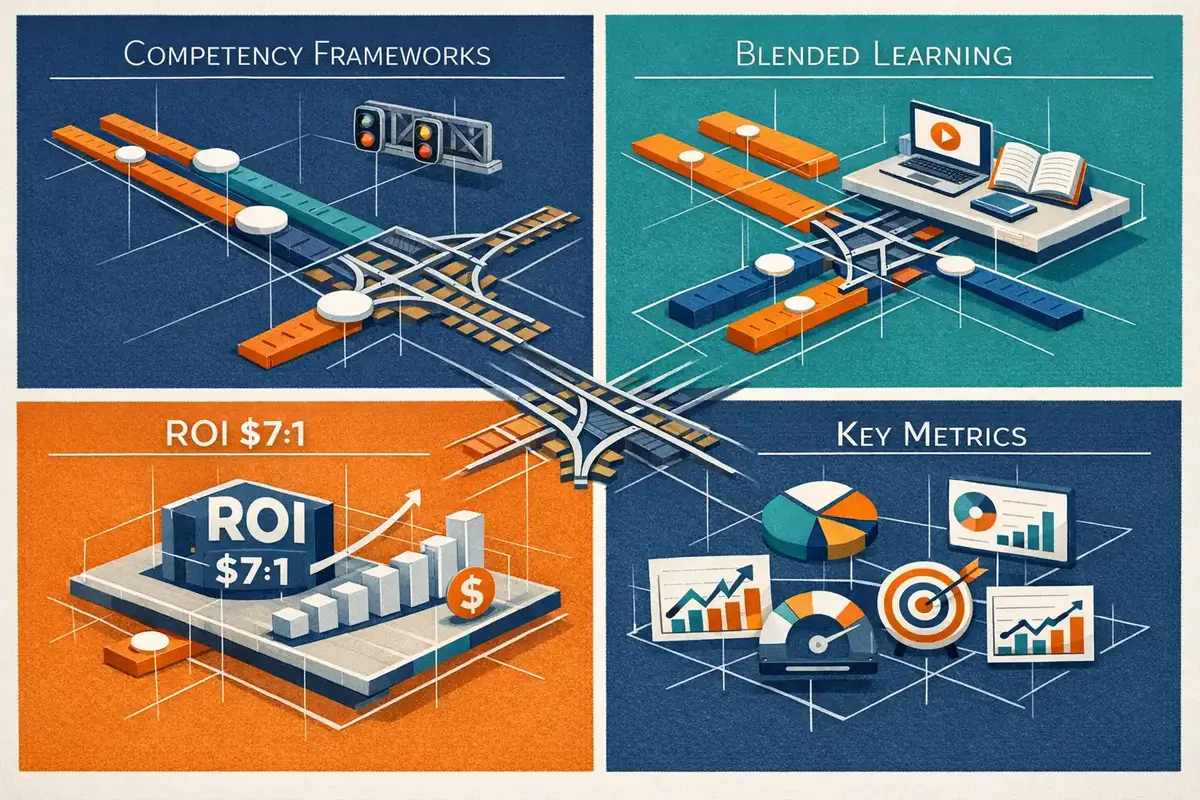
Every $1 spent on leadership development programs results in an average of $7 back to the company (SHRM, 2025).
That return does not come from any single format magically solving everything. It comes from fit. DDI reports measurable gains in retention, productivity, safety, and revenue from its leadership development subscription, which is a useful reminder that business impact shows up when development is tied to operating outcomes, not isolated learning events (DDI, 2024).
When blended learning beats a single-format program
Blended learning works best when the organization needs more than one result at once. A workshop can teach the core skill. An assessment can show where each leader is likely to struggle. Coaching can help them change behavior. Action learning can test whether that change holds in real work.
That sequence is often stronger than a single-format program because leadership gaps rarely arrive one at a time.
The harder question is not which format sounds strongest. It is whether a first-line manager, a director, and a VP should be developed the same way—or whether your program is flattening differences that matter.
How should leadership development change by leader level?
41% of employees said their organization has slashed management layers. That means many companies are asking fewer leaders to carry more complexity—while still sending them through the same generic development path (Korn Ferry, 2025).
That is the common mistake. Organizations often believe one strong leadership curriculum can serve everyone, from a new supervisor to a C-suite executive. In practice, that design usually fails all of them.
One program, four very different jobs
Put a first-time manager, a mid-level leader, and an executive in the same cohort and the cracks show fast. The new manager needs help running one team through other people for the first time. The executive needs sharper judgment on enterprise trade-offs, succession, and culture signals. The material may be “leadership,” but the work is not the same.
In a regional healthcare system during a team restructure, a newly promoted nurse manager is struggling with scheduling conflict, feedback avoidance, and how to hold peers accountable after becoming their boss. Two floors up, a service-line director is trying to align staffing, patient flow, and budget decisions across multiple units. In the same quarter, the COO is deciding which leaders can absorb broader span after another layer reduction. Give all three the same workshop and you create polite frustration, not capability.
Level-based design fixes that by matching development to the transition each leader is actually living.
What each level should learn
For first-time managers, the priority is managerial basics under pressure: setting expectations, giving usable feedback, delegating clearly, and handling performance issues early. This is where many pipelines first weaken. If people fail in their first manager role, you do not just lose one leader. You damage the next layer of successors.
For mid-level leaders, the work shifts. They need to lead managers, not just individuals; translate strategy into operating choices; and coordinate across functions where authority is partial and incentives are mixed. This layer is often the real bottleneck because it carries execution upward and talent development downward.
For senior leaders and executives, development should focus less on interpersonal technique and more on enterprise judgment: portfolio choices, organizational design, succession depth, and the signals their behavior sends across the system. This is where targeted experiences such as leadership development for general managers become more useful than broad manager training.
When 41% of employees report fewer management layers, manager depth matters more—not less (Korn Ferry, 2025).
The practical question is no longer whether people attended development. It is whether each layer is becoming stronger at the work only that layer can do. And if your manager layer is thin, can your pipeline really fill key roles from within—or does it only look healthy on a slide?
Can your leadership pipeline actually fill key roles from within?
75% of CHROs prioritize internal promotion, but only 49% of key roles could be filled internally today. That is the succession problem in one line: the intent is there, the bench often is not (DDI, 2025).
You know the moment. A business unit head resigns, the board wants a replacement path by Friday, and the names on the succession slate look familiar but not convincing. Everyone has completed something. Few look truly ready.
The pipeline test is role coverage, not program participation
This is why leadership development has to connect directly to succession planning, not sit beside it as a separate learning agenda. If the business says internal mobility matters, then development should be built backward from the roles that matter most: plant manager, regional sales leader, operations director, country head. The question is not who attended the program. It is who could step in with acceptable risk.
DDI found that while 75% of CHROs prioritize internal promotion, only 49% of key roles can be filled internally today (DDI, 2025).
That gap is more useful than most training metrics because it exposes whether your pipeline can actually absorb leadership turnover. DDI’s findings carry weight here because they come from a broad base—10,796 leaders and 2,185 HR professionals across 2,014 organizations in more than 50 countries (DDI, 2025). This is not a niche sample. It is a market signal.
In a mid-market manufacturing company during annual planning, this usually shows up one layer below the executive team. The VP role may have a named successor. The plant manager role often does not. And when that layer is thin, internal promotion becomes a slogan rather than an operating option.
Assessment, readiness, and development have to work as one system
A stronger approach starts with leadership assessment. Not to label people, but to separate potential from readiness and readiness from wishful thinking. Someone may have the raw capacity for broader scope and still be twelve months away from handling the role well.
That distinction matters. Good succession systems define a small set of critical roles, assess likely successors against the real demands of those jobs, and then assign development that closes specific gaps. More cross-functional exposure. A tougher operating assignment. Coaching on decision quality. A stretch role with visible stakes. This is how succession planning becomes practical rather than ceremonial.
Research and practice both point the same way. Organizations with mature pipelines do not treat assessment, development, and succession reviews as separate HR processes. They run them as one talent system. That is one reason institutions that work deeply in this space, such as the Center for Creative Leadership, have stayed relevant at scale; CCL notes it has partnered with over two-thirds of the Fortune 1000 (Center for Creative Leadership, 2026).
The hard part comes next. If you want to measure pipeline strength honestly, what evidence counts—course completions, or actual readiness to move?
How do you measure leadership development without relying on attendance?
39% of existing skill sets will be transformed or become outdated between 2025 and 2030. If capability is moving that fast, why do so many leadership programs still report success through attendance, completion, and satisfaction alone?
That is the comfortable dashboard. It is also the least useful one. A full cohort tells you people showed up. It does not tell you whether managers are making better decisions, keeping stronger people, or stepping into larger roles with less risk.
The measurement question is harder than most teams admit: if attendance is not the right success metric, what should leaders measure instead?
Measure movement, not activity
Start with a simple chain: baseline, change, business outcome.
Baseline means defining the problem before the program starts. Are regrettable exits too high in one function? Are safety incidents concentrated under inexperienced supervisors? Are internal promotions stalling at a specific layer? Without that starting point, post-program reporting becomes storytelling.
Change means looking for evidence that leader behavior actually shifted. This is where leadership assessment becomes useful. Good assessment tools do not just rate people in the abstract; they help connect development activity to readiness signals—decision quality, coaching consistency, delegation, judgment under pressure. That gives you a way to test whether the program changed capability, not just confidence.
Then comes the business outcome. SHRM reports that every $1 spent on leadership development programs results in an average of $7 back to the company (SHRM, 2025). That kind of return is only credible when it is tied to operating measures executives already trust.
Practical outcome measures include retention, productivity, safety, revenue, and internal promotion—not course completions.
Use metrics the business already respects
In a quarterly review at a regional retail company, a COO does not need another slide showing 94% completion. She needs to know whether store manager turnover fell, whether ramp time for newly promoted district leaders improved, and whether more openings were filled internally without performance dipping in the first ninety days.
That is the right standard.
DDI points in the same direction: its Forrester TEI study found measurable gains in retention, productivity, safety, and revenue from leadership development (DDI, 2024). Those are board-level outcomes because they show whether leadership capability is changing how the business runs.
Keep the scorecard alive
Measurement cannot be a one-time exercise because the target keeps moving. McKinsey found that 39% of existing skill sets will be transformed or become outdated between 2025 and 2030 (McKinsey, 2025). A program that worked two years ago may now be building the wrong strengths.
So the real test is not whether leaders completed development. It is whether your system keeps producing leaders the business still needs. And if the answer changes over time, what does a strong development system look like when it is built to adapt—not just to deliver?
What a strong leadership development system looks like over time
The leadership system loop is what matters here: get it wrong and you do not just waste training budget, you lose revenue through slower execution, erode trust through uneven management, and watch strong people leave teams they no longer want to work for.
When leadership development is done well, the change shows up outside the program.
The system is the point
A strong approach is not a calendar of courses. It is a system that connects assessment, development, practice, feedback, and measurement so each part sharpens the next. Assessment shows where risk sits. Development builds the few capabilities that matter most. Practice tests those capabilities in real work. Feedback shows whether behavior is changing. Measurement tells you whether the business is actually stronger.
Break any link and the whole thing weakens. You get insight without behavior change, training without transfer, or measurement without a credible baseline.
In a quarterly review at a regional technology company, a VP may see that two newly promoted directors completed the same program. One is building stronger managers under her. The other is still escalating routine decisions and losing key talent. The difference is rarely content alone. It is whether the organization gave both leaders repeated practice, useful feedback, and role-relevant expectations after the program ended.
Strong systems stay tied to level, succession, and strategy
This is why the best leadership development is continuous, not event-based. Leaders do not become more capable in a straight line, and the job keeps changing around them.
39% of existing skill sets will be transformed or become outdated between 2025 and 2030 (McKinsey, 2025).
That number should push leaders away from static curricula and toward systems that can adapt. The same is true structurally. 41% of employees said their organization has slashed management layers, which means fewer leaders are often carrying broader spans and more ambiguity than before (Korn Ferry, 2025). In that environment, generic development ages fast.
The stronger model is level-based and linked to the roles the business must fill. First-line managers need one kind of support. Directors need another. Senior leaders need a different test again. When those paths are also tied to succession priorities and business goals, development stops being an HR activity and starts functioning as operating infrastructure.
What to look for now
Over time, the real signal is cultural. Organizations that treat leadership growth as part of how work gets done — not as a side program — are better positioned to absorb skill shifts, thinner layers, and unexpected vacancies.
That leaves a practical closing test. Are you funding a set of programs, or building a system with four clear qualities: level fit, the right program mix, a visible pipeline link, and credible measurement? Your next step may be simple: pick one critical role family and answer that question honestly.
Key Takeaways
- Leadership development is an operating risk issue when manager quality drives engagement and execution.
- Program value depends on fit: the right format, the right leader level, and the right business problem.
- Strong pipelines connect assessment, development, and succession planning to real role readiness.
- Measurement should focus on business outcomes, not attendance or completion.
Frequently Asked Questions
Why is leadership development considered a business risk issue rather than just a training activity?
Leadership development affects productivity, retention, and execution because manager quality strongly influences team engagement and performance. When leaders cannot coach, delegate, and make decisions well, the organization loses both current output and future succession strength.
What makes a leadership development program worth the investment?
A program is worth funding when it changes how leaders behave in real work and improves business outcomes such as retention, productivity, safety, revenue, or internal promotion. Attendance, completion, and satisfaction are not enough unless they connect to measurable performance change.
Which leadership development format should be used for different types of leadership gaps?
Workshops are best for building shared skills at scale, coaching is best for changing personal behavior patterns, assessments are best for diagnosing strengths and risks, and action learning is best for developing judgment on real business problems. The strongest programs match the format to the specific gap instead of using one method for everything.
How should leadership development change by leader level?
First-time managers need help with basics like feedback, delegation, and performance conversations, while mid-level leaders need to lead other managers and translate strategy into execution. Senior leaders need enterprise judgment, succession thinking, and organizational design skills, so development should be tailored to the transition each level is facing.
How can organizations tell whether their leadership pipeline can fill key roles from within?
The best test is role readiness, not program participation. Organizations should identify critical roles, assess likely successors against the real demands of those jobs, and then use targeted development to close specific gaps before vacancies occur.