

Why Functional Leaders Need a Cross-Domain Decision Lens
What happens when a decision that looks smart inside one function quietly creates problems everywhere else? That is the real challenge in AI-enhanced functional leadership: speed is easier to buy than judgment, and cross-domain decision making is where the bill comes due.
You see it in ordinary executive moments. A regional retail VP pushes a pricing change to protect margin during a tense quarterly review. Finance likes the immediate logic. Sales sees friction in the field. Operations absorbs demand swings. Customer service gets the complaints. HR inherits the strain when frontline teams are asked to explain a decision they did not shape.
The old model assumed leaders could optimize from inside their lane. That assumption is now expensive. Functional decisions no longer stay functional, because the systems underneath them are tightly linked even when the org chart is not. Research from the Center for Creative Leadership makes the useful distinction: AI can provide data-driven insights, automate repetitive work, and generate predictive analysis, but leadership still depends on how people interpret and act on those signals (Center for Creative Leadership, 2025). This article is about that gap—between having more input and making better enterprise decisions.

AI as a Cross-Functional Translator
The practical value of AI is not that it replaces executive judgment. It is that it can act as a decision-orchestration layer across fragmented signals—commercial, operational, financial, and human.
That framing matters. Most leadership teams do not suffer from a lack of data; they suffer from data arriving in separate languages. Pipeline data says one thing, staffing data says another, and customer feedback arrives too late to shape the original call. Used well, AI helps leaders synthesize those signals, surface blind spots, and test likely downstream effects before they commit. That is far more useful than treating AI as a faster reporting engine or a clever assistant for one department alone.
Strong leaders do not need AI to make decisions for them; they need it to show where their own view is too narrow.
This is also where trust enters the picture. The Center for Creative Leadership is clear that AI can optimize decisions, but it cannot build trust, transfer wisdom, or create connection (Center for Creative Leadership, 2025). So the leadership task is not automation for its own sake. It is coordinated judgment—using tools to widen the field of view while keeping accountability human.
That is why AI in leadership is becoming less about productivity and more about integration. The leaders who benefit most are not the ones with the most dashboards. They are the ones who can see how one move in pricing, hiring, inventory, or service changes the whole system.
The Real Tension Beneath Adoption
Most organizations are already moving faster. The harder question is whether they are getting wiser—or just more efficient at shifting problems across functions?
That tension sits underneath the rest of this discussion. If leaders are already using AI, why are so many still making decisions without a clear model for how cross-domain consequences should be weighed?
Why Are So Many Leaders Already Using AI Without a Clear Decision Model?
60% of executives now regularly use AI to support their decisions, which means the decision rights model is no longer optional; AI is already inside the room where calls get made (Deloitte, 2026). Without that model, teams blur three very different actions—advice, recommendation, and automation—and accountability starts to drift.
That is the real issue behind the current wave of adoption. Leaders are not waiting for a perfect governance playbook before they use AI. They are using it in budget reviews, hiring discussions, pricing debates, and forecast calls because the tools are available and the pressure to move faster is real. The problem is that many organizations have not agreed on a simple operating question: When should AI inform judgment, when should it rank options, and when should it trigger action?
Deloitte’s data matters here because the sample is not narrow or anecdotal. Its 2026 Global Human Capital Trends findings draw on more than 9,000 business and human resources leaders across 89 countries (Deloitte, 2026). That breadth gives the pattern weight: this is not a niche behavior in a few digital-first firms; it is a mainstream management reality.
Adoption Is Ahead of Architecture
In practice, most organizations are improvising. A regional healthcare director asks AI to flag staffing risks before a holiday surge. Operations treats the output as an early warning. Finance reads it as a cost-control prompt. HR assumes it is a planning input, not a staffing decision. Same model, same data, different implied authority.
Nothing has technically failed. But the organization has no shared decision architecture for what the system is allowed to do.
When leaders skip the model, AI does not remove ambiguity; it scales it.
This is why access is the wrong debate. The harder question is whether the organization has built the discipline around decision making that tells people how to use AI outputs without confusing speed for clarity.
Low Maturity Explains the Gap
Deloitte reports that 57% of organizations operate at low decision-making maturity (Deloitte, 2026). That number explains a lot. It suggests the bottleneck is not technical capability but managerial design: unclear escalation paths, weak role definitions, inconsistent thresholds for override, and no common language for confidence, risk, or exception handling.
This is where many leadership teams get trapped. They pilot AI successfully inside one function, see local gains, and assume the enterprise is becoming smarter. Often it is only becoming faster at producing uncoordinated judgments.
A mature model does not need to be complicated. It needs to answer who decides, what AI can do, what must stay human, and what happens when signals conflict. Until that layer is explicit, adoption will keep rising while decision quality stays uneven.
And that creates the next problem. If AI helps leaders decide faster—but each function moves on a different logic—are organizations really accelerating, or just pushing friction downstream?
What Does Cross-Domain Decision Making Actually Mean in Practice?
Cross-domain decision making sounds like a coordination exercise. It is not. What changes when a leader stops asking, “What is best for my function?” and starts asking, “What is best for the system?” Most executives assume the difference is more meetings, more alignment, more voices in the room. It is usually something harder.
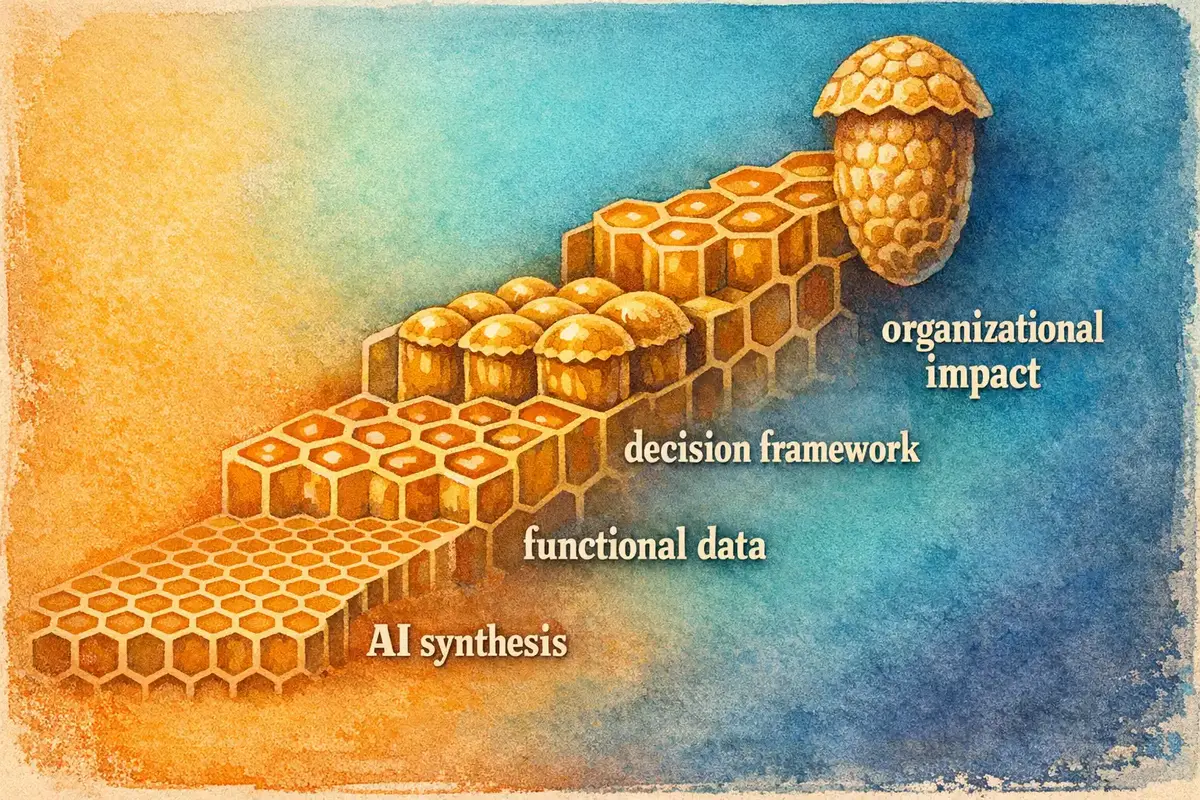
The useful framework here is the system-effects lens: a decision is not judged by whether one function can defend it, but by what it sets in motion across revenue, cost, capacity, risk, and people. That is why cross-domain decision making is not the same as simple cross-functional collaboration. Collaboration is about stakeholder input. Cross-domain judgment is about evaluating second- and third-order effects before the organization pays for them.
In plain English, it means testing one choice through several functional lenses at once. A service business deciding to cut response times, for example, is not just making an operations call. It is also making a workforce decision, a margin decision, a customer promise decision, and often a technology investment decision.
A mid-market manufacturing COO sees this during annual planning. AI recommends reducing safety stock on a high-volume component because demand variability appears lower than expected. Procurement sees working-capital relief. Plant leaders see exposure if one supplier slips. Sales sees risk to fill rates during a product launch. The right question is no longer whether the model is statistically sound inside supply chain; it is whether the recommendation still holds when commercial timing, operational resilience, and customer commitments are weighed together.
Decision Rights Matter More Than Model Confidence
This is where many teams get sloppy. They treat a strong AI recommendation as if it settles authority.
It does not. Cross-domain practice requires decision rights, escalation paths, and accountability boundaries that are explicit before the pressure hits. AI can inform a call, rank options, or flag exceptions. It does not own the trade-off between service level and margin, or between speed and compliance. The Center for Creative Leadership makes the boundary clear: AI can optimize decisions, but it cannot build trust, transfer wisdom, or create connection (Center for Creative Leadership, 2025).
A model can narrow the options. Only leaders can own the consequences.
That is why mature teams define who decides when signals conflict, what threshold triggers escalation, and which risks cannot be accepted inside one function alone. Real cross-functional collaboration starts to matter only after those rules are clear.
Explainability Is an Operating Requirement
Leaders do not just need an answer. They need a reason they can defend across functions.
Explainability means understanding what variables drove the recommendation, what assumptions matter most, and where the model is likely to be weak. If finance cannot explain the logic to operations, or HR cannot see the workforce effect behind a productivity recommendation, trust breaks fast. And once trust breaks, speed becomes theater.
That creates the next tension. If AI helps leaders reach an answer in minutes—but the organization still needs days to validate, challenge, and translate that answer across functions—is the decision process actually faster, or just front-loaded with false certainty?
Why Faster AI Decisions Can Still Create Slower Organizations
156% higher overall performance is what companies report when they use AI in an integrated way rather than in isolated pockets (Accenture, 2024). Get the operating model wrong, and that upside turns into something more familiar: revenue missed because functions moved on different assumptions, trust damaged because no one can explain the trade-off, and strong people leaving because they are forced to clean up decisions they did not shape.
What if the biggest AI mistake is not using too little intelligence, but using it too quickly inside the wrong model?
Speed Helps Only When the System Can Absorb It
Accenture also found 67% faster execution and 84% better decisions from integrated cross-functional AI use (Accenture, 2024). Those numbers are impressive, but they are easy to misread. They do not mean speed itself creates advantage. They mean speed pays off when commercial, operational, financial, and people decisions can move together.
That distinction is where many leadership teams stumble. They improve the front end of decision making — better forecasts, faster recommendations, cleaner prioritization — while leaving the back end untouched. Approval paths stay fragmented. Incentives stay local. Escalations still depend on who speaks loudest in the meeting.
So the model gets faster. The organization does not.
Fast analysis inside a slow, divided system does not create advantage. It creates backlog with better branding.
A regional services CFO sees this during annual planning. AI flags which client accounts should be repriced based on margin erosion and service complexity. Finance wants immediate action. Account leaders worry about renewals. Delivery teams know the service model is already stretched. HR sees burnout risk if low-margin work is retained without staffing changes. The recommendation is smart. The organization around it is not ready.
Cross-Functional AI Is Rising — and Raising the Bar
This is why the structural shift matters. Slalom reports that 52% of respondents used cross-functional business tech teams in 2024, up from 5% in 2023 (Slalom, 2024). That is not a small process tweak. It suggests organizations are increasingly organizing AI work around shared business problems rather than departmental workflows.
That is the right direction. It also raises the standard.
Once AI is used across functions, weak coordination becomes more visible and more expensive. A locally rational decision can now travel faster across the enterprise, carrying its flaws with it. Pricing can outrun capacity. Hiring can outrun demand. Automation can outrun customer readiness. This is exactly why strong human-AI decision making depends less on model quality alone and more on whether leaders have defined who can decide, who must align, and who can stop a bad call.
The hidden risk is not just siloed data. It is siloed authority moving at machine speed.
If cross-functional AI is now common, the next question gets sharper: how do leaders use that speed to surface blind spots early — before they harden into enterprise problems no one function can solve alone?
How Do Leaders Use AI to Spot Blind Spots Before They Become Business Problems?
The signal-reconciliation framework matters here because blind spots rarely come from missing data; they come from leaders reading conflicting signals in isolation. Without it, finance protects margin, operations protects flow, HR protects capacity, and customer teams protect experience — while no one sees the combined risk until it shows up in results.
The framework is simple. Ask AI to do three things before a decision is made: reconcile conflicting inputs, test plausible scenarios, and expose the assumptions carrying the most risk. The Center for Creative Leadership is useful on this point: AI can add data-driven insight, automate repetitive work, and generate predictive analysis, but its value depends on how leaders use those outputs in a human decision process (Center for Creative Leadership, 2025).
That changes the job from “give me the answer” to “show me what I may be missing.”
Use AI to Reconcile Signals, Not Just Summarize Them
A regional healthcare VP in the middle of a winter staffing review sees patient demand forecasts rising, overtime costs already elevated, employee fatigue scores worsening, and service complaints starting to climb. Each signal is clear on its own. Together, they are harder to interpret.
This is where AI earns its keep. It can pull those inputs into one view and flag the tension: cutting agency labor may help this month’s budget, but it may also raise wait times, increase attrition risk, and push avoidable pressure onto frontline managers. That is not automation replacing judgment. It is a system showing where local logic breaks at enterprise level.

The best AI warning is not a prediction of failure. It is an early challenge to a decision that still looks reasonable inside one function.
Scenario Modeling Makes Second-Order Effects Visible
The more practical move is scenario modeling. Instead of asking whether a decision is efficient, leaders ask what it sets in motion.
Consider a mid-market retail COO during a quarterly margin review. AI can model what happens if prices rise 4%, if store labor hours are reduced, or if both happen together. Demand may soften in one region, fulfillment pressure may rise in another, and service levels may dip just enough to increase returns. None of those effects is surprising by itself. The surprise is how often leaders approve the first-order gain without testing the second-order cost.
This is why the strongest use case is not speed alone. It is surfacing assumptions, anomalies, and trade-offs that busy teams gloss over under time pressure. Research consistently shows that when leaders treat AI as a challenge function rather than a decision substitute, they get a wider field of view and fewer avoidable surprises.
The hard part comes after the blind spot is found. Who has the authority to slow, override, or reshape the recommendation before it becomes policy — and what rules keep that intervention disciplined rather than political?
What Governance Rules Keep AI Helpful Instead of Overruling Judgment?
45% of surveyed board members and C-suite executives said AI is not even on the agenda (Deloitte, 2024). That should worry any functional leader, because adoption does not wait for oversight — it keeps spreading through pricing, staffing, forecasting, and approvals whether governance is ready or not.
The practical question is simple: how do leaders keep AI influential without letting it become the hidden decision-maker?
Governance Is Decision Design, Not Compliance Theater
Good governance starts by separating three very different uses of AI: advice, recommendation, and automation. If a model summarizes risks before a quarterly review, that is advice. If it ranks which accounts to exit, that is recommendation. If it triggers a credit hold or shifts staffing without review, that is automation.
Those categories need different rules. Who owns the call? What threshold requires escalation? Who can override the output — and who has to document why? Can the organization reconstruct what the model suggested, what a leader decided, and what happened next?
That is the core of responsible governance. Not bureaucracy. Ownership, escalation, override, and auditability designed before the pressure hits.
AI becomes dangerous quietly — when a recommendation starts being treated like a decision no one remembers making.
A mid-market finance director sees this during a month-end risk review. An AI tool flags a cluster of customers as likely late payers and recommends tighter terms. Collections acts fast. Sales objects after two strategic accounts escalate. No one can tell whether the system was meant to inform judgment, trigger action, or simply surface exceptions. The damage comes from ambiguity, not malice.
Trust Changes Whether AI Creates Value
This is where many executives still think too narrowly. Trust is not a cultural side issue; it is a performance variable.
Deloitte found that workers who trust the AI agents they work with are 10 times more likely to see those agents as critical to creating value (Deloitte, 2025). That finding matters because people do not use AI well when they are guessing about its limits. They either defer too quickly or ignore it completely.
Trust grows from clarity. People need to know what the system is good at, where it is weak, when human review is mandatory, and how exceptions are handled. That is how responsible governance improves adoption while reducing misuse.
The deeper issue is not whether AI can produce an answer. It is whether the organization can tell the difference between a tool that sharpens judgment and a system that slowly replaces it. And once that line starts to blur — who, exactly, is still leading?
The Real Measure of AI-Enhanced Leadership Is Organizational Judgment
Organizations do not break because analysis was too slow. They break when revenue is sacrificed to local optimization, trust thins out between functions, and strong people leave after cleaning up decisions no one truly owned.
That is why the real measure of AI-enhanced leadership is not how quickly a team gets to an answer. It is whether the organization gets better at judgment.
Better Judgment Is the Outcome That Matters
If AI can make decisions faster, what still has to remain unmistakably human for the organization to stay coherent? The answer is not mysterious. Someone still has to weigh context the model cannot fully hold, own the trade-off when two good priorities collide, and manage the relationships that determine whether a decision can actually stick.
The Center for Creative Leadership puts the boundary plainly: AI can optimize decisions, but it cannot build trust, transfer wisdom, or create connection (Center for Creative Leadership, 2025). That is not a limitation to work around. It is the leadership job.
A founder in a growing technology company sees this during a team restructure after a weak quarter. AI helps map role overlaps, likely productivity gaps, and where management layers have become too heavy. The analysis is useful. But the real decision turns on things the model only touches indirectly: which leader can carry credibility through change, which team has enough resilience for a sharper span of control, and where one poorly handled move could trigger quiet departures over the next month.
The machine can show patterns. It cannot carry the consequences.
The point of AI in leadership is not to remove judgment from the system. It is to improve where judgment starts, how it is tested, and who is accountable for it.
Durable Advantage Comes From Combination, Not Substitution
The strongest leaders will not be the ones who delegate the most thinking to machines. They will be the ones who combine machine-generated insight with human context, accountability, and relationship management in a way competitors struggle to copy.
That combination is harder than buying software. It requires leaders who can ask better questions of the system, challenge outputs without defensiveness, and translate a recommendation into language that finance, operations, HR, and customer teams can all work with. In practice, that is what maturity looks like.
It also explains why two organizations can use similar tools and get very different results. One treats AI as a shortcut to certainty. The other treats it as a disciplined input into a broader human process. Only one of those approaches strengthens the organization over time.
If you want a practical place to explore how leaders are building those habits, AI Coach System is a useful resource for hands-on AI-coaching tools. Not as an authority on the research — as a way to think through application.
The Next Step Is Simpler Than Most Teams Think
For leaders still early in this work, the next move is not to compare more platforms or chase more features. Start with three operating questions: what kinds of decisions are we making, who has the right to make them, and what cross-functional consequences must be considered before we act?
That shift matters. Decision types clarify whether AI is informing, recommending, or triggering. Decision rights clarify who owns the call when pressure rises. Cross-functional consequences force leaders to look past local wins and ask what the decision will do to the wider system.
This is where organizational judgment becomes visible. Not in the dashboard. In the meeting after the dashboard, when leaders decide whether to narrow the question to fit the tool — or widen their thinking to fit reality.
That is the closing test. Is AI making your organization more certain, or more thoughtful? And in the next important decision your team faces, what would better judgment actually require of you?
Key Takeaways
- AI can widen leaders’ field of view, but it does not replace human judgment.
- Cross-domain decision making focuses on system effects, not just functional wins.
- Clear decision rights, escalation paths, and governance keep AI useful and accountable.
- The real measure of AI-enhanced leadership is better organizational judgment over time.
Frequently Asked Questions
What is AI-enhanced functional leadership?
AI-enhanced functional leadership is the use of AI to improve decision quality across business functions such as finance, operations, sales, HR, and customer service. The goal is not to let AI replace leadership, but to help leaders interpret complex signals, spot trade-offs, and make better enterprise-level judgments.
What does cross-domain decision making mean?
Cross-domain decision making means evaluating a choice by its effects across multiple parts of the organization, not just within one function. It looks at second- and third-order impacts on revenue, cost, capacity, risk, and people before a decision is finalized.
Why can AI adoption create problems if there is no decision model?
Without a clear decision model, AI outputs can be treated inconsistently as advice, recommendations, or automated actions. That ambiguity weakens accountability and can cause one function to act on a signal that another function interprets very differently.
How can AI help leaders spot blind spots before they become business problems?
AI can reconcile conflicting signals, test scenarios, and highlight assumptions that carry the most risk. Used this way, it acts as a challenge function that reveals where a decision may look reasonable in one function but create hidden costs elsewhere.
What governance rules keep AI from overruling human judgment?
Effective governance clearly separates AI used for advice, recommendation, and automation, and defines who owns each decision. It also sets escalation thresholds, override rules, and auditability so leaders remain accountable for trade-offs and outcomes.