

Why AI Becomes More Useful When It Stops Treating Every Signal the Same
38% of employees say their organization has already integrated AI to improve productivity, efficiency, and quality. Yet in the quarterly review, the dashboard looks sharper than the conversation around it—and leaders still cannot tell what AI is actually changing (Gallup, 2026).
That gap is not trivial. It shows up when a regional healthcare VP sees faster documentation, lower response times, and cleaner workflow data, then walks into a meeting where morale feels brittle, trust is uneven, and no one agrees on what the numbers mean. The system is producing more signals, but not more clarity.
A median of 34% of adults across 25 countries are more concerned than excited about the increased use of AI in daily life (Pew Research Center, 2025).
That concern matters inside organizations because adoption without interpretive discipline creates a false sense of certainty. Teams start treating every output as if it belongs to the same category of truth: sentiment as behavior, behavior as culture, culture as system design. The cost is practical. Leaders misread resistance, overstate adoption, and fund the wrong interventions. This article addresses that problem by showing why AI becomes more useful when it stops acting like a universal interpreter and starts working as a quadrant-specific assistant.
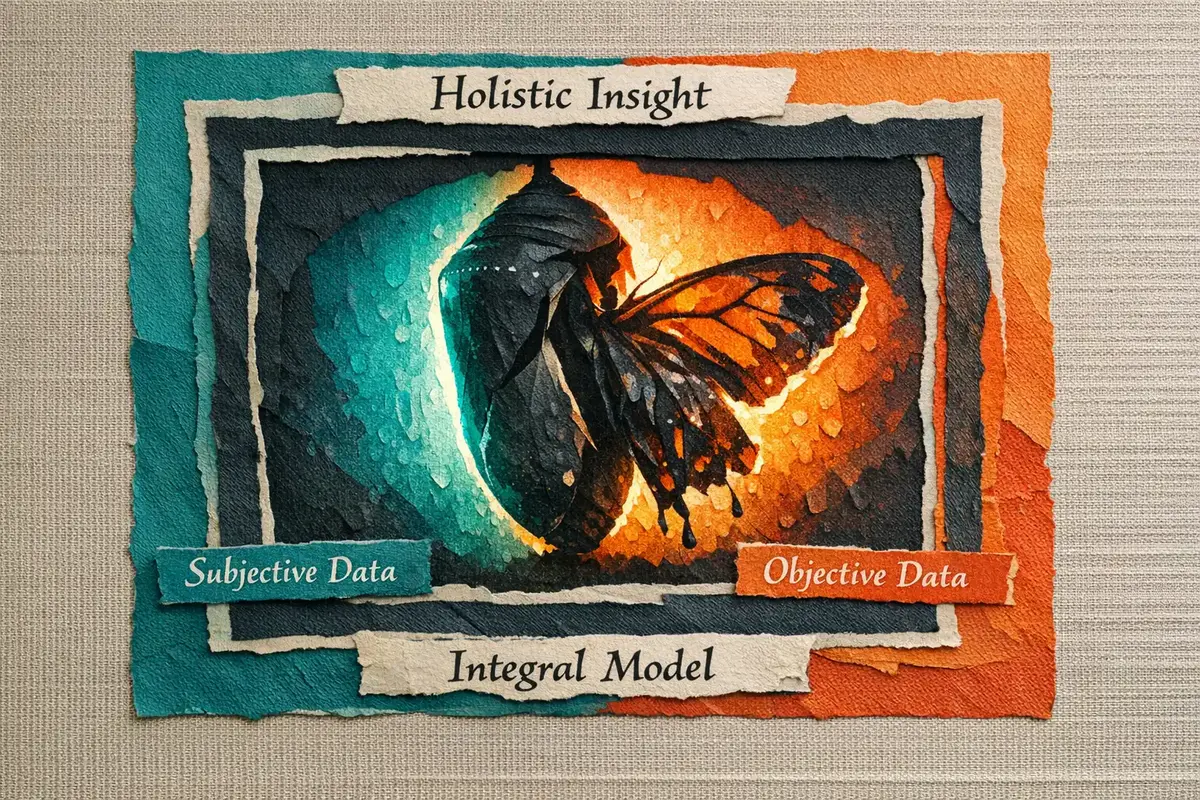
The Real Failure Is a Category Error
The central mistake is simple: different kinds of reality require different kinds of evidence.
A person’s interior experience is not the same as their observable behavior. Shared norms are not the same as formal process. And system logic is not the same as individual intent. When AI flattens those distinctions, it can sound comprehensive while being conceptually wrong.
This is where the AQAL frame becomes useful—not as philosophy for its own sake, but as a way to prevent analytical slippage. The Four Quadrants force a harder question: What kind of signal is this, exactly? If the answer is unclear, the model may still produce an output, but the output will often be misapplied.
AI Helps Most When Its Job Is Narrower
Used well, AI does not replace judgment across all quadrants. It supports different forms of inquiry within each one.
It can detect patterns in workflows, summarize recurring language, surface anomalies in operational systems, and help compare stated values with observed routines. Useful, yes. But each of those tasks depends on respecting the boundary between subjective meaning, observable behavior, shared culture, and systems logic. AI is strongest when its role is specific and bounded.
That raises the real strategic question. If the quadrants name four different realities, what does each one actually ask of AI—and where does the technology start to overclaim?
What Does AQAL Actually Mean When You Are Trying to Use AI?
AQAL matters here because most AI mistakes are not technical failures; they are framing failures. What if the biggest barrier to better AI analysis is not the model, but the fact that most teams do not know which kind of reality they are looking at?
That sounds abstract until a leadership team starts treating every signal as if it belongs in one bucket. A comment in an employee survey becomes proof of performance. A workflow delay becomes evidence of low commitment. A drop in meeting participation gets labeled “culture” when it may be a system design problem. The model is not the hard part. The sorting is.
In plain English, AQAL says any organizational issue can be viewed through four perspectives on reality: I, It, We, and Its—the core structure behind Integral Theory and the broader Integral Model described by The Integral Institute and Ken Wilber’s AQAL materials.
Four Quadrants, Four Different Questions
I is the interior of the individual: what a person feels, believes, fears, values, or means. AI can summarize language that hints at these states, but it cannot directly observe them. Inner experience is interpreted, not measured.
It is the exterior of the individual: behavior, output, response time, error rate, attendance, completion speed. This is where AI is often most comfortable because the evidence is visible and countable.
We is the interior of the collective: shared language, norms, trust, stories, and the unwritten rules that shape how people make sense together. Culture lives here. Not in a slogan, but in recurring patterns of meaning.
Its is the exterior of the collective: structures, workflows, incentives, reporting lines, policies, platforms, and handoff logic. This is the operating environment people move through every day.
| Quadrant | Focus | What AI Can Do Well | Main Limitation |
|---|---|---|---|
| I | Interior of the individual | Summarize language and cluster themes | Cannot directly observe inner experience |
| It | Exterior of the individual | Read behavior, output, and other visible traces | Cannot explain meaning on its own |
| We | Interior of the collective | Detect recurring language and sentiment patterns | Cannot reduce culture to a score |
| Its | Exterior of the collective | Connect workflows, incentives, and structural friction | Cannot replace human judgment |
One Problem, Four Readings
Take a mid-market retail director in a quarterly review. Customer complaints are rising after a new AI-assisted scheduling system goes live.
In the I quadrant, store managers may feel watched and second-guessed. In It, you can see missed shifts, slower restocking, and longer checkout times. In We, teams may start using cynical language—“head office optimization”—that signals a shared loss of trust. In Its, the real issue may be incentive design: labor targets reward coverage efficiency while punishing local judgment.
Same problem. Four realities.
That is the practical value of AQAL as framed by Ken Wilber and The Integral Institute: it stops leaders from asking one tool to answer four different questions. And once you see that, a sharper issue appears. Where does AI genuinely help—and where is it strongest only because the evidence is easier to count?
Why AI Is Strongest in the Objective Quadrants and Weakest Where Meaning Lives
$109.1 billion in U.S. private AI investment in 2024 tells you something important: most organizations now assume the models are becoming broadly capable, not just technically impressive (Stanford HAI, 2025). But the evidence points to a narrower truth—AI keeps getting better fastest where reality is structured, observable, and rich in repeatable patterns.
That is why leaders often overestimate what the tools can do in human settings. They see rapid progress in model-building—U.S.-based institutions produced 40 notable AI models in 2024, far ahead of China’s 15 and Europe’s three (Stanford HAI, 2025)—and infer that the same systems can reliably read motivation, trust, or shared meaning. They cannot. Not in the same way.
Where AI Earns Its Confidence
In the It and Its quadrants, AI has a real home field advantage. These domains produce the kind of evidence machines handle well: timestamps, transaction logs, workflow steps, defect rates, handoff delays, utilization patterns, and policy exceptions. The signal is external. The categories are usually stable. The feedback loop is clear.
A regional manufacturing VP sees this during a budget-cycle review. The plant’s AI layer flags rising rework on one line, links it to a supplier shift, and shows that maintenance intervals are drifting by shift pattern. That is useful because the question is objective: what happened, where, and in what sequence? In organizational diagnostics, this is where AI can reduce ambiguity rather than manufacture it.
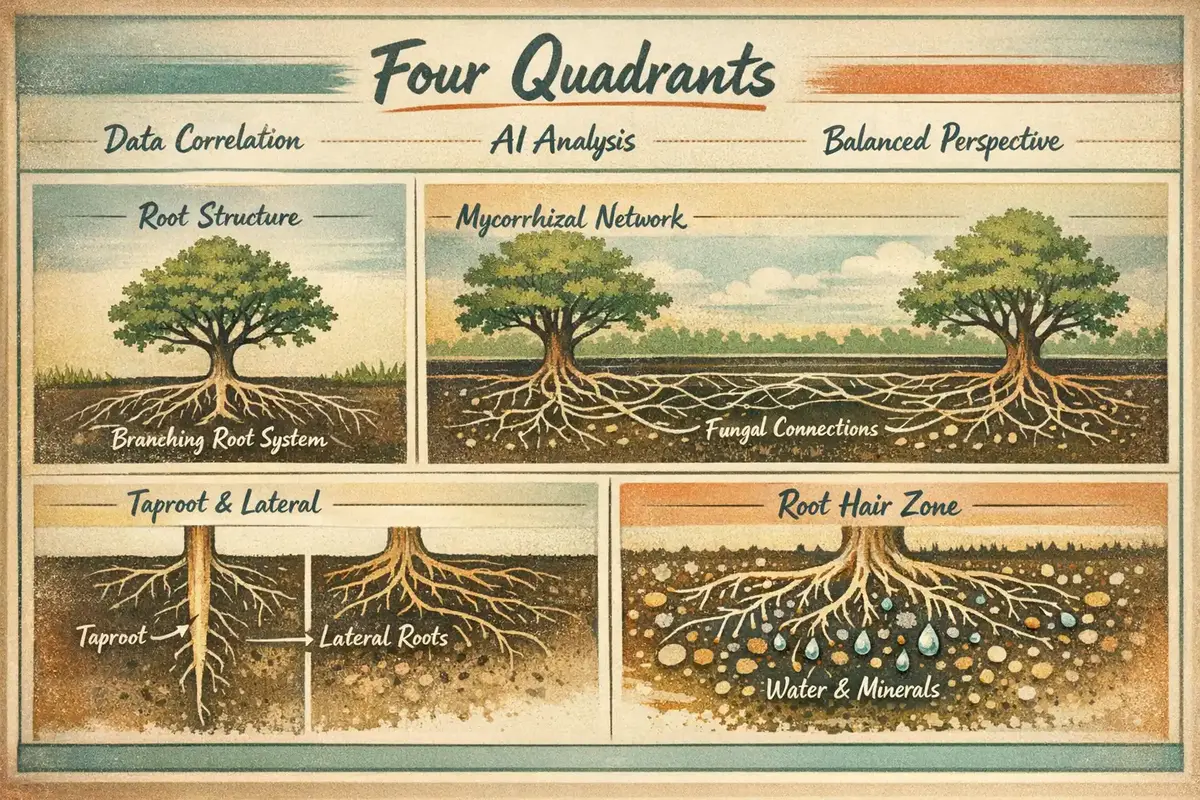
The strength is not magic. It is fit. AI performs best when the world has already been rendered into detectable variation.
Where Meaning Stops Being Measurable
The I quadrant is different. AI can cluster interview themes, summarize open-text reflections, and help a leader see recurring concerns across hundreds of comments. That is assistance, not access. A model can organize expressions of frustration; it cannot feel frustration, distinguish guarded language from genuine conviction with certainty, or know whether stated intent matches lived intent.
The We quadrant is harder still. AI can detect recurring phrases, shifts in tone, and patterns of sentiment across teams. It may show that one business unit uses more defensive language after a restructure, or that trust-related terms appear more often in manager comments than frontline ones. Useful again. But culture is not a word cloud, and trust is not a sentiment score.
The Limitation Is Clarifying, Not Fatal
This is the practical boundary: AI can map traces of meaning, but it does not inhabit meaning. It can point to where interpretation is needed; it cannot finish the interpretive work.
That distinction matters because many leadership errors start right here—treating a pattern in language as proof of belief, or a behavioral metric as an explanation of culture. So the real design question is no longer whether AI is powerful. It is whether you are matching the method to the quadrant—or asking one kind of system to answer the wrong kind of question.
How Do You Match AI Methods to Each Quadrant Without Making Category Errors?
55% of adults across 25 countries say they have at least some trust in their nation’s ability to regulate AI (Pew Research Center, 2025). That is just enough trust for leaders to move fast—and enough misplaced confidence to lose revenue, damage credibility, and push good people out when they use one analytic method as if it fits every human problem.
What happens when a leadership team uses the same AI method for employee sentiment, performance metrics, culture, and workflow design? In practice, they start confusing expression with behavior, behavior with norms, and norms with structure.
A services company learned this the hard way during a client escalation. The COO of a mid-market firm used one sentiment model across employee comments, customer complaints, manager notes, and ticket-resolution logs. The model showed “negative tone” rising in one delivery unit, and leadership responded as if morale were the root issue. Two weeks later, the real problem was obvious: a routing rule in the service platform had created handoff delays, rework, and missed deadlines. They had treated a systems failure as an attitude problem.
A Method Should Follow the Evidence
This is the decision rule: match the AI method to the data type before you match it to the business question.
In the I quadrant, where the issue is individual meaning, AI is best used for text analysis and careful thematic clustering. It can organize reflections, surface recurring concerns, and show where interpretation deserves attention. It cannot verify sincerity or infer motive with confidence.
In the It quadrant, where the evidence is observable action, forecasting and anomaly detection fit better. Output trends, response times, error rates, and completion patterns are visible traces. Here, the model is reading behavior, not guessing at belief.
The Map Matters More Than the Model
The We quadrant needs a different discipline. Shared norms and cultural signals are better approached through clustering and comparative language analysis across teams, functions, or time periods. Even then, the output is a prompt for inquiry, not a final verdict on culture. A trust score is not trust.
The Its quadrant is where synthesis becomes useful. Policies, workflows, incentives, and reporting lines often sit in separate systems; AI can connect those fragments and show where structural friction is building. That is a different job from reading employee language, even if both tasks use the same underlying technology.
Across 25 countries, a median of 53% of adults trust the European Union to regulate AI effectively (Pew Research Center, 2025).
Regulation may set guardrails. It does not choose your method for you.
A quadrant-to-method map is not academic overhead. It is how leaders avoid false diagnosis. And once you start sorting methods correctly, another question gets sharper: when adoption stalls, are you looking at a skills gap—or a trust problem hiding in plain sight?
What Do Trust, Skills, and Leadership Support Reveal About AI Adoption?
76% of U.S. workers recognize the need for new skills. That should change how leaders read AI adoption: hesitation is often less a rejection of the technology than a signal about preparedness (SHRM, 2025).
A regional healthcare director sees it in a budget meeting. The new GenAI tools are technically available, usage is uneven, and the room splits quickly between the confident few and the politely silent many. No one is arguing about the software. They are reacting to what its arrival means for competence, status, and support.
That is why adoption belongs partly in the We quadrant. It is not only a question of access or workflow fit; it is also a question of whether people believe they can learn safely, ask basic questions without losing face, and trust leadership to set fair expectations. When those conditions are weak, low usage can look like resistance even when the deeper issue is uncertainty.
83% of HR leaders say upskilling is vital in an AI-driven economy (SHRM, 2025).
That number matters because it moves upskilling out of the training department and into operating design. If capability-building is treated as a side project, AI adoption becomes socially uneven: early adopters gain fluency, managers over-rely on them, and everyone else learns that experimentation carries reputational risk. In practice, the organization teaches caution while claiming it wants innovation.

Leadership Support Changes the Meaning of the Tool
Boston Consulting Group makes the leadership effect hard to ignore: the share of employees who feel positive about GenAI rises from 15% to 55% with strong leadership support (Boston Consulting Group, 2025). That is not a marginal lift. It is a shift in emotional climate.
Support here does not mean executive enthusiasm alone. It means managers who model use without pretending certainty, clear guidance on where AI helps and where judgment still rules, and visible investment in Leadership Development and Team Development. People watch local leaders for cues. If those leaders are evasive, performative, or absent, the tool inherits that ambiguity.
Read Adoption as a Human Diagnostic
This is the practical reveal: AI adoption data is often a proxy measure for trust, learning culture, and managerial credibility. A low-use team may not need another rollout campaign. It may need better coaching, clearer norms, and leaders who can reduce social risk.
So where should a leader begin—by buying broader access, or by diagnosing the human conditions that make useful adoption possible at all?
Where Should a Leader Start When Building an Integral AI Diagnostic?
38% of employees say their organization has already integrated AI to improve productivity, efficiency, and quality. So ask the uncomfortable question first: if AI is already in the workflow, why do so many leaders still begin with the tool instead of the decision (Gallup, 2026)?
That is usually where misuse starts. Not with a bad model, but with a vague question.
Start With the Decision, Not the Data
A practical integral AI diagnostic begins by naming the decision before collecting evidence. Are you trying to decide whether a rollout problem is a training issue, a workflow issue, a trust issue, or a leadership issue? Until that is clear, quadrant boundaries blur and every signal starts looking interchangeable.
A finance VP in a mid-market firm faces this during budget cycle planning. AI summaries show complaints rising in one division, usage logs show uneven adoption, and meeting transcripts suggest frustration. If the decision question is merely “What is going wrong?”, the team will mix interior experience, observed behavior, shared norms, and system design into one messy conclusion. If the question is sharper — What explains the adoption gap strongly enough to justify investment? — the diagnostic becomes disciplined.
That is the real first step in Organizational Diagnostics: define the decision in a way that forces the right evidence to show up.
Let AI Find Patterns. Let Humans Make Meaning.
A median of 34% of adults across 25 countries are more concerned than excited about increased AI use in daily life (Pew Research Center, 2025). Leaders should treat that as a design constraint, not a public-opinion footnote.
The right early use of AI is modest and powerful at the same time. Use it for pattern-finding, summarization, and correlation. Let it surface recurring language in interviews, show where behavior changed after a policy shift, or connect workflow friction with team-level outcomes. Useful. Fast. Often clarifying.
But interpretation is still a human job. A correlation between lower usage and negative comments does not tell you whether people distrust the tool, dislike the process, or simply lack time to learn it. AI can narrow the field. It should not close the case.
Validate by Quadrant
Before acting, test each conclusion against the kind of evidence it claims to represent. If you say morale is low, do you have interior evidence — not just output metrics? If you say culture is blocking adoption, do you have shared-language or norm evidence — not only individual comments? If you say the system is the problem, can you point to process logic, incentives, or structural bottlenecks?
This validation step is where weak diagnoses fail. And where good ones become credible.
Because once you have a cleaner read across the quadrants, a harder question appears: what should AI actually be allowed to decide — and what must remain a matter of judgment?
The Real Promise of Integral AI Is Better Judgment, Not Automated Wisdom
Companies do not lose their way because AI is weak. They lose their way when leaders let a fluent system collapse distinct human realities into one neat answer — and then act on it.
That is where revenue gets missed, trust thins out, and strong people leave.
What This Model Actually Asks of Leadership
In a technology startup during a board prep cycle, a founder reviews AI-generated summaries of product delays, customer complaints, and employee comments. The model suggests one story: execution discipline is slipping. It sounds plausible. It is also incomplete. Some of the issue sits in workflow design, some in team norms, and some in how a few key managers are privately making sense of a chaotic quarter. Treating those as one problem would be efficient. It would also be wrong.
This is the real promise of integral AI. Not automated wisdom. Better discrimination.
A quadrant-aware approach helps leaders see what they would otherwise blur together: experience is not behavior, culture is not process, and structural friction is not personal resistance. That is why the AQAL frame matters in practice. It does not make AI more mystical. It makes it more honest.
More Honest, More Useful, More Human
The goal is not to make a machine produce meaning on our behalf. The goal is to improve the quality of attention, strengthen the chain of evidence, and support better judgment at the point of decision.
That is also what makes AI more trustworthy. Research from Pew Research Center shows that public trust in AI governance is conditional, not absolute (Pew Research Center, 2025). Inside organizations, the same principle holds. People trust AI more when its role is clear, bounded, and disciplined — not when it pretends to know more than the evidence can support.
Used this way, AI becomes less grand and more valuable. It helps you ask a better question before you make a costly call.
That is a more human standard. And probably a better one. So in your next decision, what are you asking AI to do — clarify the terrain, or replace the judgment you still need to own?
Key Takeaways
- AI is most useful when it is matched to the kind of reality being examined, not treated as a universal interpreter.
- AQAL’s four quadrants help separate interior experience, observable behavior, shared culture, and system design.
- AI is strongest in structured, observable domains and weaker where meaning, trust, and interpretation matter most.
- Better AI use starts with the decision, then selects the method and evidence that fit it.
Frequently Asked Questions
What does AQAL mean in the context of AI analysis?
AQAL is a framework that separates reality into four perspectives: individual interior experience, individual behavior, collective culture, and collective systems. In AI analysis, it helps ensure that different kinds of evidence are not mixed together or misinterpreted as the same thing.
Why is AI more reliable in some quadrants than others?
AI is strongest where data is observable, structured, and repeatable, such as workflows, logs, errors, and response times. It is weaker where meaning, trust, values, and inner experience matter because those cannot be directly measured by a model.
How should AI methods be matched to the four quadrants?
Use text analysis and thematic clustering for individual meaning, forecasting and anomaly detection for observable behavior, comparative language analysis for shared culture, and synthesis for workflows and structural friction. The method should fit the evidence type before it is used to answer a business question.
Why do AI adoption problems often reflect trust or leadership issues, not just skill gaps?
Low adoption can signal uncertainty, fear of judgment, weak managerial support, or a lack of safe learning conditions. When people do not feel supported or prepared, they may avoid using AI even if they recognize its value.
What is the best first step in building an integral AI diagnostic?
Start by defining the decision you need to make, not by collecting every available data point. Then gather evidence from the quadrants that match the question, use AI for pattern-finding and summarization, and let human judgment make the final interpretation.