

Why AI Is Useful for Peak-Experience Narratives but Dangerous as the Final Interpreter
55% of organizations already use AI in at least one business function. That matters because many teams now assume the same systems can also interpret peak-experience narratives with equal confidence (McKinsey, 2023).
Picture a healthcare director in a quarterly review, scanning dozens of reflective accounts from clinicians after a difficult change initiative. The model returns clean themes in seconds—renewed purpose, burnout, moral strain, resilience—and everyone in the room feels the relief of speed.
That is where the risk starts.
When the material is subjective, emotionally charged, or described as hard to put into words, pattern detection is not the same as interpretation. AI can cluster phrases, surface recurring metaphors, and show where stories converge or split. It is useful for first-pass sensemaking. But it cannot tell you whether “I see my work differently now” signals a durable developmental shift, a temporary emotional high, a socially desirable response, or language borrowed from the surrounding culture.
The gap is not academic. It is operational.
Only 5% of executives strongly agree their organization is investing enough in helping people learn new skills for a changing world of work (Deloitte, 2024). So teams are under pressure to move faster with less interpretive capacity, often handing meaning-rich human material to systems built to summarize text, not judge development. The cost is subtle but serious: weak decisions about leadership readiness, culture change, coaching impact, and learning design. This article addresses that exact problem—how to use AI without letting it flatten transformation into tidy language.
Where AI Helps—and Where It Overreaches
Used well, AI is a strong junior analyst. It can reduce the hours spent coding narratives, highlight anomalies worth human review, and make large qualitative datasets navigable. For peak experiences, that matters. These accounts are often long, nonlinear, and full of symbolic or contradictory language.
55% adoption means the question is no longer whether AI enters interpretive work, but whether humans still govern what counts as meaning (McKinsey, 2023).
What AI cannot do is settle the central question. Transformation is not just a theme in language; it is a shift in how a person organizes meaning over time, across contexts, and under pressure. That requires judgment about biography, setting, developmental capacity, and the difference between insight and integration. An Integral framework becomes useful here because it asks a harder question than summary tools do: what changed, where, and by whose standard?
The Real Decision
Executives do not need another debate about whether AI is powerful. It is. The real decision is narrower and more consequential: should AI help humans notice possible transformation—or quietly become the final interpreter of it?
If the narrative itself is spiritual, emotional, or barely sayable, what exactly counts as “data” in the first place—and what gets lost the moment we pretend the text is the whole event?
What Counts as Qualitative Data When the Experience Is Spiritual, Emotional, or Ineffable?
Qualitative inquiry matters here because it starts with a harder question than most AI projects do: what exactly is the thing being studied? If a person says, “Something shifted in me,” is the data the sentence, the emotion behind it, the context that produced it, or the later behavior that confirms it?
Do not answer too fast.
When leaders hear “qualitative data,” they often picture interview transcripts and open-text survey comments. But in transformative work, the usable material is wider and stranger: reflective journals, coaching notes, life-story interviews, debrief conversations after retreats, and narrative accounts of peak moments that people can describe only indirectly. Qualitative research is built to study meaning, experience, and context rather than just count variables (National Library of Medicine, 2014). That is why these materials belong in the dataset even when they look messy.
The Data Is Real—But It Does Not Behave Like Operational Text
In a mid-market technology company during a budget review, a VP reads leadership-program reflections to decide what to fund next. One manager writes about “finally seeing the team as people, not obstacles.” Another describes a moment of silence in a client crisis that “changed how I lead.” A model can tag both as empathy or self-awareness.
That is not wrong. It is incomplete.
These accounts are symbolic, emotionally dense, and often resistant to neat categories. People borrow metaphor when literal language fails. They contradict themselves. They describe rupture before they can explain it. Methodologically, that means the analyst is not just coding content; they are judging how language, setting, and self-understanding interact. Recent methodological work in International Journal of Qualitative Methods argues for exactly this kind of epistemic reflexivity—researchers must stay alert to how meaning is produced, not merely extracted (International Journal of Qualitative Methods, 2025).
In this kind of material, ambiguity is not noise to remove. It is often part of the phenomenon itself.
A Practical Test for Transformative Learning
A beginner-friendly definition helps. Transformative learning is not simply having a strong experience or describing it vividly. It is a deeper shift in how someone interprets the world, themselves, or their choices—followed by some change in action, relationship, or judgment over time.
That distinction matters. “I felt inspired” is description. “I can no longer justify leading the way I used to” may signal a change in worldview. “I redesigned my team meetings and handled conflict differently for three months” starts to look like evidence.
The problem for AI comes next. If a system can summarize recurring themes, how does it tell a repeated topic from an actual reorganization of meaning—theme, or transformation?
Why AI Summaries Miss the Difference Between Themes and Transformation
The NIST AI Risk Management Framework matters here because it draws a line most organizations blur: a system can be useful, well-performing, and still not be fit to make high-stakes interpretive judgments on its own (NIST, 2023). Most teams still treat a clean AI summary as evidence that they have understood the data; the research says the opposite problem is more common—apparent clarity can hide interpretive weakness (NIST, 2023; International Journal of Qualitative Methods, 2025).
What happens when a model finds a pattern that looks meaningful but may only be statistically tidy?
A regional financial services firm in a quarterly talent review offers a familiar example. The CHRO runs 120 leadership reflections through a model and gets a polished output: confidence, resilience, clearer communication, stronger ownership. The room relaxes. It feels like proof that the program worked.
It is not proof. It is a map of repeated language.
Themes are recurring expressions. Transformation is a change in how a person makes sense of self, role, and action over time. Those are not the same unit of analysis. A model can reliably detect that “confidence” appears often; it cannot, from text alone, determine whether that confidence reflects identity reconstruction, a short-lived emotional lift after an offsite, or language people know leaders are expected to use.
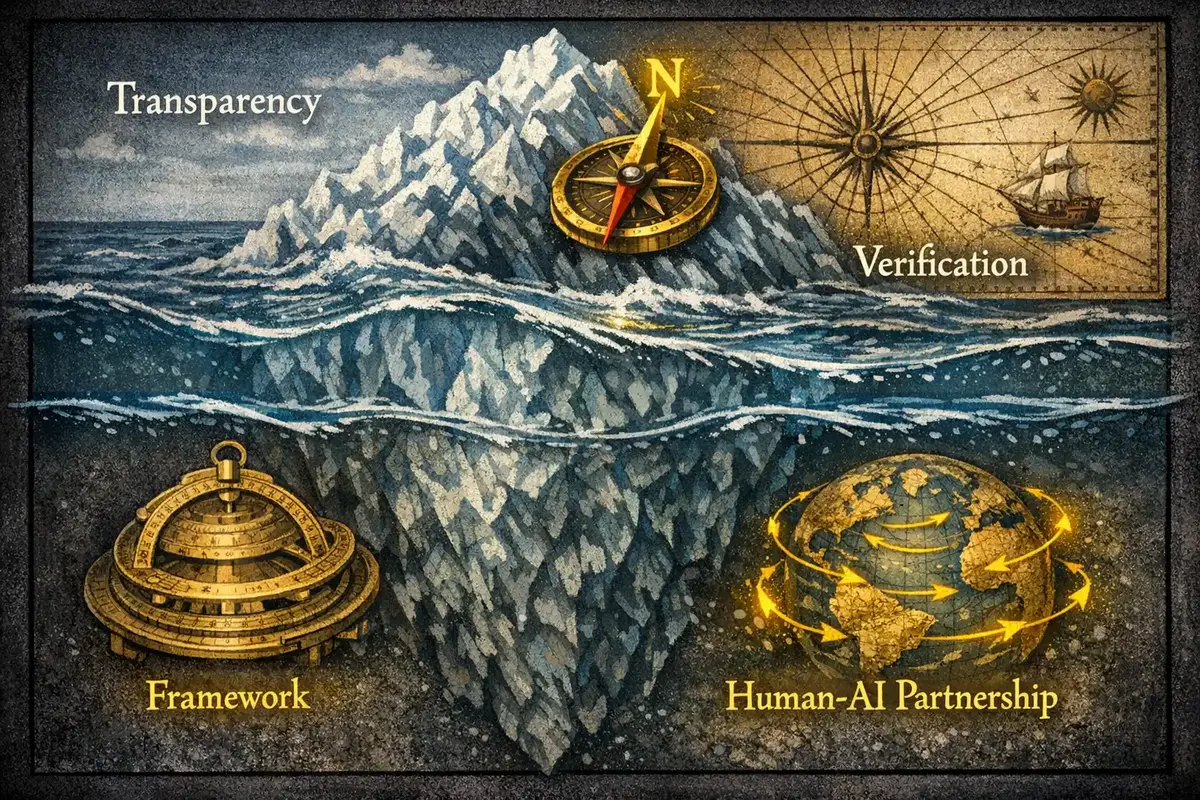
Pattern Strength Is Not Interpretive Strength
This is where overconfidence enters. The more coherent the summary, the easier it is for decision-makers to skip the harder questions: What came before this statement? Did behavior change three months later? Does the person describe the same shift under stress, or only in a reflective setting? Research on AI in qualitative analysis keeps returning to the same caution: rigor depends on reflexivity, context, and transparent human judgment—not just efficient coding (International Journal of Qualitative Methods, 2025).
A trustworthy system is not one that sounds certain. It is one whose limits are visible and governed (NIST, 2023).
That is why a trustworthy AI framework is useful but insufficient by itself. Governance can tell you where automation should stop. It cannot supply the missing interpretation.
The Mistake Executives Make
Executives rarely confuse themes and transformation in theory. They confuse them in practice—during budget decisions, promotion calls, and program evaluations. Once a pattern is labeled, it starts to harden into a conclusion.
So the real challenge is operational: if AI can surface candidate meanings but not validate them, what kind of workflow keeps human judgment in the loop without losing speed?
How Do You Build a Workflow That Preserves Meaning Instead of Flattening It?
The NIST AI Risk Management Framework matters here because it forces a practical question: if AI should not be the final judge, what does a defensible workflow actually look like? Most teams assume the answer is better prompting. It is not. The real issue is sequence—where automation helps, where it must stop, and where human interpretation has to re-enter with discipline (NIST, 2023).
A trustworthy workflow is not one big analysis step. It is a chain of checkpoints.
Start with Collection and Preprocessing—Not Interpretation
In a manufacturing enterprise during a post-restructure review, a plant director may be sitting on interviews, shift-lead journals, coaching notes, and open-text pulse responses. If those materials are thrown straight into a model, the system will flatten unlike things into one text stream. That is the first avoidable mistake.
Begin by separating raw narrative, context notes, and follow-up evidence. Clean transcripts. Remove obvious transcription errors. Standardize speaker labels. Mark missing context instead of guessing it. This is where AI is genuinely useful: transcription cleanup, de-duplication, clustering similar passages, and generating candidate themes fast enough to make a large corpus workable. That kind of support fits a human-centered approach because the system is assisting analysis, not deciding what the experience means (OECD, 2019).
Then pause.
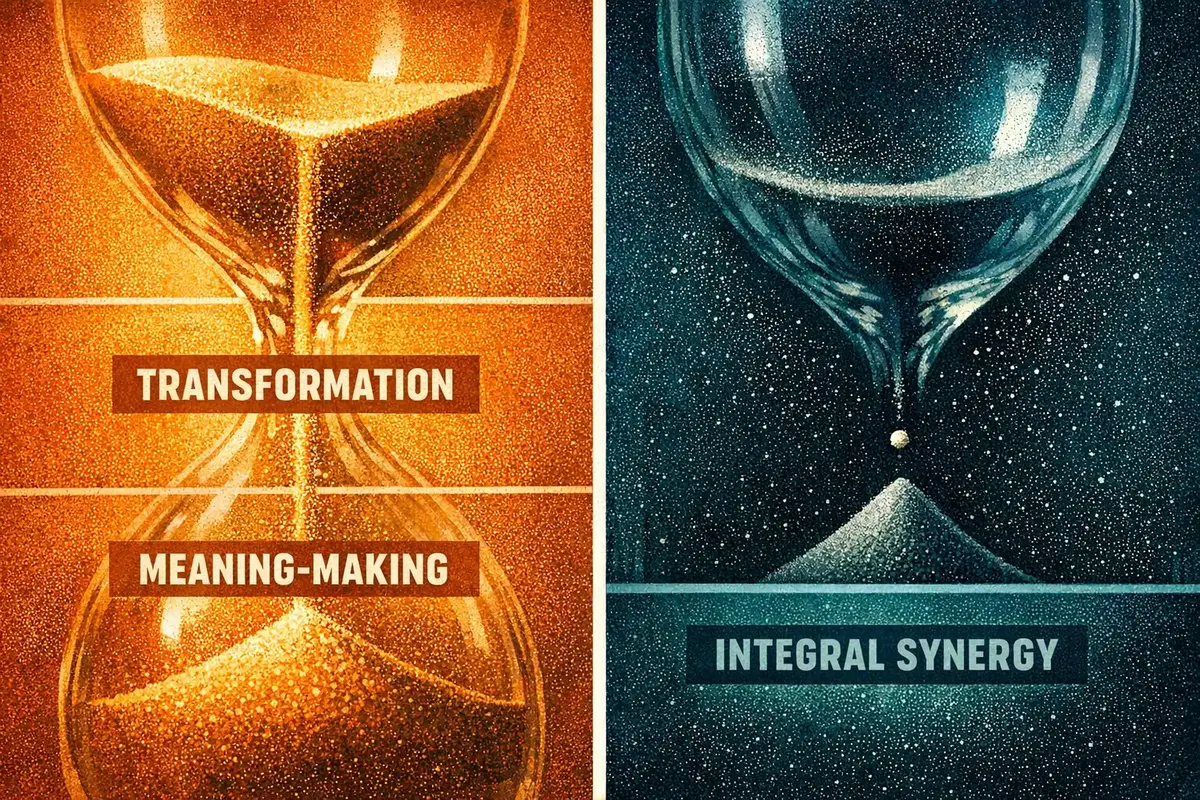
Move from Candidate Themes to Human Review
This is the handoff that many organizations skip. A model can suggest that several accounts point to identity shift, conflict reappraisal, or renewed purpose. It cannot establish that those are valid developmental claims.
Human reviewers now need to test each candidate theme against three questions: What in the text supports this reading? What context could change it? What later behavior, if any, confirms it? UNESCO’s guidance is clear on this point: AI systems require human oversight and clear accountability, especially where judgments affect people and institutions (UNESCO, 2021).
The workflow becomes trustworthy only when the strongest claims face the strongest human scrutiny.
Add Theory Alignment and Reflexive Interpretation
Only after review should the team align findings to a developmental frame such as the AQAL model. That step matters because it asks whether the reported shift is interior, behavioral, cultural, structural—or some combination. It also exposes overreach. A moving statement may show emotional intensity without showing durable transformation.
The final stage is reflexive interpretation. Analysts document their assumptions, note where evidence is thin, and separate “possible shift” from “substantiated change.” That is not bureaucracy. It is governance with epistemic humility—exactly the kind of interpretability and accountability both NIST and OECD argue for (NIST, 2023; OECD, 2019).
The hard part comes after the workflow is built. What lens should humans use when they return to the data—ordinary coding categories, or a fuller map of development itself?
What Does an Integral Lens Add That Ordinary Thematic Analysis Misses?
The AQAL model matters here because it gives analysts a way to hold several kinds of evidence at once, instead of mistaking one kind for the whole story. Most organizations still treat qualitative interpretation as a sorting exercise—find the dominant themes, count their frequency, report the top five—but The Integral Institute’s framework shows that human change rarely sits in one bucket (The Integral Institute).
What gets lost when a profound inner shift is reduced to a single theme or a single metric? Usually, the thing that matters most.
One Story, Four Dimensions
Ordinary thematic analysis is useful for identifying repeated language. It can tell you that people mention clarity, purpose, trust, or courage. It is far weaker at showing whether those words point to a private realization, a visible behavior change, a shift in relationships, or a response to altered conditions around them.
An Integral lens forces that distinction. In practical terms, it asks the analyst to examine at least four dimensions of the same account: first-person experience (what the person felt or realized), behavior (what they actually did differently), relationships and culture (how others experienced the shift), and systems or context (what structures enabled or constrained it) (The Integral Institute).
That changes the reading.
A regional healthcare provider, in the middle of a quarterly review, is deciding whether a leadership program changed anything real. A director’s reflection says, “I stopped leading from fear.” A model can code that as self-awareness. An ordinary analyst may stop there. An Integral reading asks harder questions: Did her team meetings change? Did conflict patterns shift? Did peers notice more openness? Did workload design or reporting pressure make the old behavior likely to return?
Why This Matters for Spiritual Language and Purpose
This is where reductionism usually enters. Inner insight gets treated as either just a feeling or proof of performance. Both are bad readings.
Narratives of peak experience often include spiritual language, identity reappraisal, or a changed sense of purpose. Those accounts are easy to mishandle because they sound subjective on the surface and grandiose in summary. The Integral Institute’s work on purpose-driven leadership and values integration is useful precisely because it frames purpose not as a slogan but as something that must be integrated across values, choices, and role demands (The Integral Institute).
That is the practical gain. The lens does not romanticize inner experience, and it does not dismiss it. It asks whether meaning became action, whether action held under pressure, and whether the surrounding system supported or distorted the change.
A cleaner coding scheme will not answer that. Human interpretation still has to decide what counts as evidence—signal, or projection?
Which Evidence Shows That Learning and Development Still Depend on Human Interpretation?
99% of participants say what they learned is relevant to their challenges. That sounds like success—until a company funds the wrong programs, promotes the wrong people, and watches trust erode because “relevant” was mistaken for “transformative” (Center for Creative Leadership, 2025).
If organizations already track learning outcomes, why is it still so hard to tell whether people have truly changed?
Strong Metrics, Weak Meaning
In a regional retail company during budget season, a VP of people reviews leadership-program results before deciding what survives next year. The dashboard looks excellent: 98% say they apply what they learned to their work, and 99% say it is relevant to their challenges (Center for Creative Leadership, 2025). On paper, that should settle the case.
It does not.
Relevance is not the same as reorganization of meaning. Application is not the same as durable transfer under pressure. A participant may use a feedback tool for two weeks, repeat the language of self-awareness in a debrief, and still interpret conflict, authority, or responsibility in exactly the same way as before. Measurement shows that learning landed. It does not, by itself, explain how it landed, why it mattered, or whether it changed judgment when the stakes rose.
High satisfaction and high application rates tell you that learning was usable. They do not tell you what kind of human development actually occurred.
That is why a serious leadership development framework has to include interpretation, not just reporting.
The Scale Problem Is Getting Worse
The organizational need is not abstract. Only 23% of the world’s employees were engaged at work in 2022 (Gallup, 2023). At the same time, employers expect 39% of workers’ core skills to change by 2030 (World Economic Forum, 2025).
Those two numbers belong together.
Low engagement tells you many people are present without being meaningfully connected. Skill disruption tells you roles are changing faster than old development models can explain. Put them side by side and the challenge becomes obvious: organizations need ways to understand subjective learning at scale without pretending that a metric is a meaning system.
Human interpretation is what connects the dots. It asks whether a reported shift reflects compliance, enthusiasm, identity change, or genuine developmental capacity. Without that layer, learning data becomes easy to count and hard to trust.
And that leaves one final question hanging over every AI-enabled workflow: are humans still making meaning—or just approving what the system has already framed?
The Real Test of AI in Transformative Learning Is Whether Humans Stay in Charge of Meaning
At the end of a quarterly review, a services firm VP is staring at two neat outputs on the screen: strong coaching feedback and an AI summary that says people show more confidence, clarity, and ownership. The room wants to move on—to funding, staffing, next quarter—but this is the moment that decides whether interpretation stays serious or becomes administrative.
The numbers can be impressive. In the ICF/PwC Global Coaching Client Study, 86% of respondents who could calculate company ROI said their company at least made back its investment, with a median company return of 700% and a median individual ROI of 344% (ICF, 2023). That should make any executive pay attention.
It should not make them careless.
Strong Returns Do Not Remove the Need for Judgment
High returns tell you the work created value. They do not tell you, on their own, what kind of change occurred. A person may report sharper focus, better conversations, or more decisive action and still be operating from the same assumptions about control, identity, or authority.
That is why the most credible use of AI is support, not substitution. Let it organize transcripts, surface anomalies, and show where stories converge. Useful work. Fast work. But when the question is whether someone has undergone a meaningful developmental shift, the evidence is often indirect: how colleagues describe them now, what happens under stress, whether a new stance holds after the workshop glow fades.
Meaning Lives in Context, Not Just in Text
This is where many teams overreach. They treat a polished summary as if it were a conclusion.
Transformative narratives are subtle. They are often relational before they are verbal. A leader may not say, “My worldview changed.” Instead, the signal appears in fewer defensive reactions, better listening in conflict, or a different quality of accountability noticed by others. No model can responsibly name that as transformation without human reflexivity—the discipline to question one’s own reading, test context, and admit uncertainty.
That is also why an integral leadership lens remains useful at the end of the process, not just the beginning. It keeps the analyst from confusing inner language with outer change—or outer performance with deeper meaning.
The Future Is Better Partnership, Not More Automation
The practical future is clear enough. Machines will keep getting better at finding patterns. Humans still have to decide what those patterns mean, what they do not mean, and what evidence would change the judgment.
That is the real test. In your own work, is AI helping you see more clearly—or quietly deciding, in advance, what counts as transformation?
Key Takeaways
- AI is useful for first-pass sensemaking, but it should not be the final interpreter of peak-experience narratives.
- Qualitative data in transformative work includes journals, coaching notes, interviews, and other meaning-rich accounts.
- Themes, summaries, and high satisfaction scores do not by themselves prove transformation or durable development.
- Human judgment, reflexivity, and an integral lens are needed to preserve meaning and context.
Frequently Asked Questions
What is the main risk of using AI to interpret peak-experience or transformative-learning narratives?
The main risk is confusing pattern detection with real interpretation. AI can summarize recurring language and surface themes, but it cannot determine whether a statement reflects durable transformation, a temporary emotional high, or socially expected wording.
What counts as qualitative data in transformative learning research?
Qualitative data includes reflective journals, coaching notes, life-story interviews, debrief conversations, and open-text narratives about meaningful experiences. These materials are valuable because they capture context, meaning, and change over time, not just measurable variables.
How is a theme different from transformation in qualitative analysis?
A theme is a recurring idea or phrase in the text, while transformation is a deeper shift in how a person understands themselves, others, or their role. A model can identify repeated themes, but only human judgment can assess whether those themes reflect genuine developmental change.
What workflow helps preserve meaning when using AI on qualitative narratives?
A defensible workflow uses AI for transcription cleanup, de-duplication, clustering, and candidate themes, then hands interpretation back to humans for review. Analysts should test each claim against context, later behavior, and developmental theory before concluding that change has occurred.
Why is an integral or AQAL lens useful for interpreting transformative experiences?
An integral lens helps analysts examine multiple dimensions of change at once, including inner experience, behavior, relationships, and surrounding systems. This reduces the chance of mistaking a powerful feeling or a polished summary for evidence of durable transformation.