

Why one-size-fits-all development keeps missing the learner
A regional healthcare director approves the same leadership program for new managers, senior clinicians, and high-potential administrators. By week three, the feedback is predictable: too basic for some, too abstract for others, badly timed for almost everyone.
That is not a content problem. It is a matching problem.
In 2024, 45% of U.S. employees participated in training or education to build new skills for their current job, which tells you the appetite for development is real; the frustration comes when that investment still lands as generic rather than useful (Gallup, 2025). The cost is easy to miss because it rarely shows up as a single failed program. It shows up as low completion, weak transfer into daily work, and managers who start treating development as a compliance exercise instead of a performance tool.
This article addresses that gap: how AI can help turn development from a standardized offering into a more relevant personal learning journey.
The familiar failure: equal access, unequal fit
Most organizations still design development around administrative efficiency. One curriculum. One sequence. One calendar. That makes procurement easier, but it ignores the obvious: a first-line manager trying to run better one-to-ones does not need the same next step as a functional leader wrestling with ambiguity, identity, and cross-system influence.
This matters even more in integral development, where growth is not just about skills. It includes mindset, behavior, relationships, and the capacity to make sense of complexity. When every learner gets the same material, the program may be consistent, but the experience is not coherent. Some people are under-challenged. Others are pushed into concepts they cannot yet use. Both groups disengage for rational reasons.
36% of employees who used AI at work said they used it to learn new things (Gallup, 2025)
That number is a signal. People are already using AI to close relevance gaps on their own.
Where AI actually helps
The useful role of AI is narrower — and more practical — than the hype suggests. It does not replace faculty judgment, coaching expertise, or the human discernment required in serious development work. It helps with routing.
Done well, AI can look at signals such as role, prior progress, stated goals, pace, and patterns of engagement, then suggest a better next step than a fixed curriculum can. Not a perfect step. A more relevant one. That may mean slowing someone down, skipping redundant material, surfacing reflection at the right moment, or connecting a learner to a coach instead of another module.
That is the shift worth paying attention to. Not more content, but better sequencing. Not automation for its own sake, but support that meets the learner where they are.
The hard question follows from there: if personalization is increasingly possible, what exactly should be personalized in an integral journey — content, cadence, practice, coaching, or all four?
What personalized learning journeys actually mean in an integral context
The personalization–adaptation–individualization framework matters here because most executives use these terms as if they mean the same thing. But what changes when development is treated as a journey instead of a content library? If the answer is just “better recommendations,” the concept is still too small. If the answer is “every learner gets something different,” it is also too loose.
The useful distinction is simpler than the jargon suggests.
Three terms, three different jobs
Individualized learning usually means the destination stays fixed while the path changes a little. Two people may be expected to reach the same capability standard, but one gets more practice, another gets more time, and a third skips material they already know.
Adaptive learning is narrower. It reacts to performance inside a system. Miss a concept, and the platform serves remediation. Show mastery, and it moves you ahead. That can work well for technical knowledge. It is less useful when the real issue is not knowledge but judgment, identity, or how someone interprets pressure.
Personalized learning journeys are broader. They ask a different question: what is the right next move for this person, in this role, in this context, now? That move may be content. It may also be reflection, practice, feedback, coaching, or a stretch assignment.
A mid-market manufacturing VP facing a team restructure does not mainly need “Module 7: change leadership.” She may need help seeing why her usual command-and-control habits work in a plant shutdown but fail in cross-functional redesign. That is not a content gap. It is a developmental one.
| Term | What changes | Main focus | Best use |
|---|---|---|---|
| Individualized learning | Path changes a little | Same destination, adjusted pace or practice | Reaching a fixed capability standard |
| Adaptive learning | System reacts to performance | Immediate response to right/wrong answers | Technical knowledge and remediation |
| Personalized learning journeys | Next move changes by person and context | Content, reflection, practice, coaching, or stretch | Developmental work in real roles |
Why the integral lens changes the design
In an integral context, personalization cannot stop at preferences or pace. It has to account for behavior, mindset, relationships, and environment at the same time. This is where developmental stages and quadrant analysis become practical, not theoretical.
One learner may need a new skill. Another may already have the skill but lack the meaning-making capacity to use it under stress. A third may be capable individually yet stuck in a team system that punishes experimentation. Treat those as the same problem and the program becomes elegant on paper, ineffective in practice.
AI’s role, then, is not to turn development into an endless recommendation feed. It is to help interpret signals that humans often see only in fragments — assessment results, reflection patterns, observed behavior, role demands, and timing — and suggest the next best learning move. Sometimes that move is acceleration. Sometimes it is pause. Sometimes it is a coach, not a course.
That sounds reasonable. The harder question is not whether AI can recommend something relevant — it is how the system decides what relevance means. Useful judgment, or pattern-matching at scale?
How does AI decide what to recommend next?
398 talent development professionals responded to the latest Association for Talent Development survey, which matters because it cuts through a common executive assumption: if AI can recommend content instantly, the hard part is solved (Association for Talent Development, 2024). In practice, speed is rarely the issue. Programs fail when the system is good at serving material and weak at judging what kind of intervention should come next.
That is the distinction most organizations miss.
The recommendation engine is really a decision loop
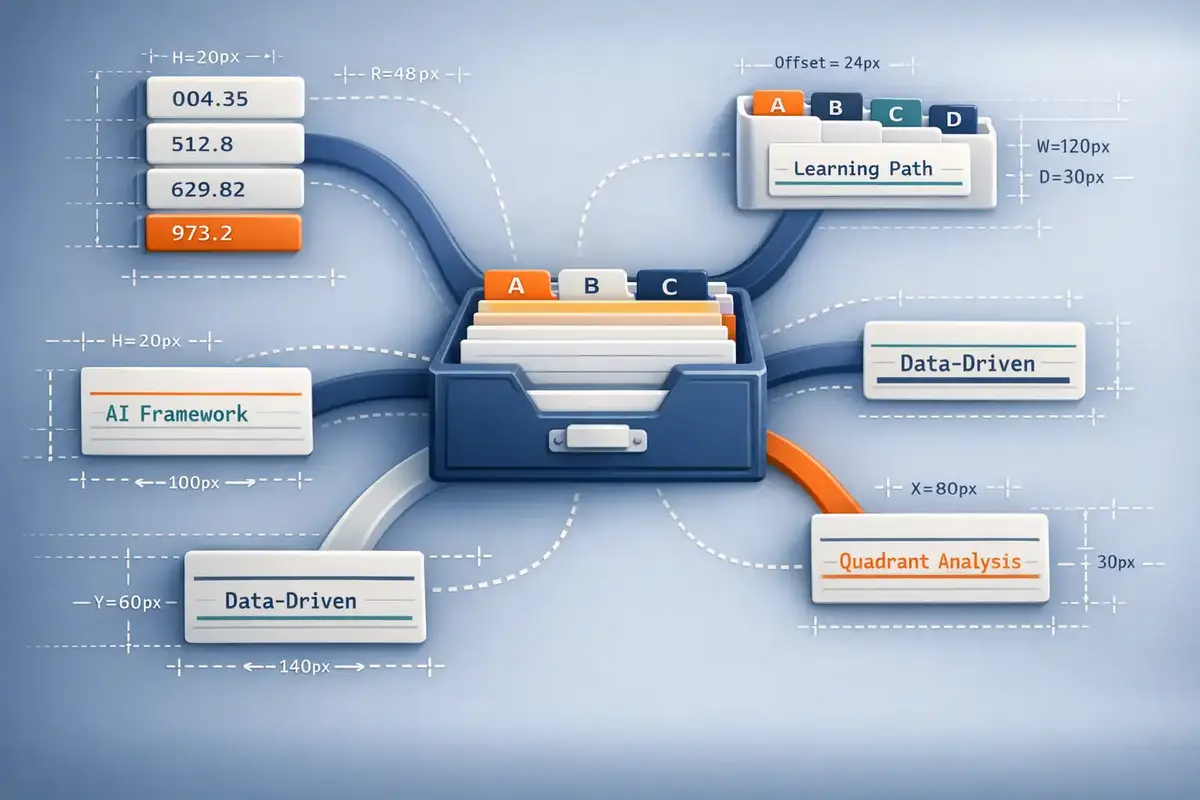
A useful AI recommendation model is not a magic feed. It is a loop: assess, diagnose, recommend, observe, adjust. Each step matters because each corrects a different failure in standard learning design.
Assess means gathering more than quiz scores. In an integral program, the inputs can include developmental stage indicators, quadrant-based signals across inner and outer dimensions, reflection responses, and observed behavior patterns from managers, coaches, or work artifacts. A learner who writes thoughtful reflections but shows repeated conflict escalation in team meetings is sending a different signal than someone who performs well behaviorally but cannot yet name the assumptions driving those choices.
Diagnose is where the system asks the real question: is this a knowledge gap, a practice gap, a sense-making gap, or a context problem? That is why basic adaptive learning is only part of the answer. It can react to right and wrong answers. It is less reliable when the issue is that the learner is applying the wrong frame to a messy human situation.
Strong recommendations are mostly about timing
The best systems do not just choose content. They choose sequence.
A regional services firm director heading into a quarterly review may not need another lesson on feedback models. If recent reflections show defensiveness, manager observations show avoidance, and team data suggests trust is thinning, the right next step may be a coaching conversation followed by a live practice assignment — not more theory. Two weeks later, once the behavior shifts, new content becomes useful again.
This is where personalization becomes credible. The system recommends coaching when interpretation is the bottleneck, practice when transfer is the bottleneck, reflection when awareness is the bottleneck, and new content when capability is genuinely missing.
Then it watches what happens. Did the learner apply the practice? Did reflection deepen or stay performative? Did observed behavior change under pressure? That is the observe and adjust part, and it is what keeps personalization from becoming a one-time guess.
The logic is straightforward. The organizational reality is not. If the model can see the right next move, but the company cannot support it, where does the failure actually sit — in the algorithm, or in the system around it?
Why the biggest barrier is not the algorithm but the organization
95% of talent development professionals in the organizational readiness model cited budget constraints as a barrier to AI implementation, and that tells you where personalization usually breaks first: not in the recommendation logic, but in the operating system around it (Association for Talent Development, 2024). Without that readiness, even a strong engine produces weak outcomes—good suggestions sit idle, coaches are not looped in, and managers treat the system as one more platform to administer.
That failure pattern is common.
A smart system inside an unready company
Consider a mid-market finance firm during budget season. The CHRO approves an AI-driven personalization layer for leadership development after a pilot shows promising engagement. The platform can detect who needs practice, who needs reflection, and who should be routed to coaching. On paper, it works.
Then the rollout hits the organization.
There is no agreed governance for who reviews recommendations that carry developmental or ethical weight. Managers are told to “support the journey” but are not trained to interpret the signals. Coaches are available, but capacity is thin and scheduling is manual. Procurement funded the software, not the process redesign. Within one quarter, the system is technically live and operationally stranded.
94% said they did not have enough staff with the right knowledge to implement AI (Association for Talent Development, 2024)
That number matters because it reframes the problem. Personalization is not a software purchase. It is a capability stack.
Why human judgment still carries the load
This is where human judgment becomes decisive. AI can detect patterns across assessments, reflections, and behavior data. It cannot fully interpret whether a leader’s hesitation is wise restraint, political fear, cultural misread, or an early sign of burnout. Those distinctions shape the right intervention, and they are rarely visible in the data alone.
The same is true for ethics. A system may infer that a learner should be pushed into more challenge because they have mastered prior material. A skilled coach may see that the learner is already overloaded by a team restructure and that more stretch would be developmentally clumsy, not helpful. That is not anti-technology. It is the practical case for ethical AI and disciplined human judgment.
Organizations often want the tool to compensate for weak manager capability, thin coaching benches, and unclear decision rights. It cannot. Technology can improve routing. It cannot substitute for adult developmental discernment.
The real risk is subtle: a company thinks it has installed personalization when it has only installed variability. And once developmental stages enter the picture, the stakes rise—does the system know what the learner needs, or only what the learner clicked on?
How do developmental stages and coaching work together in AI-personalized programs?
The developmental fit framework matters here because getting it wrong costs more than a weak learning experience. It shows up in missed deals, trust that thins out across teams, and high-potential leaders who leave after being pushed too hard—or not challenged at all.
If AI can spot a learning need, who decides whether the next step should be coaching, practice, or reflection? In serious leadership development, that decision cannot rest on click behavior alone.
Stage data changes the level, not just the topic
A regional retail VP heading into a market shift may look, on the surface, like she needs sharper execution discipline. Her dashboard is slipping, store managers are escalating more issues, and the board wants faster action. But stage-sensitive data can reveal a different problem: not a lack of skill, but a limit in how she is interpreting complexity, conflict, and competing priorities.
That is where developmental stage data becomes useful. It helps an AI system adjust the level of challenge a learner receives, not just the subject matter. One leader may benefit from direct practice and tighter feedback loops. Another may need structured reflection because the real bottleneck is how they make sense of authority, ambiguity, or dissent. A third may need more support before more stretch.
This is why integral development has unusual value in leadership work. It does not isolate performance into a single lane. It connects inner development, visible behavior, relationship patterns, and systems awareness—so the intervention matches the actual source of the struggle, not the most obvious symptom.
Coaching is the intervention layer
This is the practical complement to AI. The system can detect patterns. Coaching can work with meaning.
A strong program uses assessment outputs to trigger the right human conversation at the right time. If a learner shows repeated signs of overcontrol under pressure, the next step may be a coach exploring what threat the leader thinks they are managing. If the data shows thoughtful self-awareness but weak follow-through, the conversation shifts toward commitment, practice design, and accountability. The point is not to add coaching everywhere. It is to route it precisely.
That is why coaching interventions and foundational coaching skills matter more in AI-personalized programs, not less. AI improves timing. The coach improves interpretation.
60% of surveyed leaders had moderate or extensive plans to integrate AI into leadership training programs (Harvard Business Review, 2024)
That number from Harvard Business Review signals momentum, but the real issue is design discipline. If AI is used only to recommend more content, organizations will automate activity and miss development. If it is used to identify when a leader needs challenge, containment, or a better question, the system becomes far more credible.
The real handoff is judgment
The best handoff is simple: AI identifies a likely developmental edge; the human decides how to work with it. Sometimes that means content. Sometimes practice. Sometimes a difficult conversation with a coach.
And that creates the next operational problem. If the system can flag who needs what kind of support, can the organization actually deliver it at the right moment—or will personalization collapse under its own complexity?
Where should organizations start if they want personalization without overcomplication?
66% faster skill change is happening in occupations most exposed to AI than in the least exposed ones (PwC, 2025). That is the tension: AI is already reshaping work quickly, yet many organizations still begin personalization by trying to redesign the entire learning ecosystem at once.
That is usually the wrong start.
Start narrow enough to learn
A better entry point is one development pathway, one learner segment, and one decision you want to improve. Not “personalize leadership development.” Something smaller: first-time managers in a regional healthcare system, or directors moving into enterprise roles during a reorganization.
A technology startup founder does not need a grand architecture in year one. She needs to know whether a more tailored journey helps team leads prepare for client escalations without flooding them with content they will not use. That kind of bounded test creates operational clarity. It also gives the organization a chance to learn where human review is needed, where manager involvement matters, and where the system is making weak inferences.
This matters because 63% of employers say skills gaps are the top barrier to business transformation (World Economic Forum, 2025). If the problem is urgent, the pilot should be practical.
Use less data, but better data
Most early programs collect too much and interpret too little.
Start with a small set of inputs that can actually change the next step: role transition, one baseline assessment, manager observation, and a short learner reflection. If your model includes developmental stages, use them because they affect intervention choice — not because they make the dashboard look sophisticated.
88% of organizations now use AI in at least one business function (McKinsey, 2025)
That does not mean they are using it with discipline.
Measure the right proof
Content consumption is a weak success metric. The stronger questions are simpler: did the journey feel more relevant, did learners follow through in the flow of work, and did coaching conversations become more precise?
Those measures sound modest. They are not. If personalization improves activity but not judgment, the organization has built a smarter delivery system — not a better development model. And that leaves the central question unresolved: is the real promise of AI more efficient learning, or better decisions under pressure?
The real promise of AI-personalized development is better judgment, not more automation
Bad development decisions are expensive. They show up as stalled deals, damaged trust, and strong people quietly deciding to leave because the support they got arrived too late or missed the point.
That is why the best use of AI-personalized development is not to automate learning. It is to help people see developmental patterns sooner — and respond with better judgment.
Earlier signals, better interventions
Picture an enterprise technology CTO in the middle of a product reset. Delivery is slipping, senior engineers are pushing back, and a previously trusted VP has started narrowing every discussion to execution details. A conventional learning system might assign more content on change leadership. A better one notices a pattern: under pressure, this leader is defaulting to control, reducing dialogue, and weakening the very coordination the business now needs.
That is the value. Not faster content delivery. Earlier pattern recognition.
Research consistently shows that AI is moving into leadership and talent systems quickly, but the practical question is still the same one raised by Harvard Business Review, McKinsey, PwC, Gallup, the World Economic Forum, and the Association for Talent Development across their recent work: can organizations use these systems to improve decisions, not just increase activity? The answer depends less on technical sophistication than on whether leaders treat AI outputs as prompts for interpretation rather than instructions to follow.
Relevance without losing ethics
The future of personalized learning journeys will be decided by balance.
Programs need enough relevance to feel timely, enough ethical discipline to avoid overreach, and enough human interpretation to keep context in view. A recommendation can be accurate in pattern terms and still wrong in human terms. It may flag challenge when the wiser move is containment. It may suggest acceleration when the real need is a hard conversation, a pause, or a coach who can hear what the data cannot.
The strongest systems will feel almost modest. Timely. Contextual. Unmistakably human.
If you are shaping one of these programs, the next step is not to ask how much development you can automate. It is to ask a harder question: where would better judgment change the outcome for your people — and what would help you see that sooner?
Key Takeaways
- One-size-fits-all development often fails because it matches content to calendars, not to learner needs.
- AI is most useful when it improves routing, sequencing, and timing rather than replacing human judgment.
- In integral development, personalization should account for behavior, mindset, relationships, and environment together.
- The strongest programs start small, use better data, and pair AI recommendations with coaching and ethical oversight.
Frequently Asked Questions
What are personalized learning journeys in integral development?
Personalized learning journeys are development paths that adjust content, practice, coaching, and timing to fit a learner’s role, context, and current developmental needs. In an integral approach, they address not only skills but also mindset, behavior, relationships, and the surrounding environment.
How is AI used to personalize development programs?
AI helps by analyzing signals such as role, progress, goals, engagement patterns, and assessment results to recommend the next best learning move. It is most useful for routing learners to the right mix of content, reflection, practice, or coaching at the right time.
What is the difference between adaptive, individualized, and personalized learning?
Adaptive learning reacts to performance inside a system, usually by remediating gaps or advancing mastery. Individualized learning keeps the same destination but adjusts pace or practice, while personalized learning journeys choose the next step based on the person’s role, context, and developmental needs.
Why is human judgment still necessary in AI-personalized development?
AI can detect patterns, but it cannot fully interpret whether a learner’s behavior reflects overload, fear, cultural context, or a deeper developmental issue. Human judgment is needed to decide whether the right intervention is coaching, challenge, reflection, or more content, and to ensure the process stays ethical and context-aware.
How should organizations start implementing AI personalization without overcomplicating it?
The best starting point is a narrow pilot focused on one learner segment, one development pathway, and one decision to improve. Use a small set of meaningful inputs, measure relevance and transfer into work, and pair AI recommendations with coaching and governance.