

Why the skills gap is now a workforce design problem, not a training problem
63% of employers say skill gaps are a major barrier to business transformation. For a CHRO, that changes the question from “What should we teach?” to “How fast can talent move where the business now needs it?” (World Economic Forum, 2025)
You have seen the scene. A business leader asks for more data engineers, automation analysts, or AI-adjacent product talent during a quarterly review, and HR responds with a list of courses, certifications, and learning hours. The request was about execution capacity. The answer was about content.
That mismatch is now expensive. The World Economic Forum estimates that 44% of workers’ core skills will transform within the next five years (World Economic Forum, 2025). If nearly half the skill base is shifting on a business timetable, then treating reskilling as a traditional learning-and-development program creates drag at exactly the wrong moment: open roles stay open, managers over-rely on external hiring, and transformation plans slow down while the organization waits for talent it already partly has. This article addresses that operating gap: how CHROs should treat reskilling as a workforce design decision, not a training calendar.
The real constraint is organizational speed
The hard truth is simple. Most employees can learn more than the organization can see.
A regional healthcare provider, for example, may not lack people capable of moving into digital operations roles; it may lack a clean way to identify adjacent skills in clinical administration, prioritize which transitions matter most, and release those employees without breaking service delivery. That is not a curriculum problem. It is a system problem involving role architecture, internal mobility, manager incentives, and sequencing.
The organizations making progress are not assuming that a course creates capability on its own. They are redesigning how work is broken apart, how adjacent talent is spotted, and how people move from legacy roles into emerging ones with less friction. In practice, that means linking reskilling to workforce segmentation, role criticality, and predictive workforce planning rather than isolating it inside L&D.
From learning supply to talent flow
This is the shift CHROs need to make. Reskilling is no longer mainly about increasing learning supply; it is about increasing talent flow into priority roles.
That requires different leadership questions. Which roles create the most strategic bottlenecks? Which employees have the closest skill adjacency? Which managers are hoarding talent? Which transitions can happen in 90 days, not 12 months? Until those questions are answered, training investment will keep producing activity without enough redeployment.
And that leads to the next decision point: when leaders say upskilling, reskilling, and redeployment, are they naming the same problem—or three very different ones?
What is the difference between upskilling, reskilling, and redeployment?
The capability-movement framework matters here because most reskilling strategies fail at the level of definition before they fail at execution. If leaders cannot distinguish these three moves, how can they build a credible skills pipeline? And if every learning investment is labeled “reskilling,” what exactly is the workforce plan measuring?
That confusion is common because all three terms involve people learning and moving. But they solve different business problems. The World Economic Forum estimates that, if the global workforce were 100 people, 59 would need training by 2030 (World Economic Forum, 2025). That number is useful only if CHROs know what kind of change they are funding.
Three moves, three decisions
Upskilling means increasing capability within a person’s current role. A cybersecurity analyst learns prompt engineering for threat detection. A payroll manager learns workflow automation. The job family stays largely intact; the performance standard rises.
Reskilling is different. It prepares someone for a different role, usually by building adjacent capabilities that open a new path. A customer support specialist moves into digital onboarding operations. A maintenance planner trains for an industrial data technician role. The point is not to make the current job better. It is to make a different job possible.
Redeployment is the placement decision. It is the moment the organization actually moves talent into work where those capabilities can be used now, not later. Without redeployment, upskilling and reskilling remain potential energy.
Why language discipline changes execution
In a quarterly budget review at a mid-market manufacturing company, a VP may say, “We need to reskill 40 supervisors for smart-factory work.” But the real need often splits three ways: some supervisors need upskilling in digital dashboards, a smaller group needs reskilling into production analytics roles, and a few should be redeployed immediately into understaffed planning teams because they already have the right adjacent skills.
That distinction changes everything: budget, timeline, manager expectations, and success metrics. If CHRO teams collapse the terms into one bucket, they overcount learning activity and undercount actual talent movement. Managers then assume “reskilling” means time away from operations, when in many cases the faster answer is redeployment with targeted support.
This is why shared vocabulary is not semantics. It is operating discipline. It tells the business whether the goal is stronger performance in place, movement into a new role, or faster placement into priority work.
And once those definitions are clear, another problem appears. Digital roles rarely fit neatly into yesterday’s headcount plans — so where, exactly, should that talent move?
Why do digital roles expose the limits of traditional workforce planning?
54% of workers across industries have used AI in the last 12 months. That should make every CHRO question why so many workforce plans still treat digital capability as a niche hiring category rather than a broad internal supply question (PwC, 2025).
Most organizations still plan around job titles. They forecast headcount for data analysts, automation specialists, or AI product roles as if those labels were stable enough to anchor a three-year plan. The evidence points the other way. If more than half the workforce is already using AI in some form, the issue is not whether digital work is arriving. It is whether the company can see the skills already spreading through existing roles before the org chart catches up.
The mismatch becomes sharper when you look at intensity, not just exposure.
Only 14% of workers are using GenAI tools daily at work (PwC, 2025)
That gap matters. AI headlines create the impression of enterprise-wide readiness. Daily use suggests something else: adoption is real, but role redesign is uneven. A title-based plan misses that middle ground. It cannot distinguish between an employee who has occasional tool exposure and one who is already building the habits needed for a more digital role.
The planning unit has changed
In a quarterly workforce review at a regional retail company, a COO may ask for 25 more people in “digital operations.” The old planning logic turns that into requisitions. A better question is narrower and more useful: which current employees already show skills adjacency to that work?
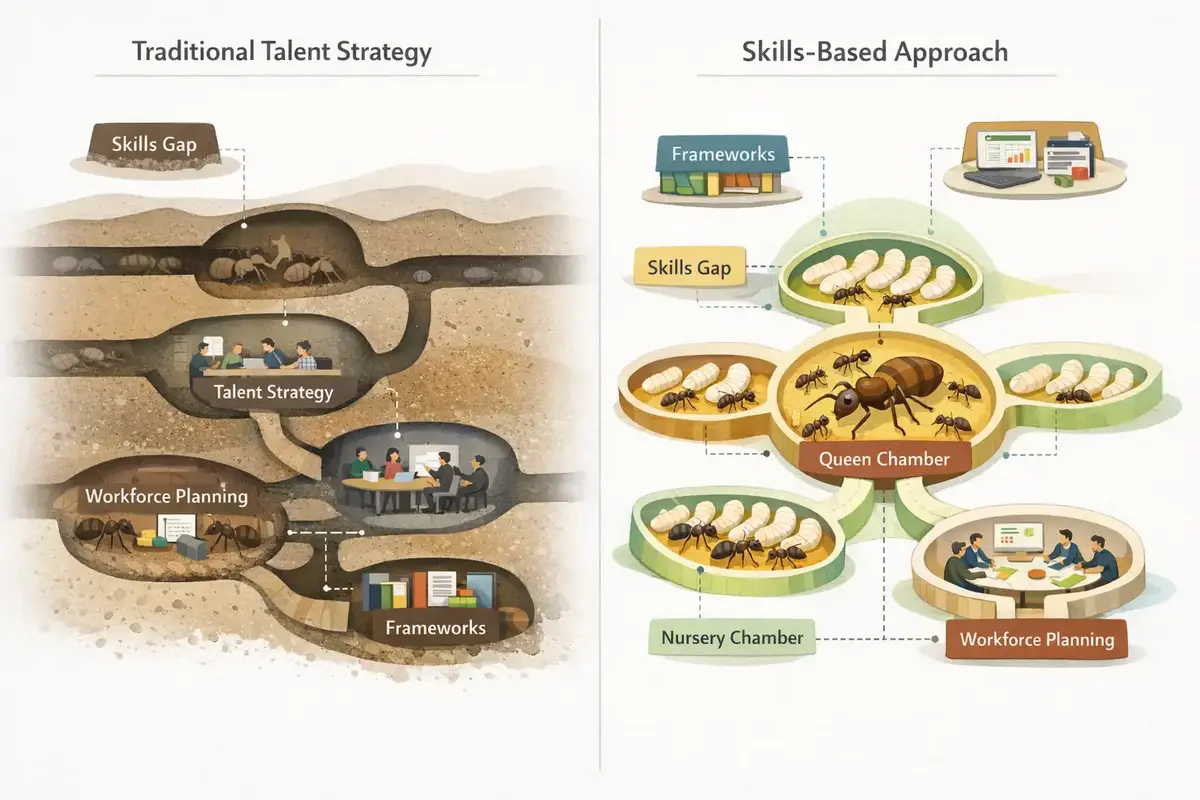
A store systems team lead who already works with exception reporting, workflow tools, and vendor data may move faster into digital fulfillment analytics than an external hire who knows the tools but not the business. That is the practical value of a internal mobility lens. It shifts planning from “Who holds the target title?” to “Who is one move away from the target work?”
This is why digital roles expose the limits of traditional workforce planning so quickly. The role names keep changing — AI operations today, model governance tomorrow, workflow orchestration after that — while the underlying capabilities often evolve through adjacent moves inside the business.
What CHROs should prioritize first
Not every digital role deserves the same attention. The right filter is simple: prioritize roles with high business value, high change velocity, and strong internal adjacency. If a role drives revenue, customer experience, or operating resilience, changes quickly, and has plausible feeder pools inside the company, it belongs at the top of the list.
That sounds disciplined. It is also political. Because once you identify the best internal candidates, the real constraint appears: can the business release them into new work without weakening current operations — or will managers protect today’s output and starve tomorrow’s capability?
How do CHROs build a skills pipeline without disrupting operations?
The assess-prioritize-sequence-deploy model matters here because the cost of getting this wrong shows up fast: revenue slips when critical roles stay half-filled, trust erodes when managers lose people without backfill, and high-potential employees leave when “development” never turns into movement. What if the real bottleneck is not learning content, but the organization’s ability to create time, structure, and movement?
A skills pipeline is not a campaign. It is an operating system.
Start with role priority, not course catalogs
Most companies still begin with broad capability surveys or enterprise learning menus. That is backwards. CHROs need to start with a short list of roles where digital work is already constraining execution, then map the tasks inside those roles to adjacent capability pools already in the business.
That means breaking a future role into component work. Not “hire more automation talent,” but: who can already handle workflow logic, exception management, data hygiene, or stakeholder translation? Once the work is visible at task level, the internal supply picture improves quickly. This is where predictive workforce planning becomes practical rather than theoretical: it helps leaders estimate which transitions are realistic in the next two quarters, not just which skills look attractive on a three-year slide.
Sequence in waves the business can absorb
In a regional financial services firm during annual planning, a division president may ask HR to “reskill 200 people into digital operations.” That usually fails because operations cannot release 200 people at once, and managers do not know who has decision rights over timing, coverage, or placement.
The better move is wave design. A first cohort of 20 to 30 people. Narrow role targets. Clear release windows. Temporary coverage plans. Then a second wave only after the first has produced usable placements and manager confidence.
This matters more in flatter organizations. 41% of employees say their organization has slashed management layers (Korn Ferry, 2025). Fewer layers can speed decisions, but only if decision rights are explicit. If not, every reskilling move gets stuck between HR, line leaders, and overloaded managers. That is why manager accountability is part of pipeline design, not a separate leadership issue.
Build learning into work, then move people
The strongest pipelines do not separate learning from execution. They use stretch assignments, shadowing, project rotations, and partial role moves so employees build capability while contributing to live work.
That creates a repeatable flow: assess current capability, prioritize role transitions, sequence development in manageable waves, then deploy people into real openings. Not everyone. Not at once. Just enough movement to prove the system works.
And once movement begins, another constraint appears. Will managers actually trust these transitions — or quietly block them when performance pressure rises?
Why manager trust determines whether reskilling actually sticks
80% of workers say they would stay in a job because they have a manager they trust. For a CHRO, that is not a culture footnote; it is a hard operating condition for whether people will risk effort on a future role they cannot yet see (Korn Ferry, 2025).
You have seen the moment. An employee says they want to move into a digital role, the manager says “great idea,” and then nothing changes because the team is short-staffed, deadlines are tight, and no one has defined what happens next.
That is where most reskilling strategies quietly fail. Not in the learning platform. In the weekly relationship between employee and manager.
Managers turn intent into behavior
Managers are the translation layer between enterprise strategy and daily work. They decide whether a new skill gets used on a live project, whether a stretch assignment is worth the short-term disruption, and whether an employee is seen as “not ready yet” or “ready enough to try.”
Research gives that practical weight. Global employee engagement fell to 20% in 2025 (Gallup, 2026).
When engagement is that low, asking employees to invest extra energy in learning without visible managerial backing is wishful thinking.
In a mid-market services company during a quarterly staffing review, a director may approve analytics training for a high-potential operations specialist. But approval is the easy part. If the manager never frees up two hours a week, never assigns dashboard work, and never protects early mistakes, the employee learns about the new role without ever beginning to perform it.

Trust changes what employees are willing to try
This is why trust, time, and reinforcement matter more than course completion. Employees apply new skills when they believe their manager will not punish the productivity dip that comes with learning in public.
The strongest managers create opportunity, not just permission. They broker project exposure, pair people with peers through mentoring, and use forums like integral team coaching to normalize experimentation across the team. That is how capability starts to stick: repeated use, social proof, and visible connection to real work.
A reskilling program without manager trust produces certificates. A reskilling system with manager trust produces role movement.
And that creates the next executive problem. If trust and reinforcement are doing so much of the work, what exactly should CHROs measure — learning activity, or evidence that capability is actually changing business performance?
What should CHROs measure before calling a reskilling strategy successful?
63% of employers identify skill gaps as a major barrier to business transformation. So what if the metrics most organizations celebrate are the ones least connected to actual workforce readiness (World Economic Forum, 2025)?
If course completions are rising, is the strategy working? If learning hours are up, has capability actually moved? Those are comfortable questions because they are easy to answer. They are also the wrong ones.
Stop rewarding activity that does not change talent supply
A reskilling strategy is successful when it changes who can do priority work, how fast they can move into it, and whether the business trusts that movement. Course completion is a volume metric. Role movement, skill application, and readiness for priority digital work are outcome metrics.
In a quarterly review at an enterprise technology company, a CHRO may report that 1,200 employees finished digital learning paths. The CEO’s better question is sharper: how many moved into hard-to-fill roles, how many are now using new workflows in live operations, and how many priority vacancies were filled internally rather than left open for months? That is the difference between learning consumption and workforce capacity.
The useful metric is not “How many people trained?” but “How many people became deployable for work the business could not staff before?”
This is where functional leadership excellence matters. Measurement has to reflect execution, not educational throughput.
Track leading indicators before lagging outcomes arrive
CHROs need a measurement stack. Start with leading indicators: internal mobility into target roles, manager participation in stretch assignments, adoption of new tools or workflows, and time-to-readiness for defined digital tasks. These show whether capability is forming before financial results fully appear.
Then watch the workforce signals around that movement. 70% of workers in Korn Ferry’s 2025 Workforce survey are concerned that the cost of living is outpacing their current salary (Korn Ferry, 2025). In that environment, reskilling is not judged only by development intent. Employees judge it by whether it creates credible progression, stronger employability, and a reason to stay.
That is why retention belongs in the scorecard — especially retention of people in feeder pools and newly transitioned talent. If the company builds skills but loses the people who gained them, the strategy is subsidizing the market.
Connect capability metrics to transformation confidence
The final test is whether reskilling increases workforce confidence in the transformation itself. Are employees applying new skills in real work? Are managers sponsoring movement? Are business leaders seeing fewer execution bottlenecks in priority digital areas?
If the answer is no, the organization may have funded learning without building a system. And that raises the harder question — is reskilling being run as an HR program, or as a durable operating advantage?
The CHRO advantage is building human potential as a system, not a campaign
44% of workers’ core skills are expected to transform within the next five years. If your workforce system still depends on static job definitions and occasional training pushes, the cost is predictable: delayed execution, manager skepticism, and capable people leaving because the company cannot convert potential into opportunity (World Economic Forum, 2025).
That is why reskilling becomes strategic only when it stops behaving like an initiative.
The system that holds when roles keep moving
If the future keeps changing faster than job titles, what kind of workforce system will still hold up?
Not a campaign with a launch date and a completion report. A workforce capability system — one that continuously identifies priority roles, equips managers to release and develop talent, creates credible paths for internal mobility, and measures whether people are becoming useful in new work.
In a mid-market healthcare company during annual planning, the CHRO often faces a familiar tradeoff: fund another external hiring push for digital operations roles, or build a repeatable way for experienced employees in adjacent functions to move into them. The second path is slower at first. Then it compounds. Business context stays in-house. Trust rises because movement feels real. The organization gets better at the next transition, not just the current one.
Four parts, one operating responsibility
The durable model is not complicated. It is disciplined.
Start with role prioritization. Be explicit about which roles matter most to growth, resilience, or customer delivery. Then build manager enablement into the design, not as an afterthought; without it, talent stays trapped in current teams. Add internal mobility mechanisms that make movement normal rather than exceptional. Finally, use measurement to test whether the system is producing deployable capability, not just learning activity.
The scale of the need is not temporary. 59% of the world’s workforce would need training by 2030 if the workforce were 100 people (World Economic Forum, 2025). That should push CHROs beyond program thinking and toward operating architecture — including a stronger leadership development framework that helps leaders sponsor movement, not merely approve it.
Human potential becomes a strategic asset when people can move, learn, and contribute ahead of demand. That is the CHRO advantage now. So in your context, is reskilling still a program — or is it becoming part of how the business actually works?
Key Takeaways
- The skills gap is a workforce design problem because speed, role architecture, and internal mobility matter as much as learning content.
- Upskilling, reskilling, and redeployment are different moves, and clear language improves execution.
- Digital roles expose the limits of title-based planning; CHROs should prioritize roles with business value, change velocity, and internal adjacency.
- Manager trust, measurement, and movement into real work determine whether reskilling creates capability or just activity.
Frequently Asked Questions
Why should CHROs treat reskilling as a workforce design problem instead of a training problem?
Because the main challenge is not access to learning content, but how quickly people can move into the roles the business now needs. Reskilling works best when it is tied to role architecture, internal mobility, and workforce planning, so talent flow improves instead of just learning activity.
What is the difference between upskilling, reskilling, and redeployment?
Upskilling improves performance within a current role, reskilling prepares someone for a different role, and redeployment places that person into the new work. These are separate decisions because each one affects budget, timing, manager expectations, and success metrics differently.
Why do digital roles expose the limits of traditional workforce planning?
Traditional planning often relies on job titles, but digital capability spreads across many roles and changes quickly. A better approach is to identify skills adjacency and internal talent pools, then plan around the work that is emerging rather than only the titles that exist today.
How can CHROs build a skills pipeline without disrupting operations?
The most effective approach is to prioritize critical roles, break them into tasks, and move people in manageable waves rather than all at once. Learning should be embedded in live work through stretch assignments, rotations, and partial role moves, with managers responsible for release and coverage.
What should CHROs measure to know whether a reskilling strategy is working?
The most useful measures are role movement, skill application in live work, internal fills for priority roles, and time-to-readiness for digital tasks. Course completions matter less than whether the organization is creating deployable capability and reducing execution bottlenecks.