

Why the succession gap becomes a leadership risk before it becomes a family problem
78% of family businesses expect a CEO transition within the next decade, which means many leadership teams are already operating inside the succession window whether they have admitted it or not (Deloitte, 2025). In practice, the risk shows up before anyone calls it a family issue.
You see it in ordinary operating moments. A mid-market manufacturing company enters its annual budget cycle, and the non-family CFO starts making longer-dated capital calls while the founder still reverses decisions informally in hallway conversations. The family is not yet in open conflict. Performance is. People stop asking who owns the business and start asking who is actually allowed to decide.
That is the first mistake in many succession discussions: treating transition as a future event. It is usually a present-tense design problem. If authority still depends on personal access to the founder, then the business is already exposed—regardless of whether the next chief executive will be a daughter, a son, or an external operator.

The numbers make the exposure hard to dismiss. Deloitte reports that while 78% of family businesses expect a CEO transition within ten years, only 57% have a plan (Deloitte, 2025).
78% expect a CEO transition within the next decade, but only 57% have a plan (Deloitte, 2025)
That gap is not administrative. It is operational. It means a meaningful share of firms are trying to run today’s business with yesterday’s leadership assumptions: unclear decision rights, inherited deference, and too much institutional memory sitting in one person’s head. The cost is slower execution, avoidable talent loss, and a weaker hand in markets that reward speed. This article addresses that exact problem by showing how non-family C-suite talent becomes central to succession planning and durable family business continuity.
The continuity layer most families underestimate
The strongest non-family executives are not placeholders while the family “figures it out.” They often become the continuity layer that keeps the enterprise coherent while ownership, identity, and future leadership are still being worked through.
That role matters because businesses do not pause during transition. Customers still expect delivery. Banks still expect discipline. Senior managers still watch for signs of drift. A capable non-family C-suite can hold operating standards steady, translate founder instinct into repeatable decisions, and keep the company governable while the family resolves questions it cannot answer overnight.
The real issue is alignment, not lineage
This is why the core decision is rarely family or non-family leadership. The real test is whether authority, trust, and legacy are aligned across both systems.
When they are not, even excellent executives become cautious and even committed family members become bottlenecks. When they are, surname matters less than stewardship. The harder question follows from that: if legacy is more than inheritance, what exactly are you asking the next leader to protect?
What does legacy planning actually mean when the next leader may not share the family name?
What, exactly, is a family asking a non-family leader to protect? If the honest answer is only “the shares stay in family hands,” the business is not doing legacy planning at all. It is doing ownership transfer — and confusing that with continuity.
That distinction matters because companies rarely break at the legal handoff. They break when the unwritten rules vanish.
Four terms that should not be treated as interchangeable
Start with clean definitions. Succession planning answers who will hold a role. Legacy planning answers what must endure when that role changes. Governance defines who gets to decide what, under which rules. Continuity is the operating result — the business keeps moving without losing its character or control.
Most families collapse these into one conversation and then wonder why capable executives hesitate. A non-family CEO or CFO cannot protect a legacy that has never been translated into management language. “Respect the founder’s way” is not a management standard. Neither is “keep the family culture intact.”
Research from PwC shows how present this issue already is: succession planning is affecting family firms now, not at some distant transition point (PwC, 2025). That is precisely why legacy planning has to move beyond naming a successor and into defining the enterprise logic that successor is expected to preserve.
What must be made explicit
In a regional healthcare business, a non-family COO enters a quarterly review expecting to make a service-line decision based on margin, staffing pressure, and patient access. The family owners stop the discussion — not because the analysis is wrong, but because the unit has symbolic importance tied to the founder’s history in the community. If that priority was never stated in advance, the executive learns the wrong lesson: performance matters until identity enters the room.
This is where legacy planning earns its name. It identifies the non-negotiables — purpose, reputation thresholds, risk boundaries, treatment of employees, community commitments. It also identifies what is adaptable — product mix, org structure, capital allocation methods, even leadership style. Then it draws the line between family identity and management authority, often through explicit family governance rather than personal intervention.
Without that line, executives do not become stewards. They become interpreters.
Legacy becomes credible only when authority is clear
The practical test is simple: can a non-family executive explain the family’s operating values in decision terms, not ceremonial language? If not, the business is asking for loyalty without giving usable guidance. That weakens family business continuity long before any title changes.
And once an executive knows what is sacred, what is flexible, and where authority truly sits, a harder issue appears. Will the family actually let that clarity govern behavior — or override it when pressure rises?
Why non-family executives stay committed when authority is clear and ambiguity is not
Only 23% of family businesses are actively implementing a succession plan, which tells you something uncomfortable: many executives are being asked to carry transition risk inside systems that still have not defined who can decide what (Deloitte, 2025). Most families assume commitment comes from shared values and personal trust. In practice, strong external leaders stay when the role has legitimacy, not just access.
That is why role clarity is the first real trust signal. It tells a non-family CFO, COO, or CEO where they have authority, where consultation is required, and where family influence properly overrides management judgment. Without that map, every major decision becomes a political reading exercise.
Assumed loyalty breaks where decision rights blur
Why do strong external leaders leave family enterprises even when the business itself is healthy? Usually not because the strategy is weak. Because the authority is.
In a regional services company, a non-family CEO leads a team restructure after two quarters of margin pressure. The board approves the change. Then a family shareholder, outside any formal operating role, asks that two long-tenured managers be protected. HR pauses. The executive team hesitates. The CEO is still accountable for the result, but no longer fully authorized to produce it.
That is the retention problem in its most common form: symbolic authority paired with real accountability. Capable executives will tolerate hard constraints. They will not stay long in roles where constraints appear only after decisions are made.
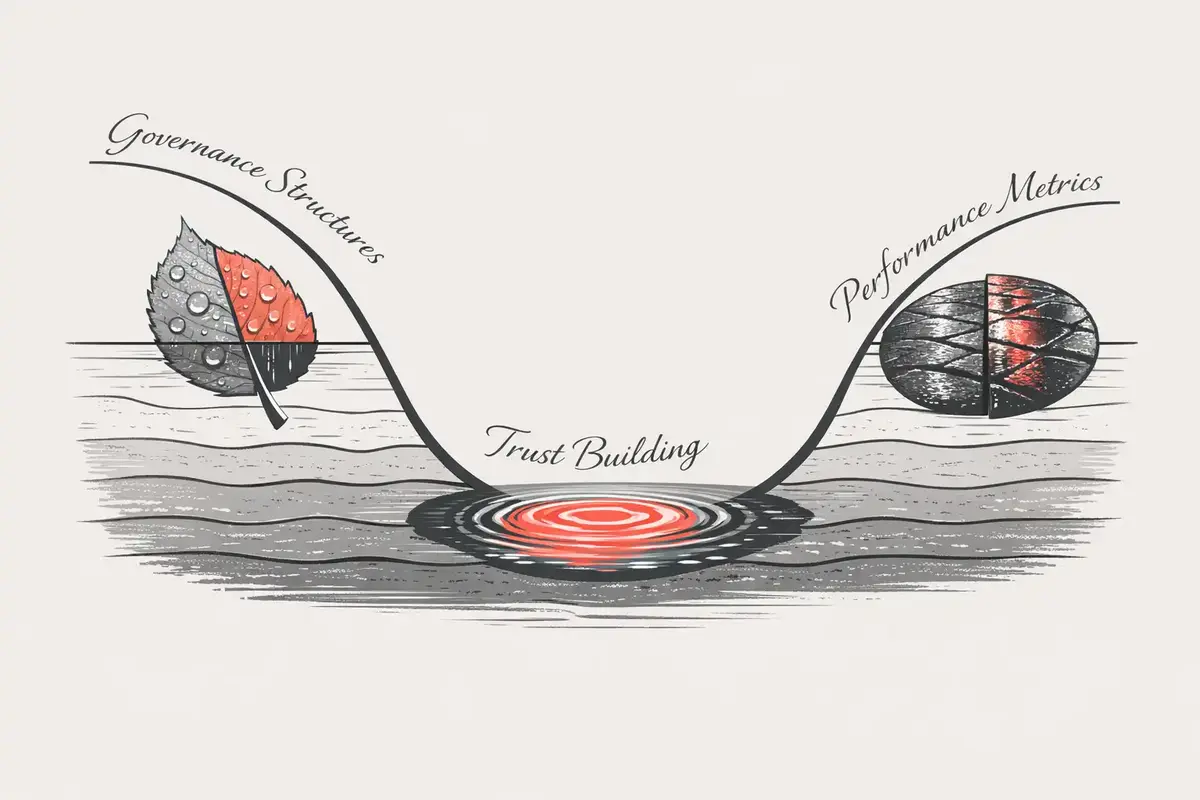
Research consistently shows that ambiguity does not announce itself dramatically. It accumulates through delayed approvals, informal reversals, and exceptions that bypass the agreed chain of command. Over time, executives stop making bold calls. They narrow their horizon to what is politically safe. The business still looks stable from the outside, but decision quality has already deteriorated.
Commitment is earned through boundaries, not chemistry
Families often overrate cultural fit. It matters, but it is not enough. A seasoned executive does not read commitment from warm inclusion at family events; they read it from explicit expectations, clean escalation paths, and a shared understanding of what happens when management and family priorities collide.
This is where role clarity becomes more than an org-chart exercise. It is the operating proof that stewardship is possible. And it is why engaging non-family executives starts with governance discipline, not motivational language.
Only 23% are actively implementing a succession plan — a gap that leaves many non-family leaders managing transition exposure without fully defined authority (Deloitte, 2025)
The hard question follows. When performance improves under non-family leadership, is that because the family chose the better executive — or because it finally created the conditions for any strong executive to succeed?
What the numbers say about family versus non-family leadership outcomes
39 percent of transitions to non-family executives created value in McKinsey’s comparison, versus 29 percent for transitions to family executives (McKinsey, 2024). So what changes when families stop asking who should inherit and start asking which leadership model creates the most durable value?
That question unsettles people for a reason. It sounds like a referendum on family leadership itself. It is not. It is a test of whether the business is choosing its next leader through identity, or through the conditions most likely to protect performance and continuity.
39% of transitions to non-family executives created value, compared with 29% of transitions to family executives (McKinsey, 2024)
Read the numbers as a governance signal, not a bloodline verdict
The lazy interpretation is that outside leaders are simply better. McKinsey’s data does not support that conclusion. What it does suggest is more useful: in some contexts, professional management creates value at a higher rate because the system around the leader is more disciplined — clearer mandates, stronger oversight, and less tolerance for informal override (McKinsey, 2024).
That distinction matters. A family CEO operating inside a well-designed governance model can outperform a weak external hire. A non-family CEO dropped into a business that still runs on founder exceptions can fail quickly. The variable is not surname alone. It is whether the enterprise has built the operating conditions that let leadership work.
Where the comparison becomes practical
Picture a regional retail company in a market shift. The family is deciding between a next-generation candidate and an external CEO after two years of margin pressure and uneven store performance. The real decision is not “family or outsider.” It is whether the company needs a leader who can close underperforming locations, reset capital allocation, and redesign incentives without every move being re-litigated through family history.
That is why the numbers are useful. They force a harder conversation. Not who deserves the role, but which leadership model the business is actually prepared to support.
In many firms, that leads straight to structure: board composition, escalation rules, and family business incentives that reward long-term value rather than symbolic control. Once those are in place, leadership choices get sharper. The family can evaluate candidates against continuity, execution, and governance readiness — not just trust earned over decades.
Evidence helps families ask better questions
This is the real contribution of comparative data. It moves the discussion out of family mythology and into decision quality.
McKinsey’s 39 percent versus 29 percent comparison should not make families anti-family. It should make them anti-assumption (McKinsey, 2024). If a non-family executive is more likely to create value in a given situation, the responsible response is not defensiveness. It is design.
And that raises the next challenge. If the evidence points toward system quality, how does a family turn values into rules that mixed leadership teams can actually run?
How do boards turn family values into operating rules for mixed leadership teams?
A non-family COO recommends closing an underperforming product line during the quarterly review. A family director agrees in the room, then asks for a delay afterward because the line still carries the founder’s name.
That moment is where many mixed leadership teams start to wobble. Not because the values are wrong, but because nobody has translated them into a rule the business can actually use.
The board is where intent becomes governable
KPMG reports that 67% of high-performing family businesses had a formal board (KPMG, 2025). That matters because a formal board is not a ceremonial layer. It is the mechanism that converts family intent into visible authority, oversight, and escalation.
67% of high-performing family businesses had a formal board (KPMG, 2025)
Without that mechanism, “protect the legacy” stays vague. One executive hears long-term brand stewardship. Another hears preserve every historical choice. A family shareholder may mean community reputation, while the CFO reads the issue as capital discipline. The board’s job is to remove that interpretive burden.
A good board does three things. First, it defines decision rights: what management can decide, what requires board approval, and what belongs to owners rather than operators. Second, it sets oversight: which metrics matter, how performance is reviewed, and where values should shape trade-offs. Third, it creates escalation rules so conflict does not spill into side conversations and informal reversals.
Governance protects performance and trust at the same time
This is why governance is not bureaucracy. It is what keeps a hard business decision from becoming a family loyalty test.
In a regional technology company, for example, a non-family CFO may support a tighter investment threshold while family owners want to preserve a reputation for patient growth. A functioning board does not force one side to win by personality. It frames the trade-off in advance — through approved risk limits, return expectations, and clear review triggers. That is what board governance in a family business is supposed to do.
The same logic applies to trust. Families often assume trust is relational. In mixed teams, trust is also structural. Executives trust the system when it does not change under pressure. Families trust management when they can see how values are being applied, not merely promised. That is where family governance and board discipline meet.
Legacy only survives if it can be repeated. And once the board has made values operational, the next question gets sharper: how do you get non-family leaders to carry those rules as stewards — not just comply with them as employees?
Where should families start when they want non-family leaders to think like continuity stewards?
Mismanaged transition costs show up fast: a delayed investment, a key executive walking out, a customer sensing drift before the family does. By the time owners call it a succession issue, trust has usually already thinned inside the business.
The first move is not to hire faster. It is to define what the business is asking a non-family leader to protect.
Start with a shared definition of success
In a regional finance company during budget season, a non-family CFO pushes to exit a low-return client segment and redirect capital to a faster-growing line. The family agrees on the economics, then hesitates because the legacy segment still carries relationships built by the founder. Nothing is wrong with that instinct. The problem is leaving it unstated until the decision is on the table.
That is where families should begin: with business outcomes, family principles, and decision boundaries stated in the same conversation. Not as abstract values. As operating expectations.
What must the executive deliver over time? Which principles are genuinely non-negotiable when trade-offs get hard? Where does management authority end and owner judgment begin? If those answers are vague, even a strong leader will default to caution. If they are explicit, the executive can act like a steward rather than a guest.
This is more urgent than many families admit. PwC found that succession planning affected many US family firms in the past year, which tells you the issue is already shaping current decisions, not just future ones (PwC, 2025).
Then make the system reward continuity
Clarity alone is not enough. People follow the scorecard.
If a non-family CEO is praised for long-term resilience but paid for short-term optics, the family has answered its own question. The executive will manage to the incentive, not the aspiration. The same is true of reporting lines and meeting rhythms. A leader cannot think like a continuity steward if performance reviews focus narrowly on quarterly presentation while the real expectations live in private family conversations.
This is where family business incentives matter. Incentives should reinforce durable outcomes: leadership bench strength, disciplined capital use, customer retention, reputation protection, and fewer surprise escalations. Communication should do the same. Regular, structured conversations between owners, board, and executives reduce the need for interpretation — and interpretation is where drift begins.
Deloitte’s finding that only a minority are actively implementing succession planning helps explain why so many firms struggle here (Deloitte, 2025). They are asking for stewardship before they have built the management conditions that support it.
The practical starting point, then, is simple and demanding at once: define success so both the family and the executive can recognize it in the same moment. That is the real foundation of engaging non-family executives.
And once that foundation is in place, the final test gets harder. When the next disruption hits, will continuity hold because the system is sound — or will the old reflex to equate legacy with lineage return?
Why continuity is the real test of legacy, not whether the next leader shares the surname
74% of employer-business owners nearing retirement plan to sell or transfer ownership. That sounds like preparation, but the evidence shows how often ownership movement is mistaken for continuity itself (Gallup, 2024).
Most organizations still treat legacy as a handoff problem: get the shares transferred, name the next leader, keep the family visible. The harder reality is that a business can complete all three and still lose what made it durable. Continuity is the test. If the company cannot preserve decision quality, purpose, and operating discipline through leadership change, then the transfer was administrative, not generational.
Ownership can move while continuity breaks
The gap is visible in the planning data. Only 23% say they have a formal exit plan (Family Business Association, 2025). Gallup also found that 27% of owners nearing retirement plan to close the business (Gallup, 2024). Those numbers point to the same truth: many firms are approaching transition without a reliable way to carry the enterprise forward.
74% plan to sell or transfer ownership, yet only 23% report a formal exit plan (Gallup, 2024; Family Business Association, 2025)
In a mid-market technology company during a market slowdown, a non-family CEO is asked to protect growth, retain key engineers, and preserve the founder’s reputation for careful product quality. The title is clear. The mandate is not. Board members want speed, family owners want caution, and nobody has translated those priorities into a rule set the executive can actually run. Six months later, the company still has the same owners. It no longer has the same coherence.
That is why legacy survives only when families make values operational — through governance, clear authority, and shared expectations that hold under pressure. Not slogans. Not founder stories. Rules people can use.
Stewardship has to be visible
A non-family executive becomes effective when the business treats them as a continuity steward, not a temporary operator. That means defined authority, explicit boundaries, and a visible mandate from owners and board alike.
This is where family business continuity becomes practical rather than aspirational. The question is not whether a non-family leader can “fit” the family. It is whether the system lets that leader protect what matters while adapting what must change.
And that brings the article to its real conclusion. The deepest transition question is not who leads next. It is whether the business can keep its purpose intact while leadership changes.
If your current model depends on one surname to hold the whole thing together, that is not legacy. It is concentration risk. The honest next step is to ask a simpler, harder question: if leadership changed tomorrow, would your business carry its values forward — or just its ownership records?
Key Takeaways
- Succession risk becomes operational before it becomes a family conflict.
- Legacy planning is about what must endure, not just who inherits.
- Non-family executives stay committed when authority, trust, and boundaries are clear.
- Continuity, not surname, is the real test of legacy.
Frequently Asked Questions
What is the best way to engage non-family C-suite talent in family business legacy planning?
Start by defining the legacy in management terms: what must endure, what can change, and who has authority to decide. Non-family executives are more likely to commit when their role, decision rights, and escalation paths are explicit and supported by governance.
Why is role clarity so important for non-family executives in a family business?
Role clarity reduces political ambiguity and prevents executives from being accountable without being authorized. When decision rights are clear, non-family leaders can act decisively, and family members are less likely to override decisions informally.
How does legacy planning differ from succession planning in a family business?
Succession planning focuses on who will fill a role, while legacy planning focuses on what the business must preserve through leadership change. Legacy planning also defines the values, boundaries, and operating principles that should remain intact regardless of who leads.
What governance practices help mixed family and non-family leadership teams work well?
A formal board, clear decision rights, and defined escalation rules help translate family values into operating standards. These structures make it easier for management to act, for owners to oversee, and for conflicts to be resolved without informal reversals.
Why is continuity a better measure of legacy than whether the next leader shares the family surname?
A business can transfer ownership and still lose decision quality, purpose, and operating discipline if the system is weak. Continuity is the real test because it shows whether the enterprise can keep performing and adapting after leadership changes.