
Why Single-Model Leadership Falls Short in Today’s Complex Environments
Leadership decision-makers across industries are facing a sobering new landscape. Accelerating organizational change is now the norm—up 183% since 2020, and leaders are being asked to do more with less as organizational structures flatten and spans of control triple (Source: IMD, Flashpoint). As the stakes rise, so do the costs of leadership failure: Burnout and disengagement rates now tally at 40%—driven by 71% of leaders reporting rising stress (Source: DDI Global Leadership Forecast 2025).
Most solutions on offer—transformational, servant, adaptive, or authentic leadership frameworks—promise renewal but often deliver fragmentation. Adopting any one model in isolation can breed new silos rather than dissolving old ones. The result? Organizations inadvertently play “leadership bingo,” layering programs, tools, and principles that rarely add up to the coherent cultural shift decision-makers hunger for.
What if the real challenge isn’t about picking the perfect model, but orchestrating an integrated, holistic approach that fits the unique context—your industry, maturity, culture, region, and purpose? That’s the real promise of Integral Leadership Frameworks & Methodologies: A “meta” perspective that draws from the best of every model, turns risk into insight, and unites individual growth with organizational outcomes.
The Integral Leadership Meta-Framework: Beyond Best Practices
At its core, Integral Leadership is not a single model to be slotted in, but a powerful synthesis—a lens that brings together quadrants of intelligence (cognitive, emotional, somatic, and systemic), vertical maturity, and context-aware application (Source: The Integral Institute).
-
Quadrants of Intelligence
Integral approaches recognize that effective leadership arises from a spectrum of capacities. Leading in 2026 means integrating emotional intelligence (EQ), cognitive agility, somatic awareness (embodied presence), and systemic insight. For instance, a leader may excel in vision (cognitive), yet undermine trust if emotional or embodied aspects are ignored. -
Vertical Development
Unlike horizontal skills training, vertical development addresses the “how” and “why” of meaning-making. Leaders evolve from ‘expert’ to ‘catalyst’ to ‘synergist’, becoming more adaptive, self-aware, and able to handle paradox. Integrating the concept of vertical growth enables organizations to balance experience with growth potential—a crucial differentiator in suffocatingly complex environments. For a detailed exploration of mapping and supporting vertical growth, review the Vertical Development resource at The Integral Institute. -
Contextual Integration
Integral methodology acknowledges there is no one-size-fits-all guide. Instead, it provides a toolkit and a map—drawing from diverse, evidence-based traditions and blending them to suit organizational nuance. This flexibility is what allows the integral meta-framework to transcend static “best practices” that quickly date.
This synthesis makes the Integral Leadership Frameworks & Methodologies uniquely suited for today’s landscape. It is not a competitor to transformational, servant, or adaptive leadership, but a harmonizer, integrator, and calibrator of these approaches.
Leadership Models in Conversation: Synthesis, Benefits—and Pitfalls
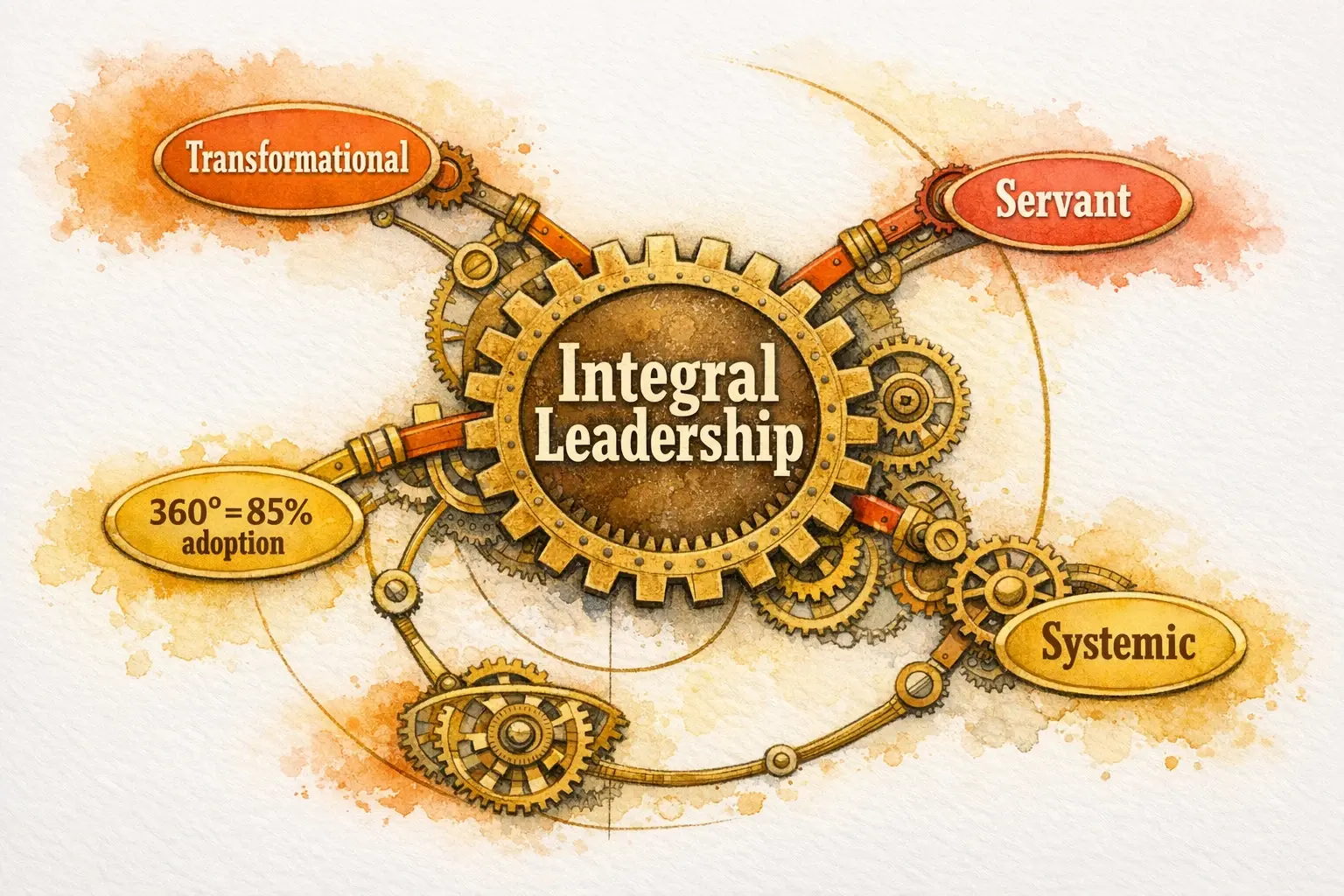
The prevailing wisdom often frames leadership models as rivals: transformational versus servant, adaptive over authentic, and so on. In practice, the most effective organizations take both/and approaches—drawing the best from each while skillfully navigating their limits.
-
Transformational Leadership
This model thrives on vision, motivation, and change. Its strengths are undeniable: it uplifts teams, drives innovation, and aligns cultures around shared purpose. But unchecked, it can slide into ‘visionary overload’—strategic plans outpacing operational reality, or charisma substituting for discipline. -
Servant Leadership
Inspiring service, humility, and trust is vital for retention and engagement—high purpose alignment increases retention 4.1x (Source: Gartner). Yet, leaders who over-identify with service can become mired in consensus, losing the courage to challenge, reset standards, or make hard choices under pressure. -
Adaptive Leadership
Particularly prized in dynamic, complex environments, adaptive leadership fosters resilience, experimentation, and agility. It’s highly effective when environments shift faster than plans mature. Still, teams can exhaust themselves on “perpetual pivot” if adaptation is not balanced with stability. For concrete strategies in diverse contexts, see Adaptive Leadership. -
Authentic, Inclusive, and Distributed Leadership
Models emphasizing authenticity, inclusivity, and decentralized decision-making have surged as organizations globalize and digitize. When embedded thoughtfully, they spark innovation and psychological safety. Yet, overused, authenticity can cross into oversharing, or devolve into “leadership by personality” rather than by purpose.
The common thread: Every leadership model, when pressed to excess or applied without systemic integration, exposes organizational risk and creates the very silos or stagnation it sets out to cure.
Integral Leadership addresses this by making explicit the need for synthesis. No single frame suffices; the context—organization size, maturity, market dynamics, and culture—matters as much as the model itself.
Operationalizing Integral: From Theory to Practice
Understanding frameworks is half the battle. The decisive factor is operationalizing them—turning a meta-framework into everyday behaviors, rituals, and measurement systems.
Assessment and Readiness
Work begins by benchmarking current leadership capacity and organizational climate. A robust Integral Leadership Assessment goes beyond self-report or intuition. It incorporates 360-degree feedback, climate surveys, vertical development mapping, and organizational diagnostics—to reveal strengths, gaps, derailers, and capacity for transformational change.
Implementation Roadmaps
Rather than “big bang” rollouts, high-performing organizations adopt phased, layered approaches:
- Leadership Diagnostics: Data-rich assessment of skills, mindsets, and shadow areas across all management levels
- Experiential Learning: Immersive Integral Workshops build both self-awareness and concrete skills, connecting theory to day-to-day team dynamics
- Vertical Growth Journeys: Leaders undertake staged development, moving beyond “what I do” to “who I am” as a leader
- Embedding in Systems: KPIs, reward structures, and feedback loops are recalibrated to reinforce new behaviors—integrating analytics-driven insight (not just sentiment or observation)
- Continuous Course Correction: Pulse checks and real-time analytics flag emerging issues, from burnout flare-ups to culture drift
“Development as a living system” is not a slogan. It is a measured, iterative process—seen in organizations that combine vertical, behavioral, and cultural metrics for feedback and adaptation.
Data-Driven Integration
Leaders can no longer rely solely on gut feel or anecdotal learning. The most progressive organizations are harnessing leadership analytics for proactive development:
- Real-time dashboards track alignment, engagement, shadow triggers, burnout hotspots
- AI-driven nudging supports micro-habit formation and accountability at every level
- Succession planning and talent mobility are informed by both potential and demonstrated maturity
Those who embrace analytics outperform traditional, intuition-led approaches—achieving higher ROI and stronger succession accuracy (Source: AIIR, Gartner).
Measuring Impact: KPIs, Benchmarks, and the Feedback Loop
One of the clearest differentiators of leading organizations is how they define and measure leadership effectiveness—not only at the individual level but across teams and the enterprise.
Individual Level
- Progress through vertical stages (e.g., “expert” to “catalyst”)
- Behavior change validated by 360-feedback/peer assessment
- Reduction in burnout signals and increase in engagement markers
Team Level
- Increased psychological safety and collaboration
- Measurable uplift in innovation, trust, and matrixed team effectiveness
- Improved retention and lower voluntary turnover
Organizational Level
- Strategic alignment with purpose (measured by engagement and pulse surveys)
- Improved performance against business-critical KPIs (ROI, innovation rate, customer satisfaction)
- Greater resilience and adaptability to stress, volatility, and transformation initiatives
These KPIs form a closed feedback loop, informing not only ongoing coaching and development but the design of future programs. Organizations leveraging comprehensive analytics—especially those integrating both vertical development metrics and behavioral KPIs—report sharper improvement and fewer derailment blips (Source: CCL, AIHR).
The “Dark Side” and Sustainable Leadership: Risks, Blind Spots, and Shadow Work
The temptation to view leadership models only through their strengths blinds organizations to lurking risks. Every framework carries a potential “dark side”—the shadow that emerges when any single style dominates unchecked.
- Transformational leadership untempered by correction risks vision overreach, ego traps, and burnout cascades.
- Servant leadership in excess breeds indecision, avoidance of conflict, or neglect of performance standards.
- Adaptive leadership for its part courts instability if the climate becomes perpetually restless and unanchored.
Integral practice insists on shadow work as a core diagnostic. Surfacing and addressing these pitfalls proactively makes it possible to recalibrate leadership strategy in real time—not after cracks appear. Shadow mapping, embedded in the assessment process and monitored through behavioral analytics, transforms risk into development opportunity.
“A narcissistic psychopath won’t be fixed by training alone”—as one consultant bluntly noted. Only by mapping overuse and derailment patterns as part of the evaluation process can organizations ensure their frameworks foster resilience, not hidden toxicity (Source: Crazy Might Work).

Case Examples and Synthesis Playbook
High-performing organizations rarely follow a single “playbook.” Instead, they blend frameworks, adapt to context, and correct in motion.
- Large-scale transformation? They might begin with transformational vision, but deploy servant leadership to build trust, then loop in adaptive and inclusive practices as the operating context shifts.
- Decentralized structures? Integrating Integral Leadership for Managers provides continuity of values while Adaptive Accountability ensures autonomy is balanced by collective standards.
Analysis of real-world initiatives confirms that resilience comes from intelligent synthesis, contextual adaptation, and openness to feedback—not rigid fidelity to a single model (Source: Quarterdeck, Holistique Training).
Global, Hybrid, and Cross-Cultural Adaptation
Organizations today often operate across borders, time zones, and cultures. Integral frameworks don’t just tolerate this diversity—they harness it.
An effective synthesis takes into account:
- Cultural values (e.g., power distance, uncertainty avoidance)
- Remote/hybrid challenges (psychological safety, digital trust)
- Industry-specific demands (compliance cultures vs. innovation-driven climates)
The most advanced approaches leverage tools like the Integral Leadership Frameworks & Methodologies perhaps augmented by immersive Integral Workshops to calibrate leadership programs at local, regional, and global levels.
It’s not simply about technical adaptation (“Zoom etiquette” or “cultural dos and don’ts”). It’s about tuning leadership mindsets to the global context—where inclusivity, ethical sensitivity, and cognitive flexibility stitch together robust, purpose-driven cultures.
FAQ: Integral Leadership Frameworks & Methodologies
What makes Integral Leadership different from traditional models?
Integral Leadership goes beyond single-model thinking by synthesizing multiple frameworks—transformational, servant, adaptive, authentic—through a systemic, whole-person lens. It integrates vertical (mindset) development, multiple intelligences, and organizational analytics, making it uniquely adaptable and measurable at every level.
How do you actually measure progress in vertical development?
Vertical development is tracked using expert-validated tools combining 360-feedback, climate surveys, and AI-powered profile mapping. Progress becomes visible not just as skills acquired, but as shifts in how leaders think, relate, and make meaning in increasingly complex situations. Explore Vertical Development for deeper insights.
Can Integral Leadership frameworks work in decentralized or matrixed organizations?
Yes. By design, integral frameworks adapt to complexity and scale. For decentralized teams, Adaptive Accountability strategies balance local autonomy with global standards, reinforced by analytics and culture-first rituals.
What are the risks of overapplying any one leadership model?
Overreliance on any single model can create blind spots: Transformational leadership may become grandiose, servant leadership may stall hard decisions, adaptive leadership may destabilize what needs rooting. Integral methodology confronts these “shadows,” using diagnostics and feedback to maintain balance.
How important is data-driven analytics in modern leadership development?
It’s now essential. Organizations using leadership analytics—especially those tracking behavior and vertical growth—achieve higher ROI and succession success. Data closes the loop between insight, action, and result, making growth a living system, not a once-a-year assessment.
How do you adapt these frameworks for global or remote teams?
Successful adaptation starts with cultural awareness as a core competency, not a bolt-on. Programs draw from Integral Leadership Frameworks & Methodologies, while cases and workshops address the nuances of local markets, remote collaboration, and industry specifics.
Where should organizations start if they want to integrate these frameworks?
Begin by assessing current capacity using a robust Integral Leadership Assessment, surface shadow risks, and select key programs that fit both strategic objectives and cultural context. Implementation is then staged—building from early wins to enterprise scale, always supported by feedback and analytics.
Leadership as a System, Not a Personality
When the dust settles after yet another wave of change, one truth stands out: Leadership is not a trait you possess, nor a checklist to tick. It is a living system—contextual, relational, measurable, and developmental.
The organizations poised to thrive are not those who chase after the trendiest new flavor, but those who orchestrate the right integration of frameworks, adapt as they learn, and measure their progress both in numbers and in lived experience. Leadership challenges will continue to evolve; the models for making sense of them must evolve as well.
If you see your own context reflected in these insights, perhaps the next step is to explore what integration could look like for your organization—not to simply “buy” Integral Leadership, but to begin a conversation about systemically unlocking collective potential.
Continue Your Leadership Journey
- Integral Leadership Frameworks & Methodologies — Explore the foundation and integration of diverse leadership approaches for a holistic organizational impact.
- Vertical Development — Discover how mapping and supporting leaders’ growth stages amplifies organizational effectiveness.
- Adaptive Leadership — Tactics and tools for thriving in dynamic, regionally diverse, or rapidly changing environments.
- Integral Leadership Assessment — Evaluate your leadership landscape with comprehensive, multi-level diagnostics for measurable improvement.