

Why the First-Time Founder CEO Advantage Now Depends on AI Leverage
75% of newly picked CEOs are now first-timers. If you are a founder stepping into the CEO seat, that statistic changes the question: your situation is no longer unusual, but the expectations are still unforgiving.
You know the scene. It is the Monday before a board update, your product lead wants faster hiring, your customers want enterprise-grade responsiveness, and your team is already stretched. At the same time, everyone assumes you should have a view on AI—not as a trend, but as an operating model.
That pressure is not abstract. Korn Ferry reports that companies led by first-time CEOs averaged 16.3% annual stock return, versus 36.3% for veteran CEOs (Korn Ferry, 2025). The gap should not be read as a verdict on founder potential. It should be read as a warning about transition risk: new CEOs are expected to scale judgment, communication, and execution at once, often without the institutional scaffolding more seasoned leaders inherited. This article is about how to use AI to close that gap without looking careless, thin, or over-reliant.
The New CEO Default Has Changed
For years, first-time founder CEOs were treated like exceptions who needed to “grow into” the role. That framing is outdated. If three out of four newly appointed CEOs are first-timers, then the leadership transition itself is now the norm, not the edge case (Korn Ferry, 2025).
The mistake many founders make is assuming AI is mainly a productivity tool. It is not. At the CEO level, AI is a test of operating judgment. Investors, employees, and customers are all asking versions of the same question: Does this founder know where automation creates speed, and where human ownership protects trust?
That is why leadership development now has to include AI fluency. Not tool fluency. Decision fluency.
Small Teams Can Look Bigger—If the Founder Draws the Line Well
A five-person founding team can now produce research, draft customer communications, summarize calls, model scenarios, and prepare internal briefs at a pace that used to require layers of support. Used well, AI lets a small company show up with the responsiveness and preparation of a much larger one.
Used badly, it does the opposite.
A regional software founder in a quarterly review can now arrive with polished plans, fast answers, and cleaner follow-through. But if the team senses that strategy is being generated rather than led, credibility drops fast. People do not lose trust because AI is present. They lose trust when accountability becomes blurry.
75% of newly picked CEOs are first-timers—but first-time CEOs still trail veteran CEOs on performance outcomes (Korn Ferry, 2025)
That is the real tension behind AI for founder CEOs. The win is not “using AI more.” The win is deciding, with discipline, what AI should absorb and what only the CEO and team can own. Get that boundary wrong, and efficiency becomes theater. Get it right, and a lean company starts to look unmistakably strong.
And that raises the harder question: what should a founder hand to AI first—and what must stay human, even when time is tight?
What Should a Founder Automate First, and What Must Stay Human?
56% of CEOs report that GenAI has already improved how employees use their time, which is why founders need an Automate-Aughtment-Hire-Defer framework before they touch another workflow (PwC, 2025). Without that filter, companies get faster at the wrong work—polished output rises, while judgment, trust, and strategic clarity thin out.
The framework is simple. Ask two questions of every recurring task: How repeatable is it? And how much trust or context does it require? High-repeat, low-context work is the first candidate for automation. High-trust, high-stakes work stays human-led, even if AI supports the preparation.
That distinction matters because confidence in AI is still uneven. PwC found that only 33% of CEOs say they have a high degree of trust in having AI embedded into key processes (PwC, 2025). So the practical move is not to automate the core of the company first. It is to automate the edges where speed compounds and downside is contained.
Start Where the Work Repeats
A founder in a regional services startup usually feels this during a quarterly review. Pipeline notes are scattered, competitor moves are half-tracked, customer questions are piling up, and someone still has to build a first-pass forecast before Friday.
That is where AI earns its place.
Market research, competitive analysis, content production, support triage, and first-pass financial modeling are strong starting points because they are pattern-heavy and time-consuming. AI can scan public signals faster than a human analyst, draft usable customer-facing copy, sort inbound support by urgency, and turn rough assumptions into an initial model the team can challenge. If you want a practical picture of how this works across roles, the best examples tend to look less like replacement and more like AI augmented teams.
56% of CEOs say GenAI is already creating efficiency in how employees use their time (PwC, 2025)
The sequencing is the point. Automate work that saves hours without quietly moving authority away from the people who own outcomes.
Keep the Trust-Bearing Work Human
Some work should not be handed off, even when AI can produce a plausible draft.
Product vision stays with the founder and leadership team because it depends on conviction about where the market is going, not just pattern recognition from where it has been. Investor relationships remain human because capital partners are evaluating judgment under uncertainty, not presentation quality. Strategic partnerships require reading incentives, timing, and power—subtle signals that rarely sit cleanly in a dataset. And final judgment calls must stay visible and owned.
This is also where founders get tripped up in hiring. If AI can absorb screening, scheduling, and structured comparison, the founder should redesign the process—not disappear from the decision. The line between efficiency and abdication is especially thin in AI hiring decisions.
The founder’s real job is not to personally do every task. It is to design an operating model where AI handles the repeatable work, people handle the trust-bearing work, and accountability remains obvious.
That sounds clean on paper. It gets messier when investors see AI everywhere and start asking a harder question: is this disciplined leadership—or a thin team hiding behind tools?
Why AI-Skeptical Investors Still Expect a Human-Led Story
95% of CEOs use at least one of a professional coach or an informal advisor network. If nearly every CEO relies on outside judgment, why do so many founders still walk into investor meetings acting as if they alone must have every answer (Stanford / Hoover Institution, 2025)?
That performance backfires. Not because investors want less confidence, but because they know what real leadership looks like under pressure. It rarely looks solitary. It looks like a founder who can explain where judgment sits, how decisions get challenged, and why speed has not come at the expense of control.
The issue is not whether your team uses AI. Most investors already assume you do. The issue is whether your story makes AI sound like operating discipline or like a polite way of saying you have not built enough company around the product.
Investors Are Testing for Concentrated Judgment
In a budget review at a mid-market healthcare startup, a founder can now show a surprisingly polished operating plan with a very small team: market scans done in hours, customer themes summarized overnight, board materials drafted in a day. Impressive at first glance.
Then the real questions start. Who owns the product bets? Who is hearing customers directly? Who decides when the model is wrong? If the founder cannot answer those crisply, the efficiency story flips into an underbuilt story.
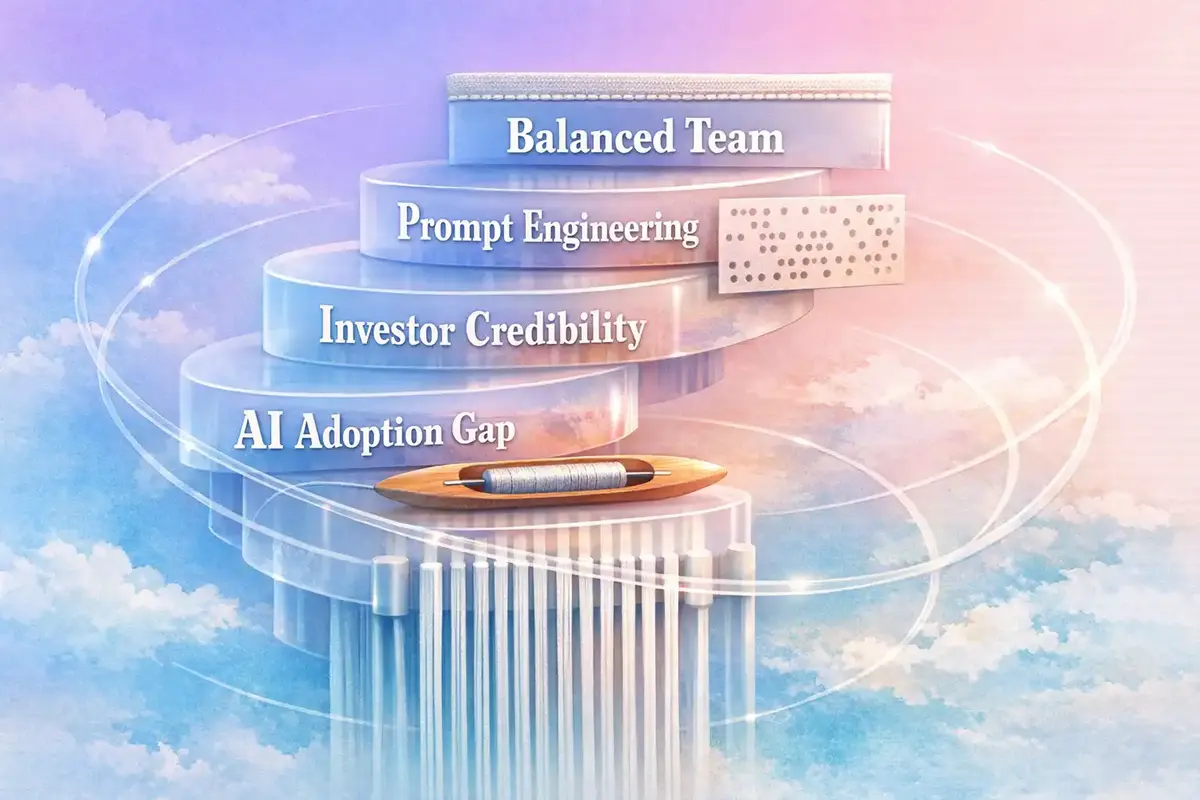
That is the distinction founders often miss. A lean team is not automatically credible because it is efficient. It becomes credible when the founder shows that human judgment is concentrated in the places that create enterprise value: product direction, customer interpretation, hiring standards, and strategic tradeoffs.
58% of CEOs use a professional coach—a useful reminder that serious leaders do not confuse support systems with weakness (Stanford / Hoover Institution, 2025)
This is also why investor credibility depends less on saying “we use AI across the business” and more on saying “here is exactly what AI speeds up, and here is exactly what leadership still owns.”
The Story That Reassures Sophisticated Investors
The strongest founder narrative is specific. AI helps the company move faster on research, synthesis, forecasting, and internal coordination. Fine. But the founder must pair that with visible human ownership.
Say it plainly: AI reduces cycle time on analysis, so the leadership team can spend more time with customers. AI drafts first passes, so product and go-to-market leaders can debate the real tradeoffs sooner. AI improves resource allocation, so scarce headcount goes to roles where judgment compounds rather than to work that can be systematized.
That framing matters because investors are not buying software usage. They are buying a team’s ability to convert information into decisions. A founder who understands this can talk about AI without sounding defensive, inflated, or thin.
Research from Stanford and the Hoover Institution points in the same direction: CEOs routinely rely on structured counsel, whether through coaches or broader advisor networks (Stanford / Hoover Institution, 2025). Founders should take the hint. Mature leadership is not the absence of support. It is visible accountability inside a well-designed support system, which is exactly why founder coaching often becomes a credibility asset rather than a private fix.
The investor hears one question beneath all the others: is this company compact by design, or small because it has not built enough muscle yet? In the AI era, that answer is no longer about headcount alone—it is about whether a small team can look unmistakably strong.
Can a Small Team Look Stronger Than a Large One in the AI Era?
71% of leaders reported increased stress, which is not just a wellbeing issue; it is how revenue slips, trust frays, and good people start returning recruiter calls when the founder’s judgment gets harder to read (DDI, 2025). If you lead a small team, the risk is sharper: one vague decision, one over-automated customer moment, one muddled hiring signal, and “lean” starts looking like “underbuilt.”
The Real Test Is Not Efficiency. It Is Believability.
Picture a founder in a regional retail startup on the morning of a quarterly review. The board deck is tighter than it was six months ago. Customer feedback has been summarized overnight. Pricing scenarios are already modeled. The team has moved fast.
But the founder still feels the private question: Will this look impressive, or thin?
That is the part many operators miss. A small team does not earn credibility because it produces more output per person. It earns credibility when outsiders can see a believable path from today’s compact team to tomorrow’s scaled company. Capability, momentum, and future scale have to hang together. If AI makes the company look fast but not durable, the story breaks.
This is why the founder’s job is not merely to save hours. It is to direct scarce human attention toward the few places where judgment compounds: customer interpretation, product choices, key hires, and standards. Everything else can move faster. Those things cannot get blurrier.
Small Can Beat Large When Attention Is Allocated Well
Large teams often lose speed in coordination, handoffs, and internal explanation. A smaller AI-augmented team can beat them by stripping out low-value work and keeping senior attention on the decisions that actually change outcomes.
That sounds obvious. It is rarely practiced with discipline.
A founder who uses AI to compress research, first drafts, and internal synthesis can spend more time in customer calls, more time coaching managers, and more time pressure-testing assumptions before they harden into strategy. That is where smaller teams start to look stronger than larger ones: not because AI replaces people, but because it protects human focus from being wasted.
The operating advantage is real. The signaling advantage matters just as much.
Trust in managers dropped from 46% to 29% since 2022 — a warning that speed without visible ownership can quickly erode confidence (DDI, 2025)
Culture Has to Make the Rules Visible
Founders carry a psychological burden here that few admit openly. Small headcount can trigger impostor syndrome. AI can trigger a second anxiety: am I building a better company, or just delaying hires I will eventually need?
Those doubts do not disappear through optimism. They ease when the team sees clear rules.
A strong culture normalizes AI collaboration while making human ownership unmistakable. Use AI for preparation, pattern finding, and draft work. Hold people accountable for decisions, quality, and consequences. Review outputs in the open. Name what must never be delegated. That is how standards become visible rather than assumed.
This is also where AI leadership skills stop being abstract. The founder has to model calm scrutiny — not blind enthusiasm, not defensive caution. Teams take their cue from that posture.
A small team can look formidable. But only if the operating model is clear enough that people know where the machine helps and where the humans still carry the weight. Otherwise the same setup that looks efficient in a board meeting starts to feel fragile inside the company.
And once that line is clear, a harder question appears: what does that team actually look like day to day — in roles, rhythms, and responsibilities?
What Does an AI-Augmented Lean Team Actually Look Like in Practice?
86% of employers expect AI and information processing to transform their business, which is why a founder needs an Automate → Validate → Hybridize → Hire model before the team starts scaling (World Economic Forum, 2025). Without that sequence, a lean company usually breaks in one of two ways: it automates noise before it understands demand, or it hires around confusion that should have been designed out first.
Automate the First Pass, Not the Standard
In practice, an AI-augmented team gives AI first-pass responsibility for work that benefits from speed and pattern recognition: research briefs, draft content, support triage, analysis, and coding acceleration. That does not mean “let the model decide.” It means the founder defines the bar.
A technology startup founder facing a product roadmap review can use AI to summarize user interviews, cluster bug reports, draft release notes, and help engineers move faster on routine code generation. Useful, yes. But the operating discipline sits elsewhere: what counts as a usable summary, what error rate is acceptable in support responses, what code must be reviewed line by line, and what customer-facing language requires human approval.
That is the part inexperienced teams skip. They assign tasks to AI without defining quality thresholds. Then they act surprised when output volume rises faster than trust.
86% of employers expect AI and information processing to reshape how the business works (World Economic Forum, 2025)
The founder’s job is to make “good enough” explicit. If AI drafts outbound content, define the claims it cannot make. If it supports analysis, define which assumptions must be checked by a person. If it accelerates coding, define where testing and architectural judgment remain fully human.
Validate Before You Scale the System
This matters most before product-market fit. Early-stage companies do not fail because they lacked enough automation. They fail because they misread weak signals from customers and scaled the wrong interpretation.
In a regional healthcare startup, for example, a founder may be tempted to automate onboarding flows, support replies, and feature education as soon as usage starts climbing. Too early, and the company loses the raw customer observation that reveals what people are actually confused by, what they value, and what they ignore. Human learning is still the scarce asset.
So the second step is validation. Use AI to widen the funnel of information, then force human review at the points where learning happens. Listen to calls. Read complaint threads. Watch where users hesitate. A founder who automates before understanding usually gets cleaner dashboards and worse judgment.
Hybridize the Core, Then Hire Into the Gaps
The durable model is hybrid. AI handles throughput. Humans handle interpretation, relationship-building, and irreversible decisions.
That changes how a founder should think about org design. The question is not “which jobs disappear?” It is “which capabilities do we need now, and which can wait until the work becomes repeatable?” Zero-to-one companies need direct customer contact, product sense, and fast decision loops. Later, once patterns stabilize, they can add specialists around systems, controls, and scale.
That is why the hiring sequence matters more than the headcount number. The World Economic Forum reports that 77% of employers plan to upskill workers (World Economic Forum, 2025). Smart founders should read that as a design principle: teach the team to work with AI before assuming every new bottleneck requires a new role. In some cases, that will sharpen AI hiring decisions by showing which roles truly need judgment density and which only need better workflow design.
A strong lean team, then, is not a company with fewer people. It is a company that knows when to automate, when to validate, when to hybridize, and only then when to hire.
That sounds operational. It is also deeply managerial. Because once AI becomes part of how the team thinks and works, the founder faces a harder question: is AI fluency just a tool preference—or is it now part of leadership itself?
Why the Best Founder CEOs Treat AI Fluency as a Leadership Skill, Not a Tool Choice
86% of employers expect AI and information processing to transform their business. If you get this wrong as a founder CEO, the cost is not abstract: decisions slow down, trust thins, strong people leave, and revenue opportunities slip while the company mistakes activity for progress (World Economic Forum, 2025).
That is why the real question is no longer whether you use AI. It is whether you can lead through AI.
Tool Users Chase Output. Leaders Build Judgment
The weaker founder posture is easy to spot. New tool every week. Faster drafts. More dashboards. Little improvement in decision quality.
The stronger posture looks different. AI fluency sits beside vision, resilience, and sales ability as a core founder competency because it changes how the company thinks, not just how it works. PwC found that 56% of CEOs said GenAI created efficiencies in how employees use their time (PwC, 2025). Useful, but incomplete. Time saved only matters if leadership redirects that time toward better calls, sharper priorities, and clearer standards.
In a mid-market finance company during a team restructure, a founder can now get instant summaries, draft role scopes, and scenario models before the leadership meeting starts. That speed helps. But if the founder cannot tell which recommendation is shallow, which assumption is dangerous, and which tradeoff belongs with a human leader, the system becomes a confidence trap.
This is why AI fluency is not a software preference. It is managerial judgment under new conditions.
Leadership Development Now Includes System Design
A founder’s development path used to center on storytelling, hiring, fundraising, and endurance. It still does. But now it also includes prompt quality, tool selection, delegation to systems, and quality control over machine-generated output.
That may sound tactical. It is not.
Prompting, at a senior level, is structured thinking. Tool selection is operating design. Delegating to systems is a question of authority. Reviewing outputs is a question of standards. Founders who treat these as side skills usually create hidden messes — inconsistent customer communication, weak internal analysis, and teams that no longer know where final judgment lives.
PwC reports that only 33% of CEOs say they have a high degree of trust in having AI embedded into key processes (PwC, 2025). That number matters because it shows where the leadership work is. Not in enthusiasm. In disciplined trust-building.
If you are serious about AI leadership skills, the work is less about mastering every tool than about setting rules your team can actually operate by.
The Scaling Shift Is From Heroics to Boundaries
Most first-time founders begin as the system. They sell, decide, review, unblock, and catch errors by force of attention.
That model does not scale.
The next challenge is building a human-and-AI operating system with clear role boundaries: what the machine drafts, what the team validates, what leaders decide, and what the founder must still own personally. This is now part of modern leadership development. Not because founders need to become technical specialists, but because they need to stop being the bottleneck without becoming absent.
The best long-term companies will not win because they have access to the same commodity models as everyone else. They will win because they build proprietary data, earned judgment, and a culture that knows how to use common AI without outsourcing its standards.
That is the closing discipline. Use shared tools. Protect unique insight. Keep human trust visible.
So ask yourself the harder question: are you still using AI as a convenience layer — or are you learning to lead a company where leverage, judgment, and accountability must work as one?
Key Takeaways
- First-time founder CEOs are now the norm, but the performance gap with veteran CEOs makes transition risk real.
- AI should absorb repeatable, low-trust work first, while product vision, investor relationships, and final judgment stay human.
- Investors want a human-led story with clear ownership, not a company that sounds thin behind its tools.
- Strong lean teams use AI to protect human attention, make rules visible, and build leadership fluency around judgment and boundaries.
Frequently Asked Questions
What is the main leadership challenge for first-time founder CEOs in the AI era?
The main challenge is not just using AI, but deciding where AI should create speed and where human leadership must remain visible. First-time founder CEOs must scale judgment, communication, and execution at the same time while avoiding the trap of looking efficient but thin.
Which tasks should a founder CEO automate first with AI?
Start with repeatable, low-trust work such as market research, competitive analysis, content drafting, support triage, and first-pass financial modeling. These tasks benefit from speed and pattern recognition without putting core judgment or trust at risk.
What work should stay human even when AI can help prepare it?
Product vision, investor relationships, strategic partnerships, hiring standards, and final judgment calls should stay human-led. AI can support preparation and analysis, but the founder must own the decisions that shape trust, direction, and accountability.
How can a small team look strong rather than underbuilt when using AI?
A small team looks strong when AI frees human attention for the few decisions that compound value, such as customer interpretation, product choices, and key hires. Credibility comes from clear ownership, visible standards, and a believable path from a compact team to a scalable company.
Why is AI fluency considered a leadership skill for founder CEOs?
AI fluency is a leadership skill because it changes how decisions are made, how work is delegated, and how quality is controlled. Strong founder CEOs use AI to improve judgment and operating design, not just to produce more output faster.