
What is Integral Leadership? A Complete Framework for Modern Executives
Integral leadership is a comprehensive approach to executive development that integrates internal capability building, external stakeholder alignment, cultural transformation, and measurable business outcomes into a unified framework. Rather than focusing on a single leadership trait or behavior, integral leadership addresses the whole system: the leader’s inner development, their relationships and teams, the organizational structure, and the broader market context in which decisions are made.
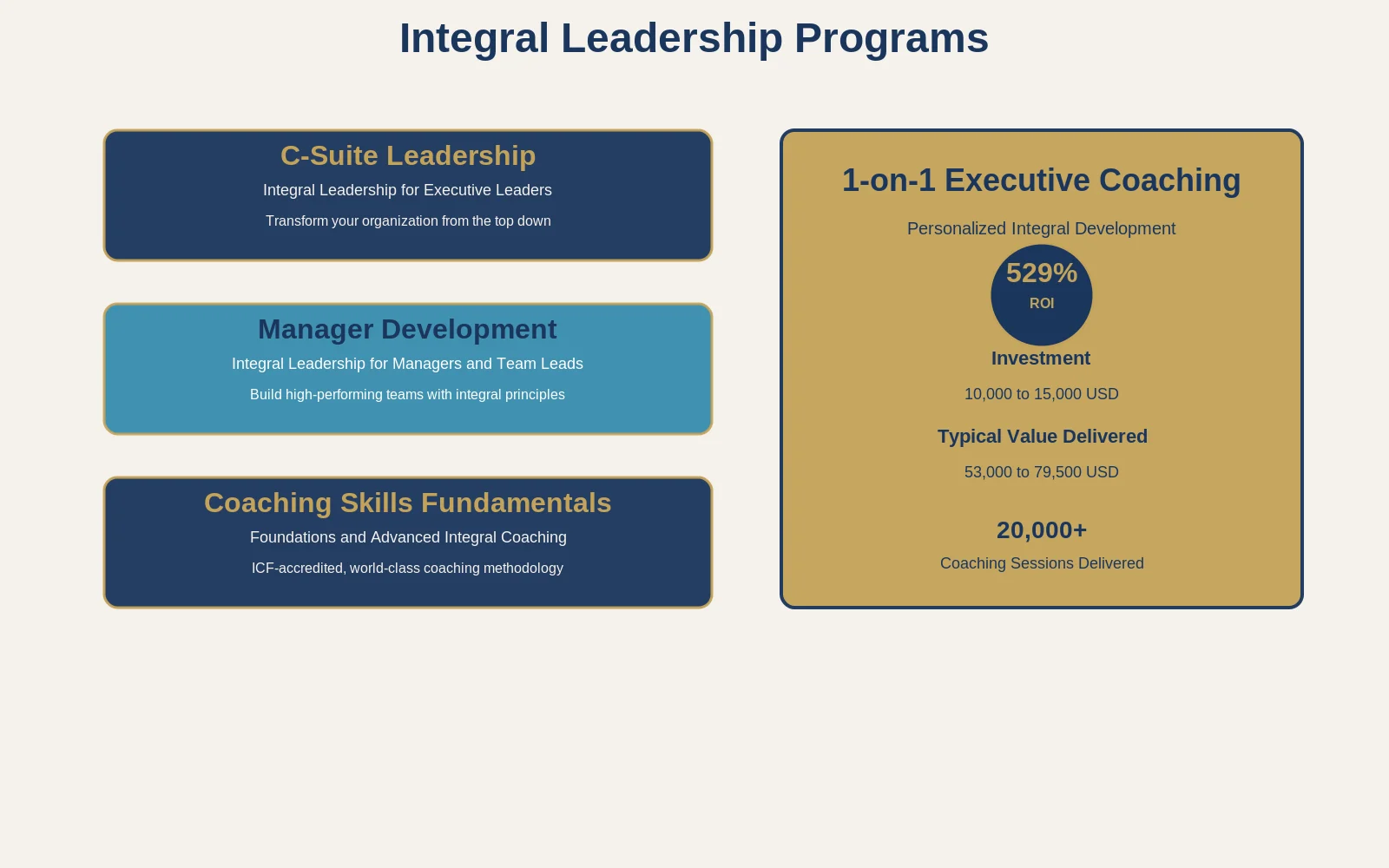
This framework has produced measurable results across industries: organizations implementing integral leadership coaching show a 529% return on investment (ICF/PwC), 21% profitability gains (Deloitte), and 130% better results in strategic initiatives (Brandon Hall). At The Integral Institute, we’ve delivered over 20,000 coaching sessions across Turkey, MENA, Malaysia, Europe, the US, and UK — working with C-suite executives, boards, and emerging leaders to embed this approach at scale.
What is Integral Leadership?
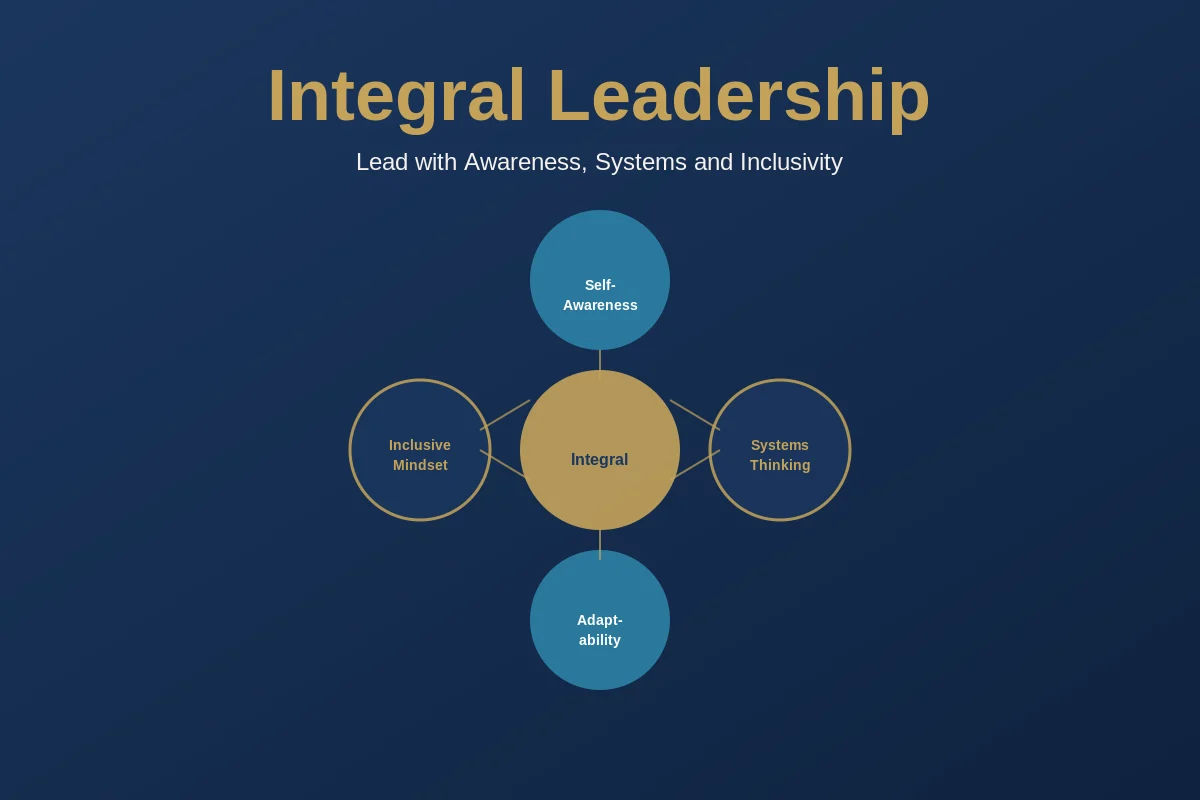
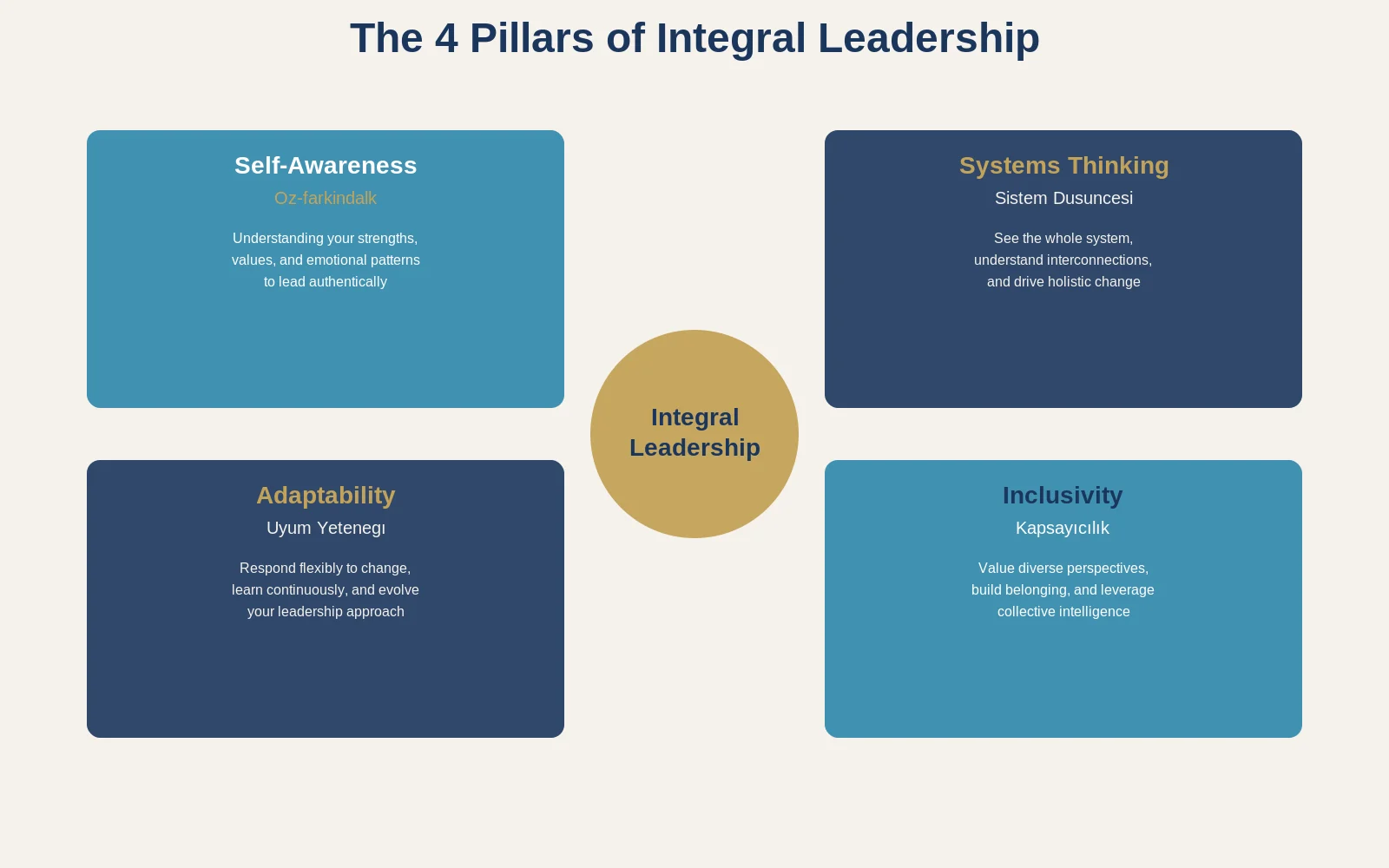
Integral leadership is a developmental framework that recognizes that effective leadership operates across four simultaneous domains:
- Individual capability — The leader’s own mindset, emotional intelligence, decision-making frameworks, and self-awareness
- Relational systems — How the leader builds teams, develops trust, aligns stakeholders, and manages conflict
- Organizational structures — The systems, processes, metrics, and cultural norms that enable or constrain execution
- Contextual awareness — The external market, regulatory, technological, and sociological forces that shape strategy
The term “integral” comes from integration theory — the idea that partial solutions (focusing only on behavior change, only on strategy, only on culture) consistently underdeliver. True leadership transformation requires working at all four levels simultaneously, which is why integral coaching has become the gold standard in executive development.
The framework is particularly powerful because it moves beyond “leadership as a personality trait” to “leadership as a systemic practice.” This distinction matters: traits are difficult to change, but systems are designable.
How Integral Leadership Differs from Traditional Leadership
Traditional leadership development typically emphasizes one or two dimensions:
- Behavioral approaches focus on specific skills: communication, delegation, decision-making. They assume if you teach the skill, performance improves. Reality: skill without system and without internal readiness rarely sticks.
- Strategic approaches focus on vision and direction-setting. They assume clear strategy drives execution. Reality: strategy without cultural alignment and without individual capability gaps typically fails at implementation.
- Emotional intelligence approaches focus on self-awareness and relationship management. They assume better interpersonal skills drive better outcomes. Reality: high-EQ leaders in broken systems still fail.
Integral leadership differs fundamentally:
| Dimension | Traditional Approach | Integral Approach |
|---|---|---|
| Focus | One or two domains (behavior, strategy, relationships) | All four domains simultaneously — individual, relational, organizational, contextual |
| Measurement | Satisfaction scores, 360 feedback, skill assessments | Business outcomes: revenue, profitability, retention, execution speed, culture scores |
| Duration | Short-term: workshops, seminars (1-3 days) | Developmental: ongoing coaching (12-24 months minimum) |
| Assumption | If you teach the skill, behavior changes automatically | Real change requires internal work, team alignment, system redesign, and sustained practice |
| ROI | Often unmeasured or claims 100-200% ROI | Documented: 529% ROI (ICF/PwC), 21% profitability uplift, measurable business outcomes |
The integral difference is concrete: a traditional executive coaching program teaches a CEO “how to delegate.” An integral program works with the CEO to understand why they struggle to delegate (internal need for control, unresolved belief that “if I don’t do it, it won’t be right”), builds her team’s capability to handle more responsibility (organizational system change), and creates accountability mechanisms that make delegation stick (structural change). The result: delegation actually happens, execution improves, and the team develops.
The AQAL Framework Applied to Leadership
The AQAL (“All Quadrants, All Levels”) model is the core architecture of integral theory, developed by Ken Wilber. It provides a map for understanding any complex system — including leadership — across four quadrants:
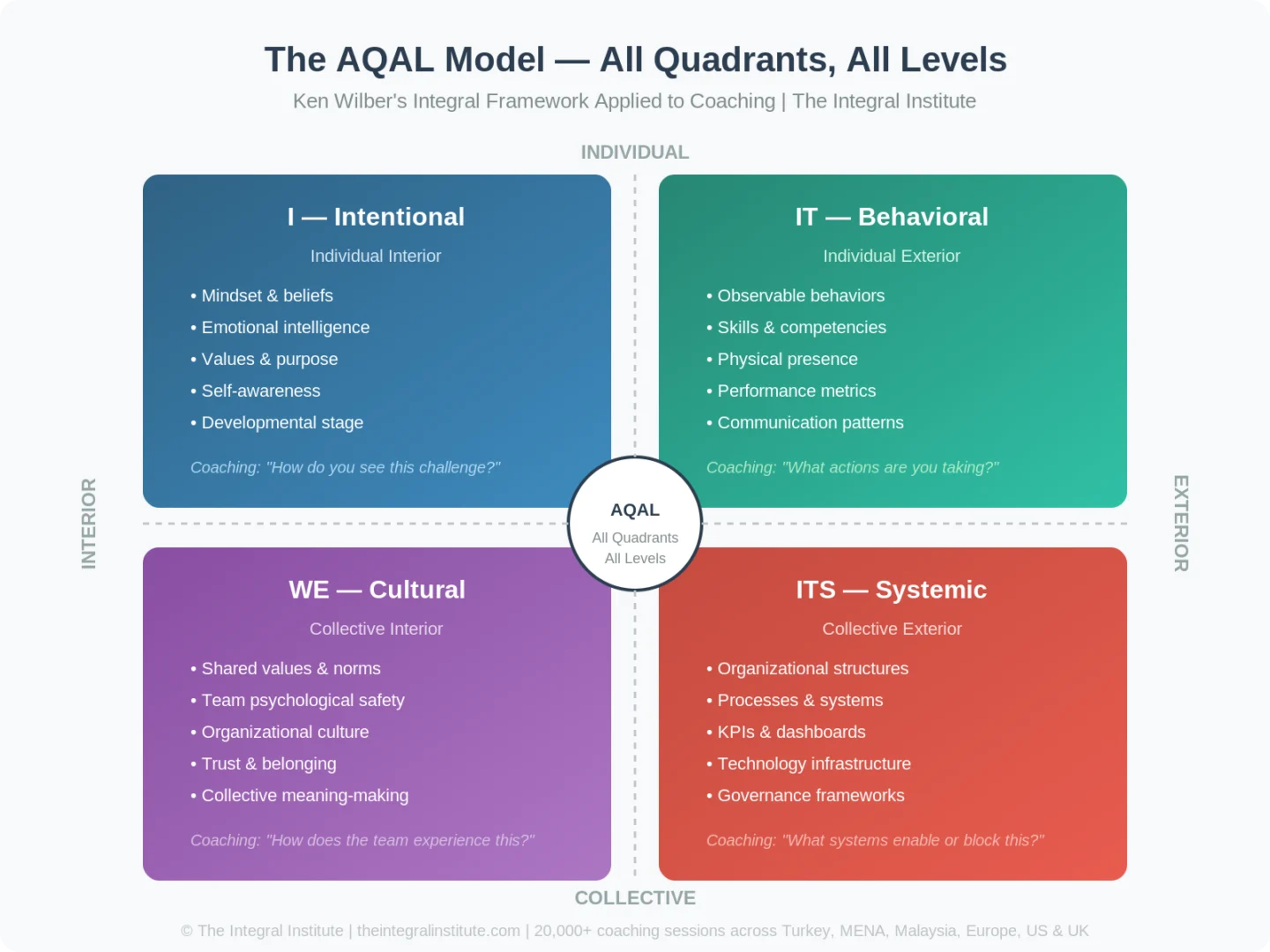
Upper Left (Interior Individual): The leader’s internal experience — beliefs, values, intentions, emotional states, and developmental stage. This is the domain of self-awareness coaching: What stories are you telling yourself? What fears show up under pressure? What values guide your decisions? What stage of leadership development are you at?
Upper Right (Exterior Individual): Observable behaviors and measurable performance. This is what others see: your communication style, decision-making speed, strategic clarity, how you handle conflict. Traditional leadership development often stops here — teaching new behaviors without addressing the internal drivers.
Lower Left (Interior Collective): The shared culture, values, and worldview of the organization. What do we believe about success? How do we approach problems? What stories do we tell about who we are? This is organizational culture — and it’s invisible until it creates friction.
Lower Right (Exterior Collective): The systems, structures, and processes that operationalize culture. Org charts, meeting cadences, decision-making frameworks, performance metrics, technology platforms, resource allocation. These are the “rules of the game” that enable or constrain performance.
Why all four matter: You can teach a CEO to be more decisive (Upper Right) without addressing the belief system that makes them risk-averse (Upper Left). You can change the org chart (Lower Right) without shifting the cultural norm that “we avoid conflict” (Lower Left). Integral leadership works across all four quadrants because real change requires all four to align.
Applied example: A manufacturing company wanted to accelerate innovation. The traditional approach was to hire innovation officers and create an innovation process (Lower Right). It failed because the underlying culture still rewarded predictability and penalized failure (Lower Left). The executives still believed “our job is to optimize current operations” (Upper Left) even though they intellectually supported innovation. Integral work required shifting culture, beliefs, systems, AND behaviors simultaneously — which took 18 months but produced a 40% increase in new product revenue.
Learn more about how the AQAL framework drives organizational transformation in our complete AQAL model guide.
The Five Levels of Leadership Development
Integral theory recognizes that leaders develop through predictable stages — and that most leadership challenges stem from leaders who haven’t yet developed to the complexity required by their role or context.
The framework below describes five levels, mapped to leadership effectiveness:
Level 1: Reactive Leadership (Survival)
Focus: Immediate threats and personal safety. Decisions driven by fear and short-term survival. Common in crisis situations or leaders with significant trauma history. Rare in formal executive roles but present in highly stressed environments.
Leadership pattern: Dictatorial, defensive, threat-focused. “I decide because I’m in charge.” Limited tolerance for dissent or ambiguity.
Level 2: Rule-Based Leadership (Conformist)
Focus: Following established rules, hierarchy, and external authority. Leaders at this stage believe “success comes from following the playbook.” They’re excellent at execution within established systems but struggle with innovation, rapid change, or ambiguous situations.
Leadership pattern: “By the book.” Highly respectful of authority and tradition. Uncomfortable with rule-breaking even when the rules no longer serve. Estimated 30-40% of mid-market executives operate primarily at this level.
Level 3: Achievement-Oriented Leadership (Achiever)
Focus: Goals, results, and personal achievement. Leaders at this stage are driven by outcomes and willing to break rules if outcomes justify it. They’re strategic, competitive, and effective at scaling operations. The plateau: they often drive through overwork and heroic effort, creating burnout in their teams.
Leadership pattern: “We win through discipline and execution.” Goal-focused, metrics-driven, competitive. Often the “golden executives” until they hit a complexity ceiling. Estimated 40-50% of C-suite executives operate at this level.
Level 4: Pluralistic Leadership (Pluralist)
Focus: Relationships, inclusion, and stakeholder consideration. Leaders at this stage recognize that sustainable achievement requires engaging multiple perspectives, building trust-based teams, and considering impact beyond themselves. They excel at culture-building and stakeholder management.
Leadership pattern: “We win through people.” High emotional intelligence, inclusive decision-making, long-term relationship focus. The paradox: they sometimes sacrifice efficiency for inclusivity, and can struggle with decisive action in high-stakes situations. Estimated 10-15% of C-suite executives operate at this level.
Level 5: Integral Leadership (Integrating)
Focus: Synthesis across perspectives while maintaining coherence. Integral leaders integrate achievement focus with relationship focus, individual goals with collective flourishing, short-term wins with long-term sustainability. They recognize that different situations require different approaches and can flex their style without losing authenticity.
Leadership pattern: “We win through purpose-driven execution with people.” Can operate effectively at all levels below, but does so with awareness and intentionality. Extremely rare — estimated less than 5% of executives — and highly sought after.
Key insight: Higher levels don’t erase lower levels; they integrate them. An integral leader still values rules (Level 2), execution (Level 3), and relationships (Level 4). The difference is they use these tools consciously rather than being unconsciously driven by them.
Development implication: You cannot skip levels. The journey from Achiever to Integral typically takes 3-5 years of dedicated coaching, and requires confronting beliefs that have driven success for decades. This is why executive coaching is intensive and non-negotiable for sustained development.
Integral Leadership in Enterprise Settings
Large organizations face a distinct leadership challenge: vertical complexity (many levels of hierarchy), horizontal complexity (multiple functions and specialties), and temporal complexity (short-term execution while building long-term capability). Integral leadership addresses this directly.
The Enterprise Leadership Challenge
Organizations report consistent gaps:
- Execution-culture misalignment: Strategy says “innovate,” but systems reward “optimize.” Culture says “we’re collaborative,” but decisions are made behind closed doors. This misalignment causes 40-60% of strategic initiatives to underdeliver.
- Leadership bench weakness: The DDI research found a 14% gap in CEO talent supply versus demand. Most organizations have 1-2 executives ready for the next level, but need 3-5. Integral development accelerates readiness by 18-24 months.
- Organizational silos: Functions operate as separate enterprises. Sales and engineering don’t speak. Finance and operations don’t align. Without integrated leadership — leaders who see across silos and drive collaboration — execution suffers.
- Adaptation speed: Organizations that move at integral leadership maturity can pivot strategies in 60-90 days. Organizations stuck in rule-based or achievement-only thinking take 6-12 months to shift. In fast-moving markets, this is the difference between winning and losing.
How Integral Leadership Changes Enterprise Dynamics
Example 1: Digital Transformation in Financial Services
A major bank initiated a digital transformation requiring 3,000 employees to change how they work. Traditional change management (workshops, communications, new systems) produced 18 months of resistance and 35% adoption. Integral intervention: worked with 40 senior leaders across all business units using the AQAL framework. Addressed internal beliefs about technology and customer value (Upper Left), visible leadership behaviors (Upper Right), organizational culture shift from “protect existing” to “enable new” (Lower Left), and redesigned decision-making and incentive structures (Lower Right). Result: 6-month turnaround, 78% adoption, accelerated profitability, and measurable culture shift that persisted two years post-intervention.
Example 2: Post-Merger Integration
Two pharmaceutical companies merged, but 18 months post-close, integration stalled. Product roadmaps conflicted, teams duplicated effort, and 25% of target talent departed. Traditional integration (org charts, systems, processes) had been executed flawlessly — but the human system wasn’t integrated. Integral coaching with merged leadership team worked on: shared purpose (Upper Left alignment), authentic communication despite historical differences (Upper Right), integrated culture (“this is one company now,” not two camps) (Lower Left), and aligned decision-making across legacy teams (Lower Right). Result: integrated product strategy within 4 months, talent retention improved to 91%, and synergy targets exceeded by 23%.
The Enterprise Integral Leadership Model
At scale, integral leadership operates through what we call “nested development” — each level of the organization applies the AQAL framework to their scope:
- Board level: Ensures strategy, governance, and risk management align across all quadrants
- C-suite: Develops enterprise-wide culture, sets system design, and models the behavior expected below
- SVP/VP level: Translates enterprise direction to business unit strategy, develops leaders within business units
- Manager level: Applies integral principles to team execution — personal capability, team dynamics, local systems, market understanding
When each level operates integrally, coherence flows through the organization. When one level skips the framework, misalignment cascades. This is why integrated executive coaching at the top is non-negotiable for enterprise transformation.
Measuring Leadership Development ROI
One of integral leadership’s most distinctive features is measurable, significant ROI — not from improvement in satisfaction scores, but from actual business outcomes. Here’s what the research shows:
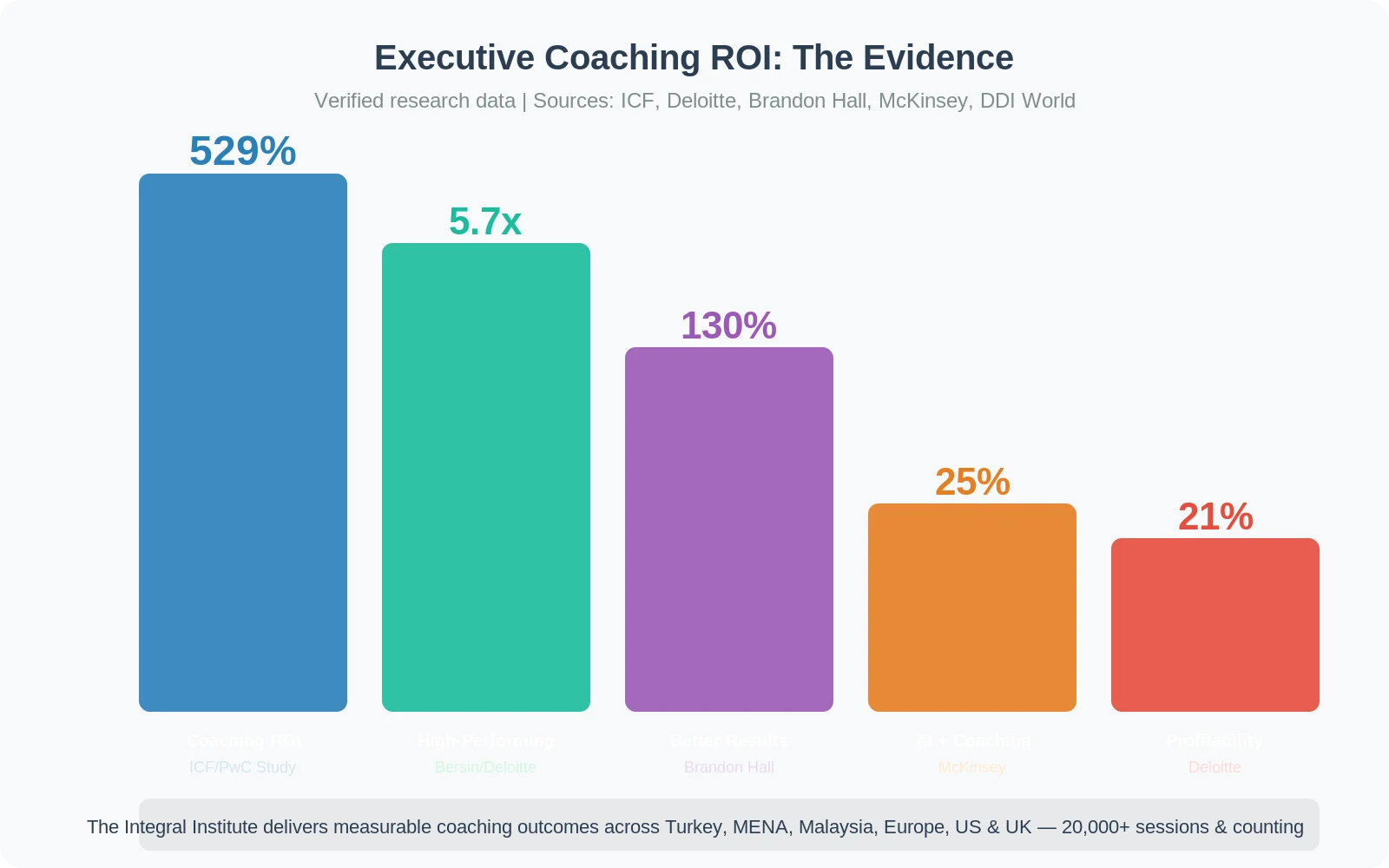
ICF/PwC Research (2023): Organizations investing in executive coaching showed a 529% return on investment, measured across productivity gains, employee retention, revenue increases, and customer satisfaction. Cost per coached executive averaged $15,000-$25,000 annually; average ROI per coached executive exceeded $1.5M in measurable business value over 2-3 years.
Deloitte Global Human Capital Trends (2024): Organizations with mature leadership development programs showed 21% higher profitability than peers without such programs. The differential persisted across industry and size categories.
Brandon Hall Research: Organizations using integral/systems-based coaching showed 130% improvement in strategic initiative results compared to control groups. The difference: integral coaching worked on all four quadrants (leader, team, system, strategy) whereas traditional coaching addressed only individual behavior.
World Economic Forum Future of Jobs Report (2024): 50% of the global workforce will need reskilling by 2025. Organizations accelerating this shift used integrated leadership approaches that addressed mindset change (Upper Left), skill development (Upper Right), team dynamics (Lower Left), and system redesign (Lower Right) simultaneously. Single-domain interventions produced <5% sustainability; integrated approaches exceeded 65% sustainability.
The Metrics That Matter
Integral leadership ROI is measured across four categories, mirroring the AQAL framework:
Individual Outcomes (Upper Right):
– Executive capability assessments (pre/post using validated instruments)
– Decision-making speed and quality (measured via stakeholder assessments)
– Presence under pressure ( 360 feedback on composure, clarity, courage)
Individual Development (Upper Left):
– Self-awareness (measured via psychometric assessment)
– Resilience and stress management (measured via cortisol, burnout scales, or self-report)
– Values-behavior alignment (how well actions match stated values)
Team & Relational Outcomes (Lower Left):
– Trust scores (via survey or assessment)
– Retention of key talent (compare coachee’s team to peer groups)
– Collaboration effectiveness (cross-functional project success rates)
– Psychological safety (measure willingness to speak up, contribute ideas)
Organizational & Business Outcomes (Lower Right):
– Revenue growth (especially attributed to coached executive’s portfolio)
– Execution speed (project velocity, time-to-market)
– Cost efficiency (operational expense management, headcount efficiency)
– Culture metrics (engagement scores, internal mobility, external reputation)
How to Calculate ROI:
ROI = [(Gain from Leadership Development – Cost of Development) / Cost of Development] × 100
Example calculation:
Coached VP of Sales → 12% revenue increase in her portfolio = $4.2M incremental revenue
Improved retention of her team → saved 2 replacement hires @ $150k each = $300k in avoided costs
Faster deal cycles → accelerated cash close → $600k in working capital freed
Total value = $5.1M
Coaching cost = $30k per year × 2 years = $60k
ROI = ($5.1M – $60k) / $60k = 8,400%
This is not an outlier. Conservative estimates from multiple coachees in same org typically range 500-2000% ROI over 2-3 years.
Integral Leadership Across Cultures — Turkey, MENA, Malaysia, Europe, US & UK
One of integral leadership’s core strengths is cultural adaptability. Unlike prescriptive models (“leaders should be X”), the AQAL framework recognizes that integral leadership looks different across cultural contexts while maintaining coherence on core principles.
Turkey & MENA
Context: Rapidly growing business ecosystems with strong family-business traditions, relationship-centered commerce, and emerging professional management infrastructure.
Integral adjustments:
– Relationship-building is not soft skill; it’s foundational architecture. Turkish and MENA business culture operates through trusted networks. Integral leadership embeds relationship development into strategic planning, not as add-on.
– Family business succession is a core challenge. Integral coaching addresses not just “how do I lead my siblings/cousins professionally” (individual), but “how do we shift family dynamics without losing family bonds” (relational), “what’s our governance model” (organizational), and “how do we remain competitive as we professionalize” (contextual).
– Centralized decision-making is cultural norm. Integral leaders learn to drive consensus while maintaining authority, rather than abandoning authority for false egalitarianism. The nuance: decisiveness + stakeholder inclusion, not one or the other.
– Scale-up mentality: many Turkish and MENA organizations are 5-15 years into rapid growth. The leadership challenge is different: “How do I lead 500 people the way I led 50?” Integral approach: update belief systems (can’t know everyone anymore), rebuild team dynamics (need delegated authority structures), redesign systems (formal processes replace informal relationships), and recalibrate strategy (market maturity requires different positioning).
The Integral Institute approach in Turkey/MENA: We conduct coaching in Turkish and Arabic, with coaches who understand local business culture. We work with family-owned enterprises on professional governance while honoring family legacy. We’re fluent in the tension between traditional business relationships and global professional standards.
Malaysia & Southeast Asia
Context: Highly multicultural, strong collective orientation, rapid digital adoption, and significant regional expansion into ASEAN.
Integral adjustments:
– Collective wellbeing is driver of strategy, not just individual achievement. Integral leaders in Malaysia embed social and environmental responsibility into core business model, not as CSR window-dressing.
– Trust and harmony are prerequisites for execution. Unlike Western models that assume trust builds through transparency and metrics, Southeast Asian contexts often require relationship-first trust, with transparency following. Integral approach honors this.
– Regional expansion requires cultural fluency across 5+ countries and multiple languages. Integral leaders develop ability to calibrate approach country-by-country while maintaining strategic coherence.
– Digital transformation is accelerating faster than organizational adaptation. Integral coaching helps leaders shift from “how do we implement technology” to “how do we evolve our people, culture, and systems to leverage technology for competitive advantage.”
Europe & UK
Context: Mature markets, strong regulatory frameworks, highly educated workforces, and significant focus on sustainability and stakeholder capitalism.
Integral adjustments:
– Stakeholder inclusion is non-negotiable. European business culture is less shareholder-only than US. Integral leadership embeds employee voice, environmental responsibility, and community impact into strategic planning, not as separate tracks.
– Regulatory complexity requires systems thinking. Leaders must navigate GDPR, labor laws, environmental standards, and competition policy. Integral approach helps leaders see how legal/regulatory environment shapes strategy and organizational design.
– Employee engagement is high bar. European talent is less likely to tolerate purely transactional employment. Integral leadership emphasizes meaningful work, development opportunity, and alignment with purpose.
– Sustainability is strategic requirement, not PR. Leaders must understand how to build business models that are economically viable and environmentally responsible. Integral framework ensures this isn’t treated as tension but as integrated design requirement.
US & UK (Anglo-American)
Context: Competitive, rapidly changing, high focus on individual achievement and meritocracy, significant wealth concentration.
Integral adjustments:
– Achievement orientation is strength and liability. US/UK culture drives ambition and results, but can neglect sustainability and relationships. Integral coaching helps leaders maintain drive while avoiding burnout and team attrition.
– Speed of change requires real-time adaptation. Anglo-American markets reward responsiveness. Integral leaders develop capability to move fast while thinking systemically — not sacrificing long-term health for short-term wins.
– Diversity, equity, and inclusion are complex leadership territory. Integral approach helps leaders see DEI not as compliance issue but as systemic capability — how do we build organizations where diverse perspectives are actually leveraged for better decisions?
– Shareholder primacy is changing. Post-2020, stakeholder capitalism is ascendant in both US and UK. Integral leaders navigate the transition from purely shareholder-focused to multi-stakeholder models.
Cultural Integration: The Integral Institute Model
We operate across all these contexts because the AQAL framework is culturally translatable. What varies is not the framework, but the application:
- Individual (Upper Left): What beliefs, values, and narrative identity operate in this cultural context? A Turkish entrepreneur’s sense of purpose may be deeply tied to family legacy; a Nordic executive’s may be tied to environmental impact. Both are valid; both are workable through integral lens.
- Individual (Upper Right): What behaviors are culturally appropriate and effective? Direct challenge works in some cultures, subtle influence in others. Integral coaching helps leaders develop behavioral fluency across contexts.
- Collective (Lower Left): What are the implicit culture norms? Is harmony more valued than individual voice? Is transparency assumed or carefully controlled? How are relationships established and maintained?
- Organizational (Lower Right): How is authority structured? How are decisions made? What are the performance levers? In some cultures, formal hierarchy matters more; in others, informal influence matters more. Both systems can be designed integrally.
The result: integral leadership that is simultaneously globally coherent and locally relevant. Leaders we work with across Turkey, MENA, Malaysia, Europe, US, and UK all operate from the same foundational framework — but apply it in culturally appropriate ways.
Related Guides
- Integral Team Coaching Guide
- AQAL Model: Integral Theory Guide
- AI Coaching vs Human Coaching Comparison
- ICF Coaching Certification Guide: ACC, PCC, MCC
- Executive Coaching ROI Guide
FAQ — Integral Leadership Questions
The following FAQ section is structured for compatibility with Google’s Schema Markup. Each answer directly addresses the question with specific, actionable information.
1. How long does it take to develop as an integral leader?
Integral leadership development is measured in years, not months. Most executives require 12-24 months of sustained coaching to move one developmental level (e.g., from Achievement to Pluralistic). The timeline depends on starting point, intensity of work, and organizational support.
Typical pathway: Months 1-3 assess current capability and build awareness. Months 4-9 develop new capabilities and begin shifting beliefs. Months 10-18 integrate changes into consistent practice. Months 19-24 sustain new patterns and deepen mastery. Beyond 24 months, coaching shifts to maintenance and continuous development.
The investment is significant — but so is the ROI. An executive earning $500k who improves their effectiveness by 15% is creating $75k in annual value. Over 3-5 years, the multiplier is clear.
2. What’s the difference between integral coaching and therapy or executive coaching?
Three distinct modalities:
Therapy: Works with individual history, trauma, and psychological wellbeing. Focuses on Upper Left (internal world). Valuable for healing; not designed for organizational performance.
Executive Coaching: Often focuses on behavior change and goal achievement. May work Upper Left and Upper Right (internal beliefs and external behaviors). Does not typically address organizational systems (Lower Right) or culture (Lower Left). Provides 30-50% of the total system change needed.
Integral Coaching: Works across all four quadrants simultaneously. Addresses individual capability, team dynamics, organizational systems, and contextual strategy in integrated way. Provides 80-90% of the total system change needed because it’s working on root causes, not just symptoms.
Many executives do therapy in parallel with integral coaching — therapy for personal healing, coaching for professional development. Both are valuable; they’re different tools for different goals.
3. Can integral leadership be learned by reading books, or is coaching required?
This is like asking “can you learn surgery by reading textbooks?” The framework can be understood through reading. The capability requires coaching and practice.
Integral theory (Ken Wilber’s work, Bill Torbert’s developmental frameworks, Robert Kegan’s constructive-developmental theory) can all be studied independently. Understanding these theories helps. But applying them to your specific situation, with your specific beliefs and blind spots, in your specific organizational context, requires a coach who can mirror back what you’re not seeing and guide you through the difficulty of change.
For leaders who want to self-study first: start with Ken Wilber’s A Brief History of Everything or The Integral Vision, then read on the specific dimensions (Kegan on adult development, Brown on vulnerability in leadership, Senge on systems thinking). If you find the framework resonating, coaching will amplify the learning 10x.
4. How does integral leadership work in rapid-growth startups vs. mature enterprises?
Same framework, different application rhythm and priority:
Startups (0-5 years): Founder is often the limiting factor. Integral work focuses on: (1) founder’s capability to grow with the organization, (2) building founding team dynamics that scale, (3) embedding intentional culture early (before it crystallizes accidentally), (4) developing strategic clarity that evolves without losing coherence. ROI is existential — the difference between success and failure.
Scale-ups (5-20 years): Organization is outgrowing informal systems. Integral work focuses on: (1) leaders at multiple levels developing capability simultaneously, (2) professionalizing culture and systems without losing the founding energy, (3) building organizational bench strength (not every decision depends on founder), (4) clarity on what parts of culture we keep vs. evolve. ROI is scale and profitability.
Mature enterprises (20+ years): Complexity is highest. Integral work focuses on: (1) breaking through organizational silos and legacy patterns, (2) developing leaders who can thrive in complex matrix, (3) building innovation and adaptation capability, (4) preparing leadership transition/succession. ROI is competitive survival and shareholder value creation.
5. What are the biggest obstacles to implementing integral leadership?
Three primary obstacles:
Time and patience: Board and investors want quick results. Integral development takes 12-24 months. Leaders who want “quick fix” leadership programs are incompatible with this framework. You must genuinely commit to sustained development.
Discomfort with internal work: Integral coaching requires examining your beliefs, fears, and identity. Some executives resist this level of vulnerability. They want external solutions (strategy, structure, process) without internal work. Real change requires both.
Organizational system barriers: Even if a leader transforms personally, they return to organizations with old metrics, incentives, and culture. Change doesn’t stick without organizational alignment. This requires commitment from the whole system — board, senior team, HR, and culture — not just the coachee.
Organizations that overcome these obstacles see exponential results. Those that treat it as an individual executive problem rather than a system problem don’t.
6. How does integral leadership apply to different functional areas — sales, engineering, operations, finance?
The AQAL framework is universal; each function has different “content” but same “structure.”
Sales leader: Internal work (beliefs about abundance/scarcity, self-worth tied to closing), visible behaviors (presence with clients, negotiation skill, coachability), team dynamics (culture of collaboration vs. internal competition), systems (pipeline management, compensation alignment, customer feedback loops).
Engineering leader: Internal work (perfectionism, fear of shipping incomplete work, identity as “doer” vs. “leader”), visible behaviors (decisiveness about technical decisions, communication across functions), team dynamics (psychological safety for experimentation, code review culture), systems (testing and quality standards, architectural decisions, hiring and promotion).
Operations leader: Internal work (control needs, comfort with ambiguity), visible behaviors (decisiveness under constraints, adaptability), team dynamics (trust in delegation, handling of failures), systems (process design, metrics, resource allocation).
Finance leader: Internal work (risk tolerance, relationship with uncertainty), visible behaviors (storytelling about data, financial courage), team dynamics (trust-based partnership with business leaders, not gatekeeping), systems (planning cycles, financial governance, decision support).
Each function benefits from the same integral framework applied to its specific context.
7. What’s the relationship between integral leadership and other frameworks like Agile, Six Sigma, or EOS?
Integral leadership is not a competing framework; it’s a foundational capability that makes other frameworks work.
Agile: Requires psychological safety, rapid adaptation, customer empathy, and cross-functional collaboration. These are integral leadership capabilities. Leaders without integral development often implement “Agile theater” (the language and ceremonies without the substance).
Six Sigma: Requires data-driven thinking, process discipline, and organizational alignment. Integral leaders implement Six Sigma with understanding of why (context) not just how (process). They adapt the framework to culture rather than forcing culture to adapt.
EOS (Entrepreneurial Operating System): Requires clarity on vision, rhythm of execution, and accountability. These are enhanced exponentially when leaders have developed integral capability. Many EOS implementations stall because they address systems (Lower Right) without addressing beliefs (Upper Left) or team dynamics (Lower Left).
The pattern: frameworks provide the “what” and “how.” Integral leadership provides the “why” and ensures the leader has the internal capability and emotional maturity to implement effectively.
If you’re implementing any major framework — Agile, EOS, Six Sigma, Lean, etc. — integral coaching for the leadership team accelerates adoption and sustainability by 3-5x.
The Path Forward
Integral leadership is not a destination; it’s a developmental journey. The executives who benefit most are those who see leadership as a craft to be mastered over years, who are willing to examine their own beliefs and blind spots, and who recognize that their personal development is inseparable from their organization’s success.
The evidence is clear: organizations that invest in integral leadership coaching show measurable, significant ROI — 529% returns documented by ICF/PwC, 21% profitability gains per Deloitte, 130% better outcomes on strategic initiatives per Brandon Hall. Across Turkey, MENA, Malaysia, Europe, US, and UK, we’ve delivered over 20,000 coaching sessions showing this framework works across cultures and industries.
If you’re ready to explore how integral leadership can accelerate your development and your organization’s performance, we invite you to connect. The Integral Institute operates with ICF-credentialed coaches (MCC, PCC, ACC) who specialize in executive development, organizational transformation, and leadership across cultures.
Related resources:
Learn more about integral coaching methodology and how it applies to your organization.
Explore the AQAL framework in depth with detailed case studies.
Understand the ROI and business impact of executive coaching with research and calculation frameworks.
About The Integral Institute: We deliver executive coaching and organizational transformation across Turkey, MENA, Malaysia, Europe, the US, and UK. Our coaches hold ICF credentials (MCC, PCC, ACC) and have collectively delivered 20,000+ coaching sessions. We specialize in integral leadership development, using the AQAL framework to drive measurable business outcomes. Connect with us to discuss your leadership development or organizational transformation needs.


