

Why COO Development Is Now an Execution Risk, Not a Training Topic
46% of COOs say talent retention and skill shortages are now a top-three barrier to executing strategy. That shifts COO development out of HR’s training lane and into the core of execution risk management (PwC, 2025).
You see the pattern in the quarterly review. A regional manufacturer misses a margin target, not because the strategy was weak, but because hiring gaps slowed plant changes, digital workstreams stalled in the middle, and sourcing assumptions expired before teams could adjust. The COO is still the person everyone turns to. But the job has changed faster than most development paths have.
The cost is not abstract. When execution depends on cross-functional coordination, every capability gap compounds: delayed decisions, slower recovery from disruption, and more management time spent forcing alignment that should already exist. PwC’s 2025 COO findings show 87% are ramping up digitization and scenario planning, which tells you this is not a niche response to one bad year; it is a broad operating reset (PwC, 2025). If the environment now demands faster judgment under uncertainty, the question is no longer whether COOs should develop—it is whether the business can afford a COO who develops too slowly. This article answers that question by treating COO development as an execution system, not a leadership perk.
The COO Role Has Moved From Control to Coordination
For years, many organizations treated the COO role as a stabilizer: own the process, tighten the controls, keep the machine running. That is no longer enough.
Today’s COO is judged less on functional command and more on whether strategy becomes a repeatable operating rhythm across the enterprise—how priorities get translated into decisions, trade-offs, escalation paths, and execution cadence. In practice, that means aligning commercial, operational, digital, and workforce realities at the same speed. A COO who can optimize one function but cannot synchronize ten will still look experienced right up until the system is stressed.
Volatility Exposes Development Gaps Fast
Supply-chain pressure makes this visible quickly. PwC reports that 85% of COOs see tariffs as a structural shift in global trade, not a temporary disruption (PwC, 2025). That matters because structural volatility punishes leaders who rely on static playbooks. It rewards those who can redesign operating assumptions while the business is still moving.
85% of COOs say tariffs represent a structural shift in global trade, not a temporary disruption (PwC, 2025)
This is why COO development now belongs in continuity planning. Not because the role became more prestigious, but because execution has become more fragile. The real test is no longer whether a COO can run operations well in a stable model. It is whether they can build the coordination capacity the model now requires—or whether the organization is mistaking tenure for readiness.
What Does the Modern COO Actually Need to Lead?
80% of COOs were promoted from within their companies. So why do so many firms still feel exposed when the COO seat opens (Spencer Stuart, 2025)?
The assumption is usually wrong. If someone has run a plant, a region, a service line, or a major function well, the enterprise role can look like a bigger version of the same job. It is not. The modern COO is no longer just the owner of process discipline; the role now sits at the junction of operational excellence, cross-functional trade-offs, and technology-enabled execution.
The job is no longer to run operations. It is to connect systems.
That distinction matters because organizations are still betting heavily on internal succession. 75% of organizations now prioritize internal promotion for leadership roles, yet only 20% of HR leaders say they have leaders ready to fill many or almost all critical leadership roles (DDI, 2025). The gap is not ambition. It is readiness.
75% of organizations prioritize internal promotion for leadership roles, but only 20% say they have leaders ready for many or almost all critical roles (DDI, 2025)
What stalls many rising COOs is not lack of experience. It is the shift from functional command to enterprise integration. A strong operator can improve throughput, tighten controls, and hit a budget. A strong COO has to connect supply chain assumptions, workforce constraints, system dependencies, risk governance, and decision cadence into one operating rhythm. That is a different craft.
Consider a mid-market healthcare provider during budget season. The newly promoted COO had been an excellent operations VP—disciplined, credible, fast on cost actions. But when reimbursement pressure hit at the same time as staffing shortages and an EHR rollout, the problem was no longer operational in a narrow sense. Finance wanted savings, clinical leaders wanted flexibility, IT needed sequencing, and compliance would not move. The real work became integration: which trade-offs got made, by whom, and how quickly.
Development has to match the actual transition
This is why COO development cannot stop at functional depth or generic leadership training. It has to build the ability to translate strategy into enterprise-wide coordination—how priorities move across forums, how tensions get surfaced early, and how governance supports speed rather than slowing it down. That is also why operational excellence is still necessary but no longer sufficient. Excellence inside one lane does not guarantee coherence across the whole system.
Spencer Stuart shows how often companies choose insiders (Spencer Stuart, 2025). DDI shows how often those pipelines still feel thin (DDI, 2025). The uncomfortable question follows: which capabilities actually turn a proven operator into a true enterprise integrator—and which ones merely create the appearance of readiness?
Which Capability Stack Separates Strong COOs From Merely Experienced Ones?
70% of the variance in team engagement sits with managers, which is why the right model here is a COO capability stack, not a list of operational skills (Gallup, 2024). Without that stack, execution methods look sound on paper but break in practice—delegation gets fuzzy, decisions stall, and improvement efforts die in the handoff.
The stack is diagnostic. It shows what many organizations overvalue, what they underbuild, and why experienced operators still struggle in the enterprise seat.
Four layers, not one
At the base is execution strategy: the ability to turn strategic intent into sequencing, governance, and trade-offs that people can actually act on. Many COOs have seen strategy. Fewer can convert it into a decision architecture that survives pressure.
The second layer is supply chain optimization—not as a technical specialty, but as a leadership test. A COO does not need to personally redesign every network or inventory model. They do need to know when a sourcing issue is really a planning issue, when a planning issue is really a commercial promise problem, and when the whole system needs a different cadence.
The third layer is process innovation. This is where merely experienced leaders often get trapped. They know how to standardize. They know how to tighten controls. But innovation in operations means redesigning work so the business can absorb change without constant executive intervention.
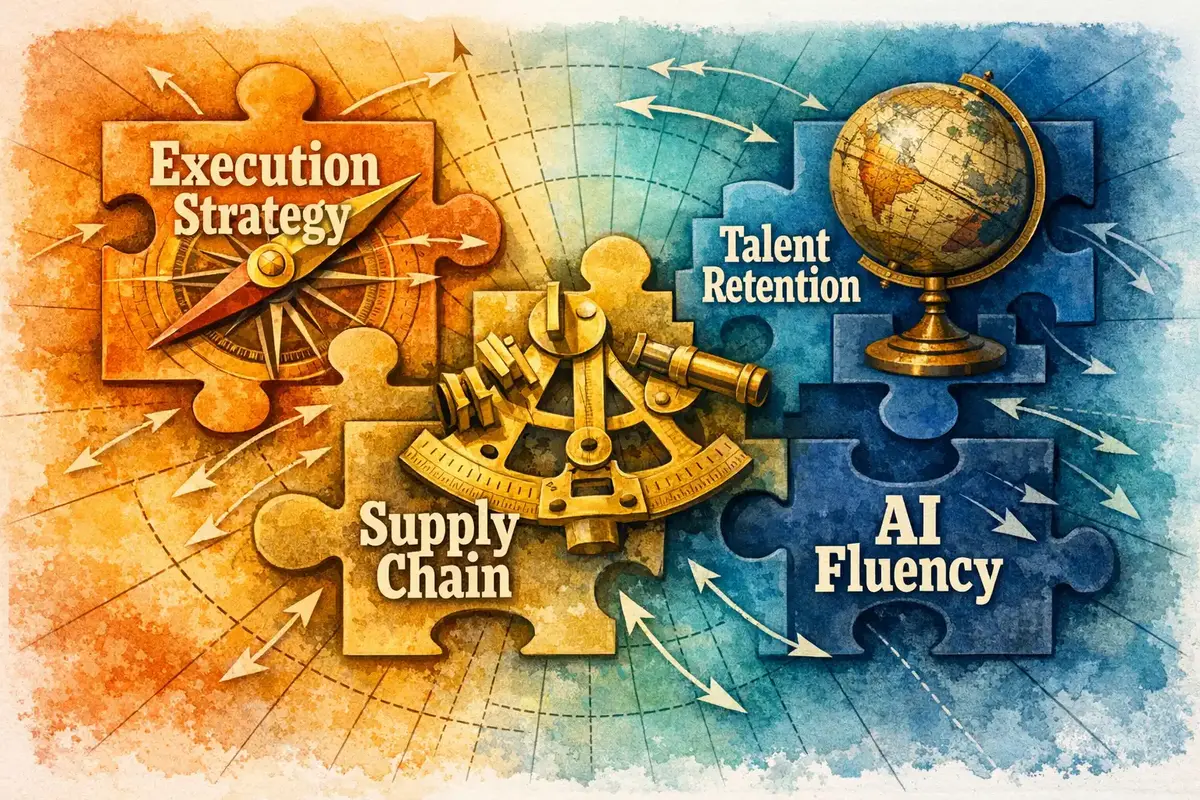
The fourth layer is continuous improvement as a leadership discipline, not a workshop method. That means building forums where weak signals surface early, teams learn across boundaries, and operating friction becomes usable information rather than political noise. This is where continuous improvement stops being a process program and becomes part of how the organization thinks.
Why maturity changes the outcome
A regional retail COO in a budget cycle can have all the right dashboards and still fail. In one familiar pattern, store operations wants labor flexibility, finance wants tighter controls, and supply chain wants forecast stability before a peak season. The issue is not missing data. The issue is whether the COO can force clear choices, delegate cleanly, and create enough trust that bad news travels fast.
That is why leadership maturity belongs inside the capability stack. Gallup shows manager engagement fell from 27% to 22% between 2024 and 2025, which should worry any company expecting middle management to carry transformation (Gallup, 2025). And with only 20% of employees worldwide engaged in 2025, the operating environment is already telling you that process discipline alone is not enough (Gallup, 2025).
Only 20% of employees worldwide were engaged in 2025 (Gallup, 2025)
The best COO development models connect operational excellence with culture, collaboration, and learning. The weak ones split them apart—operations in one lane, leadership in another.
That split is expensive. If the capability stack is clear, the harder question follows: why do so many COO development efforts still produce polished leaders with fragile operating range—design flaw, or organizational habit?
Why Do COO Development Programs Break Down in Real Organizations?
What if most COO development programs fail because they teach the visible part of the job too well? That matters because the breakdown rarely shows up in the classroom. It shows up later—inside a budget review, a restructuring, or a delayed launch—when the COO has to hold alignment across competing priorities without burning out the system.
The usual design flaw is simple. Companies train for technical operations and assume the rest will follow.
The hidden work most programs barely touch
A regional financial services firm offers a familiar example. The COO is leading a platform migration, a cost program, a control remediation effort, and a sales-process redesign at the same time. None of those initiatives is irrational on its own. The strain comes from the overlap: the same directors are in multiple steering meetings, frontline managers are translating shifting priorities to tired teams, and every function believes its work is the urgent one.
In that environment, the COO does not fail for lack of operational knowledge. The failure point is more basic and more demanding: can they create clarity when the organization hears four messages at once, enforce delegation without creating ambiguity, and give feedback that sharpens execution rather than spreading defensiveness?
That is why many programs disappoint. They build confidence in process tools, dashboards, and transformation methods, but underinvest in the relational disciplines that make those tools usable under pressure. Real cross-functional leadership is not a soft add-on. It is the mechanism that keeps decisions moving when incentives diverge.
Change saturation turns good programs into weak ones
McKinsey notes that employees now move through a constant stream of planned change rather than occasional transformation waves (McKinsey, 2024). That distinction matters. A COO is no longer leading one initiative against a stable backdrop. They are leading one change inside many others.
Organizations are not struggling with isolated transformation. They are struggling with accumulated transformation load (McKinsey, 2024).
This is where development programs often misread the problem. They treat capability as knowledge transfer—teach the model, practice the framework, certify the leader. But repeated change cycles expose a different test: whether the COO can sustain a consistent operating message across forums, keep trade-offs explicit, and stop local workarounds from becoming the real strategy.
That is a harder standard. And it raises the next question: when organizations compare development options, are they buying insight—or buying the ability to hold execution together when the system is already tired?
How Should Organizations Evaluate COO Development Options?
A COO development decision usually gets made in a familiar moment: the board wants faster execution, the CEO wants a stronger second-in-command, and HR is comparing polished programs that all sound credible. The risk is choosing the option that presents well rather than the one that changes how the business runs.
That mistake is easier to make now because the operating context is moving so fast. 87% of COOs are ramping up digitization and scenario planning, which means development has to prepare leaders for shifting assumptions, not stable playbooks (PwC, 2025). If the environment is changing this quickly, the right evaluation question is not “Which provider has the strongest brand?” It is “Which approach improves execution when conditions turn against us?”
Judge the option by what it changes under pressure
Start with operational impact. A strong program should make three things better: how quickly decisions get made, how cleanly functions coordinate, and how well leaders hold judgment when trade-offs are messy. If a provider cannot explain how its work improves those outcomes, you are not evaluating development. You are evaluating presentation quality.
A practical test helps. In a mid-market technology company during a quarterly review, the COO is trying to stabilize delivery delays while product, sales, and customer success each defend different priorities. The useful development option is the one that helps that COO clarify decision rights, reduce escalation loops, and keep teams aligned when the pressure rises. That is the real standard for technology adoption, not whether participants liked the workshop.
Compare architecture, not just reputation
The next filter is program architecture. Does the design connect live business issues to coaching, reflection, and operating practice—or does it separate leadership from the work itself? Good COO development is integrated. It links enterprise judgment, delegation, resilience, and alignment to the actual demands of scaling operations.
Then look at practical relevance and leadership depth together. PwC reports that 46% of COOs say talent retention and skill shortages are a top-three barrier to executing strategy (PwC, 2025). That should immediately raise the bar. Any option focused only on process rigor, without building the human disciplines that keep managers clear and teams steady, is incomplete.
Ask for evidence that survives volatility
The strongest providers can show evidence of outcomes in business terms: fewer escalations, faster cross-functional decisions, stronger succession readiness, better execution consistency. They should also show adaptability. PwC found that 85% of COOs see tariffs as a structural shift in global trade, not a temporary disruption (PwC, 2025).
85% of COOs say tariffs represent a structural shift in global trade, not a temporary disruption (PwC, 2025)
That matters because development should expand operating range, not just sharpen performance in one stable context. The real question is blunt: are you buying a prestigious program—or a stronger operating system? And if the difference only becomes visible during strain, what does effective COO development actually look like when it is built well?
What Does Effective COO Development Look Like in Practice?
Bad COO development shows up in the income statement before it shows up in any talent review. Revenue slips through delayed decisions, trust erodes when functions hear different priorities, and strong operators leave when the system keeps asking for heroics instead of clarity.
Why do some development efforts change behavior while others only improve vocabulary? Because effective COO development is built inside the work, not beside it.
Development has to live in the operating cadence
In a regional healthcare system during a service redesign, the COO is not learning in a classroom. She is deciding how to sequence staffing changes, process handoffs, and technology fixes while clinical leaders, finance, and IT all push on different timelines. That is where development becomes real: in crisis response, in process redesign, and in the messy middle of cross-functional execution.
The practical question is not whether the COO understands frameworks. It is whether they can use crisis management discipline to steady the organization while redesigning how work actually moves. The strongest programs put live operating issues at the center, then coach against decision quality, escalation patterns, and coordination failures as they happen.
That design fits the succession reality. Most companies want to grow leaders from within, and most COOs come from inside the business, which means development has to convert familiarity with the company into broader enterprise judgment rather than assuming promotion will do that work by itself (DDI, 2025) (Spencer Stuart, 2025).
The method is iterative, not event-based
Useful COO development follows a harder rhythm: diagnose the gap, test a new operating habit, review the result, repeat. One cycle might focus on cleaner decision rights. Another on how the COO runs a tense weekly forum. Another on whether lean methodologies are being used as tools for learning rather than as compliance rituals.
This is where systems thinking and people leadership stop being separate tracks. A COO has to see the interdependencies — incentives, bottlenecks, timing, governance — and still mobilize people through uncertainty without flooding the organization with noise.
The evidence is visible fast: fewer side conversations, sharper trade-offs, better follow-through. The harder question is what happens when that discipline becomes the company’s normal rhythm — does it create a durable advantage, or does it still depend on one unusually capable executive?
The COO Advantage Is Built in the Operating Rhythm, Not the Title
Only 20% of employees worldwide were engaged in 2025. For any CEO or board expecting the COO to turn strategy into repeatable behavior, that number should change the conversation immediately (Gallup, 2025).
Most organizations still act as if COO development is about preparing one executive for a bigger seat. The evidence points somewhere else. If the COO role sits where execution, culture, and resilience meet, then development is not mainly about personal readiness. It is about whether that leader can shape an environment where people make better decisions, surface problems earlier, and keep improving when conditions get rough.
The role is bigger than execution alone
Gallup’s finding that managers account for 70% of the variance in their team’s engagement is useful here because it explains why operational resilience is never just a process question (Gallup, 2024). A COO can redesign governance, tighten metrics, and run cleaner reviews. But if the management layer beneath them is confused, cautious, or disengaged, the operating model will still fail under pressure.
Managers account for 70% of the variance in their team’s engagement (Gallup, 2024)
You can see this in a large services company during a team restructure. The COO has the right cost logic, the right reporting lines, and a sensible timeline. Yet six weeks in, directors are escalating routine decisions, middle managers are waiting for permission, and frontline teams are hearing three different versions of the plan. The issue is no longer org design. It is whether the COO has built an operating rhythm that creates clarity and trust at the same time.
That is the real advantage. Not the title. Not the résumé.
Continuous improvement is a leadership habit
Strong organizations treat continuous improvement as a leadership behavior embedded in weekly forums, post-mortems, staffing discussions, and cross-functional reviews. Weak ones turn it into a side program — useful language, little carry-through.
The distinction matters because resilience is cumulative. It grows when leaders make it normal to question assumptions, fix handoff failures quickly, and learn across boundaries without waiting for a formal transformation effort. In that kind of system, the COO is not the hero solving every problem. The COO is the architect of how the organization learns.
That is also the only test that really counts after any program ends. Did the leader gain insight, or did the business gain a stronger way of operating?
If this article has argued for anything, it is this: COO development is the work of building a leadership operating system. The honest next step is to look at your own cadence — your reviews, escalations, decision rights, and management habits — and ask a blunt question: is your COO development producing a more capable executive, or a company that can keep getting better without one person carrying it all?
Key Takeaways
- COO development is now an execution risk issue because capability gaps directly affect coordination, speed, and resilience.
- The modern COO must connect systems, not just run functions, and translate strategy into enterprise-wide operating rhythm.
- Strong COO development builds a capability stack that includes execution strategy, supply chain optimization, process innovation, continuous improvement, and leadership maturity.
- Effective programs are embedded in live operating work and judged by outcomes that hold up under volatility.
Frequently Asked Questions
Why is COO development considered an execution risk issue rather than just a training topic?
COO development affects how quickly an organization can coordinate decisions, adapt to disruption, and keep strategy moving through the business. When capability gaps slow hiring, delay digital work, or weaken cross-functional alignment, they directly increase execution risk.
What capabilities does a modern COO need beyond traditional operational management?
A modern COO needs enterprise integration skills: turning strategy into operating rhythm, balancing trade-offs across functions, and aligning technology, workforce, and supply chain realities. Strong process control is still important, but it is no longer enough on its own.
What is the most useful capability stack for evaluating COO readiness?
A strong COO capability stack includes execution strategy, supply chain optimization, process innovation, continuous improvement, and leadership maturity. Together, these capabilities help a COO make decisions, coordinate teams, and redesign work under pressure.
Why do many COO development programs fail in practice?
Many programs focus too heavily on technical operations and not enough on the relational and judgment-based work that makes execution possible. They often underbuild clarity, delegation, feedback, and cross-functional leadership, which are essential when the organization is under strain.
What does effective COO development look like in a real organization?
Effective COO development is embedded in live operating work, such as crisis response, process redesign, and cross-functional decision-making. It uses iterative feedback, real business problems, and measurable outcomes like faster decisions, fewer escalations, and better coordination.