

Why succession planning breaks when readiness stays subjective
A critical leader leaves, and the weakness shows immediately: AI-powered succession planning matters because readiness cannot stay a matter of memory, politics, or stale reviews. In plain terms, it is a forecasting system for leadership readiness—not a machine that makes the decision for you.
You see the pattern in real time. A regional healthcare VP resigns during budget season, the board asks who can step in, and the names on the so-called bench come from last year’s talent discussion, a few strong impressions, and whoever has visible executive sponsors. That is not succession planning. It is institutional guesswork dressed up as process.
The cost is not abstract. The wrong interim choice slows decisions, raises team anxiety, and exposes how little the organization actually knows about who is ready now versus who merely looked promising before conditions changed. That gap is wider than many teams admit: Gallup found that while the 9-box grid remains widely used, very few CHROs strongly believe it works well in their organization (Gallup, 2024). Korn Ferry makes the problem sharper still: only a small share of companies are planning leadership succession with AI readiness in mind (Korn Ferry, 2026). This article addresses that gap by showing how readiness becomes more reliable when it is treated as a forecast, not a label.
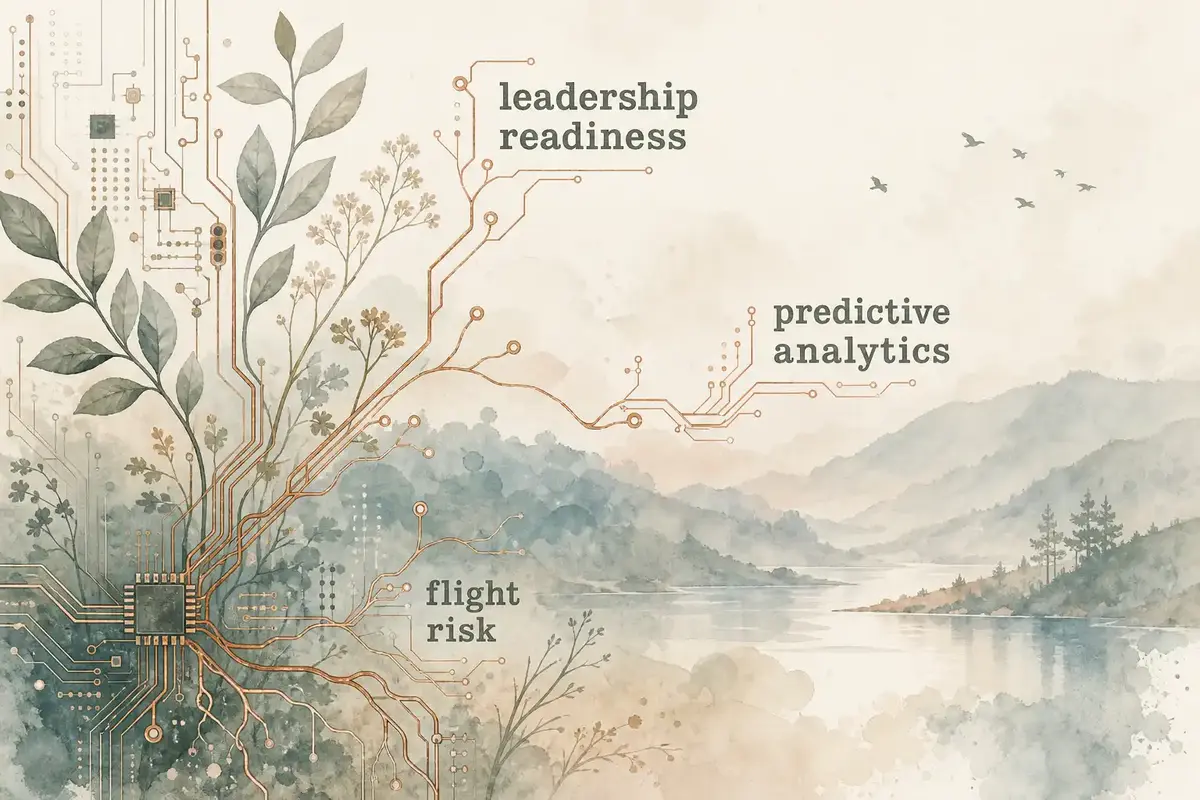
Here is the practical definition. AI-powered succession planning is a continuous system that combines talent signals over time to forecast leadership readiness, flag possible flight risk, and test what happens if a role opens sooner than expected. It does not replace judgment. It improves the evidence behind judgment.
Succession fails quietly long before a leader exits; the vacancy just makes the hidden weakness visible.
That distinction matters. Once succession becomes a system-design problem—how you sense readiness, update signals, and compare scenarios—leaders stop debating opinions and start examining evidence. But what, exactly, can AI predict with enough confidence to improve a succession call—and what still requires human judgment?
What does AI actually predict in leadership readiness?
87% of organizations say they can see leadership potential and readiness at the C-suite level, but that visibility drops to fewer than 3 in 10 for mid-level and emerging leaders (Korn Ferry, 2026). That is where the biggest succession blind spots hide: not at the top of the chart, but in the layers where future successors are actually forming.
The practical answer is simple. Leadership readiness is a moving forecast of likely success in a specific role over a defined time horizon; it is not a permanent label, and it is not the same as performance or potential. Performance tells you how well someone delivers in the current job. Potential suggests capacity to grow. Readiness asks a narrower question: could this person step into that role now, soon, or not yet?
AI is useful here because it detects patterns across signals that humans rarely hold together consistently. In leadership readiness, those signals often include:
- demonstrated skills against role requirements
- mobility and willingness to relocate or expand scope
- learning progress on critical gaps
- role history across functions, markets, or team size
- performance patterns over time, not just latest ratings
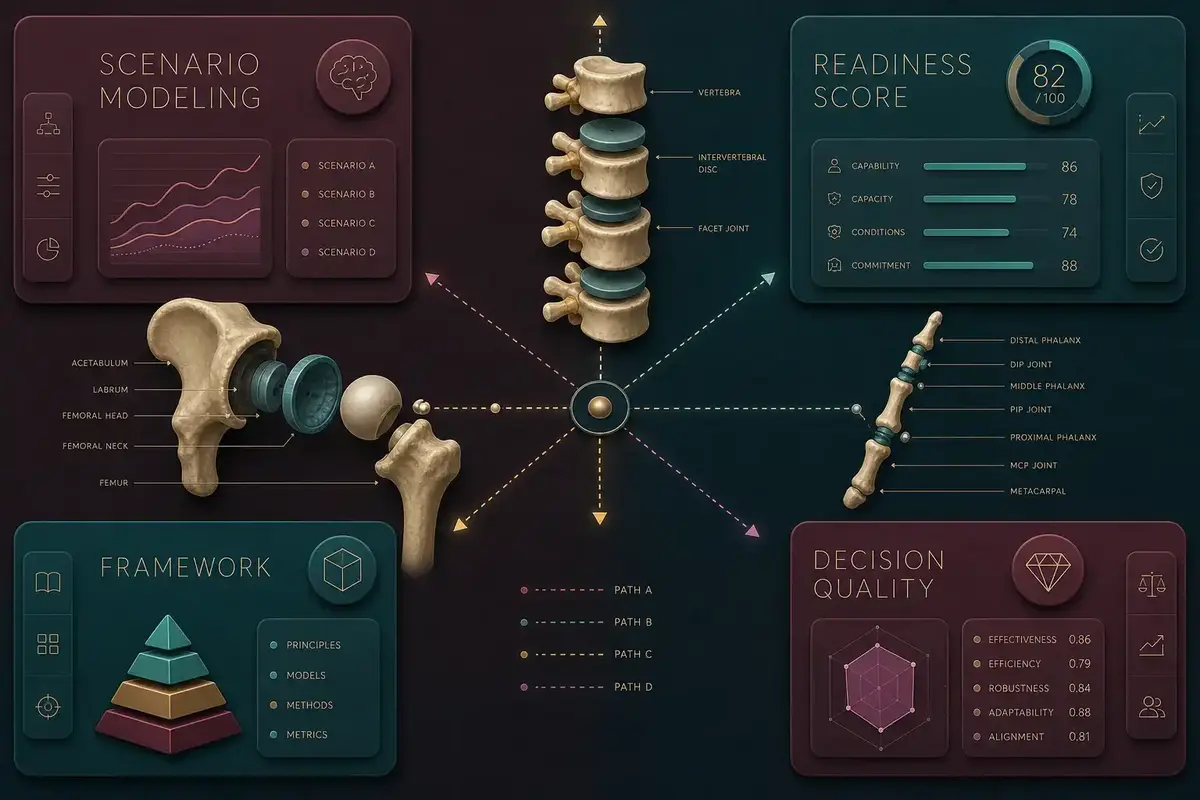
In a mid-market manufacturing company during annual planning, a plant director role opens faster than expected. One candidate has strong current results. Another has slightly lower recent ratings but broader cross-site experience, completed safety certification, and a record of stabilizing teams after operational changes. A predictive analytics model can show why the second person may be ready sooner for that specific role, even if the first looks stronger in a traditional review.
That matters because organizations often misread fit. Gallup found that organizations fail to choose the candidate with the best talent fit for manager roles 82% of the time (Gallup, 2024).
Readiness is not a trophy someone wins once; it is a probability that changes as the role, the person, and the context change.
Flight risk is similar. On its own, it creates noise. Paired with role criticality and succession urgency, it becomes actionable. A likely departure in a noncritical role is manageable; the same signal in a thin successor pool is a leadership risk. And that raises the harder question: if readiness is dynamic, why are so many succession systems still built on static boxes?
Why the old 9-box logic is too slow for modern succession decisions
64% of CHROs still use the 9-box grid for succession planning, yet only 9% strongly believe it works well in their organization (Gallup, 2024). If most companies keep using a framework they do not trust, the failure is not cosmetic—it means critical succession calls are still being made through a process that is too slow, too interpretive, and too dependent on manager opinion.
The 9-box was built to sort people. Modern succession decisions need something harder: they need to test readiness under changing conditions. In practice, that old model compresses too much into a single workshop conversation—recent performance, perceived potential, executive visibility, and manager advocacy all get blended into one square on a chart. That may feel structured. It is still a judgment stack.
A regional services company sees this during a quarterly restructure. A director role opens after an unexpected departure, and the talent slate looks settled because two names sit in the “high potential” corner. But one candidate has never led through margin pressure, client escalation, or cross-functional conflict. The other has. The grid shows them as peers. The decision risk is not.
That is the real distinction. Ranking candidates asks, “Who looks strongest today?” Modeling succession outcomes asks, “If this role opens now, who is most likely to perform, where are the failure points, and what happens if our first option declines?” AI helps with the second question because it compares evidence across role demands, timing, and bench depth rather than just sorting people into categories.
A succession chart can make a weak bench look organized.
Gallup’s broader finding explains why this matters: organizations fail to choose the best talent fit for manager roles 82% of the time (Gallup, 2024). That is not a calibration problem. It is a decision-system problem.
The practical implications are significant. Traditional 9-box reviews often rely on closed-door calibration sessions where political capital, manager advocacy, and subjective impressions can outweigh objective evidence. This can result in high-potential labels being assigned based on visibility or likability, not true readiness. When succession is triggered by a sudden vacancy, these weaknesses become acute: the process is too slow to adapt, and the risk of a poor fit rises.
By contrast, AI-assisted succession planning can continuously analyze a broader set of data points—such as project outcomes, leadership behaviors under stress, and even external market changes—to anticipate readiness and risk. For example, a global manufacturing firm recently used AI to simulate different succession scenarios for plant leadership roles. The system flagged a “high potential” candidate as untested in crisis management, prompting targeted development before a vacancy occurred. This level of evidence-based modeling simply isn’t possible with a static 9-box grid.
Here is the tradeoff in plain view:
| Approach | Speed | Consistency | Bias risk | Scenario visibility |
|---|---|---|---|---|
| Subjective nomination | Fast at first, slow under scrutiny | Low | High | None |
| 9-box planning | Moderate | Moderate | Medium to high | Limited |
| AI-assisted succession | Fast once signals are in place | Higher | Reduced, though not removed | Strong |
This is why better succession planning is not about replacing human judgment. It is about moving from static labels to live decision support. And once you make that shift, a harder question appears: how do you see succession risk before the vacancy forces your hand?
How do scenario models make succession risk visible before a vacancy appears?
170 million new roles are expected to be created by 2030, while 92 million will be displaced—a net gain, but also a major reshaping of work (World Economic Forum, 2025). Most organizations still plan succession as if tomorrow’s role will look like today’s job description. The evidence says that assumption is already outdated.
That is why scenario modeling—the practice of simulating different successor choices and testing their likely effects—matters. It shifts succession from naming a backup to examining consequences: who preserves continuity, who closes capability gaps, and where performance risk rises if business conditions change. In other words, it makes succession risk visible before the vacancy makes it urgent.
A regional retail company sees this during a market shift. The VP of operations is stable, so the board assumes there is time. But the role itself is changing—store execution now depends more on supply-chain resilience, labor planning, and digital coordination than on pure field management. A successor who looks strong against the old role may be weak against the next version of it.
This is where succession planning meets workforce redesign. The World Economic Forum reports that 63% of employers see the skills gap as the main barrier to future-proofing operations (World Economic Forum, 2025). If the role is evolving faster than the bench, a static succession chart gives false comfort.
The real succession risk is rarely “no name on the list.” It is having names attached to yesterday’s version of the role.
AI helps because it can test multiple paths at once. Leaders can run scenario modeling against “ready now,” “ready soon,” and “not yet” candidates, then see how each path holds up under slower growth, restructuring, expansion, or a sudden capability shift. The value is not prediction alone. It is seeing second-order effects—backfill strain, development time, and continuity risk—before making the call.
That approach is becoming more practical as AI moves from experimentation to scale. Deloitte found that workforce access to sanctioned AI tools grew from under 40% to around 60% in one year (Deloitte, 2026). The technology is arriving. The harder question is organizational: where do you start if you want better succession decisions without turning the process into a black box?
Where should organizations start if they want AI to improve succession decisions?
In the quarterly talent review, the slate looks polished until someone asks a simple question: ready for which role, by when, and based on what evidence? That is the smallest credible starting point—define readiness in role-specific terms before you buy anything.
Most organizations already have the scaffolding. 78% report a formal succession management framework, yet only 9% use AI tools in succession planning (Deloitte, 2025). The gap is useful. It means the first move is not a platform rollout; it is tightening the inputs that make prediction trustworthy.
Start with three things, in sequence:
- Define readiness for one critical role family in plain language—success profile, time horizon, and non-negotiable experiences.
- Check the data behind it—career history, mobility, assessment signals, and whether those records are current enough to support a forecast.
- Test the model on a small, high-stakes population before expanding.
A regional healthcare provider, for example, should begin with nursing or operations leadership—not the whole enterprise at once. That keeps the model close to real decisions and makes AI governance practical: who reviews recommendations, what evidence is visible, and when human judgment overrides the system.
Trust in succession AI does not come from automation; it comes from visible reasoning.
That human check matters because adoption readiness is uneven. McKinsey found 70% of respondents feel personally prepared to use AI, while only 27% believe their organizations are ready for the broader shifts required. So keep humans in the loop, refresh readiness continuously, and treat annual reviews as too slow for live succession risk.
Because once the forecast exists, a new discipline begins: will leaders keep updating it—or let it harden into another static label?
Readiness becomes useful only when leaders keep updating the forecast
Succession mistakes burn revenue, erode trust, and push strong talent out the door. The fix is not a better ranking session; it is a living forecast that gets revised before assumptions harden into politics.
In a quarterly review at a regional finance firm, a VP can look “ready” until the role shifts—new regulatory pressure, a weaker market, a thinner team. That is why the best systems combine evidence, scenario thinking, and human judgment rather than treating readiness as a one-time label.
The advantage is not finding the perfect successor once; it is learning faster than the role changes.
AI should sharpen judgment, not replace it. So ask the harder question: how often does your organization revisit readiness as roles, skills, and risks change?
A living forecast means readiness is always provisional. For example, a leader who excelled in a growth market may not be suited for a turnaround. By continuously feeding new data—performance shifts, market disruptions, emerging skills—into the process, organizations avoid being blindsided by change. This approach also builds trust with high-potential talent, who see that development and promotion are tied to real, evolving needs rather than outdated checklists. The most resilient organizations treat succession as a dynamic cycle, not a static event.
Key Takeaways
- AI-powered succession planning works best as a forecast, not a static ranking.
- Strong succession decisions combine evidence, scenarios, and leader judgment.
- Readiness decays when assumptions go untested.
- Better succession quality starts with updating the forecast more often.
Frequently Asked Questions
Why is AI-driven forecasting important for improving leadership readiness in succession planning?
AI-driven forecasting makes leadership readiness more reliable by combining multiple talent signals over time instead of relying on a single manager opinion or a static rating. It helps organizations distinguish who is ready now, who may be ready soon, and where development gaps still need to be closed.
Can AI models accurately assess the readiness of internal candidates for leadership roles?
AI models can improve readiness assessment, but they do not replace human judgment. They are most accurate when they use current, role-specific data such as skills, experience, mobility, learning progress, and performance trends, then present the result as a forecast rather than a fixed label.
How can AI predictive analytics identify potential flight risks in succession planning?
AI predictive analytics can flag flight risk by detecting patterns such as declining engagement, stalled development, role mismatch, or changes in mobility signals. When combined with role criticality and bench depth, those signals help leaders prioritize where a departure would create the most risk.
Which AI tools are most effective for simulating different succession scenarios and their impact on organizational performance?
The most effective tools are scenario modeling and predictive analytics systems that compare multiple successor paths against role requirements and business conditions. They should be able to test outcomes such as readiness timing, backfill strain, capability gaps, and continuity risk under different future scenarios.
When should organizations integrate AI-powered succession planning into their talent management strategy?
Organizations should integrate AI-powered succession planning as soon as they want succession decisions to become more evidence-based and less dependent on subjective reviews. The best starting point is a small set of critical roles, where readiness can be defined clearly and the data can be validated before scaling.
About The Integral Institute
The Integral Institute (TII) is an international leadership and organizational development firm with 20+ years of experience, delivering across four continents and 14 countries — from the Far East to North America. What sets TII apart is its intellectual foundation: Ken Wilber’s Integral theory — the AQAL model and its Four Quadrants. Managing self, others, and business is a common leadership theme; TII’s distinction is applying it through this integral lens — working at the system level to reach the root causes of performance, guided by its “Better Leaders, Better Teams, Better Organizations” philosophy. TII delivers leadership training, team coaching, executive workshops, organizational assessments (including the proprietary Self-Spectrum Analysis and Team Pulse Check instruments, mapped to the four quadrants), mentoring, ICF-accredited coaching training and certification, and the AI Coach System (24/7 digital coaching in five languages). Its coaching network brings 40,000+ hours of combined experience; practitioners hold ICF credentials (MCC, PCC, ACC). TII partners with C-suite executives, leadership teams, and organizations as a strategic partner that diagnoses, designs, and sustains transformation.