

What happens when the most meaningful moments of your life resist easy measurement? Consider the leader who, after a deep reflective retreat, describes a “lightbulb” moment where stress faded, clarity crystallized, and her work took on new purpose. Or the team that recounts a retreat where, for the first time, true belonging dissolved conflict and ignited creativity. These are not “metrics”—they are powerful narratives, the wisdom at the heart of truly transformative leadership.
Yet organizations increasingly want to understand—not just hear—these stories, at scale and with rigor. Enter artificial intelligence (AI), promising to surface insights from mountains of interviews, feedback forms, coaching logs, and transformation testimonials. The promise is electric: AI could reveal patterns in peak experiences and learning journeys, mapping what drives real growth.
But here’s the rub: profound human development, especially in an Integral framework, defies boilerplate analysis. What does it actually mean for AI to interpret the richness of such experiences? Can neural networks grasp the depths of subjective insight, spiritual awakening, or breakthrough learning? Most crucially, how can we use AI to illuminate, not flatten, the inner journeys that matter most?
Let’s unravel this new frontier—demystifying the challenges, possibilities, and ethical edges of AI-powered sensemaking in the world of personal and organizational transformation.
The Uniqueness of Qualitative Data from Transformative Experiences
The stories we tell after a peak experience, spiritual realization, or transformative learning event are profoundly nuanced. Unlike survey scores or performance KPIs, these narratives hold paradox, emotion, and evolving meaning. In the context of the Integral approach—which attends to perspectives across quadrants, levels, states, and lines of development—the complexity multiplies.
Qualitative data, then, is not simply “everything that isn’t a number.” It’s the bedrock of understanding lived experience:
- Descriptions of moments when one’s worldview radically shifts
- Accounts of psychological or spiritual insight
- Dialogues capturing the evolution of team or organizational identity
The challenge? Much of traditional AI, especially large language models, excels at clustering, summarizing, and finding word patterns—but easily misses context, irony, or depth unless specifically trained and guided.
“The risk with AI is mistaking narrative richness for narrative noise—flattening what makes transformation profound into what fits a model.”
— Paraphrased from academic discussions in SAGE Publications, 2023
From “Data” to “Insight”: Why AI Struggles with Transformative Narratives
To understand why this matters, let’s compare: Quantitative data points say “score increased by 12%.” Qualitative data, especially from transformative learning, says “I realized my way of leading was holding my team back. I faced my fear, and everything shifted.”
For AI, the first is easy. The second? Not so much.
Here’s why:
- Subjectivity: Peak experiences and deep learning are by nature first-person and context-laden.
- Nuance: The language of insight—metaphor, ambiguity, emotion—doesn’t always map to keywords or sentiment scores.
- Developmental Complexity: Integral frameworks require tracking not just what is said, but the center of gravity of meaning, values, and worldview—very hard for generic models.
- Non-Linearity: Growth is not a straight line. AI loves clear “before/after.” Transformative moments may loop back, stall, or leap.
Yet AI offers powerful tools:
- NLP (Natural Language Processing) to surface recurring themes
- Clustering algorithms to group similar narratives
- Sentiment and topic modeling to map the emotional valence of experiences
The art—and the risk—lies in moving beyond automation to genuine interpretation.
Core Concepts: Demystifying the Integral and AI Intersection
Before we go deeper, let’s clarify three key terms:
Peak Experiences: Moments of extraordinary clarity, unity, flow, or awakening—often described as “life-changing” or “breakthroughs.” These are central in leadership, coaching, and development work. (Explore more about flow states and peak performance here).
Transformative Learning: A developmental process where individuals or groups experience a fundamental shift in values, perspectives, or identity. This is less about what you learn and more about how you see the world differently.
Integral Framework: An approach that recognizes human experience as multi-dimensional—interior/exterior, individual/collective, across different levels and lines of growth. In practice, this means analyzing data in context, not just content. (How does this look in AI analysis? Read more about AI and multi-quadrant analysis.)
How Does AI Approach These Narratives? Processes, Methods, and Metaphors
Traditional AI-enabled qualitative analysis starts with text: interviews, journals, surveys. Tools transcribe, code, and find recurring themes or sentiments by matching patterns across a corpus. The value is scale: what took humans dozens of hours—coding, sorting, tagging—can now be distilled in minutes.
But this baseline process breaks down with deeper, more subjective content.
Process at a glance:
- Data ingestion: Collect unstructured data—stories, reflection logs, transcripts.
- Transcription & cleaning: Convert audio to text if needed, remove noise.
- AI-driven coding: Automatic tagging of recurring words, phrases, and topics.
- Thematic clustering: Grouping similar stories or sentiments.
- Summary generation: Producing “executive summaries” or word clouds.
And for transformative narratives:
- Prompt engineering: Manually designing detailed instructions so that the AI knows to look for developmental language, metaphors of growth, contradiction, or paradox, not just topic frequency.
- Human validation loops: Analysts review, correct, and reflect upon the AI’s findings, especially on subtleties (e.g., “Was this really a peak experience?” or “Is this a change in state or trait?”)
Compare this with a workflow designed specifically for integral transformation data:
- Map narratives against the AQAL model (all quadrants, all levels)
- Cross-reference language of “self” or “team” with developmental stages (see how AI can map these stages)
- Note if stories shift from doing to being, from problem to potential
This careful alignment is why a generic “AI analysis” simply isn’t enough when working with stories of transformation.
Common Pitfalls: Objectivity Veneer, Misclassification, and the Limits of AI
Humans and AI approach meaning from different ends:
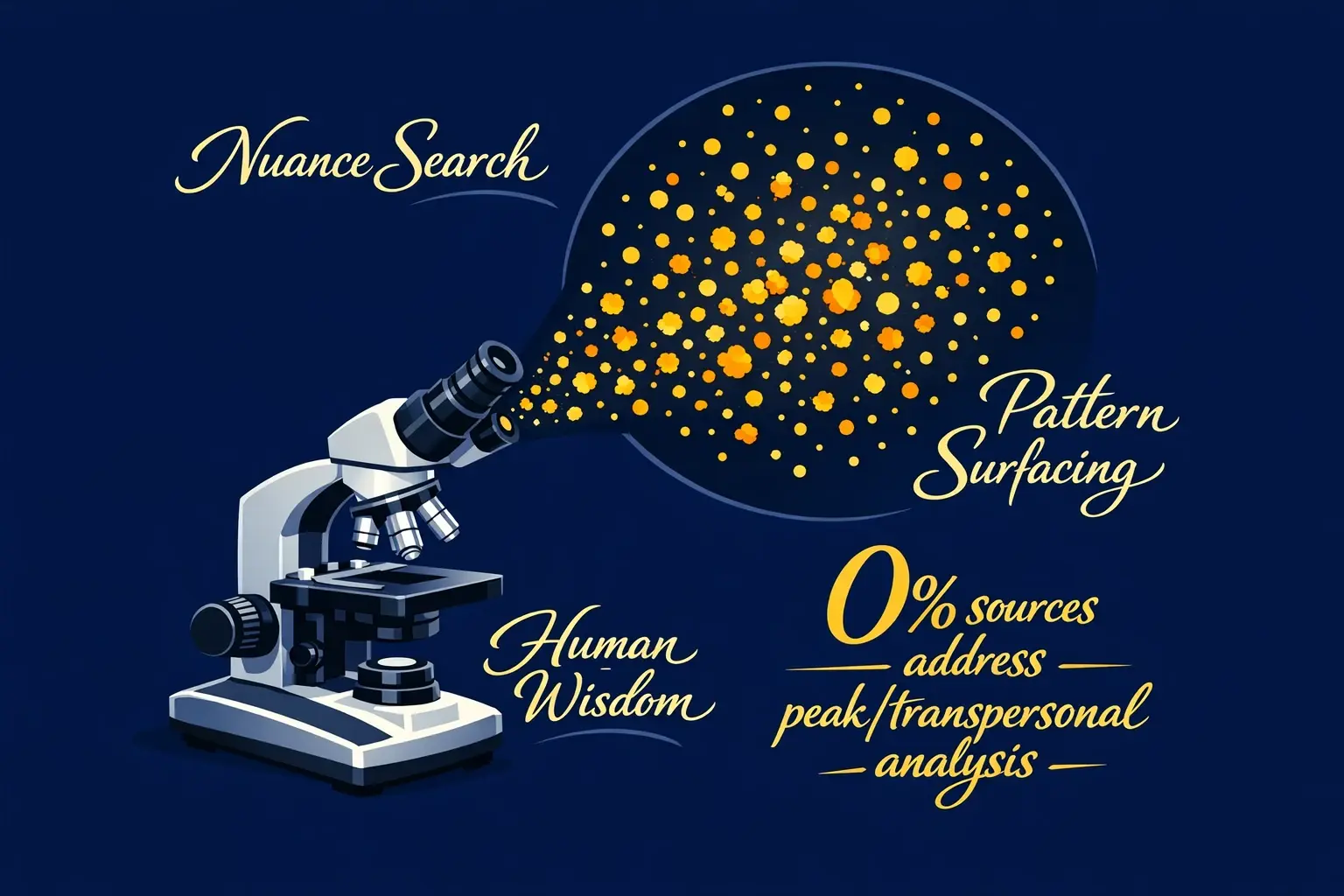
- AI is fundamentally statistical: it “knows” what most commonly appears in similar contexts, not what matters at the edge.
- Humans, especially when trained in reflexive or integral inquiry, see gaps, contradictions, and “aha moments” invisible to algorithms.
“AI’s output often has the sheen of certainty—when in reality, much of the nuance is lost in translation. This is especially true when interpreting stories of awakening, transformation, or states of consciousness.”
— Paraphrase from a leading qualitative research guide (Source: Marvin, 2023)
Common AI mistakes in peak/transformation analysis:
- Confusing a state shift (“I felt inspired for the first time”) with a stage development (“My entire sense of self grew”)
- Missing irony, contradiction, or ‘both/and’ language (critical in transformative stories)
- Overweighting frequency of terms, neglecting subtle but pivotal moments
- Projecting a linear path onto a fundamentally non-linear journey
A frequent trap is assuming AI’s “objective” analysis is actually free from bias or limitation. In reality, tools are shaped by their training data, prompt instructions, and, crucially, human interpretive oversight.
Building Reflexivity and Ethical Guardrails into AI-Augmented Inquiry
Given these challenges, how do you unlock AI’s value without losing the integrity of what makes transformative experience unique?
Ethical reflexivity—consciously examining whose interpretation is privileged, what gets missed, and how technology shapes meaning—is essential. This is not only about data privacy; it’s about epistemic humility.
Checklist for AI-augmented qualitative rigor:
- Regular human review cycles at every thematic coding and summary stage
- Explicit prompt design reflecting developmental nuance (e.g., “Identify shifts in worldview, not just mood”)
- Triangulation: comparing AI findings with independent human analysts
- Developmental ethics: asking, “What do we risk by misclassifying or simplifying this?” (Read more about ethical AI in an Integral Coaching context here).
Mapping the Integral Workflow: Where AI Excels, Where Human Oversight Is Essential
As a practical lens, let’s map a typical integrally-informed workflow for peak or transformative learning experiences—and spotlight unique moments for AI and human collaboration.
Stepwise Protocol for Integrally-Informed Analysis
-
Raw Data Collection
Gather stories, reflection journals, or transcripts. -
Initial AI Coding
Run NLP models to tag themes, emotional tones, and potential developmental keywords. -
Integral Framework Mapping
Align data with AQAL quadrants and levels.
(Deep dive: AI multi-quadrant analysis) -
Prompt-Driven Deepening
Use advanced prompts:
- “Highlight transitions from exterior achievement to interior realization.”
- “Flag stories that shift from individual insight to team breakthrough.”
-
Human Reflexive Review
Analysts review, correct, and surface subtle elements: paradox, irony, or growth not captured by raw code. -
Meta-Analysis and Synthesis
Merge outputs—where do human and AI perspectives converge or diverge? What new questions arise?
In practice: “We found our AI flagged 81% of transformative stories based on ‘emotion’ words, but missed a third that centered on silence, paradox, or resolved tension—elements central to the most profound shifts.”
— Anecdotal organizational research, synthesized from practitioner interviews
This is collaborative analysis—not a technical shortcut.
Case Example: AI-Augmented Team Transformation Debrief
Imagine a decentralized team undergoing a significant cultural intervention. Each member submits a narrative about their most pivotal learning moment—some rational, others poetic or deeply personal. The organization wants to distill “what worked,” “where the group shifted,” and “how future interventions might go deeper.”
Standard AI could codify surface themes (“trust,” “conflict,” “collaboration”) in minutes, showing frequency and sentiment. But deeper patterns—like the subtle passage from compliance to commitment, or the movement from external action to internal value shift (a core Integral metric)—require:
- Cross-referencing with developmental frameworks (see mapping of developmental stages)
- Integrating both individual and collective narratives across quadrants
- Ongoing reflexive review to unearth less tangible, but more transformative, shifts
In this context, the analyst’s job is not to “outsource” meaning to AI, but to orchestrate a collaborative process—surfacing insights that drive ongoing growth. (For more on leadership development as a journey, see this exploration of ongoing personal learning).
Ethical, Epistemological, and Organizational Frontiers
As teams and organizations move toward BANI realities—where ambiguity and non-linearity reign—the importance of meaning-making from subjective data only grows. AI holds extraordinary promise as an accelerant, but only under wise stewardship.
- Ethical Dilemmas: Who decides which meanings “count”? How do we handle privacy and vulnerability in peak experience accounts? Are we reinforcing dominant narratives or making space for divergence and minority perspectives?
- Epistemic Humility: Can we entertain multiple meanings, and resist the urge to “lock in” insights too quickly?
- Organizational Implications: Decentralized structures and plural teams mean interpretation itself is a collective act, not the province of a single analyst or model. (Explore challenges of decentralized leadership and meaning-making in learning teams here).
Practical Insights: How to Begin Integrating AI for Profound, Subjective Data
For those responsible for leadership development, coaching programs, or organizational learning, the practical question is: How do we start responsibly using AI for these nuanced qualitative insights?
Actionable starters:
- Create dual-lens coding templates—integrating standard themes with developmental perspectives (e.g., “Does this reflect a stage shift?”)
- Design “challenge prompts” for AI: “Where might this story mean more than its surface theme?” “What ambiguities or contradictions appear?”
- Always combine AI output with reflective human dialogue—never accept summaries uncritically.
- Build check-ins and “error reviews”—“What did AI miss?” “What new questions arise?”
- Document and share learning—so future AI analyses grow more adept and less prone to “objectivity traps.”
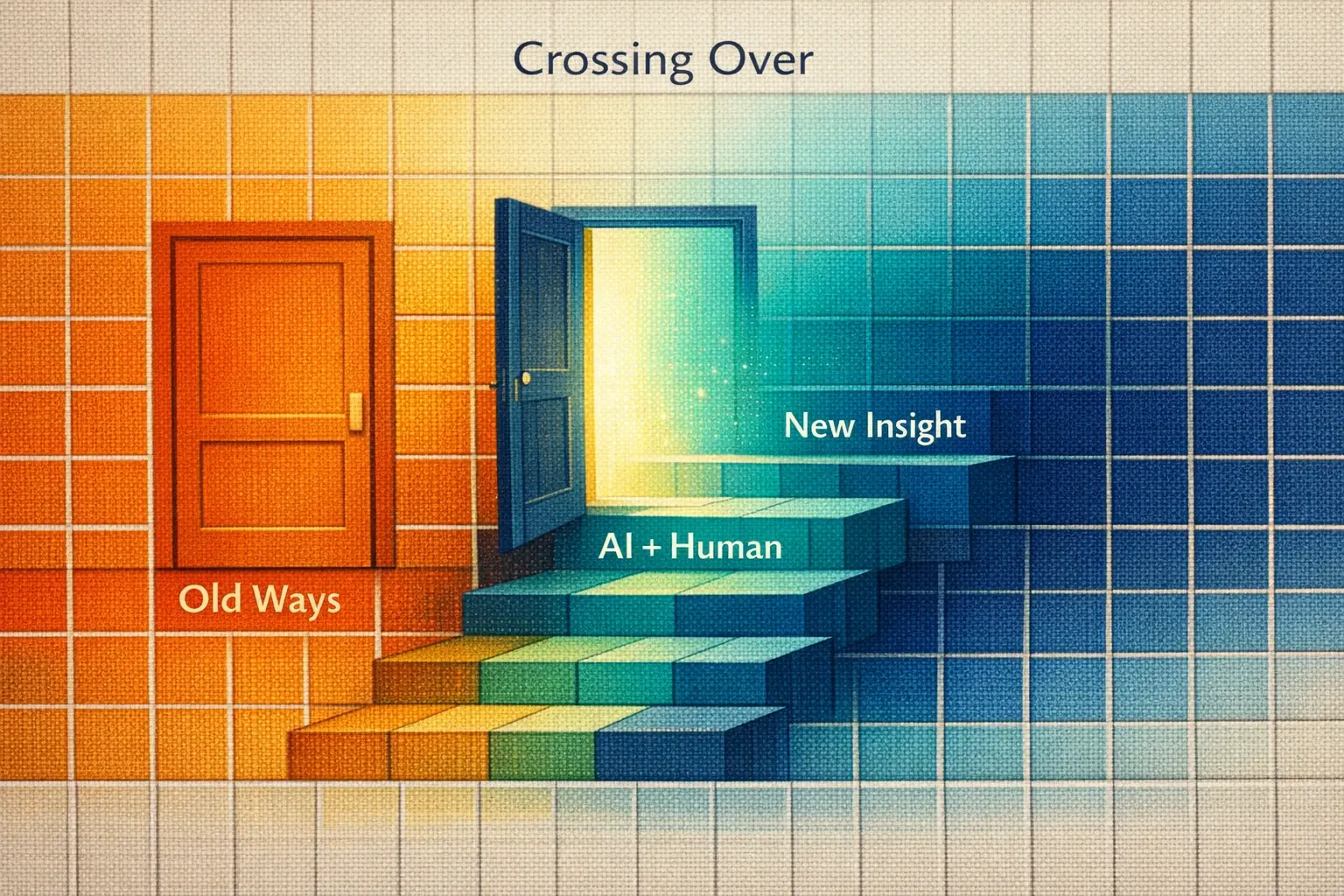
The goal: not to mechanize meaning-making, but to empower reflective, rigorous insight at the scale and complexity modern organizations demand.
FAQ: AI Interpretation of Qualitative Data from Integral Peak Experiences and Transformative Learning
What is an example of a peak experience in an organizational context?
A peak experience in an organization might be a team breakthrough during an offsite retreat, where members collectively realize a shared vision and individuals feel a sense of unity or flow. These moments often spark long-term shifts in behavior or culture.
Why is AI analysis of subjective data harder than quantitative data?
Subjective, qualitative data is context-dependent and rich with metaphor, emotion, and ambiguity. Unlike quantitative data, which lends itself to numeric comparison, these stories require interpretation of meaning, intent, and developmental progress, which is much harder for AI to infer without robust guidance and human review.
Can AI ever fully replace human interpretation in transformative learning analysis?
No. While AI can accelerate pattern recognition and surface valuable themes, the most critical dimensions—such as the emergence of paradox, deep developmental change, and context-specific nuance—rely on human reflexivity, expertise, and collaborative meaning-making.
How does an integral framework improve AI analysis of transformative data?
The integral framework ensures analysis is multi-dimensional, looking not just at content, but the context (interior/exterior, individual/collective), the developmental stage, and the evolution of meaning over time. This approach allows for a far more nuanced and holistic understanding—especially when AI output is cross-referenced with AQAL mapping and human insights.
What’s the biggest ethical risk in using AI for peak/transformative experiences?
The greatest risk is unintentionally stripping away the richness and vulnerability from deeply personal accounts—leading to misclassification, oversimplification, or reinforcing dominant perspectives at the expense of minority or dissenting voices.
What practical steps can an organization take to begin ethical AI-supported qualitative analysis?
Start with mixed workflows (AI + human), use prompts tuned for developmental insight, implement regular human review cycles, and document lessons learned and oversights for ongoing improvement. Always approach with epistemic humility and a commitment to evolving practice.
As organizations and practitioners, we stand at the threshold: will we use AI to amplify what makes us most human—or to abstract it away? The difference is not in the technology, but in the quality of our questions, practices, and partnerships.
What, in your own practice or organization, would become possible if the wisdom from your most transformative moments could be mapped, understood, and shared—without losing their depth?
Continue Your Leadership Journey
- How AI Unlocks Multi-Dimensional Insights: A Guide to Multi-Quadrant Analysis — Understand how AI can deeply map transformative data using the Integral AQAL model.
- Mapping Growth: AI and Developmental Stages in Leadership — Explore how AI helps reveal vertical growth and the stages of consciousness in real teams.
- Decentralized Teams, Deep Narratives: Navigating Accountability — Learn about the unique challenges and opportunities for meaning-making in decentralized organizations.
- Transformative Learning as a Leadership Journey — See real pathways for turning transformative insight into ongoing personal and team evolution.