

Why the GM’s Real Job Is Managing Two Time Horizons at Once
7 in 10 business leaders say their primary competitive strategy for the next three years is speed and agility—but most operating reviews still reward near-term variance control more than future capacity building (Deloitte, 2026). That is the tension a general manager lives inside.
You see it in a familiar scene. It is the last week of the quarter, a regional business unit is slightly behind plan, and the fastest way to close the gap is obvious: freeze hiring, delay training, trim customer-facing experiments, and push discretionary investment into next quarter. The numbers improve. The business often does not.
The GM’s job is not a choice between today and tomorrow
Too many discussions frame this as a moral contest between short-term P&L discipline and long-term strategy. That is the wrong model. The real job is closer to portfolio management under constraint: finite cash, finite management attention, finite organizational energy, all being allocated across initiatives with different payback periods, risk profiles, and strategic value.
That framing matters because it changes the question. Not “Should we protect profit now or invest for later?” but “What mix of cost control, capability building, and market bets preserves earnings power across multiple time horizons?” A GM is not only a quarterly operator. A GM is a time-horizon allocator.
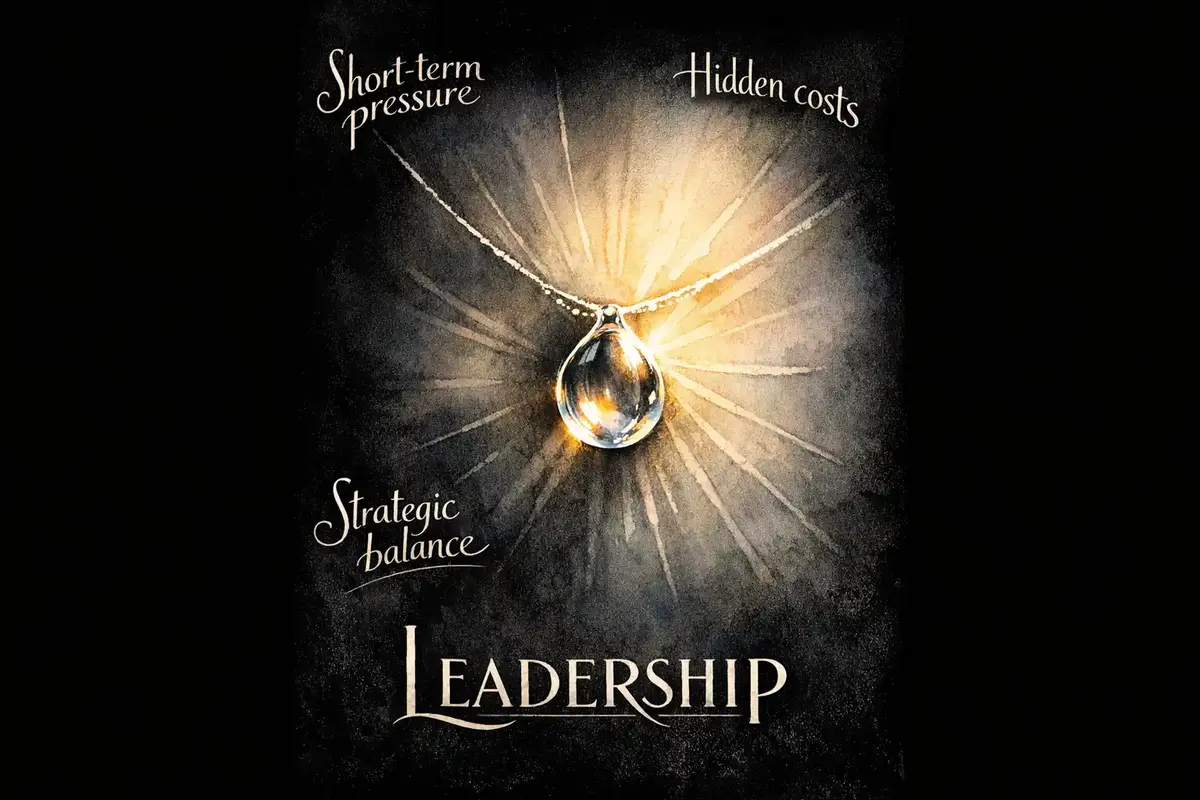
The cost of getting this wrong is usually hidden at first. Global employee engagement fell to 20% in 2025—a signal that many organizations are extracting output without sustaining the conditions that produce future performance (Gallup, 2026). When leaders treat the P&L as the only scoreboard, they do not just cut spend. They redirect attention away from product renewal, starve the bench of promotable talent, and teach high-potential managers that only immediate numbers matter.
Quarterly pressure distorts more than budgets
This is why quarterly pressure is dangerous in subtle ways. Capital gets shifted toward what lands inside the reporting window. Attention gets pulled toward firefighting. Talent gets assigned to rescue work instead of capability building. Over time, the business can look efficient while becoming less adaptable—the exact opposite of what leaders say they need from the enterprise (Deloitte, 2026).
Strong leadership shows up here as allocation judgment, not optimism. The best GMs know some spending is truly waste, some is essential maintenance, and some is the seed corn of future margin. The hard part is that budgeting, strategic planning, and long-range planning often get blurred together—and once they do, every investment starts competing on the wrong clock.
That is where most organizations lose the plot: not in strategy decks, but in the definitions they use to make tradeoffs.
What Is the Difference Between Budgeting, Strategic Planning, and Long-Range Planning?
The planning horizon framework matters here because most operating confusion starts with a basic category error. If budgeting and strategy are not the same thing, why do so many leaders manage them as if they were?
The answer usually hides in process design, not intent. Annual calendars collapse unlike decisions into one season, one set of meetings, one spreadsheet. Then the loudest near-term constraint starts to define every conversation.
Three disciplines, three jobs
Start with plain definitions.
Budgeting decides what the business will spend this year and what performance it must deliver against that spend. It is a control system. It sets limits, assigns accountability, and turns operating assumptions into a financial commitment.
Strategic planning is different. The Association for Financial Professionals defines it as the process of determining an organization’s direction and making decisions on allocating resources to pursue that direction (AFP). In practice, that means deciding where to win: which customers matter most, which markets deserve focus, which value proposition the business will back.
Long-range planning asks a third question: what will it take over several years to make that direction real? Research from the University of Texas Permian Basin describes long-term planning as setting goals that often extend beyond one year and require coordinated financial and operational choices over time (University of Texas Permian Basin). That is not a bigger budget. It is a capability path.
Control, direction, capability-building. Different jobs.
What confusion looks like in the real world
In a mid-market manufacturing company, a division VP enters the annual planning cycle needing to improve service levels and reduce unit cost. The budget review asks for immediate expense reductions. The strategy discussion says the business wants to win on reliability. The long-range requirement is a two-year investment in maintenance systems, supervisor training, and plant scheduling discipline.
If those three conversations get merged, the investment loses. Why? Because a one-year budget is a poor instrument for judging a multi-year capability build. The result is predictable: the team funds only what pays back inside the fiscal year, then acts surprised when the strategic goal remains out of reach.
That is why these disciplines are related but not interchangeable. Budgeting tests affordability. Strategy tests choice. Long-range planning tests feasibility over time.
Short-term planning typically focuses on the coming year, while long-term planning extends several years and supports broader goals (University of Texas Permian Basin).
How a GM should use each horizon
A strong GM uses budgeting to enforce tradeoff discipline, strategic planning to set direction, and long-range planning to sequence the capabilities that direction requires. One horizon asks, Can we afford this now? Another asks, Is this where we should compete? The third asks, What must be built before the economics show up?
Miss that distinction, and every debate becomes a cost debate. See it clearly, and a harder question appears: which cuts protect performance — and which ones quietly weaken the business before the numbers show it?
Why Short-Term Discipline Can Quietly Destroy Long-Term Earnings Power
The most disciplined-looking cut on the P&L is often the one that does the most strategic damage. That matters because businesses rarely lose their future in one dramatic mistake; they lose it through a series of reasonable decisions that all make the current period look cleaner.
Most organizations still treat near-term margin protection as proof of management quality. The evidence points somewhere less comfortable: enduring performance tends to come from firms that create sharp bursts of productivity improvement, not from businesses that simply shave costs more tightly each cycle (McKinsey). In other words, the real risk is usually not overinvesting in the future. It is underfeeding the few capabilities that could change the earnings curve later.
When “prudence” becomes depletion
A regional services company hits a soft quarter. In the review, the division VP pauses hiring, cuts manager training, delays a workflow redesign, and narrows a customer pilot that had not yet translated into revenue. Nothing looks reckless. Everything sounds prudent.
Then the second-order effects arrive.
Supervisors spend more time patching execution gaps because the process redesign was deferred. Strong people stop seeing a path to grow and begin returning recruiter calls. Productive experiments die before they produce learning. The business still reports acceptable margin, but it is now less adaptable, less attractive to talent, and less able to improve how work gets done.
That is the hidden mechanism. Short-term discipline often removes the very inputs that create future operating advantage: better managers, stronger systems, faster learning, and the capacity to shift resources toward what is working.
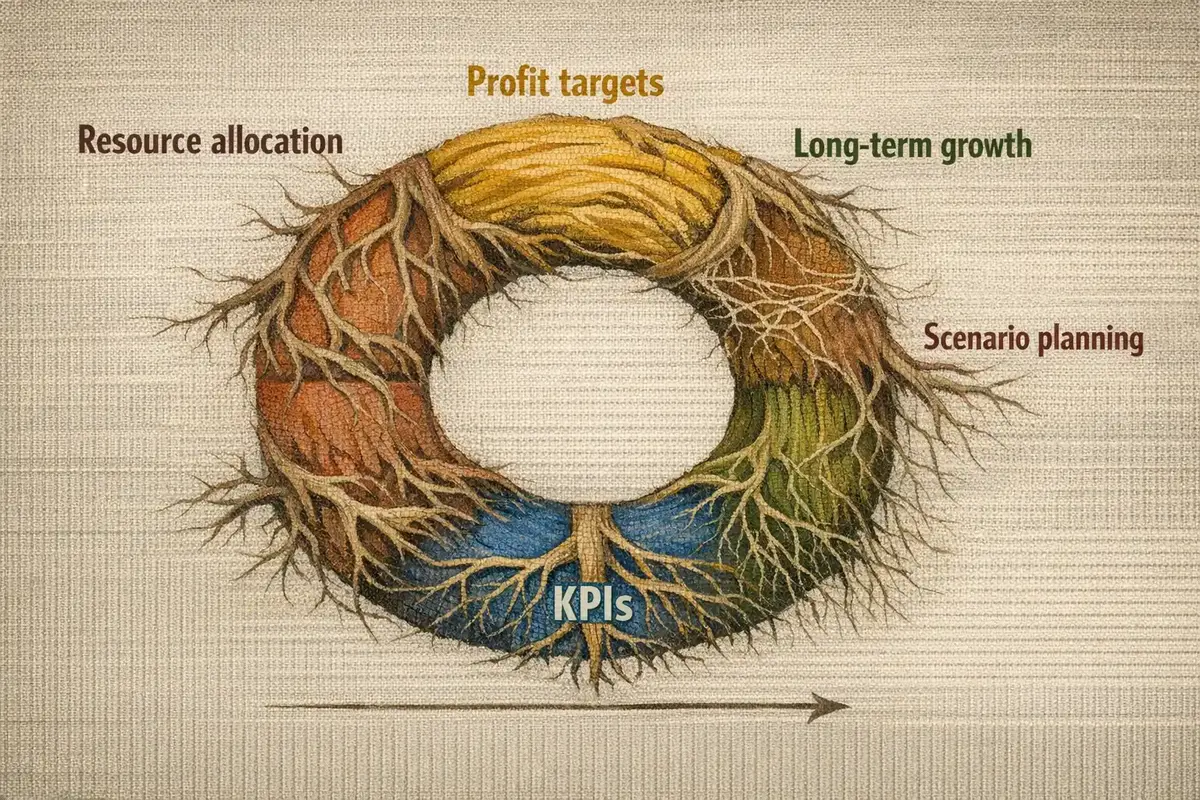
The earnings problem shows up late
This is why weak allocation choices can hide inside strong-looking quarters. By the time the damage is visible in revenue quality, customer retention, or bench strength, the causal decision is already in the past.
McKinsey’s work is useful here for a reason many leaders miss. It shows that productivity gains are not evenly distributed across firms; a relatively small group drives outsized advances, and labor shifts toward those better performers matter almost as much as improvement within firms themselves (McKinsey). That should sharpen the warning for any GM: if your business keeps cutting the investments that improve execution, your best people and best opportunities do not stand still. They migrate.
This is where strategic planning gets tested in the real world. Not in the offsite. In the budget meeting where maintenance spending, manager development, and capability building are treated as optional because their payoff is not immediate.
Strategic stagnation rarely announces itself
Very few businesses fail because they spent too much building future capacity. Many stall because they protected current margin so aggressively that they trained the organization to stop renewing itself.
The question is not whether a cut helps this quarter. It is whether it weakens the business’s ability to earn better next year. And if that tradeoff is not visible early, what starts as financial discipline can quickly become politics in disguise.
How Do You Make Tradeoffs Visible Before They Become Political?
The fund/defer/stop matrix is the simplest decision framework I know for keeping resource choices commercial instead of political. Without it, every initiative gets argued as urgent, every sponsor defends headcount, and the budget turns into a contest of influence rather than expected value.
Use three lenses, not one
A workable matrix tests each initiative on strategic value, timing, and resource intensity.
Strategic value asks whether the work protects the core, improves a critical capability, or opens a real growth path. Timing asks when the benefit can reasonably appear and what happens if the decision slips by one or two quarters. Resource intensity asks what the initiative consumes beyond cash—leadership attention, scarce talent, systems capacity, and execution bandwidth.
That last point is where many reviews fail. A project can be affordable and still be a bad idea if it absorbs the few people who are needed elsewhere.
McKinsey’s guidance is useful here because it pushes leaders to connect near-term choices to long-term strategic outcomes rather than judging them only by immediate earnings impact (McKinsey). In practice, that means an initiative should not be funded because it has a compelling narrative. It should be funded because its assumptions are visible, its timing is credible, and its strategic role is clear.
Split the budget before you debate the budget
In a quarterly review at a regional healthcare provider, the CFO asked one fair question: why were “discretionary projects” rising while margins were tightening? The problem was not the spending. The problem was the label.
The GM had bundled run-the-business spend and build-the-future spend into the same operating lines. Process automation, manager training, and service redesign were sitting beside routine maintenance and compliance costs. Once that happens, future-building work looks like optional overhead.
Separate them early. Run-the-business spend keeps today’s model performing. Build-the-future spend changes the model’s economics, resilience, or growth capacity. When those categories are explicit, the real tradeoff becomes visible: are you protecting current output, or preserving the ability to improve it?
Make the case in CFO language
This is where balanced scorecard thinking still earns its place. Harvard Business Review argued that leaders need measures beyond short-term financials because financial results reflect past actions, not the full set of drivers that create future performance (Harvard Business Review, 1992).
Financial measures tell you what happened. They do not tell you whether the business is getting stronger.
So defend an initiative with a one-page logic chain: the assumption, the leading indicator, the timing of impact, the downside if delayed, and the threshold that would trigger a stop decision. That changes the conversation with the CEO or CFO. You are no longer asking for belief. You are showing the bet.
And once those bets are visible, another question gets harder to avoid: which managers can actually turn capability spending into performance—and which ones quietly destroy value even when the budget is approved?
What Does the Research Say About Engagement, Managers, and Financial Performance?
$10 trillion in lost productivity is the estimated annual cost of low engagement worldwide—about 9% of global GDP (Gallup, 2026). For a GM, that is not an HR issue sitting off to the side; it is revenue missed, execution weakened, trust drained, and good people deciding the effort is no longer worth it.
If managers drive engagement and engagement drives performance, why is leadership capability still treated like a discretionary line item?
The manager is not a cultural accessory
Gallup’s finding is blunt: managers account for 70% of the variance in team engagement (Gallup, 2026). That should change how a GM reads the P&L. When one team consistently hits service levels, improves throughput, and keeps strong people, while another burns time in rework and attrition, the difference is often not motivation at the employee level. It is management quality.
That is why people decisions are financial decisions. A manager sets priorities, clarifies standards, allocates attention, handles conflict, and decides whether problems are surfaced early or buried until they become expensive. Execution quality lives there.
In a mid-market technology company during a budget reset, a VP cut manager training to protect quarterly margin after two soft months in enterprise sales. The savings were immediate. Three quarters later, deal reviews were slower, cross-functional handoffs were messier, and two strong team leads had left after concluding they were being asked to carry more complexity without better support. Nothing in that sequence looked like a “leadership issue” in the budget file. All of it showed up in commercial performance.

Engagement shows up in hard outcomes
The performance link is stronger than many operators admit. Highly engaged teams show 23% higher profitability and 18% higher productivity; they also see 78% lower absenteeism and 21% lower turnover in high-turnover organizations (Gallup, 2026).
Highly engaged teams show 23% higher profitability and 18% higher productivity (Gallup, 2026).
Those are operating numbers. Margin. Output. Attendance. Retention. The practical implication is simple: when you underinvest in manager effectiveness, you are not merely accepting softer culture scores. You are accepting weaker conversion of labor cost into productive work.
This is why leadership development deserves to be funded like a performance system, not defended like a perk. The same is true of talent development. A capable manager improves decision speed, raises accountability without burning people out, and creates the conditions where strategy survives contact with daily operations.
What to protect when margins tighten
Under margin pressure, most firms cut what does not pay back inside the quarter. That instinct is understandable. It is also often wrong.
The better question is narrower: which investments directly improve the quality of management at the point of execution? Coaching for frontline leaders, stronger manager selection, clearer operating cadences, and targeted development for newly expanded spans of control usually have a shorter path to financial impact than broad corporate programs. They help the business perform through pressure, not merely endure it.
That creates the real funding challenge. If leadership capability is a value driver, where should the money come from—across-the-board cuts, or a more deliberate reallocation from low-yield spend into the few capabilities that compound?
How Should GMs Fund AI, Expansion, and Capability Building Without Losing Control?
1.6x: that is how much more likely tech-focused organizations are to miss AI returns that exceed expectations compared with those taking a human-centric approach (Deloitte, 2026). For a GM choosing between AI spend, market expansion, and capability building, the real issue is not approval. It is sequencing.
Fund readiness before scale
In a regional retail business, the COO enters the annual planning round with three asks on the table: a pricing AI pilot, entry into two adjacent cities, and frontline manager development after a rough year of execution misses. The tempting move is obvious. Fund the technology, announce the expansion, and trust the organization to catch up.
That is usually where control starts to slip.
Strategic fit should decide whether an investment belongs in the portfolio. Execution readiness should decide when it gets funded. If AI sharpens a core commercial process, it may deserve priority over geographic expansion. If expansion depends on local operating discipline the business does not yet have, capability building comes first. A good GM does not rank initiatives by excitement. They rank them by dependency.
Why tech-first often underdelivers
Deloitte found that 59% are taking a tech-focused approach when it comes to AI (Deloitte, 2026). That is understandable. Technology looks concrete; capability building looks slower and less visible.
But the return on AI is rarely constrained by software alone. It is constrained by manager judgment, workflow redesign, data discipline, adoption habits, and whether teams trust the outputs enough to change how they work. Fund the tool and underfund the human system, and you do not get transformation. You get expensive coexistence — old work plus new tools.
That is why leadership matters here as an operating variable, not a cultural slogan. Deloitte’s 2026 research drew on more than 9,000 business and HR leaders across 89 countries (Deloitte, 2026), and the pattern is clear: organizations that treat AI as a people-and-work redesign challenge are better positioned to capture value.
Build a dual-horizon operating rhythm
Use a simple cadence. Review monthly for adoption and execution friction; review quarterly for commercial impact and capital reallocation. Track leading indicators before lagging ones: user adoption, cycle-time reduction, manager compliance, error rates, and time-to-proficiency.
Set explicit stop/go checkpoints at 90 and 180 days. If adoption stalls, pause expansion. If capability metrics improve but revenue lags, keep funding and narrow scope. If neither moves, stop.
That is the discipline. Not equal funding — better orchestration. And when every worthy investment cannot be funded at once, what matters more: fairness across categories, or timing that compounds?
The Best Balance Is Not Equal Spending, but Better Orchestration Over Time
Revenue is lost long before it shows up in the forecast. Trust erodes earlier still—when teams see leaders protect the quarter by delaying the very work the business says matters.
If the goal is not equal spending, what does a truly balanced GM decision actually look like?
Balance is a sequencing problem, not a symmetry problem
A balanced portfolio does not mean giving the present and the future identical treatment. It means giving each what it needs, when it needs it. The core business must perform now. The next source of earnings must be built before the core starts to fade. Those are complementary obligations, not competing ideologies.
That is why the best GMs think in orchestration, not optimization. They align capital, talent, and attention across different clocks. Some bets need immediate operating discipline. Some need protected time, patient sponsorship, and insulation from quarter-end panic. The mistake is to force all of them through the same test.
In a regional finance company during a year-end planning cycle, a division president faced a familiar choice: preserve margin by freezing specialist hiring, or keep funding a service-model redesign that had not yet improved reported results. The wrong answer would have been to split the difference mechanically. The better answer was to protect customer-facing execution in the current book of business while narrowing—rather than cancelling—the redesign, keeping the learning alive without pretending every initiative deserved full funding.
That is what portfolio judgment looks like in practice.
The GM’s edge is coordinated timing
Synovus found that corporate leaders entered the year with broad optimism about business opportunities, while CEO priorities centered on innovation, transformation, talent, and AI (Synovus, 2025). That combination should sharpen the point. Most leadership teams already know what they want to do. The harder question is when, in what order, and with which operating support.
Strategy fails less often from lack of ambition than from poor sequencing.
A GM’s advantage is not superior enthusiasm for growth or superior toughness on cost. It is the ability to keep today’s engine healthy while deliberately assembling tomorrow’s earning power. That may mean slowing one expansion to protect management capacity. It may mean funding a capability before a technology rollout. It may mean saying no to an attractive initiative because the organization has not earned the right to absorb it yet.
Sustainable growth is built that way—through protection and preparation at the same time.
So the closing test is simple. In your own business, are you trying to be fair across categories, or are you allocating by what the portfolio needs next?
Key Takeaways
- A GM’s real job is to allocate resources across multiple time horizons, not choose between short-term results and long-term strategy.
- Budgeting, strategic planning, and long-range planning are related but distinct disciplines with different purposes.
- Cutting capability-building spend can quietly weaken engagement, execution, and future earnings power.
- Better orchestration means sequencing AI, expansion, and talent investments by readiness and strategic dependency.
Frequently Asked Questions
What does it mean for a general manager to balance short-term P&L with long-term strategy?
It means allocating limited cash, attention, and talent across both immediate performance needs and future capability building. The goal is not to choose one over the other, but to manage a portfolio of investments that protects current earnings while strengthening future earnings power.
How are budgeting, strategic planning, and long-range planning different?
Budgeting sets spending limits and performance targets for the current year, so it is mainly a control system. Strategic planning decides where the business should compete, while long-range planning maps the multi-year capabilities and investments needed to make that strategy work.
Why can short-term cost cutting hurt future performance?
Cuts that reduce training, process improvement, or talent development can weaken the systems and people that create future results. A business may look efficient in the quarter while becoming less adaptable, less innovative, and harder to grow later.
How can leaders make investment tradeoffs clearer and less political?
A useful approach is to evaluate each initiative by strategic value, timing, and resource intensity, including leadership attention and execution bandwidth. Separating run-the-business spending from build-the-future spending also helps decision-makers see which investments protect today and which ones change tomorrow.
What should GMs prioritize when funding AI, expansion, and capability building?
They should fund based on strategic fit and execution readiness, not just on what looks exciting or technologically advanced. In many cases, capability building and workflow redesign must come before scale, because technology delivers value only when people and processes can absorb it.