

The seasoned General Manager knows this scene well: weeks spent designing a new process, only to watch it slow to a crawl at the intersection of Sales and Operations. Marketing launches are delayed by Finance’s risk aversion, while HR’s initiatives fragment at the Product team’s doorstep. The root cause isn’t incompetence, nor simply a lack of communication. It’s something far more subtle—organizational silos, the invisible walls that fracture effort and bury potential.
What’s at stake goes far beyond annoyance or inefficiency. In a BANI world where brittleness, anxiety, non-linear complexity, and outright incomprehensibility shape markets, these silos drain innovation, slow decision-making, and make even the best strategies underachieve. For GMs, the challenge is not simply to “get everyone talking.” It’s to orchestrate lasting synergy—aligning diverse disciplines into something greater than a sum of parts. Yet prevailing guides are long on platitudes and short on operational wisdom.
Let’s dismantle the cliches, explore the real journey from siloed to synchronized, and equip you—whether you’re new to the cross-functional chessboard or a battle-tested GM—with concrete, actionable insights for driving cross-unit success.
Understanding Organizational Silos: Beyond the Jargon
Organizational silos are more than just department borders on an org chart. They’re self-reinforcing boundaries—cultural, informational, and operational—that block the flow of knowledge, trust, and mutual accountability across teams.
Silos typically form due to:
- Competing incentives and KPIs (“Sales closes deals; Ops controls costs”)
- Legacy reporting lines and power centers
- Risk aversion and fear of losing control
- “Hero” cultures—individual teams solving for their own glory
- Emotional alliances: psychological safety within teams, suspicion outside
Why do they matter? Because they don’t just slow things down—they change the very way employees interpret what “success” means. Silos shift the definition from, “We hit our shared business goal,” to “My team hit its goal, regardless of what that means for yours.”
“Up to 70% of digital transformation initiatives underperform due to cross-functional misalignment, not technology issues.”
(Source: McKinsey, The Digital Transformation Imperative, 2022)
While a departmental boundary can be healthy—a clear mission and area of expertise—an unmanaged silo hardens into a mini-kingdom. Differences become rivalry. Knowledge is hoarded, not shared. Innovation dries up. And the GM’s well-intentioned requests for “greater collaboration” barely scratch the surface.
For a deeper dive into the operational and human realities of breaking down silos—and why it’s not simply a structural challenge—see cross-functional synergy in business units.
From Silo to Synergy: What Transformation Really Looks Like
Every company talks about “synergy,” but GMs need to see it, feel it, and measure it. Before we explore methodologies, let’s visualize the journey:
- Siloed Organization: Each function optimizes for itself, which leads to redundant work, internal competition, missed opportunities, and blame games when projects stall.
- Synergistic Organization: Teams operate with shared context, mutual trust, and visible alignment—results flow not just from compliance, but real commitment.
Picture a grid where nodes (teams) are connected only to their own row. That’s the siloed reality. Now imagine those nodes interwoven by robust lines of communication, trust, and feedback across roles. That’s the synergy sweet spot.
But here’s the nuance most guides miss—synergy is not the absence of boundaries; it’s the proactive management of overlaps. Knowing precisely when to “own” a decision and when to co-create is the daily GM dance.
Mapping Your Organizational Silos: Step One to Clarity
The journey starts, paradoxically, not with a solution, but with diagnosis. GMs must first make the invisible visible.
Silo Mapping Exercise:
- List all business units and key functions in your responsibility zone.
- For each pair, ask:
- How easily does information flow between them?
- Do conflicts linger unresolved, or get escalated?
- Are joint goals visible, or are objectives “owned” only by one team?
- When a crisis hits, do teams collaborate or retreat to their corners?
- Summarize both the “where” and the “why.” Is resistance structural (reporting lines), cultural (“that’s their problem”), or due to lack of relationships?
What you’ll often find is a map of both hard barriers (no shared KPIs) and soft walls (habits, resentments, turf battles). This sets the stage for targeted intervention.
The Core Causes: Why Silos Persist Despite Good Intentions
Why do silos outlast reorganizations and the best efforts of leadership? The answer spans incentives, mindsets, and trust deficits.
Structural Barriers
- KPIs set at the team or department level, not at the cross-functional project or customer outcome level
- Hierarchies that stymie direct (peer-to-peer) interaction across units
Emotional & Psychological Barriers
- Departmental loyalty can feel like a badge of belonging—and departments protect their “turf” to stay relevant.
- Fear—of loss of control, of blame when things go wrong, of “giving away” credit
“The hidden costs of silos are immense: up to 40% slower project cycles and an estimated 60% increase in escalated conflicts.”
(Source: Harvard Business Review, How Leaders Drive Collaboration, 2021)
This is why surface-level fixes—an extra team meeting or an open-door policy—rarely stick. Moving to synergy requires shifting both how people think and how they act.
Stepwise Methodologies: Building Synergy from the GM Seat
Let’s break the transformation down. Imagine this as a journey, not a one-shot intervention. Each stage requires clarity, courage, and patience.
1. Diagnose and Map the Silo Landscape
Use the mapping exercise to:
- Identify the highest-friction points
- Pinpoint whether tensions are goal-based, resource-based, or personality-driven
Invite honest conversation—not just among your direct reports, but between mid-level managers and cross-unit peers.
2. Establish “Synergy Habits” with Intentional Routines
Here’s what “proactive cross-functional habits” can look like:
- Rotating Leadership: Assign project leads from different functions over time (e.g., have Operations head up the next Sales-Product initiative). This “puts feet in other shoes” and breaks tribal thinking.
- Joint Problem-Solving Sessions: Monthly cross-functional sprints to tackle shared challenges—not just in crisis mode, but as a standing ritual.
- Knowledge Exchanges: Set up regular knowledge sharing—brief internal “TED Talks” or rotating lunch-and-learns where teams present successes and setbacks.
These aren’t gimmicks. They manufacture trust, highlight shared wins, and normalize collective problem-solving.
Explore more about fostering collaboration and team cohesion through Integral Team Coaching, which provides practical frameworks for emotional intelligence and cross-team alignment.
3. Realignment of Goals and Incentives
Possibly the toughest lever—turning individual KPIs into joint ownership models.
- Develop shared goals—e.g., “Reduce order-to-delivery cycle time by 20%”—and link rewards to achieving them collectively.
- Use simple visual tools: public dashboards where progress is visible to all (not just higher-ups), celebrating collective over individual wins.
- Paired Priorities: For any key deliverable, assign “goal twins” from two functions who must agree on success criteria and jointly monitor progress.
For actionable goal-mapping and performance alignment strategies, consider the insights from Turning Potential into Performance.
4. Address Emotional Barriers and Resistant Personalities
Every GM encounters the “star performer” who thrives on solo heroics—or the team that treats every suggestion as encroachment. Avoiding these conflicts cements silos.
- Conduct regular one-on-one check-ins to surface concerns early.
- Celebrate vulnerability: publicly praise teams/individuals who admit mistakes or ask for help from other departments.
- Activate “speed mentoring” across units: brief, practical shadowing or experience swaps.
For deeper work on trust building and psychological safety, especially in tricky or resistant environments, the Integral Leadership for Managers and Field Coaching Program offer advanced tools and methods.
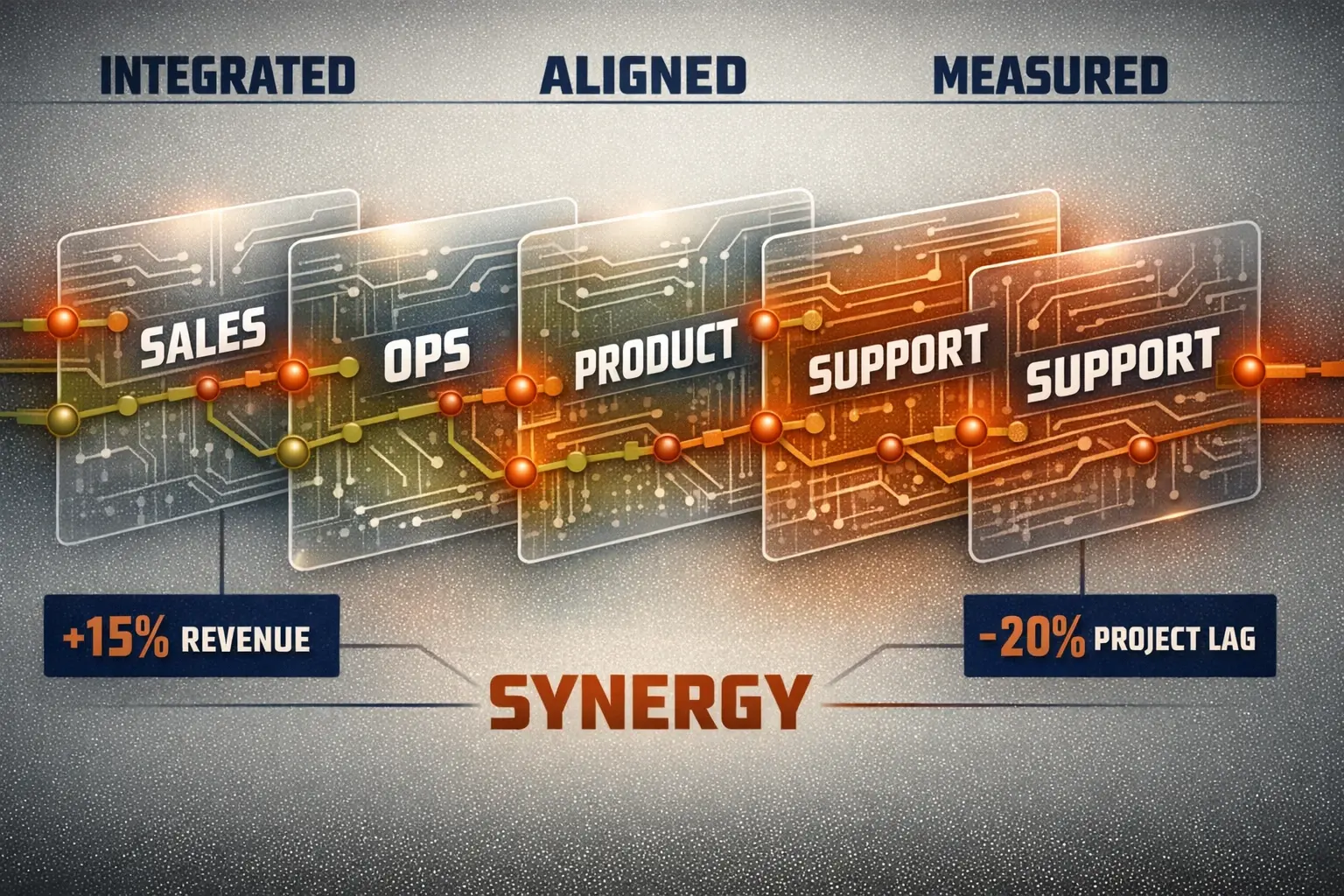
Measurement Revolution: Quantifying Cross-Functional Synergy
If you can’t measure progress, synergy remains a myth.
Tangible Synergy and Trust Metrics:
- Network Analysis: Map the “health” of collaboration patterns (using simple digital tools or survey-based diagnostics). Who connects to whom, how often, and for what reasons?
- Goal Overlap Index: What % of the quarter’s objectives are shared between at least two functions?
- Escalation Rate: How many inter-team conflicts are resolved at peer level vs. needing senior escalation?
- Trust Pulse Surveys: Run quarterly anonymous pulse checks—do people trust their counterparts to deliver? Would they proactively share a risk or opportunity?
This isn’t bureaucracy. It’s making progress visible and actionable in real time.
Advanced Mastery: Embedding Synergy as Culture
Moving from “fixing” specific silos to institutionalizing cross-functional trust is the true test of integral leadership.
1. Create Cross-Unit Rituals as Organizational Muscles
Organizations with sustainable synergy treat trust like a sport—practiced regularly, not just when “something breaks.”
“High-performing organizations embed cross-functional rituals—monthly strategy labs, rotating leadership roles, and ‘paired priorities’—to make collaboration routine and expected.”
(Source: Marie-Claire Ross, SUCCEED Together® Framework, 2023)
- Leadership rotation in critical projects
- Organization-wide post-mortems on what worked (and didn’t) in recent collaborations
- “Synergy stories” shared in company communications—narratives where transparency and hard conversations delivered better outcomes
2. Recovery and Resilience—Learning from Setbacks
Even with the best methods, setbacks are inevitable. What separates resilient organizations isn’t the absence of friction; it’s how quickly they recover—and how openly lessons are harvested.
- Build in reflection checkpoints: regular, scheduled reviews of both successful and failed efforts
- Treat each setback as a “case file,” focusing not on blame, but on what structures or habits can be improved
This iterative approach is at the heart of Integral Coaching: using feedback, reflection, and mindset shifts not just for personal growth, but for collective evolution.
Overcoming the Invisible Barriers: Emotional Dynamics and the Leadership Mindset
It’s tempting to believe that process changes or new dashboards will dissolve silos. But lasting breakthroughs hinge on the emotional climate—and the modeling of the GM.
The most influential lever? Your own behavior. How openly do you admit a mistake or ask for input from another function? How quickly do you intervene when cross-team blame surfaces? Do you celebrate collaboration over individual heroics in public?
If you sense hesitation, know that resistance is natural. The key is persistent modeling, paired with micro-interventions:
- Directly address fears about “loss of control” or “losing credit”
- Use regular, honest storytelling about times when you (or a senior leader) benefited from cross-team help
- When tension flares, intervene in the moment—not with reprimand, but with curiosity and “what-if” questions
This blend of awareness, accountability, and emotional intelligence isn’t soft; it’s the core skill set of the modern GM—and it’s teachable, through programs like leadership accountability in decentralized units and Integral Coaching.
Synergy Journeys: Real-World Examples
Consider the classic Sales vs. Operations story. At one global supplier, the GM saw quarterly launches repeatedly bottleneck when operational teams, blindsided by aggressive sales promises, played defense. Rather than a structural shakeup, the GM initiated:
- Rotating project leadership between Sales and Ops
- A bi-weekly ritual of presenting project “landmines,” where each side explained pains and potential fixes
- Joint KPIs for “on-time and under-budget” launches, celebrated with cross-team spotlighting
Within two cycles, mutual trust spiked and launch slippage dropped by 40%. The invisible barrier—fear of being “blamed”—was confronted through ritual, realignment, and resilient dialogue.
Practical Next Steps: How to Begin Your Own Synergy Journey
Every GM’s context is unique—some face entrenched turf wars, others simply habitual indifference. The journey starts with a test: try mapping your own silos, openly discussing root causes, and piloting one new ritual this month. Notice where resistance comes from—it’s a signal, not a flaw.
Progress is rarely linear, and there is no finish line—only the chance for deeper synergy, richer collaboration, and more resilient teams. Over time, you’ll find that synergy is less a destination and more a daily practice—anchored by intentional leadership.
Think about your business unit today: Where could a small “synergy experiment” start making a tangible difference this quarter?
FAQ: Driving Cross-Functional Synergy
What exactly is an “organizational silo”?
An organizational silo is a structural, cultural, or information barrier that isolates teams or departments from each other, restricting the flow of knowledge, trust, and shared accountability. While boundaries help organizations manage complexity, silos form when these become rigid—leading to missed opportunities, slow decision-making, and internal competition.
How do I tell if my business unit is suffering from silo mentality?
Look for symptoms such as information hoarding, recurring interdepartmental conflicts, delayed or stalled cross-functional projects, and a sense of blame or rivalry between teams. If project failures are met with finger-pointing rather than joint problem-solving, chances are silos are a root cause.
Aren’t some boundaries between functions healthy?
Absolutely. Healthy boundaries clarify roles, expertise, and accountability. The problem arises when these become impermeable walls, stifling collaboration and learning. The goal isn’t boundary-less chaos, but managed overlaps—where teams know when to “own” vs. when to co-create.
What’s the difference between cross-functional collaboration and true synergy?
Collaboration is working together to achieve a result. Synergy is when collaboration produces a result greater than the sum of its parts—often through shared context, mutual trust, and aligned goals. Synergy requires not just working together, but leveraging differences as a creative force.
How do you measure synergy or cross-functional trust?
You can measure synergy through metrics like network analysis (mapping regular, value-added connections), goal overlap (shared KPIs), escalation rates (how often problems are solved peer-to-peer), and regular trust pulse surveys. The real test: can teams reliably deliver outcomes they couldn’t achieve alone?
What if senior leaders themselves are reinforcing the silos?
This is a frequent but under-addressed challenge. Start by naming the issue in a constructive, non-accusatory way—sharing examples and data. Invite discussion on shared, rather than competing, objectives. Over time, modeling cross-functional vulnerability and reward can reshape senior leader behavior too.
Do technological tools help break down silos?
They can help, but they’re not sufficient. Collaboration platforms, shared dashboards, and digital feedback tools all smooth communication, but the essential work is in realigning incentives, mindsets, and rituals so that teams want to connect, not just can.
How long does it take to move from silos to sustained synergy?
There’s no universal timeline. Some quick wins can emerge in a quarter, especially with visible new rituals and pilot projects. Full cultural transformation, especially at senior levels, is often a multi-year journey—anchored by steady leadership modeling and persistent reinforcement.
Continue Your Leadership Journey
- Cross-functional synergy in business units — A practical, research-backed guide on breaking silos for General Managers, with actionable frameworks and leadership methodologies.
- Integral Team Coaching — Discover how team coaching builds emotional intelligence, communication, and alignment for powerful cross-functional performance.
- Turning Potential into Performance — Workshop strategies to align team objectives, boost motivation, and turn collaboration barriers into performance breakthroughs.
- Field Coaching Program — Explore hands-on programs for trust building, collaborative leadership, and managing change across business functions.