

Why High-Performing Executives Can Be the Most Burned-Out People in the Room
What if the executives with the strongest engagement scores are also the ones carrying the highest emotional load? Leaders report more stress than individual contributors by 7 points, anger by 12, sadness by 11, and loneliness by 10—a contradiction that should make any CHRO pause (IMD). If your operating assumption is that visible commitment signals healthy capacity, this is where it breaks.
That gap is not academic. It is expensive. In a quarterly review, a high-performing enterprise CFO can still sound sharp, hit the numbers, and project control while decision quality quietly narrows, peer relationships fray, and recovery time disappears. IMD’s reporting matters here because it shows that executives and managers are often more engaged and connected to the organization than other workers, while also experiencing more stress and negative emotions related to work (IMD). This article addresses the real leadership question underneath that paradox: how to recognize executive burnout as a system risk before performance optics stop hiding it.
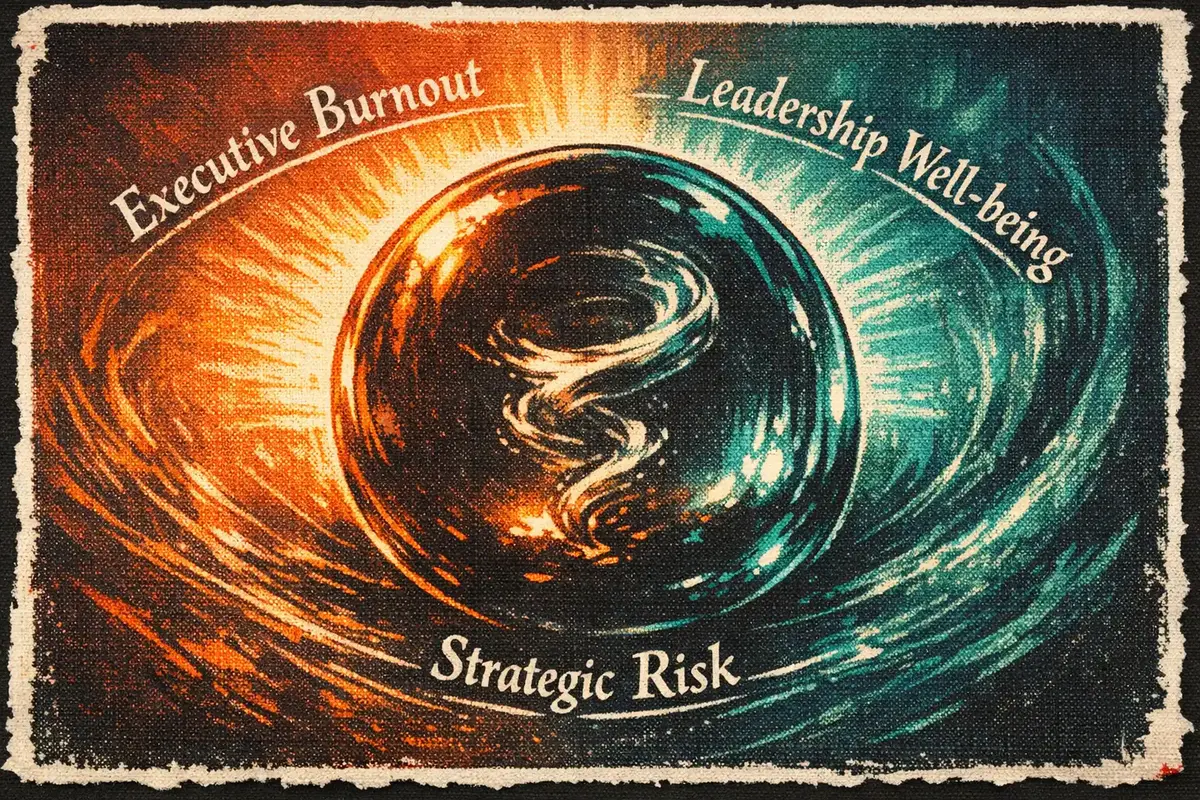
Performance Can Mask Depletion
This is the executive paradox. The people with the most authority often have the least room to show strain.
A senior leader’s calendar, compensation, and status can create a false sense of resilience. The organization sees responsiveness, stamina, and ownership. What it does not see is the cumulative cost of being the person who absorbs ambiguity, carries symbolic accountability, and cannot easily step out of role without sending a signal. Burnout at this level rarely arrives as visible collapse. It shows up first as shorter patience, flatter judgment, reduced curiosity, and a subtle shift from principled leadership to defensive management.
That is why executive burnout should be treated less as an individual weakness and more as a hidden operating risk. By the time it becomes obvious, the damage is already social and strategic: a trusted lieutenant exits, a succession conversation accelerates, a team starts managing around the leader, or the top table becomes less candid. Research on executive resilience and inner mastery points in the same direction: senior performance can remain intact long after inner capacity has started to erode.
Why CHROs Should Read the Signals Differently
For CHROs, the practical mistake is assuming that burnout will look like disengagement. Often, it looks like over-functioning.
Leaders are substantially more likely than individual contributors to report stress, anger, sadness, and loneliness on the previous day (IMD).
The issue, then, is not whether high performers are committed. It is whether the system is rewarding forms of commitment that conceal depletion until retention, trust, or judgment begins to slip. When a leader still looks successful, is that evidence of health—or the last stage before the costs become impossible to ignore?
What Is Executive Burnout, and How Is It Different from Stress?
The stress-burnout-recovery framework starts with an uncomfortable number: employees who frequently experience burnout are 2.6 times more likely to be actively seeking a new job (Gallup). That matters here because burnout is not just a harder form of stress; it is what happens when pressure stops being temporary and starts changing how a leader thinks, relates, and performs.
Stress, Burnout, Recovery: Three Different States
Stress is activation. The demands are high, the stakes are real, and the system is working hard to respond. In an executive role, that can look normal: a packed board week, a market shock, a difficult restructure, a client loss. Stress is not pleasant, but it can still coexist with clarity, energy, and a sense of purpose.
Burnout is different. It has a recognizable pattern: exhaustion, cynicism or detachment, and reduced efficacy. In plain terms, the leader is not just tired. They are starting to pull away from people, question the value of the work, and lose confidence in their ability to make good things happen. That is why burnout as a predictable outcome of chronic demands is the more useful frame than “too much stress.” Chronicity is the dividing line.
A regional healthcare CEO in the middle of budget season makes the distinction easy to see. In a hard quarter, she may feel stretched, sleep less, and still make sound trade-offs. Burnout shows up later — when every meeting feels adversarial, empathy drops, and decisions become narrower not because the issues are harder, but because her inner capacity is thinner.
What Recovery Actually Restores
Recovery is not a reward after overwork. It is the process that restores capacity before depletion becomes chronic.
That includes sleep and time off, but it also includes psychological detachment from role, emotional processing, and enough margin to regain perspective. A weekend away does little if the executive returns to the same decision load, the same symbolic pressure, and the same expectation of constant availability. CHROs should treat recovery as a design question, not a self-care suggestion.
Poor wellbeing can cost organizations 15% to 20% of total payroll in voluntary turnover costs, on average, due to burnout (Gallup).
The practical test is simple: is this a period of pressure, or a pattern of sustained overload plus emotional withdrawal? One calls for support. The other signals system failure. And when a leader still looks composed from the outside, how do you tell whether success is real capacity — or performance maintained on borrowed reserves?
Why Do Executives Burn Out Even When They Still Look Successful?
Global employee engagement fell to 20% in 2025, down from 23% in 2022 — yet many executive teams still look fully committed from the outside (Gallup, 2025). That is the trap for CHROs: visible commitment can rise even as real capacity erodes.
In a quarterly operating review, the division president is crisp, prepared, and decisive. She answers every challenge, commits to three new priorities, and stays online long after the meeting ends. Nobody in the room calls that a risk.
Success Signals Often Hide the Wrong Story
Gallup’s 2025 data makes the broader context harder to ignore: engagement has declined for a second straight year to its lowest point since 2020, while global thriving rose only one point, from 33% to 34% (Gallup, 2025). That is not enough improvement in well-being to offset the pressure many senior leaders are carrying. A leader can still be loyal, productive, and deeply invested in the enterprise while running on too little recovery.
That is the heart of the executive paradox. Senior roles create stronger attachment to outcomes, not protection from depletion. In practice, the executive is often the person absorbing board pressure, investor ambiguity, team anxiety, and market volatility at the same time. The organization reads that absorption as maturity. Sometimes it is. Sometimes it is simply expensive endurance.
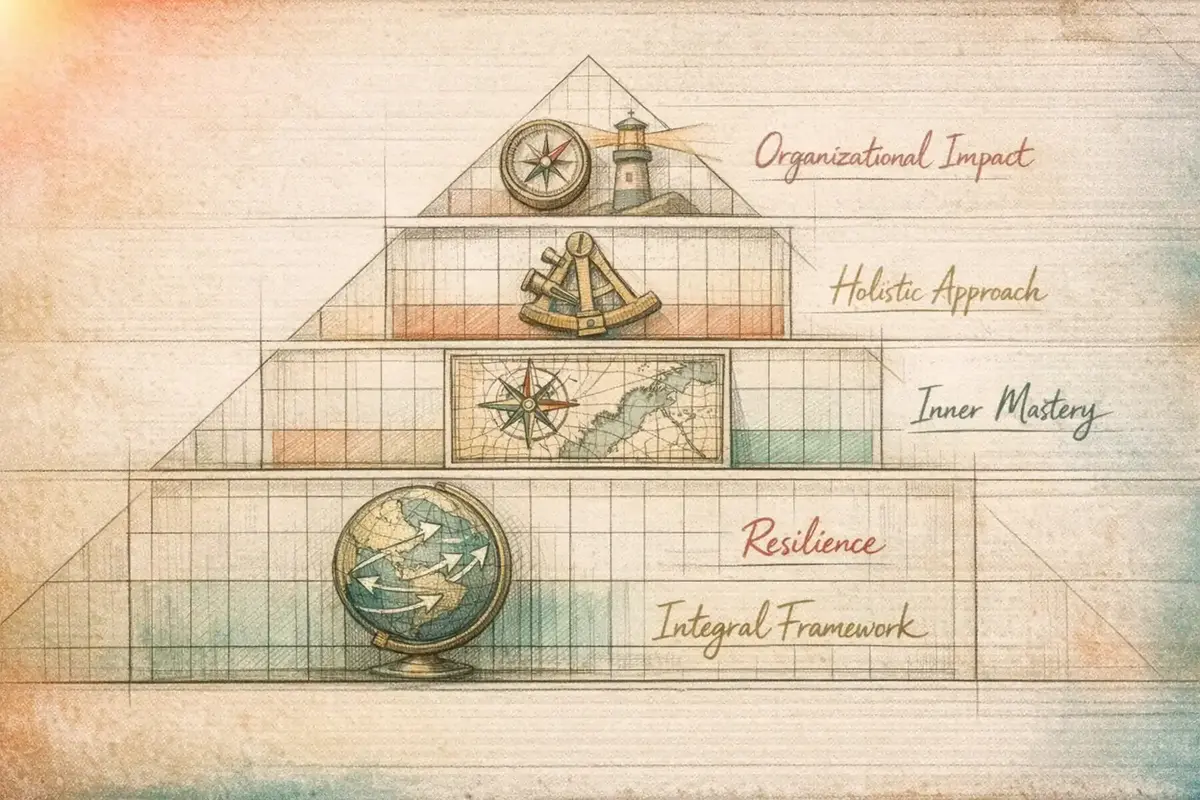
The Role Itself Makes Depletion Hard to Admit
A mid-market technology CEO in a restructuring cycle may spend half the day making hard calls and the other half regulating everyone else’s reaction to them. That is emotional labor at scale. Add constant visibility and the cost rises again: every pause is interpreted, every absence noticed, every sign of strain turned into a signal about confidence.
So executives learn to stay composed. They answer faster. They become more available. They protect the team from uncertainty by privately carrying more of it themselves.
Engagement is down globally, but thriving has improved only marginally — from 33% to 34% — a weak cushion against sustained leadership pressure (Gallup, 2025).
The problem is not just personal stoicism. It is organizational reinforcement. Many companies still reward the behaviors most likely to normalize burnout at the top: immediate responsiveness, heroic rescue work, calendar saturation, and visible self-sacrifice. Leaders who create margin can look less committed than leaders who consume themselves in public.
That is why burnout at the top so often hides inside success. The leader is still delivering — but by what mechanism? Strong capacity, or a system that keeps rewarding overextension until judgment, trust, and retention start to move?
What Should CHROs Measure Beyond Engagement Scores?
7 in 10 business leaders say their main competitive strategy for the next three years is to be fast and nimble (Deloitte, 2026). That sounds like ambition. In practice, it can also mean revenue missed through bad prioritization, trust lost through erratic leadership behavior, and strong executives walking out not because they lack commitment, but because the system keeps asking for speed without giving them control.
Measure the Work Design, Not Just the Mood
Engagement scores tell you how people feel about the company. They tell you far less about whether the company is set up in a way that makes sustained leadership possible.
A better dashboard starts with workload architecture. How many enterprise priorities sit on one executive’s plate at the same time? How often do “temporary” escalations become permanent operating expectations? How much decision traffic reaches roles that should be shaping direction rather than clearing bottlenecks?
Then measure decision rights and role clarity. Burnout risk rises fast when responsibility is high but control is low — when a leader is accountable for outcomes, yet cannot set pace, narrow scope, or say no without political cost. In a mid-market manufacturing company during an AI rollout, a VP may own delivery targets, workforce adoption, and board updates while still needing three layers of approval to change sequencing. That is not a resilience issue. It is a design flaw.
Add Recovery Norms to the Operating Review
Most organizations are taking a tech-focused approach to AI — 59% by Deloitte’s count (Deloitte, 2026). That matters because tech-first transformation often increases reporting load, exception handling, and decision velocity before it creates any real relief.
Organizations taking a tech-focused approach are 1.6x more likely not to realize AI returns that exceed expectations than those using a human-centric approach (Deloitte, 2026).
CHROs should read that as a measurement problem as much as a strategy problem. If you only track adoption, utilization, and engagement, you miss the conditions that keep strain in place: after-hours response norms, meeting sprawl, unclear handoffs, and recovery that exists on paper but not in practice. A more useful diagnostic pairs individual strain signals with organizational conditions — pulse data alongside span of control, decision latency, calendar load, and boundary violations.
That is the logic behind a human-centric approach. The real question is not whether leaders are coping. It is whether the system is producing strain faster than any individual can recover from it — and if so, what would an integral redesign actually change?
How Does an Integral CHRO Approach Prevent Burnout at the Top?
The integral lens matters here because burnout prevention fails when it is treated as a personal habit instead of an operating choice. In a budget-cycle meeting, the CHRO watches a retail COO answer every question cleanly, commit to more stretch targets, and then cancel the only recovery block on the calendar before leaving the room.
This is not a fringe issue. IMD reports that about 53% of managers globally say they feel burned out, while the 2024 NAMI Workplace Mental Health Poll found 52% of employees felt burned out in the past year because of their job (IMD, 2024; NAMI, 2024). When the numbers are this broad, the right conclusion is not that more people need resilience tips. It is that the system is producing depletion faster than leaders can offset it privately.
The Integral Model: Individual, Team, System, Culture
An integral approach works across four levels at once: the individual leader, the team around them, the organizational system, and the culture that defines what “good leadership” looks like. That is the practical value of an integral leadership complete framework. It gives CHROs a way to redesign conditions, not just offer support.
At the individual level, recovery has to be built as a capability: sleep, reflection, emotional processing, and real detachment from role. At the team level, norms matter just as much: escalation discipline, meeting hygiene, decision preparation, and the expectation that not every issue belongs in the leader’s inbox. At the system level, operating rhythms need scrutiny — quarterly planning, reporting cycles, and cross-functional approvals often create chronic overload by design. Then there is culture: if the admired leader is always available, always composed, and always absorbing everyone else’s strain, burnout will keep masquerading as commitment.

Recovery Must Become a Leadership Norm
The shift is subtle but decisive: recovery should be seen as a leadership discipline, not a private indulgence. If a senior executive cannot protect thinking time, step out of reactive loops, or model boundaries without reputational cost, the culture is teaching self-erasure.
NAMI’s 2024 poll adds an interesting wrinkle: 78% of direct managers say they feel prepared to support the mental health of their direct reports (NAMI, 2024). Preparedness is useful. It is not enough. Supportive conversations do little if the same manager is still rewarded for after-hours responsiveness, overloaded spans, and constant emotional containment. This is where empathetic leadership and burnout risks become tightly linked: empathy without structural change often turns strong leaders into better absorbers of unhealthy demand.
The CHRO’s job, then, is alignment. Align cultural signals with workload reality. Align leadership expectations with human capacity. Align operating rhythm with sustained performance.
If burnout is already visible at the top, that alignment question becomes urgent. Is the organization ready to redesign now — or will it wait until the warning signs become exits?
Where Should CHROs Start When Burnout Is Already Showing Up?
The triage diagnostic is the right starting model. Without it, organizations mistake visible strain for a motivation problem and respond with language that asks depleted leaders to cope better inside the same broken conditions.
Diagnose the Role Before You Diagnose the Person
When a senior leader becomes less present, more reactive, or oddly hard to reach, start with a short diagnostic across three points: role overload, ambiguity, and recovery gaps.
In a regional services company during a team restructure, a CHRO notices the COO still hitting milestones but arriving to executive meetings impatient, distracted, and unusually binary in judgment. The first useful questions are not about mindset. They are operational. What decisions keep bouncing back to this role? Which priorities are genuinely owned, and which are inherited by default? Where has recovery time been erased by travel, escalation, or calendar sprawl?
This matters because burnout rarely improves when the job remains structurally incoherent. Gallup’s research shows that employees who frequently experience burnout are more likely to be looking for another job (Gallup). At the executive level, that risk often appears before anyone names it directly.
Remove Friction First
The early intervention should be friction reduction, not more resilience language.
That means stripping out duplicate reviews, narrowing active priorities, clarifying who decides what, and stopping the quiet transfer of unresolved work upward. In practice, CHROs often get more traction by fixing meeting load and decision traffic than by launching another well-being message. A focused reset with the executive team — sometimes supported by integral team coaching — can expose where the system is creating avoidable drag.
Poor wellbeing can carry a meaningful turnover cost for organizations through burnout-related exits (Gallup).
Make the First Moves Visible
Three moves tend to matter early: leadership modeling, protected recovery time, and clearer decision rights.
If the CEO says recovery matters but schedules over every margin, nobody believes the signal. If protected time exists but can be overridden by any escalation, it is theater. If decision rights stay fuzzy, overload simply returns in a different form.
The first win is not a culture change campaign. It is a credible shift in how leadership work is actually run. And that raises the harder question: once those first fixes are in place, does well-being stay a temporary repair — or become part of the operating system?
Why Leadership Well-being Belongs in the Operating System, Not the Wellness Program
Burnout at the top does not stay at the top. It shows up in lost revenue from slower judgment, eroded trust in the executive team, and strong successors deciding they do not want the job they are watching up close.
If well-being is part of performance, why do so many organizations still treat it like an optional add-on?
This Is a Governance Issue, Not a Perk Decision
When a senior leader is chronically depleted, the first thing to weaken is rarely effort. It is discernment. The leader still shows up, still answers fast, still carries the room. But the range narrows. Fewer options get considered. Hard conversations get delayed or overcontrolled. Succession risk rises because the role starts to look punishing rather than meaningful.
That is why leadership well-being belongs in the operating system. It affects governance, continuity, and the organization’s ability to stay steady under pressure.
In an enterprise finance company during budget season, a CFO can keep delivering while privately running on fumes. The visible cost is a sharper tone in reviews. The deeper cost is that peers stop bringing early dissent, direct reports start filtering bad news, and the bench learns that advancement means permanent overextension. That is not a wellness problem. It is a resilience problem in the structure of leadership itself.
IMD has shown the paradox clearly: executives and managers are often highly engaged and strongly connected to the organization while also carrying more stress and negative emotions related to work than other employees (IMD, 2024). High commitment, in other words, is not proof of sustainable capacity.
Redesign the Conditions, Not Just the Coping
The durable move is not to ask leaders to endure more elegantly. It is to redesign the conditions that keep producing depletion.
That means treating recovery as part of role design, meeting load as a strategic variable, and decision traffic as something to govern rather than admire. It also means using a broader lens — the kind reflected in an integral leadership complete framework — where individual practices matter, but only alongside team norms, cultural signals, and operating cadence.
Global thriving moved only slightly, from 33% to 34%, a reminder that modest gains in well-being do not offset unhealthy system design (Gallup, 2025).
A few visible choices change the norm fast: executives protecting thinking time without apology, boards asking about sustainability as well as output, and CHROs making recovery patterns discussable in talent and succession reviews. The point is not softness. It is sustained range.
Make Sustainable Performance the Standard
The strongest cultures do not celebrate exhaustion with better language. They make recovery visible, expected, and measurable.
That is where executive resilience and inner mastery becomes useful: not as a private fix, but as one part of a larger design logic. The real test for a CHRO is simple. Are you helping leaders survive an unhealthy system — or helping redesign one they can lead in for the long term?
Key Takeaways
- High-performing executives can show strong commitment while carrying the highest emotional load.
- Executive burnout is different from stress: it combines exhaustion, detachment, and reduced efficacy.
- CHROs should measure workload design, decision rights, and recovery norms, not engagement alone.
- Sustainable performance depends on redesigning the system, not just improving individual coping.
Frequently Asked Questions
What is executive burnout?
Executive burnout is a state of chronic depletion marked by exhaustion, cynicism or detachment, and reduced effectiveness. It is different from temporary stress because it changes how a leader thinks, relates, and performs over time.
Why can high-performing executives be more vulnerable to burnout?
High-performing executives often carry the most symbolic accountability, absorb the most ambiguity, and feel the least freedom to show strain. Their success can hide depletion, so they may keep over-functioning long after their recovery capacity has eroded.
What warning signs should CHROs watch for in burned-out leaders?
Early signs often include shorter patience, flatter judgment, reduced curiosity, emotional withdrawal, and more defensive decision-making. Burnout at the top may also show up as over-responsiveness, constant availability, and a narrowing of perspective rather than obvious disengagement.
What should CHROs measure beyond engagement scores?
CHROs should measure workload architecture, decision rights, role clarity, meeting load, after-hours expectations, and recovery norms. These conditions reveal whether the organization is creating sustainable leadership capacity or producing chronic overload.
How can an integral approach help prevent executive burnout?
An integral approach addresses burnout at four levels: the individual, the team, the system, and the culture. It combines recovery practices with better role design, clearer decision-making, healthier norms, and leadership expectations that support sustained performance.