

Why Decentralized Freedom Fails Without Clear Accountability
You have seen the meeting. A regional business unit defends a missed target by pointing to local autonomy, while the center insists the strategy was clear enough.
Then everyone looks at the GM.
That moment is the real test of leadership accountability in decentralized units. Not when the model is announced, but when results slip, priorities collide, and no one can cleanly connect decision rights to outcome ownership. Decentralization often gets sold as a speed play. In practice, it becomes a diffusion play unless someone still holds the whole system together.
In 2025, global employee engagement declined for the second year in a row (Gallup, 2026).
Last year, low engagement cost the world economy approximately $10 trillion in lost employee productivity, or 9% of GDP (Gallup, 2026)
Those numbers matter here because unclear accountability is not a soft culture issue. It is an operating risk. In a mid-market manufacturing company, for example, a plant leader may move quickly on staffing, sourcing, or service recovery, yet quarterly review time still reveals the same problem: decisions were made locally, but trade-offs were never owned at the enterprise level. Speed was gained in the moment. Coherence was lost over the quarter. This article is about how GMs prevent that drift without pulling authority back to the center.

Freedom Does Not Remove Enterprise Ownership
A GM does not delegate away enterprise coherence. That responsibility stays put.
This is the mistake behind many decentralization efforts. Leaders push execution closer to the customer, the market, or the frontline team, which is often right. But they quietly assume that reduced central involvement means reduced oversight. It does not. It means oversight has to change form. The GM’s job shifts from approving more decisions to making sure the system produces aligned decisions across units, time horizons, and trade-offs.
That distinction is where many organizations get stuck. They confuse empowerment with absence.
The Real Tension Is Speed Versus Drift
The hard problem is not empowerment versus control. It is speed versus drift.
When decision rights are vague, teams move fast on local logic and slow on shared outcomes. One unit optimizes margin, another protects volume, a third escalates exceptions because nobody knows who owns the cross-unit consequence. The organization looks active. It is not aligned. That is why strong decentralized models rely on explicit accountability architecture, not managerial heroics. If you want a deeper frame for that design challenge, this is the core of leadership accountability in distributed businesses.
The question is not whether local leaders should have room to act. They should. The question is what, exactly, they are accountable for once authority is distributed—and what the GM must still hold, visibly and without apology.
What Does Accountability Mean When Authority Is Distributed?
The decision-rights framework matters here because most accountability failures in decentralized businesses are not performance failures at first; they are design failures. If people are empowered but still unclear on expectations, is the organization actually decentralized—or just loosely supervised? That question gets uncomfortable fast, because many leadership teams mistake reduced approvals for real distribution of authority.
The evidence is blunt. Only 45% of employees clearly know what is expected of them at work (Gallup). In a decentralized model, that gap is not a communication issue alone. It is a structural defect.
A Simple Test: Can People Act Without Guessing?
Accountability in distributed organizations means owning outcomes within agreed boundaries. It does not mean asking permission for every move. It also does not mean the center disappears.
That distinction matters because autonomy, accountability, and governance are different things. Autonomy is the latitude to decide. Accountability is the obligation to deliver and explain results. Governance is the operating frame that defines where local judgment applies, when escalation is required, and who resolves trade-offs when unit interests collide.
In a regional healthcare provider, a service-line VP may have full authority to adjust staffing models during a quarterly budget reset. That is autonomy. But if those changes improve local cost performance while worsening patient access in another unit, someone must own the cross-unit consequence. That is accountability. And if nobody can say in advance when that decision should have been escalated, governance is missing.
Loose supervision often masquerades as empowerment. It is not.
Autonomy Without Consequences Is Abdication
A useful line for GMs is this: autonomy lives inside a frame; abdication begins where consequences and escalation paths go undefined.
Research from PwC shows workers who feel most aligned with leadership goals are 78% more motivated than those with the least alignment (PwC, 2025). That finding is practical, not inspirational. People move faster when the goal, the boundary, and the consequence are all visible. They slow down when they have freedom in theory but ambiguity in practice.
This is why strong organizational design is inseparable from accountability. The GM should not be the default referee for every exception. The GM should define the few decisions that stay centralized, the many that move outward, and the explicit decision rights that connect authority to outcomes.
The GM’s Role Becomes Architectural
In a mature decentralized business, the GM is no longer the primary decision-maker. The GM is the designer of role clarity, review rhythms, and escalation logic.
That is a harder job. It requires deciding before the pressure hits who owns margin, customer recovery, talent moves, and cross-unit trade-offs—and how those calls will be reviewed without dragging them back to the center. Get that architecture right, and local leaders can act with confidence. Get it wrong, and every missed target turns into a debate about who was supposed to decide in the first place.
And once authority is distributed cleanly, another question appears: what kind of governance actually keeps teams aligned without rebuilding the bureaucracy decentralization was meant to remove?
Why Team-Level Governance Beats Centralized Control in Practice
Only 16% of workers say they have a very high level of trust in their employer. That should change how a GM thinks about control, because low-trust systems do not become more reliable when more decisions are pulled upward (Deloitte, 2024).
Most organizations still act as if tighter central review is the safe answer. The evidence points elsewhere. Deloitte found that 56% of executives are leading or expanding efforts to focus on individual teams and workgroups as the best places to build culture and agility (Deloitte, 2024). That is not a soft shift. It is an operating one. Leaders are moving attention to the level where work actually gets coordinated, interpreted, and adapted.
The Team Is Where Governance Becomes Real
This is why team-level governance beats centralized control in practice: it governs where judgment is exercised, not where PowerPoint is approved.
In a regional retail business during a holiday planning cycle, a district director may need stores to adjust labor allocation, local promotions, and inventory recovery tactics within days. A central team can set guardrails on margin floors, brand standards, and exception thresholds. It cannot read every local demand signal fast enough to make each call well. When headquarters insists on approving too much, the result is not better accountability. It is slower response, more workarounds, and less honest escalation.
That is the paradox. In low-trust environments, people do not become more transparent because the center asks for more sign-offs. They become more defensive.
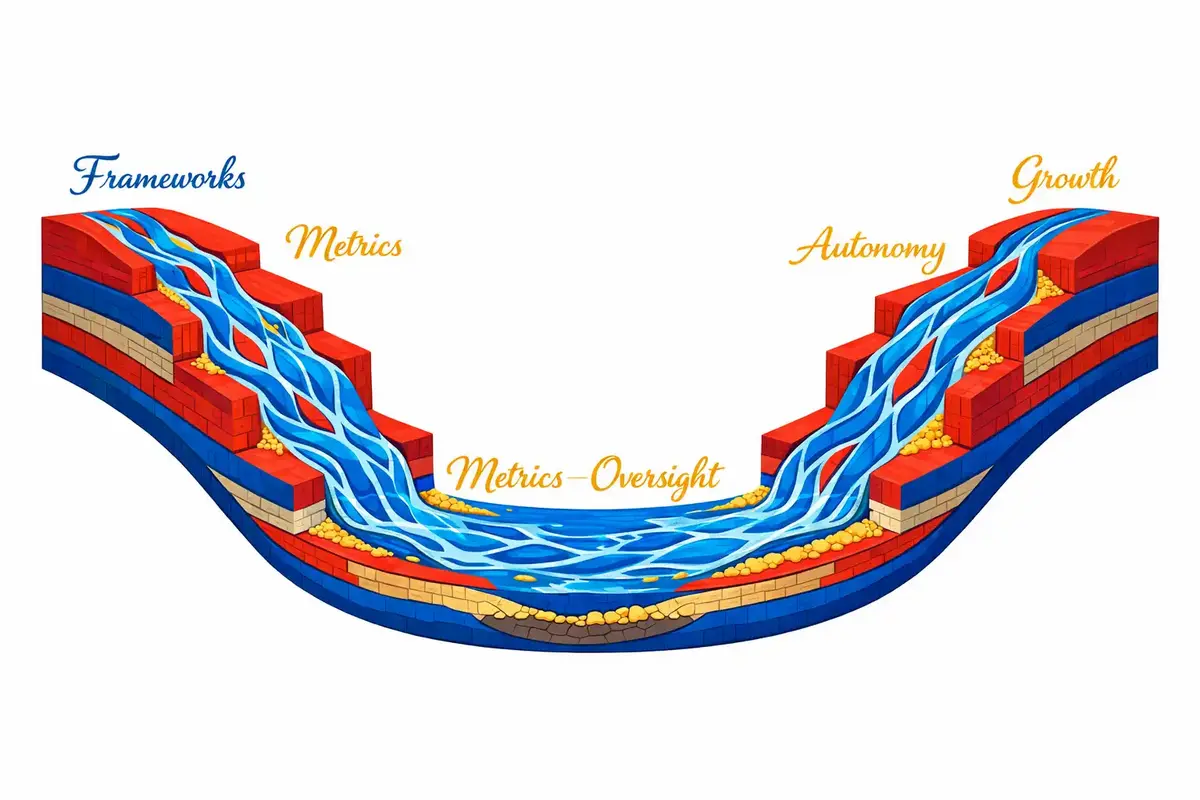
Standardize the Few Rules That Matter
A GM’s job is not to standardize every decision. It is to standardize the few rules that protect alignment.
Those rules are usually simple: which metrics define success, which decisions require cross-unit input, what triggers escalation, and how trade-offs get reviewed. Everything else should stay local. That is what makes good governance mechanisms enabling rather than bureaucratic. They create visibility without dragging execution back to the center.
The practical test is straightforward. Can two unit leaders facing different market conditions make different choices and still be judged fairly against the same enterprise logic? If yes, governance is doing its job. If not, the organization is either over-centralized or under-specified.
Consistency Builds Trust Better Than Control
Trust is fragile because employees watch for inconsistency more than they listen to slogans. They notice when one unit is allowed to adapt and another is second-guessed for doing the same. They notice when escalation rules change depending on who is asking. Team-level governance reduces that noise by making local discretion visible, bounded, and reviewable.
That is why the center should define the frame, not dominate the play. But once the frame is set, what should a GM actually watch—performance, behavior, risk, or all three?
What Should a GM Monitor Without Micromanaging?
70% of the variance in employee engagement scores across business units is determined solely by the manager. If a GM watches the wrong things, the cost is not abstract: trust thins out, good operators leave, and revenue problems show up one quarter after the leadership problem was already visible (Gallup, 2015).
That is the practical question. If managers drive that much variance, what should the GM actually monitor to catch trouble early without crawling into local decisions?
Monitor outcomes and decision quality, not activity
Start small. A GM should track a shared outcome set across all units, not a long list of local actions.
That usually means a handful of enterprise measures that reveal whether the system is healthy: growth quality, margin integrity, customer retention, talent stability, and execution reliability. The point is not to create a universal dashboard for its own sake. The point is to make accountability comparable across units that may operate in very different markets. When every unit reports different success logic, review meetings become storytelling contests.
But outcomes alone are not enough. A unit can hit the quarter by discounting too hard, delaying maintenance, or pushing risk downstream. So the GM also needs to monitor decision quality: Were trade-offs made within agreed guardrails? Were exceptions surfaced early? Did the unit leader escalate when enterprise consequences appeared? That is real performance monitoring in a decentralized model—less about surveillance, more about whether local judgment is producing durable results.
In a mid-market technology company during annual planning, one product VP may beat bookings by offering custom terms to close strategic accounts. Locally, that looks smart. Three months later, delivery teams are overloaded, margins are thinner than forecast, and another unit inherits the service burden. The GM did not need to approve the deal. The GM needed visibility into the pattern.
Standardize lagging indicators, localize leading ones
This is the clean split: standardize the enterprise metrics; let units adapt the leading indicators.
A services unit may track utilization and renewal risk. A healthcare unit may watch referral conversion and staffing coverage. A retail unit may focus on basket mix and local labor availability. Those local signals should differ. They reflect real operating conditions. What should not differ is the scoreboard used to judge enterprise contribution.
That distinction matters because manager accountability is still weak in many organizations. Talent Strategy Group places the current level of manager accountability at 3 on a 1–9 Accountability Ladder scale (Talent Strategy Group, 2024). When the baseline is that low, adding more metrics usually creates noise, not control.
Use cadence, escalation, and exceptions as the control system
The GM’s real tools are review cadence, escalation paths, and exception handling.
A monthly operating review should test patterns, not replay every decision. A clear escalation rule should define when a local issue becomes an enterprise issue—customer concentration, margin erosion, regulatory exposure, shared-capacity conflicts. Exception handling should be fast and explicit: who decides, by when, and on what basis.
That is oversight with teeth. Not interference.
And when those mechanisms are missing, breakdowns rarely start in the numbers. They start in the seams—between units, between priorities, between leaders who all think someone else owns the risk. Where do decentralized systems usually crack first—execution, coordination, or trust?
Where Do Decentralized Units Break Down First?
Breakdown usually starts while everyone is still doing their job. In a quarterly review at a regional services company, the unit heads arrive prepared, their numbers are defensible, and yet the GM can feel the drift: each leader is explaining a local win that quietly created a problem somewhere else.
That is the first crack. Not incompetence. False empowerment.
When ownership is assigned without authority
Teams are often told they “own the outcome,” but ownership without decision rights is just exposure. A unit leader is expected to improve retention, protect margin, and move faster on customer issues, yet still has to guess which trade-offs are truly theirs to make and which ones will be second-guessed later. In that environment, people do not stop acting. They start acting defensively.
PwC found that workers who feel aligned with leadership goals are far more motivated than those who do not (PwC, 2025). The practical implication is easy to miss: alignment is not created by slogans from the center. It is created when local leaders know where they can decide, when they must escalate, and how they will be judged when conditions change.
Weak governance is what makes capable teams look inconsistent. The talent is there. The effort is there. What is missing is the operating logic that connects local judgment to enterprise consequences.

The system breaks at the seams
In a mid-market manufacturing business during a budget reset, one plant director cuts overtime to protect local cost targets. Another keeps overtime high to preserve delivery performance. A third delays maintenance to avoid missing the month. Each choice makes sense on its own scorecard. Together, they distort capacity planning, create friction with shared functions, and leave the GM sorting through consequences nobody explicitly owned.
This is why decentralized systems often fail at the seams — between units, between metrics, between overlapping roles. Role ambiguity turns coordination into negotiation. Conflicting KPIs turn peers into competitors. The enterprise loses coherence long before the income statement makes the problem obvious.
Silos are usually designed, not chosen
Most silo behavior is not a cultural defect at first. It is a design outcome.
If one unit is rewarded for utilization, another for growth, and another for service recovery, they will optimize accordingly. Rational people follow the scoreboard in front of them. Research consistently shows that when incentives and accountability lines pull in different directions, collaboration becomes optional and escalation becomes political.
That is the hidden cost of vague empowerment: nobody is clearly failing, but the business still starts to fragment. So what does a GM change first — the people, or the system they are trying to operate inside?
How Can a GM Build Accountability Into the System?
The accountability map is where this starts, because the cost of getting it wrong is immediate: revenue leaks through duplicated bets, trust erodes when exceptions feel political, and strong operators leave when ownership is all burden and no clarity. If empowerment is the goal, this map is what keeps it from turning into drift.
Start with a two-column map
Keep it simple. What stays central? What moves local?
A GM does not need a grand redesign to answer that. In a quarterly review at an enterprise software company, the failure point is often obvious: pricing exceptions are local, capacity commitments are local, customer promises are local — until margin falls and delivery slips, at which point the center suddenly reappears. That is not decentralization. It is delayed centralization.
A durable system names a small set of enterprise-held decisions — capital allocation, risk thresholds, brand promises, shared-resource priorities — and pushes the rest outward with explicit leadership accountability. People can work with a clear line. They struggle with a movable one.
Build reinforcement into the operating rhythm
The system holds when decision rights, shared metrics, and review rituals work together.
PwC found that workers who feel most aligned with leadership goals are 78% more motivated than those with the least alignment (PwC, 2025). That is a design signal. Alignment improves when local leaders know which calls are theirs, which outcomes are judged across all units, and when they will be asked to explain trade-offs. Not randomly. Predictably.
Deloitte reports that 56% of executives are leading or expanding efforts to focus on individual teams and workgroups as the best places to cultivate culture and agility (Deloitte, 2024). That fits the practical reality: accountability becomes real in the unit review, the cross-functional handoff, the escalation meeting. Good governance mechanisms make those moments visible without making them heavy.
The best oversight is not constant. It is clear, regular, and hard to game.
Make oversight light enough to preserve ownership
This is the closing test for any GM: can a unit leader act fast, know the boundary, and expect a fair review afterward?
If not, the issue is usually not the people. It is the system. Your job is less referee than designer — less intervention, more architecture. So before the next miss forces the argument, what would your current model show a unit leader clearly, and what would it still leave them guessing about?
Key Takeaways
- Decentralization only works when someone still holds enterprise coherence and accountability.
- Autonomy, accountability, and governance are different; clear boundaries keep them aligned.
- Team-level governance and a small set of shared rules beat heavy centralized control.
- GMs should monitor outcomes, decision quality, cadence, and escalation without micromanaging.
Frequently Asked Questions
What does leadership accountability mean in a decentralized business unit?
Leadership accountability in a decentralized unit means local leaders own results within clear boundaries, while the GM remains responsible for enterprise coherence. It is not about central approval for every decision; it is about making sure authority, outcomes, and escalation paths are clearly connected.
How is autonomy different from accountability and governance?
Autonomy is the freedom to make decisions, accountability is the obligation to deliver and explain results, and governance is the framework that defines where each applies. When these are confused, teams may feel empowered but still lack clarity about trade-offs, escalation, and ownership.
Why does team-level governance work better than centralized control in decentralized organizations?
Team-level governance works better because it manages judgment where work actually happens, instead of slowing decisions through the center. It creates clear rules, visible boundaries, and fair review standards without rebuilding bureaucracy.
What should a GM monitor without micromanaging local leaders?
A GM should monitor a small set of shared outcomes, decision quality, escalation behavior, and review cadence. This gives visibility into whether local choices are producing durable enterprise results without controlling every action.
Where do decentralized business units usually break down first?
They usually break down at the seams between units, metrics, and roles, not because people are unwilling to perform. Common causes include vague ownership, conflicting KPIs, and decision rights that do not match the responsibilities assigned.