

Effective leadership development assessment, ROI modeling, and robust succession planning are foundational strategies for any organization aiming to cultivate future-ready talent, ensure sustainable business results, and mitigate leadership risk. For HR and talent leaders, mastering these interconnected pillars means equipping their organization with actionable tools to identify high-potential leaders, justify investment, and build dynamic, data-driven succession pipelines that support agility and sustainable growth.
The Leadership Imperative: Urgency in a Rapidly Shifting Landscape
Organizations worldwide spend approximately $60 billion annually on leadership development, yet only 24% of senior executives consider their programs a success (Source: Harvard Business Review, National Leadership Institute Study, 2017).
The gaps are not minor. With rates of executive churn at an all-time high and the cost of external leadership hires continuing to climb—external hires are 61% more likely to fail within 18 months compared to internal promotions (Source: DDI, Executive.com)—developing, assessing, and retaining future-ready leaders is a strategic necessity.
But what keeps decision-makers up at night is more than just finding “talent.” It’s building a measurable, resilient system where:
- The right people are assessed with reliable tools
- Leadership investments demonstrate hard evidence of ROI
- Succession is not left to chance or gut feel, but coordinated through continuous, agile planning
The consequences of neglecting these pillars go beyond financial waste: 77% of organizations still lack true leadership depth, creating exposure to business disruption and culture drift.
The competitive edge lies not in picking the shiniest assessment or the newest training but in integrating assessment, development, and succession into a seamless, data-driven strategy—one that transforms leadership from a vague aspiration into a measurable business advantage.
Decoding Potential: Advanced Leadership Assessment Strategies
What Is High-Potential Leadership—And Why Isn’t Performance Enough?
High-potential leadership extends well beyond current performance. Research confirms that true high-potentials show three critical markers, sometimes called the ACE model:
- Aspiration: A genuine drive and desire for greater responsibility
- Ability: Demonstrated leadership competencies and learning agility
- Engagement: Commitment to both the organization’s mission and continuous self-growth
Performance alone is no longer the proxy for future readiness. As organizations contend with complex challenges, agility, cultural alignment, and values-based leadership move to the forefront (Source: Wharton Executive Education).
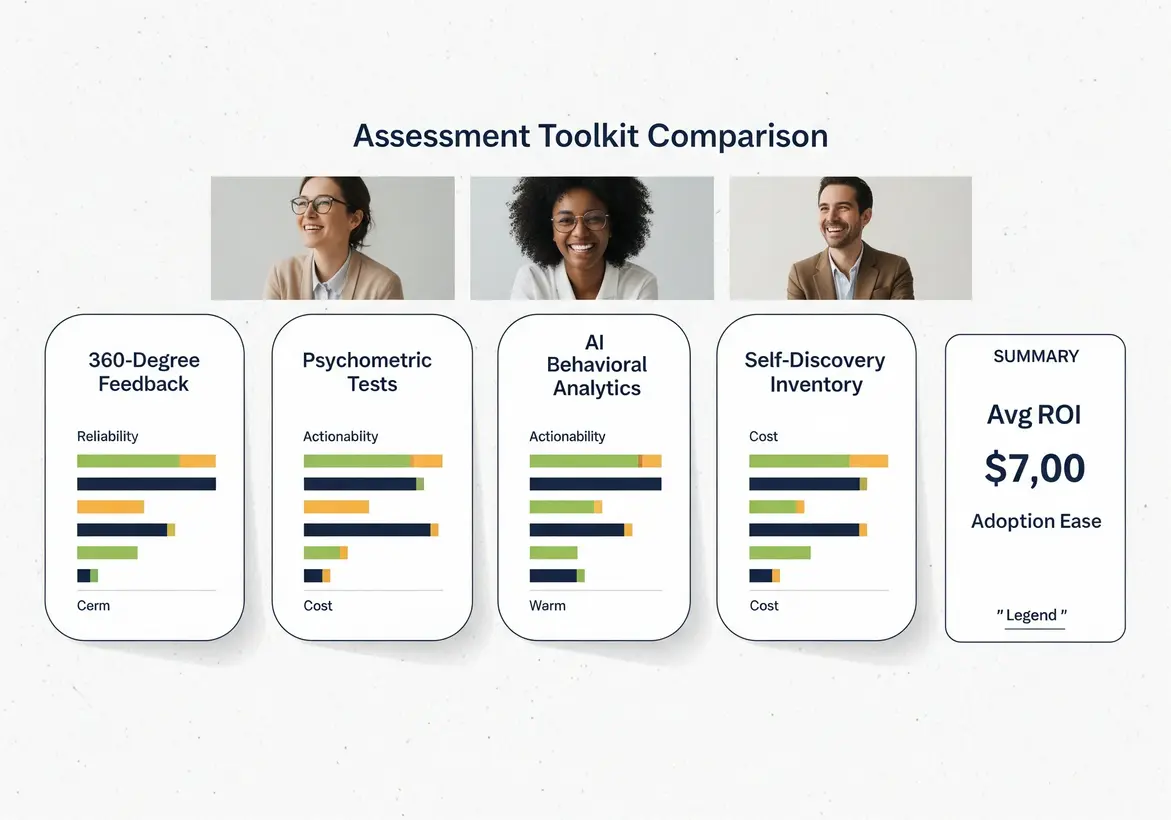
The Assessment Toolkit: Beyond the Basics
Deep Dive Into 360-Degree Leadership Assessments
The 360° Leadership Assessment process uses structured, multi-rater feedback to give leaders full-spectrum insight into their impact. At its best, it combines input from direct reports, peers, supervisors, and even customers, exposing both “blind spots” and under-leveraged strengths. Pioneers like the Center for Creative Leadership have demonstrated that when 360 assessments are part of a larger leadership ecosystem (including facilitated debriefs and action planning), application rates and measurable development outcomes improve dramatically.
For organizations seeking a multi-dimensional lens, the 360° Leadership Assessment adds substantial depth to annual reviews and complements other quantitative tools.
Psychometric Assessments: Understanding the Science
Psychometric tools measure cognitive ability, personality, motivation, and values. At the advanced end, they include proprietary batteries designed around reliability and validity metrics. Yet, for many HR leaders, the technical jargon obscures what matters most: fit and predictive power for specific leadership contexts.
For example, personality inventories, cognitive aptitudes, and motivation scales can help predict leadership efficacy—but only when used judiciously and interpreted in an organizational context. When combined with structured frameworks like the 4 Elements Assessments, which evaluate the core energies that shape leadership styles, organizations gain clarity on both potential and best-fit roles.
Behavioral Assessments & Leadership Simulations
Behavioral interviews, simulation exercises, and situational judgment tests go beyond self-reporting to observe leaders “in action.” Techniques like assessment centers and bespoke business simulations are used by organizations such as Wharton and Korn Ferry to simulate real leadership dilemmas, capture performance under pressure, and identify learning agility.
These methods are especially valuable in surfacing “hidden” leadership markers—such as emotional intelligence, strategic thinking, and resilience—that may not be fully captured by psychometric data alone.
Self-Discovery Inventories: Tools for Personal Leadership Growth
Empowering leaders to take ownership of their growth begins with self-reflection. Self-discovery inventories, when crafted with rigor, prompt evolving self-awareness and support individualized development roadmaps.
Used in conjunction with facilitated coaching and feedback, these inventories can bridge the gap between assessment data and everyday leadership decisions, ensuring growth is both personal and measurable.
AI-Driven Assessments & Behavioral Analytics: Transforming Accuracy
Modern leadership assessments are increasingly leveraging AI-powered behavioral analytics. Studies show that AI-driven tools can improve leadership skill acquisition by 20% and identify potential bias or blind spots more effectively than traditional assessments alone (Source: Harvard Business Impact, 2023).
By analyzing patterns from digital communication, video interviews, and even physiological data, AI provides predictive modeling for future leader success—allowing organizations to compare candidates not just to a static benchmark but to evolving success profiles unique to their own culture.
The Diagnosing Organizational Culture with AI & AQAL framework further illustrates how a blend of human expertise and AI can uncover deeper dimensions of organizational readiness and leadership fit.
Mastering Leadership Development ROI: Proving and Maximizing Value
The Compelling Business Case: Why ROI Measurement Demands Rigor
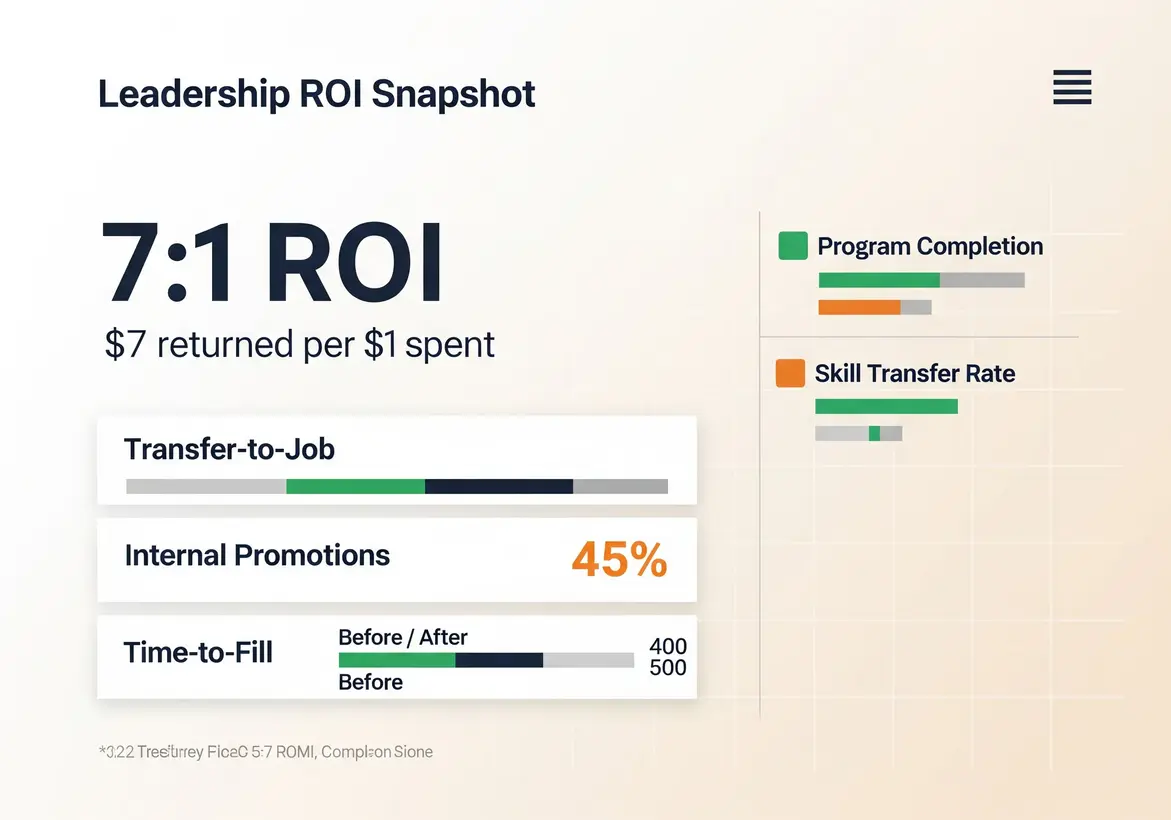
For every $1 invested in leadership development, organizations report an average ROI of $7. Over 42% attribute increased revenue directly to these efforts (Source: National Leadership Institute Study).
Despite such impressive figures, peeling back the layers reveals a challenge: only 18% of organizations systematically collect impact metrics on their programs (Source: CCL Innovation). This lack of rigor undermines both funding and credibility.
The Phillips ROI Model: A Step-by-Step Guide for Leadership Programs
The Phillips ROI Model is recognized as the most robust approach to calculating the true value of leadership investments, particularly for complex, multi-faceted programs. Here is how it moves from anecdotal benefit to boardroom-ready business case:
-
Level 0 – Inputs: Calculate all direct and indirect program costs (not just vendor fees, but lost productivity, administrative support, facilities, etc.).
-
Level 1 – Reaction: Gather immediate feedback from participants—did they find the content valuable and relevant?
-
Level 2 – Learning: Assess knowledge, skill, or attitude change using pre/post-testing, self-assessment, or demonstration.
-
Level 3 – Application: Measure job application rates (e.g., “How often did you use the skills learned within three months?”). Low transfer rates—5% in some cases—suggest a need to revisit program design for practical application.
-
Level 4 – Impact: Isolate program effects on KPIs like sales, customer satisfaction, productivity, or retention. Use control groups, trend analysis, or participant estimates to distinguish program impact from other factors.
-
Level 5 – ROI Calculation: Convert benefits into monetary value (using accepted formulas) and calculate ROI:
ROI (%) = [(Net Program Benefits / Program Costs) x 100]For example, if a revamped leadership program cost $200,000 and generated $1.4 million in measurable business outcomes, ROI = [(1,400,000 – 200,000) / 200,000] x 100 = 600%.
-
Intangible Benefits: Identify non-quantifiable outcomes (e.g., improved morale, culture change) and communicate them alongside “hard” ROI for the complete picture.
This model, when grounded in the Integral Model’s multi-level framework, enables organizations to build a bulletproof case for continued—and even expanded—investment in their leadership bench.
Benchmarking and Continuous Improvement
The Integral Leadership Frameworks & Methodologies provide a systematic approach for benchmarking leadership capability against both internal and external standards, turning ROI tracking into a continuous improvement engine.
Failing to measure both tangible and intangible outcomes not only leaves budget on the line—it exposes organizations to stagnation, wasted potential, and missed opportunities for talent leverage.
Strategic Succession Planning: Ensuring Leadership Continuity
A Modern, Agile Approach to Succession
Traditional succession planning has relied on annual talent reviews and static succession charts. Yet volatile markets demand something more: agile, continuously updated pipelines that anticipate needs and adapt to change.
Today’s best practices—drawing on 21 core recommendations from leading research—include:
- Early identification and cultivation of diverse internal talent
- Data-driven forecasting of pipeline depth and role vulnerability
- Transparent, psychologically safe communication to manage expectations and engagement
Advanced succession strategies increasingly apply predictive HR analytics to spot at-risk roles and “hidden” high-potentials, ensuring every critical position has multiple viable successors.
Key Elements of a Robust Succession Plan
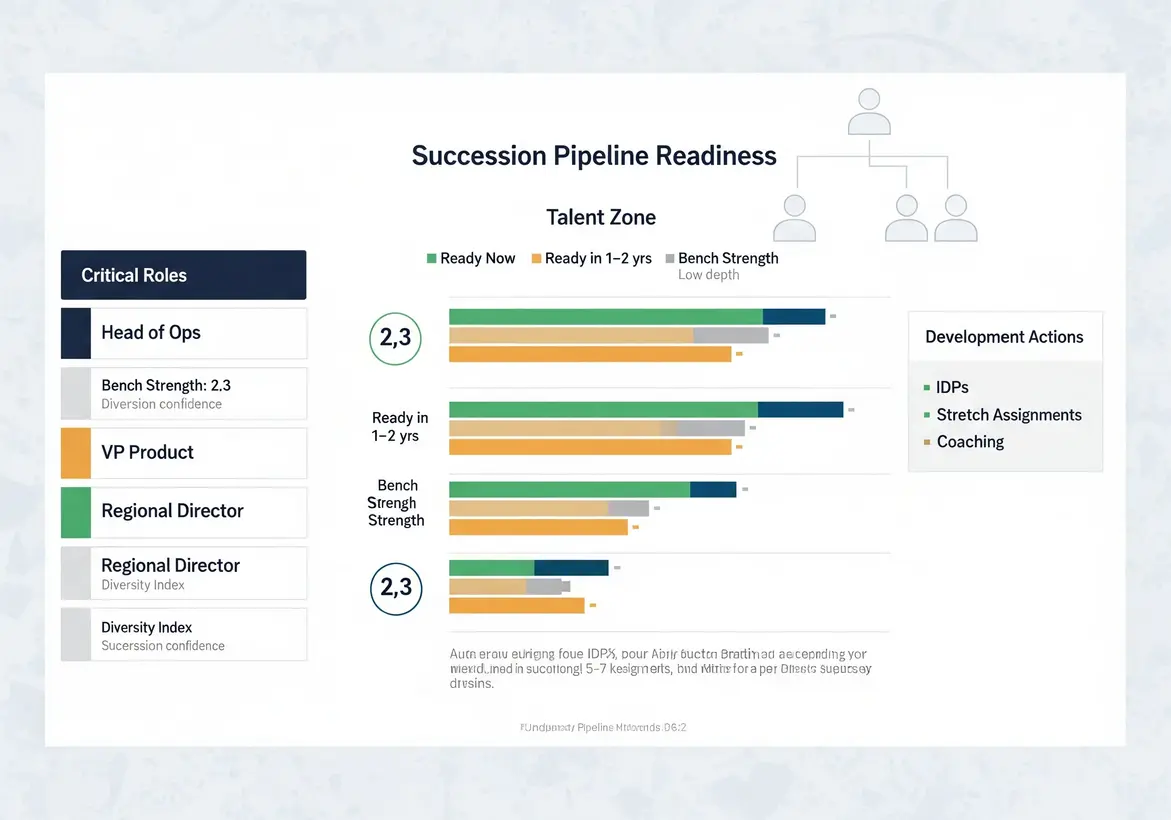
- Identify Critical Roles: Not every management job is equally vital. Start with roles whose failure would most disrupt the business or culture.
- Map Competencies: Define the skills, mindsets, and behaviors required for future success, using tools like the 4 Elements Model to ensure holistic alignment.
- Assess Internal Talent: Integrate leadership assessment outputs directly into succession pool decisions—using a blend of quantitative metrics and behavioral observations.
- Create Individualized Development Plans (IDPs): For each potential successor, customize learning paths that include stretch assignments, coaching, and mentoring.
- Mentoring & Experiential Learning: Research shows that experiential projects, “acting” assignments, and formal mentoring accelerate readiness far more than classroom training alone.
- Build a Diverse Pipeline: Ensuring that future leaders reflect the organization’s evolving demographics and values.
- Formalize the Process: Document procedures, update them frequently, and ensure executive and board oversight—this is where succession moves from a neglected file to a living strategic process.
The Engaging Non-Family C-Suite for Family Business page provides rich contextual strategies around non-family executive integration and maintaining psychological safety during transitions.
Addressing Succession Planning Challenges
Many organizations fear that openness will trigger disengagement among “passed-over” talent or political gamesmanship. Research and practical experience consistently show the opposite: transparent, well-facilitated communication—grounded in psychological safety—boosts trust, retention, and discretionary effort.
Resilient pipelines are also adaptive. They account for vacancy risk, shifts in business models, and the impact of disruptive tech trends—enabled by the regular, structured review of talent depth using HR analytics tools.
Integration & Synergy: The Holistic Leadership Ecosystem
Linking Assessment, Development, and Succession Into One Coherent System
Most organizations treat assessment, development, and succession as isolated projects. The real differentiator, however, emerges when these are woven together into a holistic leadership system.
- Assessment outcomes drive personalized development plans
- These plans, in turn, directly populate the succession pipeline with ready, willing, and able candidates
- Ongoing feedback and benchmarking close the loop, fueling continuous improvement and learning agility
“Organizations with this level of integration report up to 88% higher rates of internal promotion, superior employee performance, and dramatically reduced cost-of-turnover” (Source: National Leadership Institute Study)
Strategic HR teams blend methodology and data to foster environments where leaders stretch, develop, and share accountability for organizational goals. Psychological safety (explored in-depth at CHRO Role & Psychological Safety) acts as the foundation, supporting risk-taking, candor, and mutual trust.
In this model—backed by over 40,000 hours of certified coaching practice—leadership transformation is not episodic, but a continuous capability woven into the DNA of the organization.
FAQ: Leadership Development Assessment, ROI & Succession Planning
How do you measure the effectiveness of a 360° Leadership Assessment?
The true effectiveness of a 360° assessment hinges on more than ratings. Look for statistically significant changes in behavior, performance metrics, and feedback quality over time. When paired with action planning, periodic follow-ups, and ongoing coaching, organizations report sustained skill application and positive shifts in culture, not just momentary insight.
What is the biggest mistake organizations make with leadership ROI modeling?
Over-attributing or under-attributing impact. Many fail to isolate program effects from external shifts (market, mergers), while others overlook intangible yet critical benefits like morale improvement or leadership brand strength. The Phillips Model’s use of control groups and rigorous cost-benefit calculations avoids both extremes by focusing on what is concrete, defensible, and repeatable.
How do organizations handle succession for non-traditional or evolving roles?
By combining competency mapping, real-time HR analytics, and scenario planning, organizations can quickly model vulnerability and create “succession depth charts” for roles that didn’t exist five years ago—such as AI transformation leads or remote team architects. Continuous upskilling and cross-functional assignments also help bridge gaps before they appear.
What role does psychological safety play in succession and leadership development?
It is a force multiplier. Teams that feel safe to share, challenge, and learn report higher engagement, risk-taking, and retention—crucial for surfacing diverse succession candidates and ensuring development plans actually stick. Psychological safety is carefully cultivated through feedback culture, leader modeling, and consistent HR partnership.
Can AI really improve the accuracy of leadership potential identification?
Yes—with caveats. AI-driven assessments can analyze behavioral data and detect patterns traditional tools might miss, contributing to a more nuanced potential model. That said, AI should augment—not replace—human insight and experiential feedback, ensuring that cultural nuance and organizational context are fully respected.
Conclusion: Shaping the Future Leadership Advantage
The future of organizational leadership lies in integration: synthesizing rigorous assessment, measurable ROI, and agile succession planning into a single, adaptive system. For those evaluating their next step, the path to stronger leadership pipelines begins not with isolated solutions, but with a holistic, evidence-based approach—turning potential into measurable advantage.
If you’ve seen missed opportunities or untapped leadership capacity in your organization, now is the moment to rethink your strategy. Which pillar in your leadership ecosystem deserves the most urgent attention, and how will you weave assessment, ROI, and succession into a sustainable whole?
Continue Your Leadership Journey
- 360° Leadership Assessment — Explore a comprehensive tool for multi-level feedback and unlocking hidden leadership strengths.
- 4 Elements Assessments — Understand the foundational energies that shape authentic leadership through this integrative assessment model.
- Integral Leadership Frameworks & Methodologies — Dive into a robust model for continuous leadership benchmarking and tailored development trajectories.
- Predictive HR Analytics & Leadership Planning — Discover how predictive analytics forecasts succession and strengthens your leadership pipeline strategy.