

Mitigating business unit risk is the GM’s most pragmatic leadership lever, blending day-to-day vigilance with structured scenario planning that turns ambiguity into readiness. For GMs, this means not just reacting to crises, but developing living frameworks that anticipate—and actively address—market shocks, operational disruptions, and competitive threats. By mastering a proactive approach rooted in clear routines, strong ownership, and team engagement, GMs can transform risk from a lurking threat into a source of resilience and opportunity.
Why is Risk Both Threat and Opportunity for a Business Unit?
Traditionally, risk is cast as the villain—a lurking force waiting to undermine business performance. But from a GM’s vantage point, risk is also information: a signal of where systems are fragile, where hidden potential for growth or innovation might lie, or where overconfidence is quietly breeding vulnerability.
“Risk is the universe nudging your business unit to see what’s brittle, not just what’s broken.”
Every year, nearly 70% of business failures can be traced to leaders who either underestimated key risks or failed to translate risk signals into systemic action. GMs who learn to see risk as both a threat and an opportunity can harness it as a catalyst for improvement, innovation, and competitive advantage (Source: Organization for Economic Cooperation and Development, Global Corporate Governance Report, 2022).
What is Business Unit Risk? (And Why Aren’t GMs Talking About It Enough?)
Business unit risk is the set of potential events or conditions—internal or external—that could cause your core operations, priorities, or strategies to fail. Unlike enterprise risk, which looks across the whole company, business unit risk zooms in on the dynamics unique to your product lines, markets, teams, and processes.
Some common risk categories for GMs include:
- Market risks: Sudden shifts in customer preferences, a new competitor’s entry, regulatory changes, or geopolitical tension.
- Operational risks: Supply chain breakdowns, production errors, technology outages, or talent turnover.
- Financial risks: Currency fluctuations, credit constraints, cashflow dips, or pricing squeezes.
- Reputational risks: Negative social media cycles, quality incidents, leadership scandals, or compliance failures.
What often goes unrecognized is that these risks are not isolated—they interlock. A supply delay can trigger cash crunches, which pressure leaders into hasty decisions, which ripple out to customer trust and market position. Drawing on TII’s two-decade integral methodology, successful GMs don’t just map risks; they build living frameworks to understand how these risks interact and to develop collaborative, evolving responses.
How Does Risk Mitigation Work in Practice for a GM?
Risk mitigation is the continuous process of identifying, assessing, prioritizing, and addressing relevant risks so that potential threats are reduced to an acceptable level and new opportunities can be seized confidently. For business units, a robust risk mitigation approach goes beyond one-off workshops and checklists. It needs to be embedded in daily routines, decision-making, and team conversations.
Practical risk mitigation in a business unit includes:
- Identification: Systematic scanning for emerging risks using both historical data and real-time signals.
- Assessment & Prioritization: Classifying risks by likelihood and impact using a risk matrix unique to the business unit’s context.
- Treatment: Deciding where to avoid risks entirely, reduce them with controls, accept them (with monitoring), or transfer via insurance or partnerships.
- Ongoing Monitoring: Embedding risk discussions into team huddles and dashboard reviews, not just annual reviews.
A key insight: The most resilient GMs treat mitigation as an ongoing, living discipline—integrated into every leadership moment, not as a bureaucratic overhead.
What Types of Risks Do Business Units Face?
The modern GM’s risk landscape is not just about major disasters—it’s about recognizing risks in the everyday, often invisible, cracks of business. Examples include:
- Brittle supply chains: Just-in-time models maximize efficiency until a single delayed shipment stalls production for days.
- Digital exposure: Cloud migration boosts agility but increases cyberattack vectors, as seen in the estimated 40% year-on-year rise in mid-market ransomware incidents from 2021 to 2022 (Source: Cyber Resilience Review, European Commission, 2023).
- Regulatory shifts: A sudden change in data privacy laws disrupts established workflows in sales and marketing teams.
- People and culture risks: Silent retention crises as high-performing staff burn out or disengage, undermining innovation and responsiveness.
Often the hardest risks to mitigate are those that are “slow-moving”—climbing turnover rates, creeping customer dissatisfaction, or gradual market irrelevance.
How Does Scenario Planning Help GMs Move from Reaction to Readiness?
Scenario planning is a systematic process in which business leaders build and stress-test alternative futures—“what if” stories—that explore how a range of risks and uncertainties could impact the business unit. While most leaders view it as a once-a-year “strategy day” activity, experienced GMs treat scenario planning as a continuous, team-driven exercise.
Core steps in practical scenario planning for GMs:
- Define critical triggers: What signals would indicate that a scenario is materializing? (e.g., customer demand drops 15%, supplier delay exceeds 3 days).
- Map plausible scenarios: Use a scenario matrix to visualize 3–4 “alternative futures”—from best-case to severe disruption.
- Assign ownership: Designate team members as scenario leads, each accountable for gathering data, updating assumptions, and reporting on scenario status.
- Test response playbooks: Conduct simulation drills with the team—how would you respond today if this scenario unfolded?
By backing scenario planning with over 40,000 hours of certified coaching practice, GMs can help teams build readiness muscle—not just preparedness files.

How Do You Assess and Prioritize Risks in Your Business Unit?
Most GMs intuitively know there are dozens of risks—but struggle to decide which deserve focused attention. Here’s how leading GMs structure risk assessment:
- Create a custom risk matrix: List top 10–20 risks, assign each a likelihood (from “rare” to “almost certain”) and an impact score (“minimal” to “catastrophic”).
- Score and prioritize: Multiply likelihood by impact to get risk scores, then focus energy on the “red zone”—those with highest composite scores.
- Set triggers and metrics: Define early warning indicators—a shift in key customer behavior, a supplier misses two shipments in a quarter, or regulatory rumblings.
- Review cadence: Make the risk register a living document, reviewed in monthly leadership meetings and updated after every significant event.
“A one-time risk assessment gives a snapshot. A live, team-owned risk register becomes the dashboard on which GMs steer through uncertainty.”
Who Owns Risk in a Business Unit? What Does Real Accountability Look Like?
One of the biggest mistakes in business unit risk management is treating risk as “someone else’s department”—usually compliance or the CEO’s office. In practice, the GMs who see the most durable outcomes install shared but clear ownership through a simple accountability structure.
How to foster strong leadership accountability in your business unit:
- Map each key risk to a named leader—with specific, documented responsibilities for monitoring, escalation, and response.
- Install rotating “risk champions” for ongoing team engagement—so risk is always present in team culture, not hidden in documents.
- Integrate risk accountability into performance reviews, not just project checklists.
This way, everyone on the team knows not only “what” risk they’re watching, but “why” it matters for their functional area and how to escalate or activate a contingency.
What Does a Robust Risk Mitigation Framework Look Like?
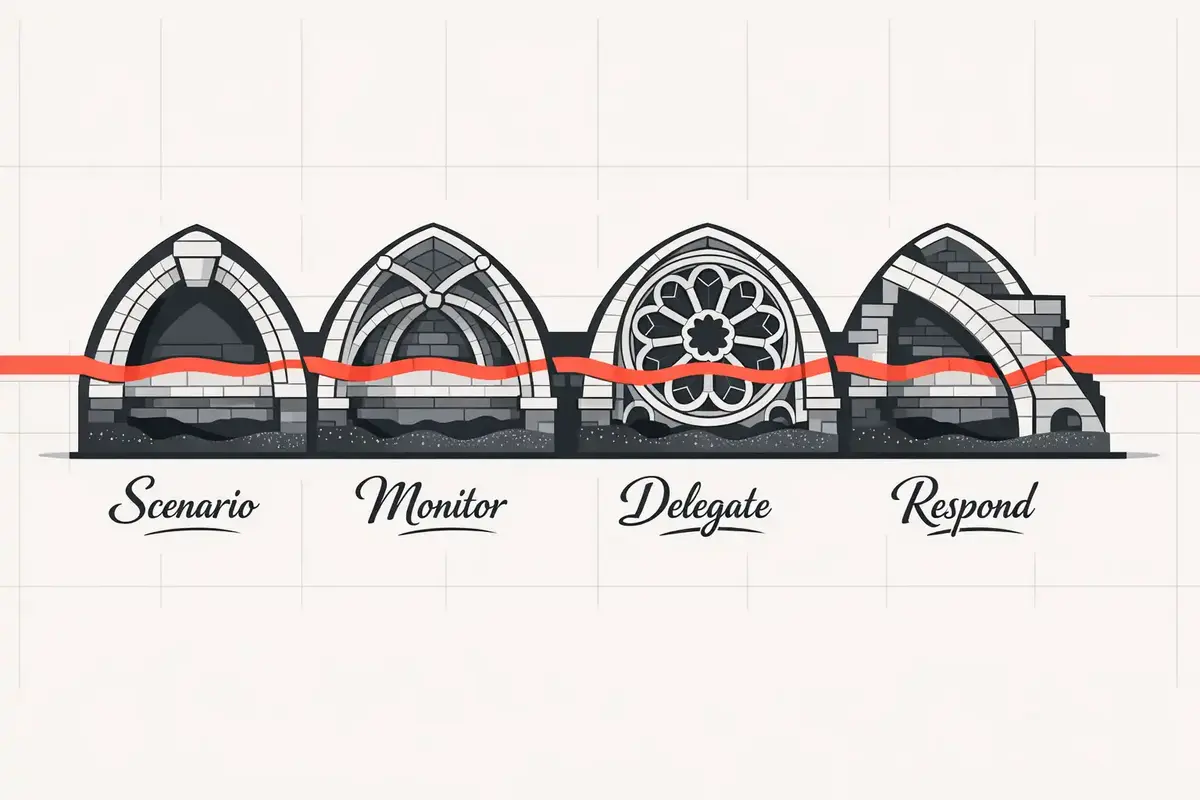
A fully realized risk mitigation framework for a GM blends several key components:
- Iterative risk registers: A dynamic repository of identified risks, status, actions, owners, and follow-ups—updated monthly or after every major event.
- Scenario matrices: Visual tools charting multiple futures (“business as usual,” “adverse supply shock,” “regulatory clampdown”), assigning owners and pre-approved response options for each.
- Trigger/action blueprints: Clear documentation of what signals start a scenario and the first 3 steps to activate a response—who, what, how.
- Contingency development processes: Pre-built action plans for high-impact risks, with playbooks tested via drills or tabletop exercises.
Grounded in the Integral Model’s multi-level framework, these mechanisms empower teams to respond—together and fast—when the unexpected arrives.
How Can Risk Mitigation Enable Innovation (Not Just Prevent Disaster)?
A counterintuitive truth emerges from decades of GM practice: The presence of robust risk frameworks can actually unlock innovation by creating psychological safety for experimentation. When teams know there are agreed-upon contingencies and clear accountability, they’re more willing to try new approaches and challenge conventional wisdom.
“Innovation isn’t stifled by risk management—rather, it flourishes when uncertainty is tamed into clear boundaries for safe exploration.”
This mindset flips a common myth: risk processes are not bureaucratic shackles, but rather the seatbelt that lets you drive faster—provided you know when to brake.
How Do You Embed Risk Culture Into Everyday Business Unit Operations?
For scenario planning and risk mitigation to stick, GMs need to move beyond mere process toward an embedded risk culture. Practical steps include:
- Make risk a standing agenda item: Include “top three risks and their status” in every leadership team meeting.
- Run rapid simulation drills: Quarterly “what if” sessions where teams rehearse responses to the latest scenarios.
- Encourage feedback loops: Invite front-line staff to surface “weak signals” or latent risks from their daily experience—often the earliest warnings.
- Institutionalize post-mortems: Regularly review near-misses or unexpected events, focusing on learning and adapting, not blame.
- Celebrate prudent risk-taking: Recognize teams that spotted risks early or developed creative mitigation, reinforcing positive behaviors.
This approach, grounded in the Integral Model’s multi-level framework, builds resilience not just through process, but by fostering shared vigilance and adaptability.

What Are the Most Common Mistakes GMs Make in Risk Mitigation and Scenario Planning?
Even seasoned leaders fall prey to recurring pitfalls:
- One-time risk workshops: Treating risk assessment or scenario planning as an annual “tick the box” activity, not a living routine.
- Generic playbooks: Building plans around industry templates that ignore the business unit’s unique context, triggers, and people.
- Diffused responsibility: Failing to assign and review ownership on every major risk—leading to blame-shifting and slow response when issues arise.
- Confusing mitigation with control: Mistaking “having a plan” for “having capability”—true readiness comes from drills and iteration, not documentation alone.
- Neglecting feedback: Ignoring front-line input or post-crisis debriefs—letting preventable patterns repeat.
Avoiding these missteps creates both agility and confidence when facing the unexpected.
How Do Metrics, Triggers, and Team Routines Build Resilience Over Time?
The highest-performing business units don’t just “prepare”—they wire anticipation and adaptation into their daily work. Key levers include:
- Defining actionable triggers: For each risk, document the quantitative or qualitative signals that indicate escalation is needed—delays, quality flags, policy shifts, or external news.
- Assigning rapid response routines: For every trigger, agree on first actions and responsible roles, so no time is lost to confusion or hierarchy in a crisis.
- Measuring leading indicators: Track early warning metrics—supplier lead times, NPS dips, staff absenteeism, regulatory updates—on dashboards, reviewed in real time.
- Reviewing and adjusting routines: After every drill or incident, document what worked and what needs refining. Make improvement itself a standing item.
Over time, these routines don’t just protect the business unit—they create a team culture where vigilance, trust, and learning become a source of everyday strength.
FAQ: Mitigating Business Unit Risks
What’s the difference between risk management and risk mitigation?
Risk management is the broad discipline of identifying, assessing, and controlling risks. Risk mitigation is a specific subset—focused on taking proactive actions to reduce the likelihood and impact of those risks. For GMs, mitigation is where strategic planning meets operational execution.
How often should a business unit conduct scenario planning?
Best practice is to run scenario planning at least quarterly, with rapid reassessment following any major market, operational, or regulatory event. Embedding mini-scenarios in regular team routines (monthly check-ins) builds everyday readiness, not just annual preparedness.
What should a risk register contain?
A robust risk register lists each identified risk, its likelihood, potential impact, owner, status/update, triggers, response plans, and review date. The register should be revisited frequently and be accessible to the full leadership team.
Why does risk ownership matter?
Clear ownership ensures risks aren’t “dropped between the cracks.” Each risk needs a point person, not only to monitor it, but also to update assumptions, escalate when triggers occur, and lead response efforts—a foundational element of true leadership accountability.
How do I balance risk mitigation and innovation?
By setting clear boundaries (what risks are allowed; which aren’t), GMs can create space for experimentation within “safe-to-fail” zones. In this way, a strong risk framework empowers, rather than hinders, team creativity.
What role does leadership presence play in risk resilience?
GMs who model open risk conversations, foster psychological safety, and invite feedback drive a risk culture where early warnings are surfaced and learnings are shared—a key to sustained, high-performance adaptability.
How do contingency development and drills help?
Pre-built contingency development plans and regular simulation drills ensure your team doesn’t just “know what’s on paper”—they rehearse real responses, spot gaps, and build confidence under pressure.
Can scenario planning be integrated into performance management?
Absolutely. Leading GMs tie scenario-plan rehearsals, risk ownership, and improvement steps directly into team goals and review cycles—so readiness is rewarded, not just remediation after problems occur.
Risk mitigation isn’t a firewall against disaster—it’s your business unit’s operating system for staying relevant, responsible, and resilient in a world that refuses to stand still. For GMs ready to move risk management from occasional event to everyday advantage, the opportunity is clear: make risk routines as integral as strategy, culture, and performance. What’s the next risk conversation your team needs to have—and how will you lead it?
Continue Your Leadership Journey
- Risk mitigation frameworks for GMs — Stepwise guides and scenario-planning deep dives for proactive business unit leaders
- Leadership accountability in decentralized units — Explore ownership models and hands-on routines for GM-led teams
- Embedding risk culture in your team — Learn how integral team practices fuel continual resilience and high performance
- Practical guide to contingency development — Tools and case examples for building your own business unit response playbooks