

Why Culture Feels Invisible Until AI Makes the Pattern Obvious
Only 20% of U.S. employees strongly agree they feel connected to their organization’s culture—which means most leaders are managing one of the biggest performance variables with weak visibility at best (Gallup, 2025). You see the symptoms in familiar moments: a quarterly review goes off script, a regional services director says collaboration is a value, and three team leads describe the same meeting climate in completely different terms.
That is the real problem with culture. It rarely fails in a dramatic way first. It shows up as mixed signals: survey scores that look stable, rising friction in cross-functional work, stronger compliance language paired with weaker initiative. Leaders then do what leaders often do under ambiguity—they infer culture from the loudest voices, the latest incident, or the cleanest dashboard. The cost is not abstract. Misread culture distorts hiring, slows execution, and turns change efforts into expensive guesswork. This article addresses that gap: how AI can help leaders diagnose culture more accurately by organizing signals they already have, and how AQAL gives that diagnosis a structure.
From intuition to pattern recognition
The timing matters. AI is no longer a side conversation in most workplaces. Gallup found that employee AI use rose from 40% to 45% between Q2 and Q3 of 2025 (Gallup, 2025).
Employee AI use rose from 40% to 45% between Q2 and Q3 2025 (Gallup, 2025)
As AI becomes part of daily work, leaders can use similar capabilities to read cultural signals across employee comments, communication patterns, workflow data, and performance trends. Not to replace judgment. To improve it.
This is where many culture discussions go wrong. They treat culture as either a feeling you sense in the room or a score you extract from an engagement survey. Neither is enough. Culture leaves traces in language, behavior, systems, and outcomes. AI can detect recurring patterns across those traces faster than any leadership team can by hand, especially in larger organizations where meaning gets fragmented across functions and layers.
A mirror, not a verdict
Used well, AI should act as a cultural mirror, not a cultural judge. It can surface contradictions leaders miss: where values language is strong but trust language is weak, where collaboration is praised but decision rights remain concentrated, where performance improves while belonging erodes.
That distinction matters because diagnosis is not the same as truth. A useful culture diagnostic does not tell leaders what to believe. It helps them see what they have been unable to see consistently.
And once the pattern becomes visible, a harder question appears: what kind of evidence actually belongs in the picture—and what gets distorted when you rely on only one lens?
What Does AQAL Actually Add to Culture Diagnosis?
AQAL gives culture diagnosis a map. Without it, leaders tend to collapse very different kinds of evidence into one number—usually a survey score—and then wonder why the intervention misses the real problem.
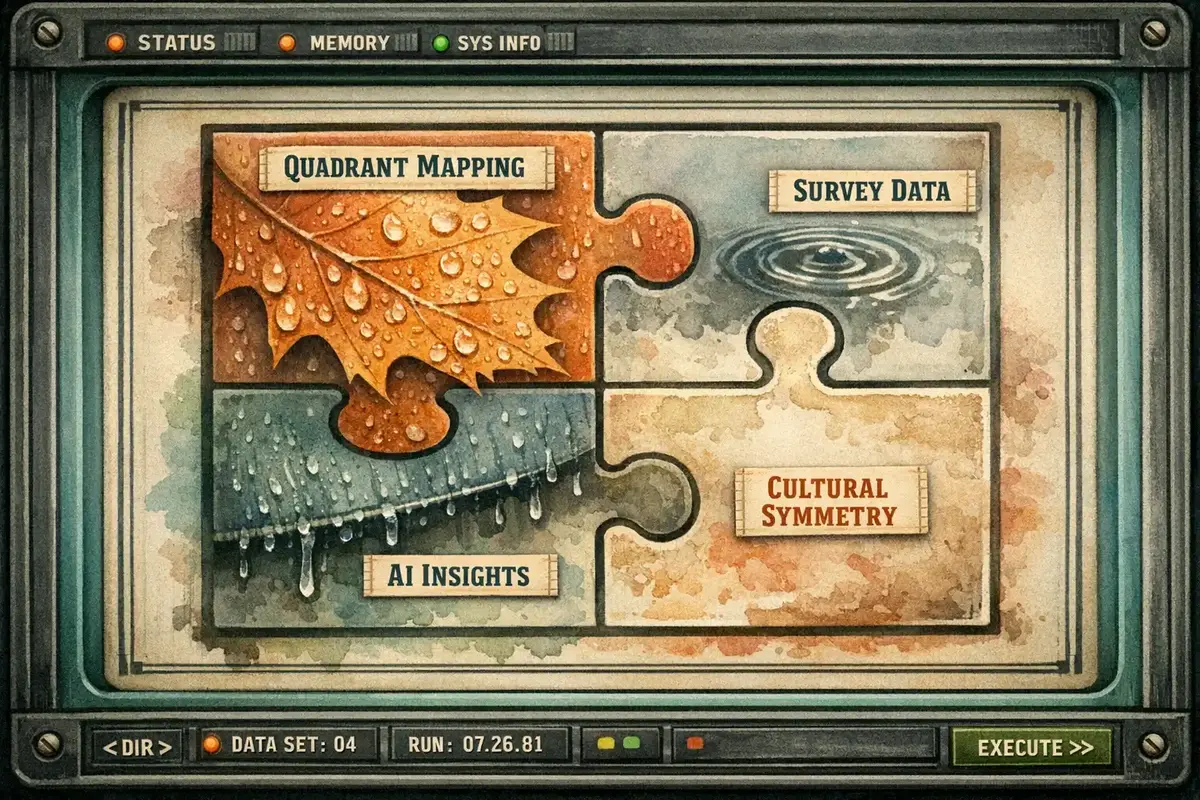
That is the practical value of the AQAL model. It does not make culture abstract. It makes it sortable. The framework, developed within Integral Theory, organizes reality into four quadrants: interior-individual, interior-collective, exterior-individual, and exterior-collective—in plain terms, what people experience, what groups believe, what people do, and the systems they work inside (The Integral Institute). Scrum.org explains the same logic in leadership language: AQAL helps teams avoid treating one perspective as the whole picture (Scrum.org).
Four kinds of evidence, not one
This matters because culture is not one thing. A manager can feel unsafe speaking up in a meeting even while the team publicly says candor is a value. A function can hit every operational target while relying on workarounds, informal gatekeepers, and quiet burnout. Those are not contradictions in the data. They are different quadrants talking.
A regional healthcare provider I worked with faced exactly this during a team restructure. The COO saw stable engagement results and assumed the culture was holding. But the deeper pattern was split across quadrants: clinicians described rising moral strain in interviews, department heads used increasingly defensive language in cross-site meetings, attendance and handoff behavior changed on the floor, and staffing rules made local problem-solving harder. One score could not hold that complexity. AQAL could.
Where AQAL becomes a systems tool
This is the bridge to systems thinking. Most culture work stays either psychological—how people feel—or procedural—how the organization is designed. AQAL forces both into the same frame. The interior side asks what meaning people are making. The exterior side asks what structures and behaviors are reinforcing that meaning. The individual side shows personal experience and action. The collective side shows norms, rituals, governance, and incentives (The Integral Institute).
AQAL’s core contribution is simple: it prevents leaders from mistaking a partial truth for the whole system (Scrum.org)
That changes the quality of diagnosis. If trust is low, is the issue private fear, shared cynicism, inconsistent manager behavior, or a decision process that punishes dissent? AQAL does not answer the question automatically. It tells you where to look so the answer is not guessed.
And that creates the next challenge. Once you accept four quadrants, what data actually belongs in each one—and how much distortion enters the picture when one source dominates?
Which Data Belongs in Each Quadrant — and Why One Source Is Never Enough?
94% of employees and 99% of C-suite leaders say they have at least some familiarity with gen AI tools—so why do culture diagnoses still fail under executive scrutiny (McKinsey, 2025)? If AI can already read so much organizational data, shouldn’t culture finally become measurable? Not quite. Most failures come from a simpler mistake: leaders confuse available data with adequate evidence.
A single source always looks cleaner than reality. That is the trap.
In AQAL terms, surveys are strongest in the interior-collective quadrant. They capture shared perceptions: belonging, trust, fairness, psychological safety, confidence in leadership. That matters because culture is partly a story people tell together about what is safe, rewarded, and expected. But surveys are still self-report instruments. They show what people are willing to say, what they can name, and what the question set anticipated. They do not reliably show what happens between the questions.
What surveys can’t see clearly
That gap is where communication data and collaboration patterns become useful. Meeting transcripts, channel activity, response times, escalation paths, network density, and cross-functional handoffs often reveal relational dynamics that survey averages flatten. A team may report acceptable trust levels while still routing every difficult decision through one manager, excluding peers from key threads, or slowing sharply when a particular function is involved. Those are not feelings. They are patterned behaviors.
During a quarterly review at a mid-market manufacturing company, a VP saw stable engagement scores and assumed the integration effort was on track. The communication graph said otherwise: plant managers had stopped contacting engineering directly, issue resolution time had stretched, and nearly every exception request was being rerouted upward. The survey showed sentiment. The network showed dependence. Together, they produced an actual diagnosis.
The exterior quadrants are where culture gets enforced
Then come the exterior-individual and exterior-collective quadrants: performance metrics, workflow data, policy design, approval layers, incentives, turnover patterns, promotion criteria. These are the systems that shape behavior whether people endorse them or not. If collaboration is praised but bonuses reward local optimization, the incentive system is telling the truth. If innovation is a stated value but approvals require six signatures, policy is the stronger cultural signal.
This is why serious culture diagnostics need synthesis, not accumulation. 62% of respondents say AI is already used somewhere in their organization (SHRM, 2026). The opportunity is not just more analysis. It is better separation of signal from noise across quadrants—subjective, relational, behavioral, systemic.
And once those streams are combined, a harder problem appears: what should leaders conclude when the quadrants do not agree—when people say one thing, do another, and work inside systems pushing a third logic?
Why AI Adoption Data Matters Before You Trust the Diagnosis
88% of businesses use AI in at least one function—so if your culture diagnostic misreads what that usage means, the cost is not theoretical; it shows up in slower decisions, weaker trust, and good people deciding the system is no longer worth navigating (World Economic Forum, 2025). When AI is already part of work, what separates a useful cultural readout from a dashboard that merely looks sophisticated is not the model. It is leadership readiness.
Adoption is no longer the constraint
The practical implication is straightforward: culture diagnostics do not need to wait for some future digital maturity. The infrastructure is already there. Gallup found that 49% of employees said they use AI at least a few times a year (Gallup, 2025), which means AI-generated traces now exist inside ordinary workflows—search behavior, drafting patterns, decision support, knowledge retrieval, escalation habits.
That changes the operating question. Not should we bring AI into culture diagnosis, but how carefully are we interpreting the signals it already leaves behind?
A regional financial services firm learned this the hard way during budget season. The executive team saw rising use of AI assistants in reporting and assumed it signaled adaptability. At the director level, the same pattern meant something else: managers were using AI to compensate for unclear priorities and overloaded review cycles. The data showed adoption. The culture issue was dependence under pressure. Without context, the dashboard rewarded the wrong story.
Familiarity is not competence
This is where many leadership teams get overconfident. They mistake exposure for fluency.
An employee who uses AI to summarize meetings is not making the same cultural meaning as a VP using it to shape headcount scenarios. A frontline manager may see AI as surveillance by another name; a senior leader may see it as neutral efficiency. Same system, different interpretation. That gap matters because culture diagnostics are not read in a vacuum. They are filtered through status, incentives, and prior beliefs about control.
Research consistently shows that tools adopted unevenly create uneven trust. If leaders want a diagnostic that helps rather than hardens defensiveness, they need governance, explanation, and visible leadership support around how AI findings will be used.
The real test is judgment
The strongest organizations use AI as an amplifier of judgment—not a substitute for it. They ask whether a pattern deserves inquiry, not whether the system has delivered a verdict.
That distinction becomes decisive when the evidence starts to split. If one quadrant says confidence is high and another shows avoidance, which signal should leaders trust—and what does the disagreement itself reveal?
What Happens When the Quadrants Disagree?
The most revealing culture data usually appears when the story breaks. In a budget review, a technology company’s VP praises collaboration, then approves bonuses tied almost entirely to individual output; everyone in the room understands the real message immediately.
That gap is not a side issue. It is the diagnostic.
Contradiction is evidence, not noise
When quadrants disagree, leaders often assume the data is flawed. More often, the disagreement is the finding. A company can speak in the language of teamwork, see decent sentiment in one part of the organization, and still run on systems that reward speed, local wins, and personal visibility. The interior story says, “We succeed together.” The exterior system says, “Protect your own score.”
Research on alignment makes the business consequence hard to ignore. Organizations that are fully aligned on purpose, strategy, and culture reported stronger growth outcomes over time (SHRM).
Organizations fully aligned on purpose, strategy, and culture reported an average of 44.5% revenue growth over three years (SHRM)
That is why mismatch matters so much. It shows where values are decorative, where incentives are stronger than leadership language, and where short-term metrics are quietly training the wrong behavior.
What AI can surface — and what it cannot decide
This is where AI becomes genuinely useful. It can detect recurring misalignment patterns across language, behavior, and systems faster than a leadership team can by hand. It can show that collaboration is celebrated in town halls, while performance reviews favor solo achievement; that managers talk about innovation, while approval paths punish deviation; that one function reports optimism, while another has learned to avoid risk.
The World Economic Forum found that senior executives widely expect AI to trigger a broader culture shift toward more innovative teams (World Economic Forum, 2025). That expectation is reasonable. But innovation does not come from pattern detection alone. It comes from what leaders do with the contradiction once it is visible.
The judgment call leaders cannot outsource
Not every mismatch means the same thing. Some are strategic: the business says it wants collaboration, but the operating model still depends on internal competition. Some are structural: the values are sincere, but incentives and metrics were never redesigned. Some are ethical: leaders know the system rewards harmful behavior and tolerate it because results still look good.
AI can surface the fracture. Humans have to name it.
And that raises the harder leadership question: when the contradictions are clear, where do you intervene first—beliefs, behaviors, or the system that keeps reproducing both?
Where Should Leaders Start If They Want a Culture Diagnostic That Actually Helps?
AQAL matters most at the start, not the end. What if the best next step is not more data, but a better question about what the data is supposed to explain?
Most leaders begin in the wrong place. They ask what data they can access, which usually means surveys, engagement comments, or collaboration logs. That feels efficient. It is also how a culture diagnostic turns into a pattern hunt with no governing hypothesis.
Start with the question, not the feed
A useful diagnostic begins with a cultural question precise enough to rule data in and out. Not “What is our culture?” but “Why do smart disagreements die before decisions get made?” or “Why does cross-functional work slow down at handoff points?” The question determines the evidence. Without that discipline, leaders confuse volume with clarity.
This is where systems thinking becomes practical. If the question is about stalled decisions, the interior quadrants may require interview themes, manager narratives, or psychological safety signals; the exterior quadrants may require approval-path data, meeting behavior, or escalation patterns. Research from CCL consistently points to leadership context and psychological safety as central conditions for whether AI-enabled change efforts gain traction or trigger defensiveness (CCL).
Compare signals, then force a human read
In a regional retail company during a client escalation cycle, a director saw AI analysis flag “low accountability” across store support teams. That sounded plausible. It was also incomplete. Human review showed a different pattern: team leads were not avoiding ownership; they were waiting on conflicting instructions from merchandising and operations. The loud symptom was behavioral. The real constraint was structural.
That is the workflow leaders need. Define the question. Map evidence to quadrants. Compare the signals. Then validate the AI readout with people who know the work well enough to spot false certainty, local exceptions, and political distortion.
Culture Partners makes a similar point from the change side: interventions work when they match the real operating system, not just the values statement on the wall (Culture Partners). That is why validation matters. AI can cluster language and detect anomalies. It cannot tell you whether a pattern reflects fear, overload, unclear authority, or a temporary market shock.
Intervene where the constraint is strongest
The first intervention should target the quadrant with the strongest constraint, not the noisiest complaint. If trust language is weak because decision rights are opaque, another listening session will not fix it. If collaboration breaks down because managers feel unsafe raising tradeoffs, redesigning workflow alone will underperform.
The discipline is simple. Diagnose the bottleneck, then act there.
Because once leaders see the pattern clearly, a harder issue remains: how much judgment should they hand to the system—and how much should stay unmistakably human?
The Real Value of AI Culture Diagnosis Is Better Judgment, Not Faster Certainty
AQAL matters here because the cost of a bad culture read is rarely a bad slide; it is trust drained from the system, strong people leaving, and leaders funding fixes for the wrong problem. When the dashboard is no longer the bottleneck, the real question is whether leaders will use AI to flatten culture into a score—or understand it as a system.
From scorekeeping to signal reading
A single number is comforting. It is also dangerous.
In a regional services firm during annual planning, a C-suite team saw stable engagement results and assumed the culture could absorb another operating-model change. Three months later, two respected managers had left, client escalations were rising, and the executive team was still arguing about whether the issue was workload, leadership, or resistance to change. The failure was not lack of data. It was overconfidence in one kind of data.
That is where AI becomes genuinely useful. Not because it produces certainty faster, but because it helps leaders see more of the system at once: what people say, how teams relate, what behavior gets repeated, and which structures keep reproducing the same outcomes. As familiarity with AI becomes widespread—94% of employees and 99% of C-suite leaders reported some familiarity with gen AI tools—the differentiator is no longer access to the technology. It is the quality of interpretation around it (McKinsey, 2025).
The real gain is not a perfect answer. It is fewer false conclusions drawn too early.
AQAL as a discipline against simplification
This is why AQAL is more than a conceptual frame. It is a restraint on executive bias.
It forces attention across four kinds of evidence: interior experience, shared meaning, observable behavior, and structural conditions. That matters because organizations routinely mislabel structural friction as attitude, or read private concern as cultural weakness when the real issue is incentive design. If 62% of respondents said AI is currently used somewhere in their organization, then many firms already have enough signal to diagnose patterns; what they often lack is a disciplined way to organize those signals before acting (SHRM, 2026).
The best leadership teams treat AI outputs as prompts for better questions. What are we rewarding? What are we enabling? What are we ignoring because the metric still looks acceptable?
What good judgment looks like now
The strongest outcome is not diagnostic perfection. It is a sharper conversation.
A useful culture diagnosis should make it harder for leaders to hide behind averages, anecdotes, or the politics of the loudest room. AI is the diagnostic amplifier. AQAL is the organizing lens. Judgment remains human work—messy, contextual, accountable.
That is the closing test in your own context: are you using AI to simplify culture into something easier to report, or to understand it well enough to change what the organization actually rewards?
Key Takeaways
- Culture often becomes visible through mixed signals, not dramatic failure.
- AI can surface recurring patterns across language, behavior, and systems.
- AQAL helps organize culture evidence into four quadrants.
- The goal is better judgment, not faster certainty.
Frequently Asked Questions
What does it mean to diagnose organizational culture with AI through an AQAL lens?
It means using AI to detect patterns in employee language, behavior, and systems, then organizing those signals with AQAL’s four quadrants: interior-individual, interior-collective, exterior-individual, and exterior-collective. This helps leaders see culture as a system of experiences, shared meanings, actions, and structures rather than a single survey score.
Why is AI useful for culture diagnosis instead of relying only on surveys or leadership intuition?
AI can process large volumes of comments, communication patterns, workflow data, and performance trends much faster than people can by hand, making hidden contradictions easier to spot. Surveys and intuition still matter, but they often miss what happens between questions or across teams, which is where many cultural problems show up.
What kinds of data belong in each AQAL quadrant for culture analysis?
Interior-collective data includes surveys and shared perceptions such as trust, belonging, and psychological safety. Exterior data includes observable behavior and systems such as meeting patterns, handoffs, approval layers, incentives, turnover, and performance metrics, while interior-individual data comes from personal experience and exterior-individual data from visible actions.
What should leaders do when different data sources or quadrants disagree?
Disagreement is often the diagnosis, not a data error. If people say collaboration is valued but systems reward individual wins, the mismatch reveals where the real culture is being enforced, and leaders should investigate the strongest constraint rather than assuming one source is wrong.
How should leaders use AI culture diagnostics without overtrusting the results?
Leaders should start with a precise cultural question, map evidence to the relevant quadrants, and validate AI findings with people who understand the work. AI should be treated as a tool for better judgment, not a final verdict, because it can surface patterns but cannot decide whether those patterns reflect fear, overload, unclear authority, or structural misalignment.