

Leadership development for Chief Marketing Officers (CMOs) is the specialized process of equipping senior marketing leaders to navigate the unique demands of brand strategy, digital transformation, C-suite alignment, data-driven decision-making, and high-performance team building. Designed for current and aspiring CMOs, this approach fuses strategic influence, market innovation, and human-centric leadership. By the end of this guide, marketing executives will understand precisely what differentiates effective CMO leadership development, why generic approaches fall short, and which frameworks truly elevate both organizational results and career trajectories.
The Modern CMO: A Crucible of Complexity and Opportunity
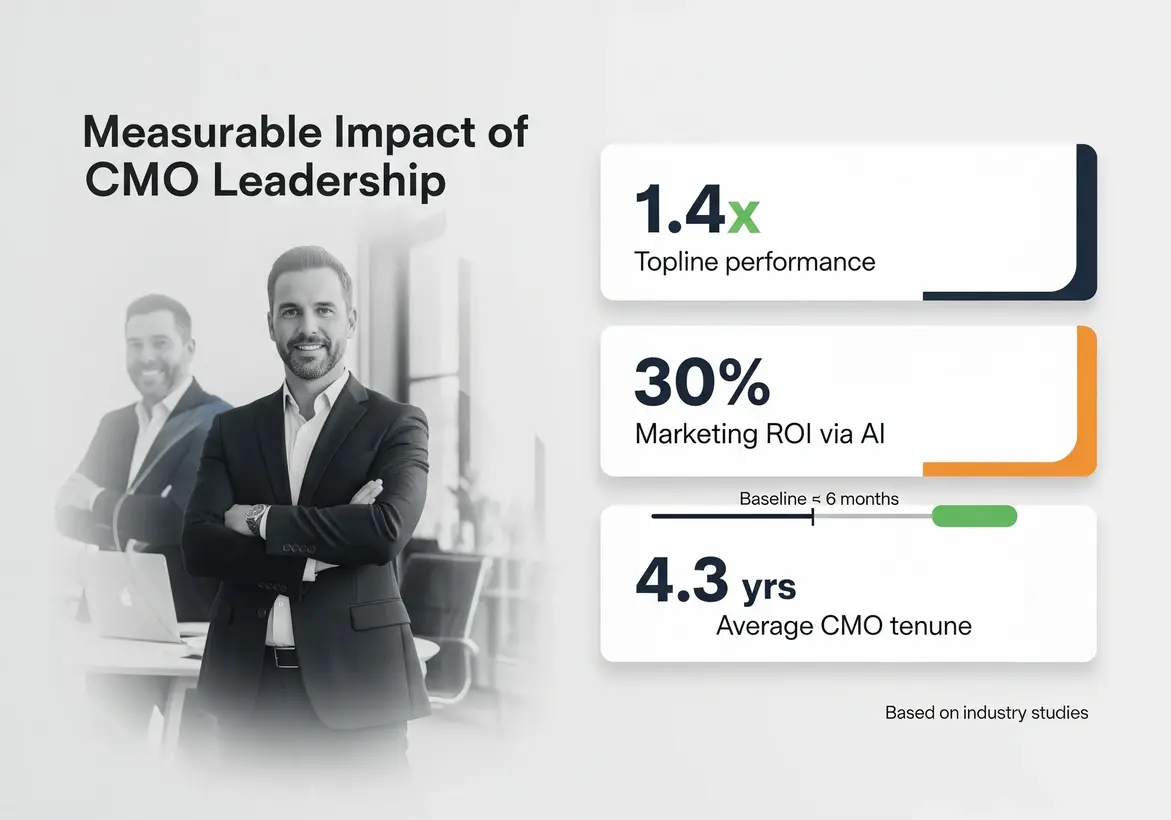
Today’s CMO sits at the intersection of relentless change, competing expectations, and career-defining pressure. The average CMO tenure for Fortune 500 companies is just 4.3 years (Spencer Stuart, CMO Tenure Study, 2024), a stark figure underscoring a highly volatile role. The stakes could not be higher—research reveals that organizations with integrated, customer-centric marketing leadership outperform peers, delivering 1.4 times higher topline performance and 2.3 times higher growth (Russell Reynolds, “The CEO-CMO Relationship”, 2023).
Yet, the forces shaping the CMO mandate grow more complex each year:
- Proving quantifiable ROI to a board that scrutinizes every dollar
- Balancing rapid advances in AI and data with the nuances of brand authenticity
- Orchestrating brand purpose, customer experience, and digital engagement in a still-siloed corporate environment
- Managing, motivating, and transforming diverse marketing teams for agility and innovation
The CMO role is truly a crucible—both a test and an opportunity—for those able to master new dimensions of leadership development.
Why CMOs Need Specialized Leadership Development — Not Generic Executive Coaching
It’s tempting to think that “executive coaching” is one-size-fits-all. Yet, for CMOs, broad-based executive coaching programs—however rigorous—often miss the vital technical, political, and creative realities unique to marketing’s C-suite.
Here’s where this specialization matters:
- Cross-functional complexity: CMOs frequently lead matrixed, cross-disciplinary teams and must influence peers in finance, IT, product, and HR. Standard coaching may touch on “influence,” but rarely offers tailored frameworks for navigating power dynamics with the CFO, CIO, or CEO.
- Pressure to prove marketing ROI: Unlike other C-suite roles, CMOs must defend both creative investments and bottom-line impact, often presenting sophisticated narratives backed by hard data to audiences with varying marketing literacy.
- AI, data, and digital transformation: The expectation to deliver market innovation through emerging tech and analytics is more acute for marketing leaders—generalist executive programs seldom address this technical-creative balance.
- Brand and purpose: CMOs are stewards of a company’s public promise. Translating purpose into daily action amid shifting consumer behavior and skepticism demands a distinct suite of leadership tools.
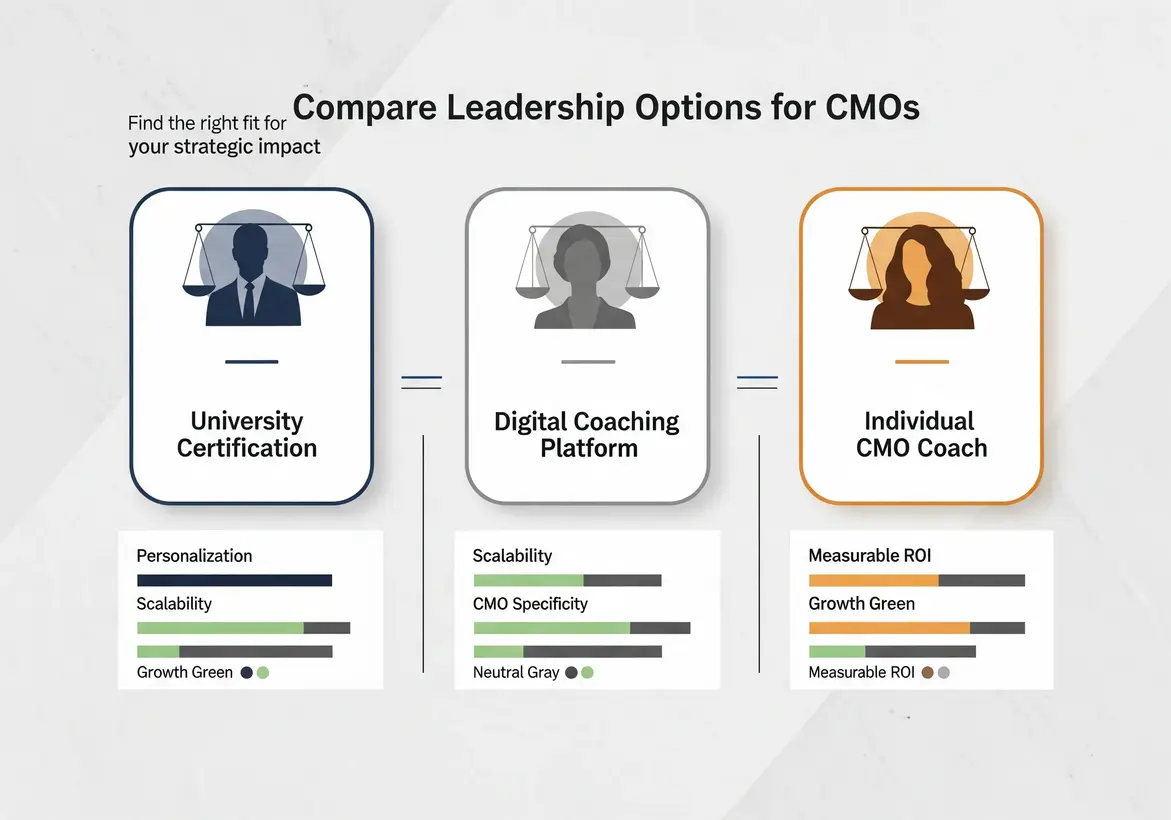
Few traditional offerings—from executive coaching certifications like those at Harvard DCE to platform-driven leadership programs—deliver the practical, CMO-specific playbooks, peer stories, or real-time, confidential partnership needed to navigate this landscape (Harvard DCE: Executive Leadership Coaching, 2024).
What Are the Key Pillars of Integral Leadership for CMOs?
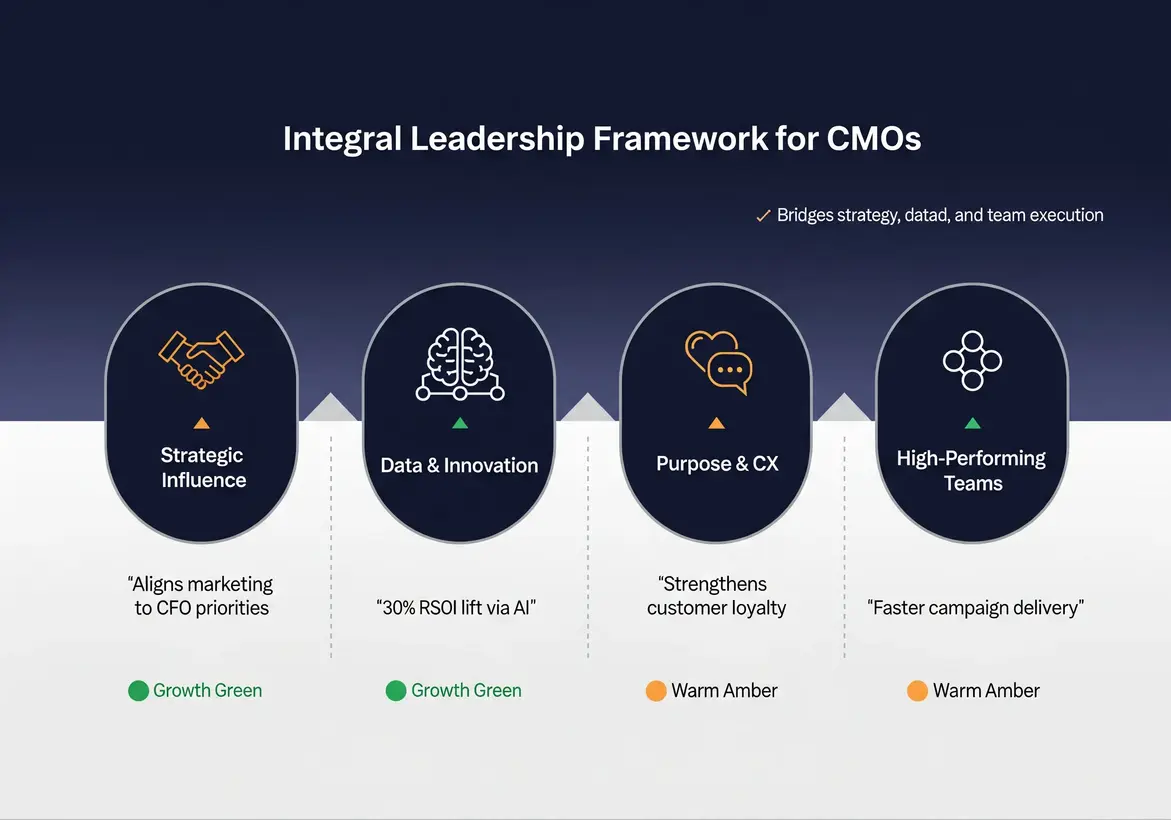
Drawing on TII’s two-decade integral methodology, an effective approach to CMO leadership blends four essential pillars. Each addresses a critical gap left by generic programs and aligns tightly with the demands of modern marketing leadership.
Strategic Influence & C-Suite Navigation
The Challenge: Securing strategic influence with cross-functional peers is consistently rated the top “overlooked technical detail” in CMO development. Marketing often stands at a cultural remove from finance or IT, leading to misunderstanding and underrepresentation at the most critical decision tables.
The Solution:
At the core of integral leadership lies a framework for building robust alliances. This includes:
- Developing political acumen and “translational” communication skills—bridging the gap between marketing creativity and CFO rigor
- Leveraging advanced stakeholder mapping to identify and influence critical decision-makers across organizational silos
- Practicing board-level storytelling, marrying data precision with strategic narrative to advocate for marketing’s central role
“CMOs most successful at C-suite alignment can attribute up to 60% of their annual budget growth to cross-functional advocacy rather than marketing metrics alone.”
(Russell Reynolds, “The CEO-CMO Relationship”)
CMOs routinely cite confidential, scenario-based coaching as pivotal for navigating executive politics and building the influence their teams and brand need.
Data-Driven Vision & Market Innovation
The Challenge:
Marketing now hinges on sophisticated technology, analytics, and automation. But unlike CIOs or CFOs, CMOs must harness these tools without losing sight of bigger-picture vision, creativity, and customer connection.
The Solution:
Grounded in the Integral Model’s multi-level framework, the most effective development for CMOs uses a dual lens:
- AI as a Growth Engine: Advanced coaching methods demystify AI for marketing leaders, enabling practical adoption of predictive analytics, automated personalization, and operational efficiency. Companies adopting AI under strong CMO leadership see a 30% lift in marketing ROI within a year.
(Evokad, “AI Integration in Marketing”, 2024) - Insight-Driven Agility: Real-time coaching interventions focus on agile strategy—the ability to pivot messaging, test innovations, and recalibrate go-to-market plans in response to real data.
- ROI Narrative Crafting: Tailored frameworks prepare CMOs for “show me the value” stakeholder sessions, providing proven steps for using dashboards, 360° data visuals, and outcome-based storytelling to turn skepticism into buy-in.
This approach directly addresses a gap in popular coaching platforms (like BetterUp), which rarely combine hands-on market tech guidance with leadership development for the CMO’s distinct needs.
Purpose-Driven Branding & Customer Experience Leadership
The Challenge:
As brand stewards, CMOs shape both the external promise and the lived experience customers encounter. In today’s market, authenticity and purpose have become not just marketing initiatives but business imperatives.
The Solution:
An integral approach to leadership development for CMOs weaves purpose, brand narrative, and customer experience into a seamless strategy:
- Authentic leadership narratives: Individual coaching surfaces personal values and helps CMOs craft leadership messages that resonate internally and externally
- Adaptive brand playbooks: Reflecting on evolving consumer behaviors, coaching focuses on scenario planning, empathy-based messaging, and ethical considerations at scale
- CX orchestration: CMOs benefit from frameworks that align IT, operations, and service teams behind customer experience principles—akin to conducting a brand symphony rather than siloed solos
Notably, this goes far beyond “storytelling” tips—integral leadership development here draws on CMO peer learning, team diagnostics (including AI-assisted tools), and actionable feedback models that link daily action to long-term reputation.
Building & Empowering High-Performing Marketing Teams
The Challenge:
Rapid turnover, shifting talent pools, and higher demands for agility mean CMOs can no longer rely on legacy command-and-control. Instead, success hinges on team culture, adaptability, and continuous learning.
The Solution:
Integral Team Coaching for CMOs focuses on:
- Talent assessment and development protocols—identifying rising stars, fostering peer feedback, and encouraging a learning culture that sparks innovation
- Cross-functional integration—developing skills to rally disparate skill sets and backgrounds around shared marketing objectives (see: cross-functional integration)
- Agile leadership routines: Implementing rhythm practices (standups, retrospectives, design sprints) that keep teams future-ready and responsive to market shifts
- Feedback and psychological safety: Using structured feedback models to build teams equipped to challenge, create, and continuously improve
Teams under integral CMO guidance report stronger engagement scores, lower turnover, and higher rates of successful campaign execution. These results are measurable, not just theoretical.
How Does Leadership Development for CMOs Deliver Measurable Impact?
Top-performing CMOs are not just better “marketers”—they are multidimensional leaders whose teams, brands, and careers consistently outperform peers. Robust leadership development programs produce outcomes that matter:
- Organizations with customer-centric CMO leadership enjoy up to 2.3x growth over their segment medians (Marstudio/Russell Reynolds, 2023)
- CMOs who master cross-functional influence and ROI storytelling see annual marketing budget gains of 20–60%—resources directly linked to business impact (Russell Reynolds, 2023)
- Adopting AI-driven strategy under CMO leadership lifts marketing ROI by 30%, driving rapid credibility gains with the board (Evokad, 2024)
- 10% of Fortune 500 CMOs ascend to CEO roles post-tenure, with 65% moving to bigger corporate opportunities (Spencer Stuart, 2024)
Success stories consistently surface around three themes:
- Strategic credibility—regardless of market turbulence, effective CMOs become indispensable, frequently being considered for CEO succession
- Team transformation and retention—agile, well-developed teams execute at higher velocity, and are less likely to churn or burn out
- Enduring brand growth—CMOs with integral development consistently evolve their organization’s value proposition as markets shift
These tangible metrics set specialized CMO development apart from both academic executive coaching certifications and digital coaching platforms.
How Does the Integral Approach Personalize the CMO Leadership Journey?
Rather than offering a prescriptive, generic curriculum, the integral methodology centers on each CMO’s real-world context.
Confidential Engagement: All coaching and mentorship is conducted within a confidential, high-trust container. This allows CMOs to tackle sensitive issues—C-suite politics, career transitions, failing campaigns—without fear of perception risk.
1:1 and Group Formats: Both immersive individual sessions and peer-based development are used, offering the benefits of tailored playbooks as well as “tested-in-the-field” peer learning (more on peer learning).
Active Diagnostics: Every engagement begins with base-lining using tools such as 360° leadership assessments, team climate surveys, and stakeholder mapping. This ensures all interventions are matched to specific challenges, not just industry generalizations (team diagnostics).
Custom Protocols for Rapidly Changing Marketing Landscapes: Integral CMO programs feature built-in agility, frequently updating leadership protocols for sector customization and adapting to emerging trends—from TikTok culture shifts to privacy tech advancements (custom protocols for rapidly changing marketing landscapes).
“CMOs leveraging individualized leadership journeys have reported 2-4x higher effectiveness in responding to market disruptions than those using standardized programs.”
(Marstudio, “Marketing Leadership Evolution”, 2023)
Backed by over 40,000 hours of certified coaching practice, this methodology ensures every CMO, regardless of industry or region, receives precision-tuned guidance.
Is This Approach Right for You? Self-Assessment for CMOs
To determine if integral leadership development is a fit for your journey, consider:
- Are you responsible for both brand narrative and direct revenue results—and finding it harder to tell that story across the C-suite?
- Does your marketing team operate in silos or struggle with cross-functional integration?
- Have board-level presentations or CFO discussions highlighted a gap in data-driven advocacy?
- Are you managing transformation—AI, digital, global expansion—on a timetable much shorter than your assumed tenure?
- Do your ambitions include CEO candidacy, legacy-building, or tackling bigger-market roles as your next step?
If you recognize these realities, a CMO-specific leadership journey—grounded in proven, integral leadership models—will likely unlock new horizons of influence, innovation, and impact.
FAQ: Leadership Development for CMOs
How is leadership development for CMOs different from general executive coaching?
General executive coaching covers broad leadership principles, but it doesn’t address the CMO’s blend of creative, technical, and political challenges. Specialized CMO programs focus on unique pain points: defending marketing ROI, building influence with non-marketing C-suite peers, mastering AI adoption, and leading through rapid innovation cycles.
What outcomes can I expect from CMO-focused leadership development?
You can expect improved cross-functional influence, higher success rates in securing marketing budgets, stronger brand growth, and higher team performance. Top CMOs using integral leadership report 1.4x topline performance, 2.3x growth, and higher career mobility (Russell Reynolds, Spencer Stuart, 2024).
How does confidentiality work in CMO coaching engagements?
Confidentiality is foundational—no session content is shared outside the agreed team unless initiated by the client. This trust enables honest discussions on sensitive topics like C-suite politics, brand crises, and personal career strategy.
Is the program adapted for different industries and international markets?
Yes. Integral leadership development uses custom protocols reflecting sector dynamics, regional consumer behaviors, and compliance requirements. Frameworks are tailored for both global corporations and high-growth, digitally native brands (see: sector customization).
What is the average investment for CMO leadership coaching?
Fees vary widely. 1:1 CMO executive coaching ranges from $350–$1,000 per hour, with full programs from $5,000–$30,000+ for multi-month engagements. The value is measured not just in personal growth, but in quantifiable marketing and business results.
Does the approach use digital and AI-enabled coaching tools?
Yes. Programs may include digital dashboards, AI-driven team diagnostics, and virtual coaching sessions. However, the core is always high-touch, confidential, and customized according to participant goals and context (coaching methodology/framework diagram).
Can CMO leadership development help with immediate business crises (e.g., PR failures, sudden market change)?
Absolutely. Integral CMO coaching is designed for high agility—able to pivot from long-term capability building to intensive, scenario-specific strategy in crisis situations.
Does the program support peer learning from other CMOs?
Yes. Peer storytelling, Mastermind-style groups, and collaborative learning modules are integrated, supporting both knowledge transfer and network building among senior marketing leaders (leadership development market).
Continue Your Leadership Journey
- Unlock world-class leadership development — Explore our comprehensive approach to building authentic, future-ready CMOs through integrated leadership and practical frameworks
- Discover the foundations of integral leadership — Learn how our model unites strategic, operational, and human-centric disciplines for sustainable impact
- Transform your marketing teams — See how executive coaching catalyzes agile, high-performance marketing organizations from the inside out
- Stay ahead with expert marketing leadership insights — Access the latest trends, peer stories, and future-focused thought leadership for today’s CMO challenging the status quo
Leadership for CMOs isn’t just about keeping pace—it’s about setting it, bringing every facet of the brand, business, and people along for the journey. What’s the next evolution in your own leadership story?