

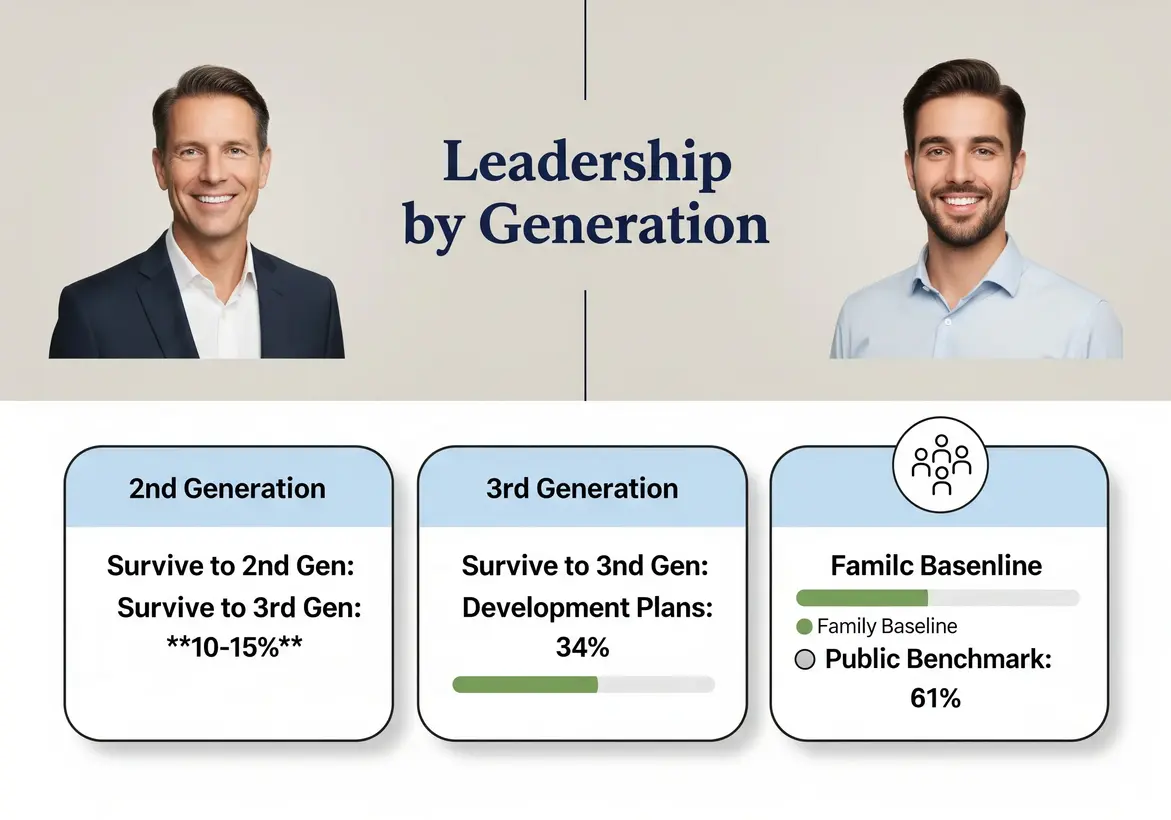
Only 30-40% of family businesses make it to the second generation, and just 10-15% survive to the third, largely due to poorly managed succession, unresolved conflicts, and unprepared C-suite heirs (Source: HBR, Cambridge Family Enterprise Group, 2025). For next-generation leaders in family enterprises, effective leadership development is not just about learning business skills—it is about navigating legacy, managing family dynamics, and building the professional structures needed to both honor tradition and drive future success. By the end of this guide, you will understand the nuanced, high-stakes challenges facing 2nd and 3rd generation C-suite family business executives, and walk away with frameworks, insights, and next-action clarity for building resilient, future-ready leadership.
Executive Summary & The Succession Crisis
The succession crisis in family businesses is more than a cliché statistic—it’s a lived reality for thousands of organizations facing the transition from founder dominance to new-generation stewardship. Data shows that 70% of family businesses fail to transition successfully by the second generation and nearly 88% by the third (Source: John Ward, Family Business Institute; HBR, 2022). The heart of this crisis is a tangled web of emotional attachment, governance gaps, and unclear leadership development pathways.
For C-suite successors—especially those in second and third generations—the pressure is acute. They must honor family values and legacy, build legitimacy in the eyes of family and non-family stakeholders, and rapidly develop advanced skills for a world that is vastly different from the one their predecessors knew. The stakes are personal and professional: reputations, livelihoods, and the family name itself are on the line.
If you are a next-gen C-suite leader or advising one, these challenges are not abstract—they are tomorrow’s board meeting agenda, tonight’s family dinner subtext, and the undercurrent of every business decision.
Decoding Generational Leadership: Challenges & Opportunities
What are the core transitions and pain points for 2nd and 3rd generation C-suite family executives? Three generational arcs emerge, each with its unique dynamic:
-
G1-G2 (Founder to Children): The classic founder shadow looms large. The second generation must navigate a delicate shift from operational dependency on the founder to stewardship and legitimacy of their own. Emotional challenges (parental reluctance to let go, the pressure to prove worth) are common derailers (Source: Cambridge Family Enterprise Group, Five Derailers of Succession).
-
G2-G3 (Siblings/Cousins): As the family tree branches, diluted vision, burgeoning stake-holder complexity, and governance gridlock can paralyze progress. The third generation often faces group leadership, more professionalization, and a growing need for structured governance mechanisms.
Yet, each generation brings vital strengths:
- G2 often pioneers professionalizing family business operations, instituting formal governance, and introducing external advice
- G3 typically accelerates global perspectives, digital fluency, and risk appetite
What unifies these generations is the intersectional challenge of leading as both a business executive and a family steward. Unlike public company C-suite, family business executives face an added, invisible layer: simultaneously preserving tradition and reimagining the future.
The Integrated Leadership Development Framework for Family Business C-Suite
Which leadership development frameworks address these intergenerational complexities most effectively? Drawing on The Integral Institute’s two-decade integral methodology, a multidimensional approach is required—one that develops C-suite successors as both business leaders and family ambassadors.
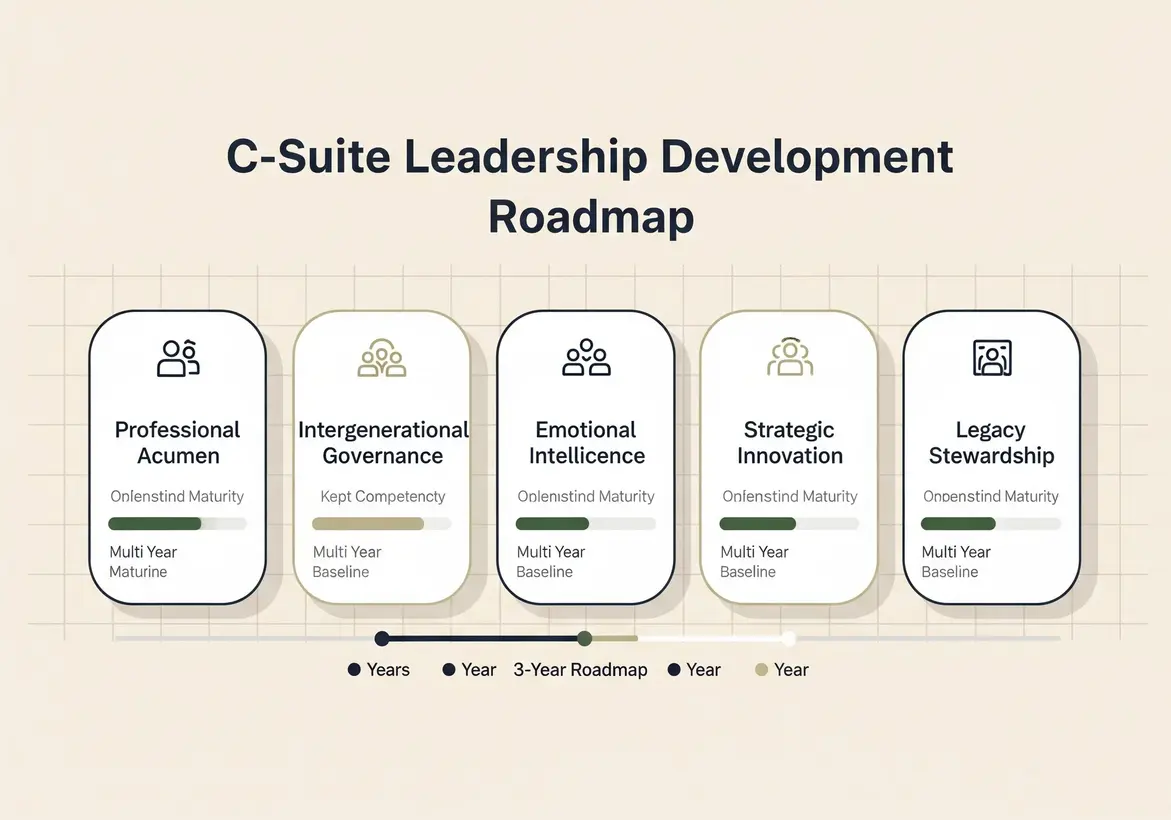
We propose a 5-Pillar Integrated Leadership Development Framework for family business C-suite:
- Professional Acumen – Building advanced capabilities in strategy, finance, and operations with an eye towards benchmarking against best-in-class external standards.
- Intergenerational Governance – Establishing and managing family charters, governance for family business, councils, and decision rights; mastering succession planning as a process, not an event.
- Emotional Intelligence & Conflict Mastery – Developing self-awareness, empathy, and advanced conflict resolution in family business, given the heightened emotional stakes.
- Strategic Innovation – Balancing the preservation of family values with breakthrough innovation, digital adoption, and global expansion.
- Legacy & Stewardship – Nurturing a sense of purpose, shared vision, and responsibility for both the business and the broader family legacy.
Each pillar is interdependent, demanding a holistic rather than piecemeal development pathway—often best served through leadership development programs explicitly tailored to next-generation family C-suite contexts.
Module 1: Mastering Intergenerational Governance & Succession Planning
Why is diagnosing root causes important before implementing leadership training programs?
Too often, succession fails not due to a lack of technical skill, but because emotional and governance “derailers” go unaddressed. As Professor John A. Davis’ “Five Derailers” framework demonstrates, lack of readiness is usually an outcome of:
- Founder reluctance to surrender control
- Ambiguous or weak governance structures
- Poorly defined succession processes (seeing it as an “event” vs. a multi-year journey)
- Absence of clear criteria for successor selection and role design
- Family misalignment on vision or values (Source: CFEG, Five Derailers of Effective Succession)
A robust development roadmap for next-gen C-suite must therefore start with diagnostic clarity—mapping family and business needs, clarifying roles, and creating a dynamic succession timeline, not just a “handover date.”
Which organizational assessment methods best identify performance challenges?
Thorough governance diagnostics may include:
- Family climate assessments (mapping trust, cohesion, and readiness)
- 360° feedback for C-suite successors
- Governance structure audits: reviewing the family charter, board composition, and council effectiveness
- Stakeholder alignment workshops: surfacing points of agreement and latent conflict
Drawing on the Integral Model’s multi-level framework, these approaches ensure interventions address not just observable behaviors, but also the often-hidden family dynamics that drive them.
Module 2: Cultivating Emotional Intelligence & Conflict Resolution in Family Enterprises
How can integrating individual, team, and organizational levels improve leadership effectiveness for family business C-suites?
Second and third generation family business executives operate under constant scrutiny: as both business leaders and family representatives, every decision is amplified by emotional history and relationship dynamics. Research shows emotional derailers—not business issues—are the primary reason 70% of family firms fail to transition across generations (Source: HBR, FBCG, 2025).
Building emotional intelligence begins at the individual level (self-awareness work, executive coaching), extends to the team (facilitated dialogues among siblings/cousins), and must be systematized organization-wide (through routines of transparent communication and structured feedback).
Key techniques include:
- Active listening and nonviolent communication
- Structured “difficult conversation” protocols
- Conflict scenario planning and role-play workshops
- Embedding “family values conversations” into leadership meetings
For families seeking deeper skills, structured programs in C-suite leadership and conflict resolution in family business, anchored by independent facilitators, build psychological safety and normalize robust, direct dialogue—crucial for resilient governance.
When should an organization consider customized leadership interventions over standard workshops?
Generic leadership programs rarely address the multidimensional pressures of family firm C-suites. Customized interventions (such as those designed through leadership development) are necessary when:
- The company is at a generational inflection point (approaching succession, dealing with emerging rivalries, or shifting governance structures)
- Family conflict is escalating and threatens business performance
- There is a need to realign the business model with evolving market conditions while still honoring the family legacy
Customized pathways can integrate everything from leadership coaching for high-potential successors to multi-generational governance offsites—structured for the family’s unique mix of personalities, history, and business context.
Module 3: Strategic Innovation & Professionalizing Operations for Legacy Preservation
How do family C-suites balance tradition with innovation—especially under the scrutiny of multiple generations?
“Preserve the core, stimulate progress.” This Jim Collins axiom feels made for family firms. Yet the feeling of being ‘caught in the middle’ is real for next-gen C-suite: should you disrupt what your grandparents built, or risk irrelevance by standing still?
Strategic innovation in family business requires both mindset and method:
- Identify and honor non-negotiable values, but challenge non-strategic traditions (e.g., reevaluating how decisions are made, what “family involvement” means as scale increases)
- Build Legacy & Innovation Matrices with your leadership team—visually mapping where current practices serve both the legacy and future needs vs. where change is urgent
- Professionalize decision-making through formal governance for family business (e.g., implementing advisory boards, clear job descriptions, and KPIs for family members)
- Encourage next-gen leaders to earn “external stripes”: gaining experience in other organizations, industries, and cultures before joining the family business C-suite
- Lead digital, ESG, and market diversification initiatives, benchmarking talent and systems to external world-class standards
Developing these adaptive, integrative skills rarely happens by default. It demands structured exposure to new thinking and hard, open conversations about what the family truly wants to pass on—and what may need to be left behind.
Building Your C-Suite Succession Profile: A Step-by-Step Guide
What does a world-class development journey for family business C-suite actually look like in practice?
A robust C-suite succession profile integrates personal, interpersonal, and organizational dimensions:
- Conduct a Leadership Needs Assessment
- Utilize 360° assessments, peer reviews, and stakeholder interviews to map current capabilities and future needs
- Establish objective criteria for “success profiles” based on both family/values fit and market competency
- Craft Individualized Development Plans
- Blend formal education, targeted coaching, and real-time project assignments
- Encourage outside experience—many top-performing family business successors work externally first
- Leverage Executive Mentorship
- Pair next-gen leaders with internal and external mentors; best practice suggests using both family “wise hands” and neutral, outside advisors
- Invest in leadership coaching for successors, tracking progress through regular reviews and growth conversations
- Institutionalize Learning in Governance Documents
- Codify key development milestones and ongoing leadership expectations in a family charter or governance charter
- Create Feedback Loops
- Operationalize regular feedback—both informal (family meetings, peer coaching) and formal (annual family council reviews, advisory board feedback)
This approach moves beyond “waiting your turn”—it actively forges the leadership capital required to carry the business, and the family, into the next era.
Case Studies: Lessons from Successes & Failures
Is there evidence that integral coaching approaches lead to sustained organizational transformation?
-
Case 1: The Second-Gen CEO Who Built Trust
After years of informal succession promises, a midsize European manufacturer leveraged integral assessment and leadership coaching for the five siblings. Within 18 months, facilitated “conflict scenario” workshops and governance reforms moved the operating CEO succession from high-drama to an orderly transition. Result: family harmony increased, employee attrition dropped 30%, and the business successfully launched a new product line—backed by over 40,000 hours of certified coaching practice. -
Case 2: Governance Gridlock in a Third-Gen Group
A regional service business suffered under cousin consortium infighting. Using a family charter process and external facilitation, the extended family re-aligned around shared values, installed an advisory board, and created an innovation fund led by younger cousins. Within two years, margins and board satisfaction scores improved significantly (Source: FBCG, Family Business Succession: 15 Guidelines).
These cases illustrate a critical lesson: transformational development happens not through ad hoc fixes, but through holistic, process-driven leadership journeys addressing business, family, and individual realities.
The Role of the External Advisor: When and How to Engage
How does a strategic partnership differ from traditional training vendor relationships in leadership development?
Family business C-suites often wonder: when is it time to bring in outside expertise, and what’s the difference between a true partnership and just hiring a “trainer”?
A true strategic partnership starts with diagnosis—not delivery. It is anchored in a nuanced understanding of the family culture, organizational goals, and specific generational challenges. This goes beyond running workshops; it involves mapping root causes of tension, facilitating difficult conversations, co-designing governance structures, and providing ongoing development frameworks—not just “training hours.”
Look for advisors who:
- Diagnose, design, and sustain transformation—not just implement a standard curriculum
- Are equipped to navigate both professional and emotional landscapes
- Focus on measurable, long-term outcomes (improved engagement scores, lower attrition, successful transitions), not just “completion certificates”
When should organizations partner externally?
The most effective time: before a crisis, ideally several years before an envisioned succession, or when inflection points (new markets, mergers, generational transitions) loom.
FAQ: Leadership Development for Family Business C-Suite
What are the key principles of the AQAL model in leadership development?
The AQAL model, popularized by Ken Wilber, emphasizes developing leadership capacity across five dimensions: individual, collective, internal, external, and developmental stages. In the family business C-suite context, this means building both professional skills and emotional intelligence, while aligning personal growth with team and organizational culture. The Integral Institute’s integral methodology applies the AQAL lens to ensure next-gen leaders are fully equipped for complex multi-level challenges.
Which organizational assessment methods best identify performance challenges?
Thorough family business assessments combine 360° feedback (from both family and non-family stakeholders), family climate surveys, governance audits, and confidential interviews with key players. These assessments uncover hidden dynamics, clarify leadership gaps, and inform the design of bespoke leadership development interventions.
How can next-generation family business leaders balance family legacy with innovation?
Balancing legacy and innovation requires structured reflection on what values are non-negotiable versus which practices should evolve. Tools like the Legacy & Innovation Matrix help families visualize where tradition supports business goals and where adaptation is necessary. Leveraging external experience, formal governance structures, and benchmarking against world-class standards also enables next-gen leaders to drive innovation responsibly.
When should a family business consider bringing in non-family C-suite executives?
Non-family C-suite talent is especially valuable when specialized expertise, neutral decision-making, or rapid scaling is required. Integrating these leaders successfully relies on authentic onboarding processes, building trust, and ensuring that family values are clearly communicated and honored. For a deep dive, read about professionalizing family business teams.
Can family business conflict really be resolved by coaching and structured dialogue?
Yes—research and practice show that family business disputes, which often derail succession, can be constructively managed through coaching and structured dialogue. These interventions build psychological safety, surface core issues, and help the family distinguish business challenges from personal grievances, leading to more durable agreements.
Are there risks in following standard “off-the-shelf” leadership development programs in a family business context?
Generic leadership development often overlooks the dual complexity of family systems and business realities. Risks include misalignment with family values, overlooking emotional dynamics, and failing to address unique succession challenges. Custom-built, integral pathways are strongly recommended for family-owned C-suite teams to ensure holistic, sustainable impact.
Every multigenerational family business is a living system—history, values, ambition, and legacy intertwine at every leadership decision. As your C-suite journey unfolds, the frameworks, practices, and examples shared here point towards a single truth: successful succession and resilient leadership are built through intentional, integrated, and emotionally intelligent development. The path is challenging, but with the right roadmap, support, and commitment to growth, your family’s business future can be as bright and enduring as its founding vision.
Continue Your Leadership Journey
- Leadership development for family business C-suite (2nd & 3rd generation) — In-depth frameworks and tailored pathways for next-generation family business C-suite excellence
- Professionalizing family business — Explore how to blend family values with the professionalism of non-family C-suite talent
- Conflict resolution in family business — Systemic strategies to resolve multi-generational disputes and strengthen governance
- C-suite leadership — Discover transformative leadership approaches specifically crafted for family business executives