

Leadership development for General Managers (GMs) in the AI era centers on equipping business unit leaders to integrate AI-powered analytics, forecasting, and intelligent automation into core P&L operations, accelerating profitable growth and sharpened decision-making. This approach transforms the GM role from traditional operator to orchestrator of hybrid human-AI teams, guiding cross-functional units through the opportunities and disruptions AI brings. By mastering these capabilities, General Managers can drive business unit performance, manage risks associated with AI adoption, and future-proof leadership pipelines over the next 2-5 years.
AI is fundamentally reshaping the job of the General Manager. No longer is it enough to be a steady operator of business processes; the new imperative is to become a strategic orchestrator—integrating AI workers, optimizing P&L through intelligent automation, and leading teams to embrace, not fear, the next wave of digital disruption. General Managers who master the intersection of human insight and AI-powered decision-making will set the pace for business unit growth and build unbeatable competitive advantage. This guide offers a detailed playbook to leverage AI for practical, measurable results—focused specifically on the evolving responsibilities and challenges facing GMs today.
The AI Imperative for General Managers: Why Your Role is Changing (and Growing)
AI adoption has surged across industries—78% of organizations used AI in 2024 (up from 55% a year prior) and 92% intend to increase investment again this year, according to leading industry research. Yet, the practical impact remains uneven: less than one-third of intended users have meaningfully altered how they work, and only 7% of organizations have reached more than half of their workforce with AI at scale (Source: Stanford HAI, 2024). For GMs, this watershed moment introduces both opportunity and organizational friction.
The paradox: while technology advances, the pressure on GMs intensifies. Business unit profitability, real-time responsiveness, and market adaptation are now judged partly by how effectively a GM can incorporate AI into day-to-day operations. Yet most managers still spend over half their time on administrative and non-managerial tasks—leaving insufficient bandwidth for high-value leadership or strategic growth (Source: McKinsey, 2024).
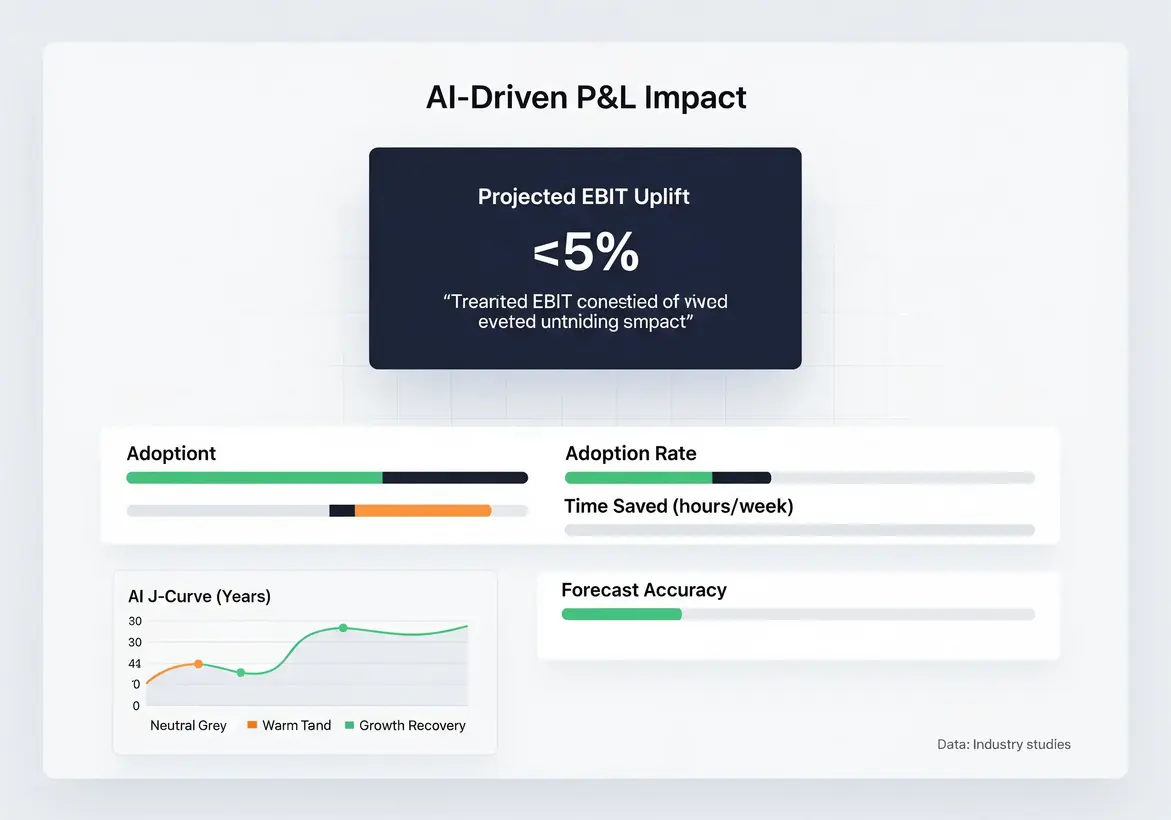
AI shifts this equation. Routine analysis, reporting, and coordination can increasingly be automated, freeing GMs for strategy, people development, and crucial judgment calls that machines alone cannot make. However, the “J-curve” of adoption—the period where productivity might dip as AI is implemented before rebounding to higher growth—poses real P&L risks if transition is mismanaged. Manufacturing firms, for example, report an initial 1.33 percentage point drop in productivity post-AI adoption—but those who persist see long-term outperformance in output, revenue, and market share (Source: MIT Sloan, 2024).
So, the GM’s challenge is not just adopting AI for the sake of innovation; it’s orchestrating a smooth transition that defends margins, speeds decision cycles, and unlocks new areas of growth.
Transforming P&L Performance with AI: A GM’s Playbook
The leap from operational manager to AI-empowered business unit strategist is most evident in the new ways GMs can directly shape P&L performance using AI. Here’s how top-performing GMs are leading the charge:
AI-Driven P&L Forecasting & Scenario Planning
Modern AI platforms now deliver multi-scenario forecasting, enabling GMs to simulate revenue, cost, and profitability impacts in real time as business drivers shift. By integrating AI-powered decision making, business units can pivot quickly—to seize market openings or contain emerging risks—while tracking financial implications with a level of speed and granularity unattainable by manual analysis. Effective use of such tools routinely reduces forecasting cycle time by 30-50% while improving scenario accuracy (Source: McKinsey, 2024). For those prepared to lead, this grounds strategic decisions in live data, not stale spreadsheets.
Predictive Analytics for Inventory & Demand Management
In consumer goods, manufacturing, and retail, General Managers historically faced the dilemma of either overstocking or missing demand. Predictive analytics now ingests historical sales, weather patterns, supply chain volatility, and market signals, then generates dynamic demand and inventory forecasts. Implemented well, this has yielded 10-20% reductions in working capital tied up in inventory and slashed stockouts—allowing business units to both cut costs and increase sales simultaneously (Source: MIT Sloan, 2024).
AI-Powered Competitive Intelligence for Regional Markets
For the GM with regional responsibilities, real-time competitive intelligence powered by AI can surface market moves, pricing shifts, and customer sentiment weeks before traditional research surfaces issues. Integrating AI-powered competitive intelligence can give GMs clarity to adapt tactics, outmaneuver local competitors, and pre-empt negative trends. This is especially powerful in fast-moving or fragmented markets, where information asymmetry determines who moves first.
Automated Reporting—Reclaim Time for Execution
Automated data preparation and reporting platforms tap into business unit data lakes, ERP and CRM systems, instantly generating tailored dashboards and reports. For many GMs, this saves several hours per week typically lost to manual reporting—hours that can instead be reinvested in strategy, coaching, and market engagement.
Case Study Snapshot: Accelerating P&L Gains Through AI
A regional GM for a manufacturing multinational leveraged predictive inventory AI to anticipate volatility in supply chains, reducing stockouts by 19% and increasing on-time fulfillment by 23% within a single fiscal year. Simultaneously, automated dashboarding allowed weekly P&L reviews rather than monthly, enabling tighter cost controls and faster margin optimization.
“GMs who embed AI into P&L management are not just optimizing; they’re future-proofing business unit growth with speed and resilience.”
— Senior research summary, drawing on TII’s two-decade integral methodology
Accelerating Decision-Making with AI-Powered Insights
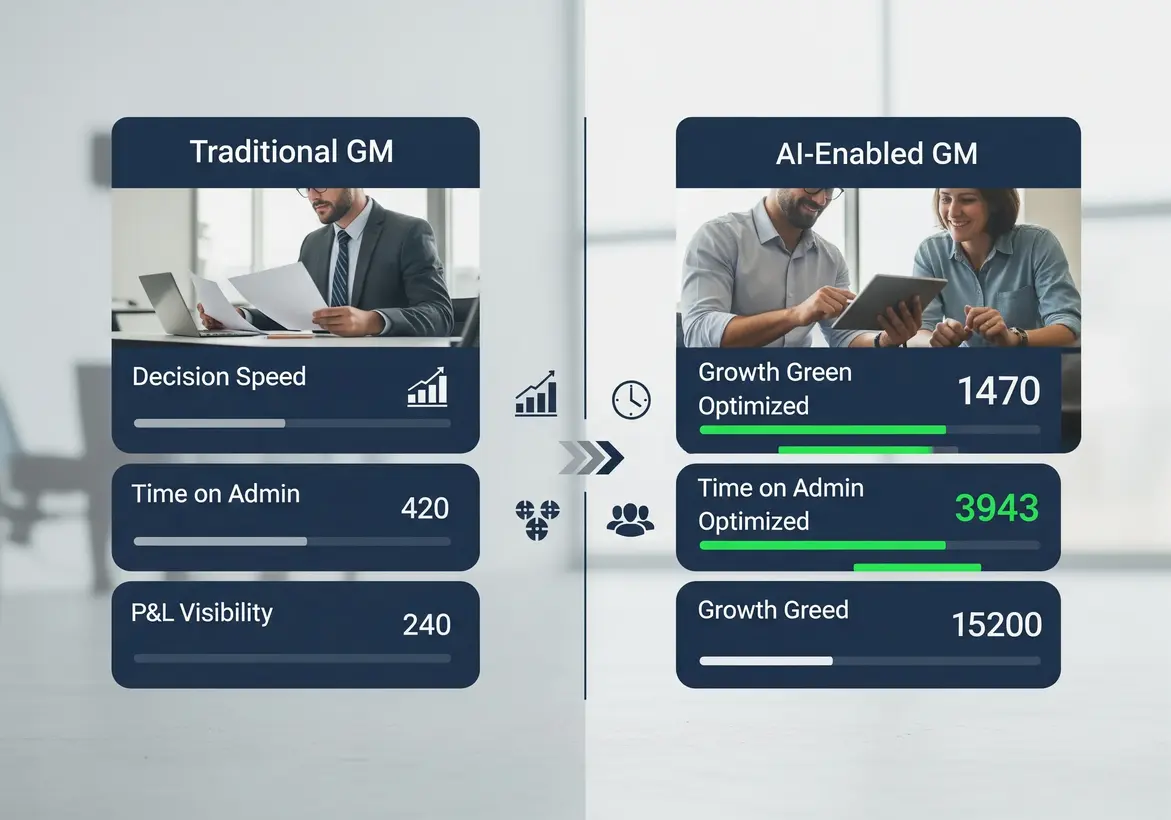
The most immediate payoff from AI adoption for GMs is in decision speed and accuracy. In a world where market conditions, customer behaviors, and cost drivers can turn on a dime, the ability to access and interpret live data becomes a decisive advantage.
Leveraging AI for Real-Time Business Insights
Rather than wading through static reports, GMs equipped with AI analytics tools see anomalies, patterns, and correlations as they emerge. These platforms can aggregate internal performance metrics with external market intelligence—detecting when competitor pricing changes or when consumer sentiment is shifting. In practice, this cuts decision latency by upwards of 40%, letting GMs make informed moves while opportunity windows are open.
Integrating Market Intelligence from AI Analysis
GMs responsible for regional or multi-country operations face unique complexity—local regulations, competitive nuances, and shifting customer expectations. By leveraging AI-powered competitive intelligence, GMs get a granular, region-by-region readout of trends and market threats, enabling precisely tailored, market-specific leadership adaptation for each territory.
Framework for Human-AI Decision Loops
At the heart of successful AI adoption is balance: knowing when to trust advanced analytics, and when human experience should override the algorithm.
A practical framework:
- Use AI to surface options, flag anomalies, and run scenario simulations
- Apply human judgment to weigh qualitative factors: relationships, ethical implications, organizational history
- Create feedback loops: systematically audit AI recommendations, learn from both wins and misses, and calibrate the blend of AI and intuition
AI-powered decision making rooted in this kind of dual-track analysis not only boosts accuracy but builds trust across the team—turning existential fear about AI replacement into pragmatic confidence.
Leading the Hybrid Human-AI Workforce: Orchestrating for Growth
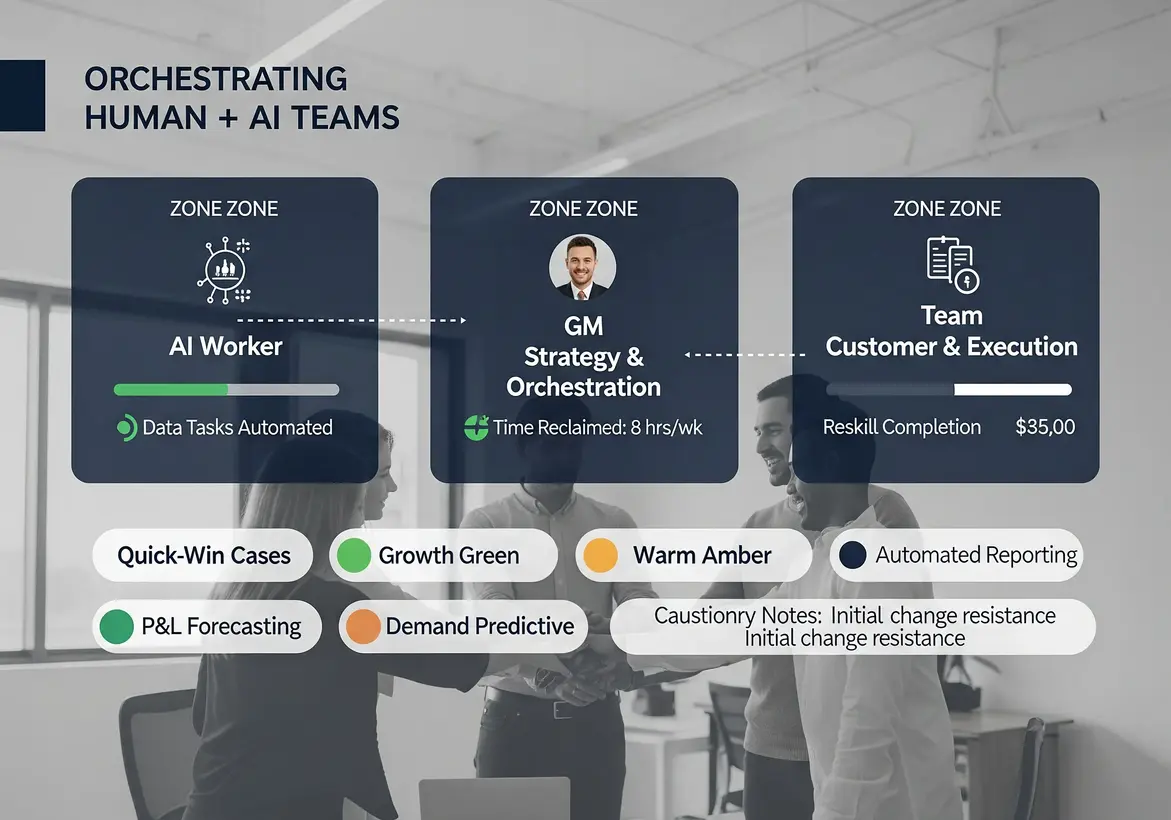
The hallmark of next-generation GMs is their ability to orchestrate hybrid human-AI teams. This isn’t just technical implementation—it’s a cultural leap, requiring new mindsets, skills, and leadership approaches.
Integrating “AI Workers” into Business Unit Operations
The practical starting point is job analysis: which processes can an AI worker handle, and which demand human judgment? For many units, AI now takes on:
- Routine data analysis and reporting
- Inventory and demand forecasting
- Predictive risk assessment
- Automated scheduling and coordination
Humans, meanwhile, shift to:
- Customer relationships
- Strategic planning
- Creative problem solving
- Talent development
Defining these roles clearly, communicating transparently, and providing training on both sides is what distinguishes a confident transition from organizational disruption.
Creating Hybrid Workflows for Human-AI Collaboration
Drawing on the Integral Model’s multi-level framework, GMs should:
- Map process flows end-to-end, assigning routine elements to AI and unique, value-adding steps to team members
- Pilot hybrid workflows with measurable output and feedback mechanisms
- Rotate roles and workflows regularly to foster adaptability, learning, and cross-training
Transparent communication is non-negotiable. Managing team concerns about AI displacement requires ongoing dialogue, active listening, and upskilling initiatives. This isn’t about vague reassurance; it’s about providing clear examples where AI augments rather than replaces—and involving team members in redesigning their own workflows. Explore dedicated resources on managing team concerns about AI displacement and achieving healthy AI adoption in business units.
Redefining Job Descriptions for Human-AI Synergy
Job profiles evolve to specify required AI fluency—the ability to frame good questions for AI, validate AI outputs, and manage handoffs between algorithms and people. Performance metrics, too, may shift toward collaboration, learning agility, and cross-functional impact.
Building an AI-Fluent Culture
Change leadership at this level is nuanced—drawing on elements like psychological safety, coaching, and fostering a sense of experimentation. GMs who normalize failure as learning, model curiosity, and invest continuously in development are those whose teams build resilience and thrive.
“AI doesn’t just automate work; it redefines what work means in teams, and GMs who lead this journey proactively will shape the culture and results for years to come.”
— Grounded in the Integral Model’s multi-level framework
GM-Specific AI Leadership Challenges & Solutions
While the promise of AI is vast, the reality for business unit leaders is managing a set of unique, often underappreciated, hurdles.
Balancing AI Investment with Business Unit Profitability Targets
GM pay and reputation ride directly on P&L outcomes. It’s essential to avoid the trap of chasing shiny AI investments that balloon costs without near-term impact. High-performing GMs prioritize:
- Piloting quick-win use cases: automating reporting, demand forecasting, and customer segmentation, which typically yield tangible payback in months, not years
- Tightly correlating each AI project to explicit margin, revenue, or cost metrics
- Staging AI deployment to minimize disruption, tracking the “J-curve” recovery to long-term productivity gains
For robust frameworks on leadership accountability in decentralized business units, see detailed institute guidance on balancing risk with agility.
Implementing AI Solutions Without Enterprise IT Bottlenecks
Enterprise IT often runs at a different tempo than market-facing business units. GMs who succeed in AI adoption find ways to:
- Build local, nimble data and AI pilot teams within the business unit
- Partner selectively with trusted IT resources, but push for business ownership of analytics and decision-making tools
- Embrace cloud-based and modular AI solutions that scale only when ROI is proven locally
Local adaptation of tools and leadership approaches is critical—especially for GMs leading business units spanning multiple regions. Deep-dive into market-specific leadership adaptation to align operational models with varied regulatory, customer, and cultural realities.
Developing Future Leaders for the AI Era
GMs must deliberately seed the next layer of AI-fluent leaders within their units. Only 30% of organizations have meaningfully shifted workforce behaviors with AI adoption so far, and leaders are nearly twice as likely to use AI as front-line employees (Source: Stanford HAI, 2024). Structured apprenticeships, inclusive mentoring, and peer learning platforms help spread expertise and ensure the pipeline of new leaders is ready for the evolving landscape. See developing future leaders for programmatic approaches.
Measuring ROI of AI Investments: Beyond Traditional Metrics
Counting cost savings or process speed alone misses much of AI’s long-term value. Forward-thinking GMs supplement traditional ROI measures with:
- Time freed for strategic initiatives (tracked and reallocated explicitly)
- Engagement and skill uplift for teams embracing new AI workflows
- Competitive moves pre-empted or countered faster due to real-time intelligence
Over a decade, every standard deviation of increased AI investment has correlated with an approximate 20% higher sales growth (Source: Brookings, 2024). But in the first year, even small wins—faster reporting, sharper forecasting—build belief and sustain momentum.
Your Path to Becoming an AI-Empowered Strategic GM: Next Steps
For General Managers ready to lead through disruption—not just react to it—the roadmap is clear:
- Identify routine processes ripe for automation—reporting, data preparation, and demand forecasting.
- Select a few targeted AI pilots with clear, short-term financial impact.
- Redesign at least one team workflow for hybrid human-AI balance.
- Commit to transparent communication and skill-building for the team—face anxieties head-on.
- Audit and iterate: use short feedback cycles to learn what AI tools work in your context, what doesn’t, and why.
Over the next 2-5 years, the line between traditional operator and strategic orchestrator will continue to blur. The GMs who learn fastest, adapt bravely, and integrate AI with human insight will shape business unit success stories others will seek to emulate. Whether you are new to the AI journey or already experimenting, the conversation continues—among your peers, your team, and with those committed to leadership in complexity.
What shift will you pilot first to accelerate your path from business operator to AI-empowered orchestrator?
FAQ: Leadership Development for General Managers in the AI Era
What are the core principles of the AQAL model used in leadership development?
The AQAL model stands for All Quadrants, All Levels, All Lines, All States, and All Types. It underpins truly integrated leadership development by examining performance, mindset, culture, and systems together. When applied to General Managers, AQAL helps map not just operational results but also the mindsets enabling AI integration, the ways team culture embraces hybrid collaboration, and how business unit systems are redesigned for speed and agility.
How can an integrated leadership coaching program improve executive performance in the AI era?
Integrated leadership coaching draws on proven methodologies—backed by over 40,000 hours of certified coaching practice—to upgrade both the hard and soft skills required for AI-powered business. GMs move beyond transactional management to become orchestrators of hybrid teams, learning to facilitate complex AI-human processes, handle ambiguity, and make high-stakes decisions at greater velocity.
Why is addressing root causes important in organizational development interventions?
Simply overlaying new tech or training will fail if underlying issues—like outdated incentives, mistrust of automation, or lack of data literacy—persist. Addressing root causes, a hallmark of The Integral Institute’s approach, ensures that P&L impact is durable. This means surfacing fears about AI, resolving process bottlenecks, and aligning incentives so every AI project links clearly to business value.
Can tailored team coaching programs increase adaptability during rapid business disruption?
Yes. Targeted team coaching enables units to practice new hybrid workflows, learn how to evaluate AI output, and develop the psychological safety needed for experimentation. Successful programs create a shared language and accountability system, drastically accelerating adaptation and boosting business unit resilience.
Is it more effective to partner with a strategic leadership development firm versus traditional training vendors?
Traditional vendors often offer standard, one-size-fits-all curricula, whereas a strategic partner diagnoses unique business challenges, designs interventions down to the team or region, and co-develops systems for sustained improvement—especially critical during AI transition phases. With AI’s complexity and pace, generic programs rarely yield measurable P&L or culture shifts.
Who benefits most from multi-level leadership training involving individual, team, and organizational layers?
General Managers in fast-scaling or highly complex organizations benefit the most. Multi-level leadership training ensures alignment from big-picture business strategy down to front-line team workflows, allowing AI rollouts to succeed both technically and culturally across every layer of the business unit.
Continue Your Leadership Journey
- AI-powered competitive intelligence — See how AI anticipates market shifts, empowering GMs to make faster, more informed business unit decisions.
- AI-driven leadership — Discover strategic operator mindsets and models for GMs mastering the next era of AI-enabled performance.
- hybrid human-AI teams — Explore practical frameworks for success in hybrid teams where human and AI roles combine for greater agility.
- AI adoption in business units — Access actionable insights and ethical guidance on managing AI transitions, upskilling, and sustaining team trust.