

Leadership development for first-time founder CEOs in the AI era is an integrated discipline that equips new founders to harness AI as a strategic force multiplier, manage lean AI-augmented teams, and make defensible decisions between automation and human hiring to accelerate zero-to-one growth. This guide unpacks how founder-CEOs translate vision into AI-enhanced business models, overcome investment biases, and build resilient cultures while sustaining founder well-being and venture defensibility.
Introduction: The AI-Augmented Founder CEO — A New Leadership Paradigm
The new generation of first-time founder CEOs faces a unique duality—unprecedented leverage and unprecedented pressure. Thanks to AI, a handful of founders can now achieve what once demanded entire departments. Yet the promise of AI comes entangled with complex decisions about automation, human leadership, team culture, and investor expectations, all within the unforgiving reality that 82% of first-time founder-led startups will not succeed (Source: ff.co, Exploding Topics, 2024).
What’s at stake for this audience is not just survival but the chance to rethink what it means to lead, build, and inspire from the ground up—where resource constraints sharpen strategy and rapid learning is the only constant. This is not general “founder advice” or vague hype about “AI in business.” It’s a psychological and operational blueprint tailored for those building zero-to-one companies with AI as their core lever. Drawing on two decades of integral methodology, this article guides founder-CEOs at the exact intersection of vision, technology, people, and self-mastery.
Phase 1: Vision to AI-Enhanced Business Model (Strategic Leadership)
The defining leadership challenge for first-time founder CEOs is transforming a bold vision into a business model where AI is not an accessory but the engine itself. The companies that outperform in this space are those that make AI leverage central—not an afterthought—in their earliest choices.
Defining Your AI-First Vision
Beginning with the end in mind, founders must articulate: What core problem does our venture solve, and where does AI offer transformative, scalable advantage? This is not about squeezing AI into a pitch deck or process. Instead, it’s about identifying “unfair advantages”:
- Can AI create unique value, such as personalization at scale, 24/7 customer interaction, or predictive insights from data that is otherwise ignored?
- What customer pain points become possible (not just cheaper) to address with clever AI integration?
- How is your business defensible against others using off-the-shelf AI?
Startups that center AI on these questions up front become more capital-efficient and defensible in the long term (Source: World Economic Forum, 2025).
Market Research & Competitive Analysis with AI
Traditional market research often exceeds the budget and time constraints of lean founding teams. Here, AI-driven tools (like GPT-based research assistants, sentiment analysis platforms, and real-time competitor monitors) provide affordable, rapid alternatives:
- Automated secondary data collection and analysis can compress a week’s work into hours.
- AI tools can scrape and contextualize emerging competitors, monitor investor sentiment, and track shifts in customer behaviors, arming founders with intelligence usually reserved for larger players.
Link: AI leverage tools empower CEO decision-making at a fraction of legacy costs, ensuring founders can spot opportunities without being blindsided by fast-moving rivals. AI leverage
Designing AI-Augmented Business Models
True AI-first models integrate three defensibility layers:
- Proprietary Data: Building or acquiring unique data pipelines (even small, private datasets) that AI models can’t easily replicate.
- AI-Augmented Workflow: Reengineering core workflows to use AI for efficiency or new capabilities, e.g., auto-generated proposals, personalized marketing, predictive customer support.
- Human-AI Synergy: Strategically deciding which functions remain “human-in-the-loop” versus fully automated, based on value, risk, and experience.
Founders must develop an acute sense for when AI increases value, when it introduces risk (quality, ethics, explainability), and when it quietly erodes competitive advantage by standardizing processes others can also automate.
What is the AQAL model and how does it apply to leadership development?
The AQAL model (All Quadrants, All Levels)—fundamental to integral leadership—frames the development journey by considering individual and collective, internal and external dimensions. Applied to first-time founder CEOs navigating AI-era challenges, it encourages leaders to examine not just technical or operational questions (What AI tools should we use? How do we automate?), but also psychological resilience, team values, culture shifts, and systemic market forces.
For instance:
- Internal-Individual (Mindset): Founder beliefs about whether AI replaces or empowers their team.
- External-Individual (Behavior): Skills in AI prompt engineering, decision-making speed, quality control.
- Internal-Collective (Culture): Shared values and attitude toward AI collaboration; fear vs. curiosity.
- External-Collective (Structure): How the org charts human-AI responsibilities, product delivery, and scaling.
This whole-system view avoids the classic founder error of automating without addressing culture, or scaling AI tools before the vision and employee buy-in are clear. Backed by the Integral Model’s multi-level framework, founders build dynamic ventures in which technology, people, and meaning progress together.
Phase 2: Building Your Zero-to-One Venture (Operational Leadership & Resource Allocation)
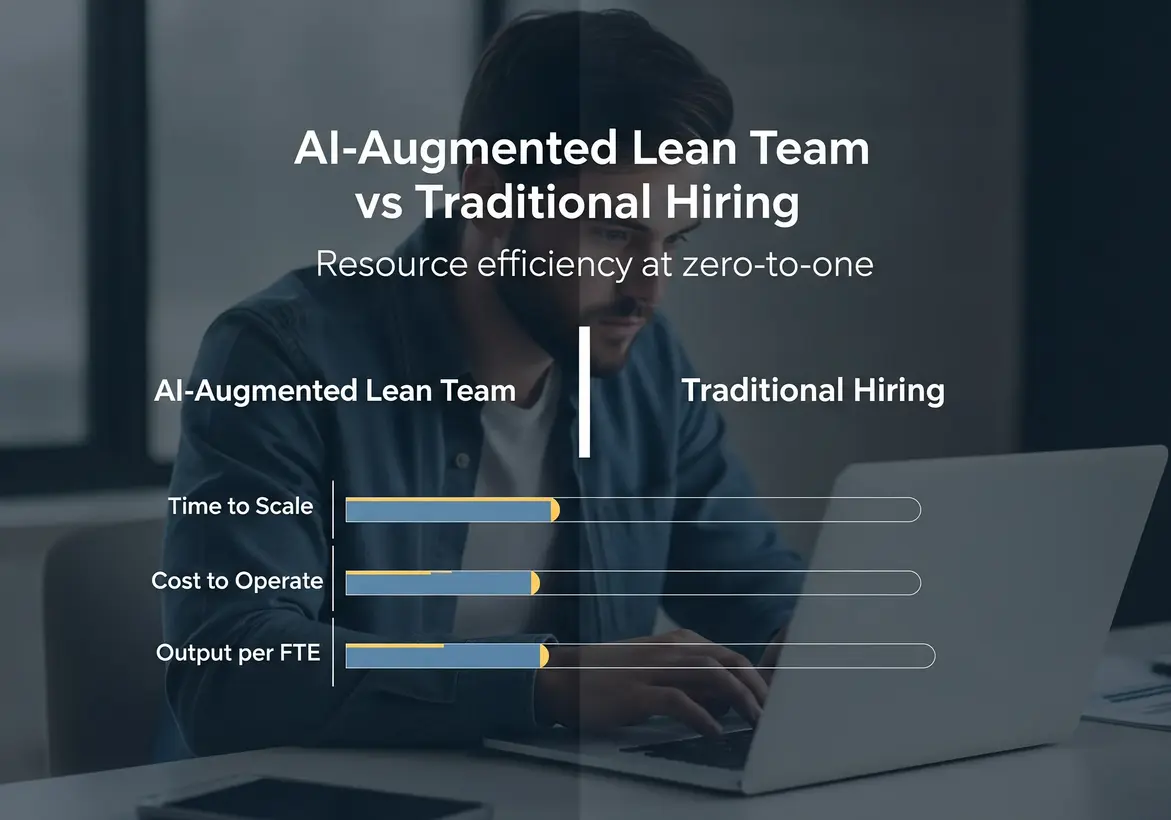
As vision turns to operations, the leadership focus shifts: How do you achieve maximum output with minimal input—in people, time, and capital? It’s not a matter of automating at all costs but of making high-stakes, first-principles calls about where to deploy scarce resources.
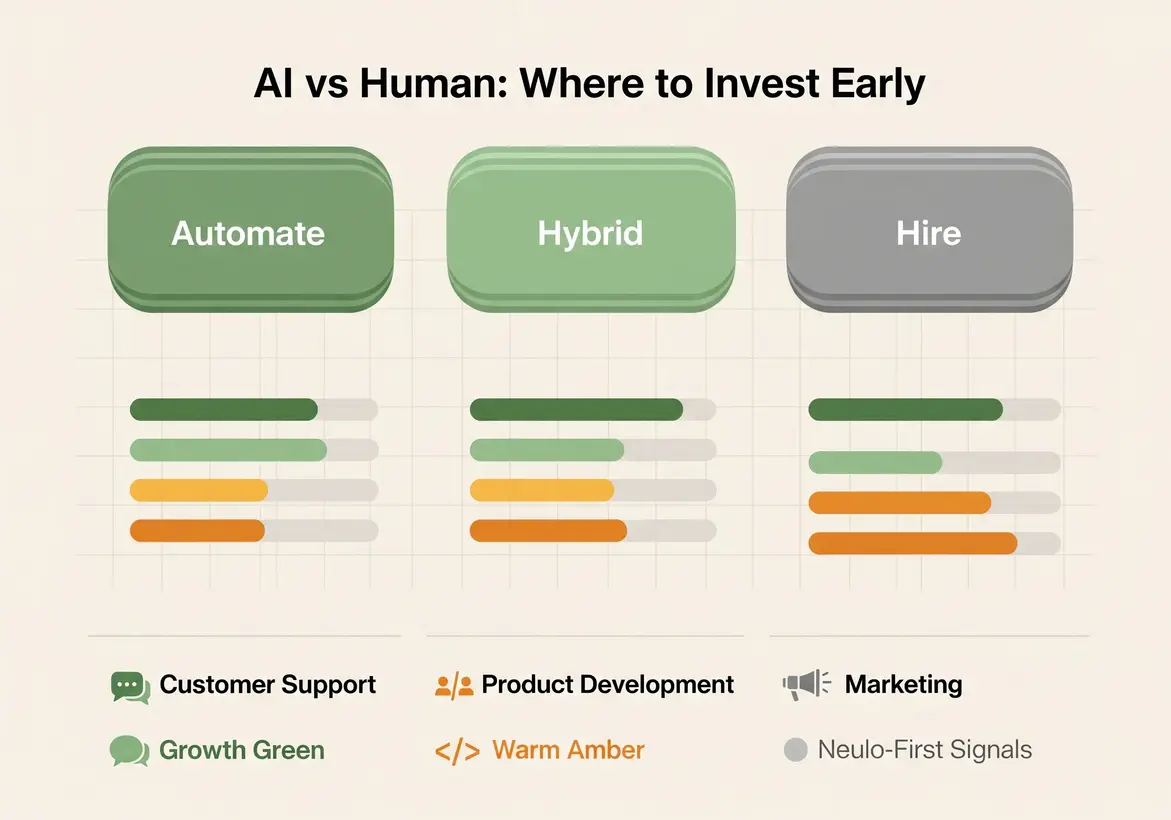
The Human-AI Workforce Equation: When to Hire, When to Automate
With top AI talent commanding salaries upwards of $500,000 at big tech—well out of range for most early-stage founders—the founder faces the “human vs. AI” decision daily (Source: Upsilonit.com, 2024).
Founders must master the logic of:
- AI Strategic Leverage: Which tasks are best handled by AI today (content generation, customer support triage, financial forecasting) versus areas where human intuition, relationship-building, or creative synthesis are non-negotiable?
- AI Human Hiring Decisions: For every task, founders should ask: Is this core IP (and so in-house), non-core but critical (maybe hybrid AI+human), or fully automatable without risk? This decision tree requires clarity on ethics, brand, and customer experience. AI human hiring decisions.
- Avoiding Over-Automation: Over-reliance on AI before reaching product-market fit can erode early customer trust or create gaps in feedback loops, resulting in missed learning.
A useful operational principle: Automate for speed in non-differentiating areas; deploy humans where nuance, judgment, or proprietary learning occur.
Leveraging AI for Lean Operations
AI can now compress the need for large teams in marketing, sales, support, analytics, and more:
- Market research: Automated insights, competitive intelligence, opportunity mapping
- Content creation: AI-driven blog, email, and pitch deck drafting—saving founders 10-20 hours weekly
- Customer support: AI chatbots managing 80%+ of initial queries, handing off edge cases to humans
- Financial modeling: AI tools forecasting cash flow, analyzing risk, preparing investor materials with minimal manual input (Source: StartUpNV, 2025)
By building around AI from day one, founders create a scalable operational backbone and preserve capital for strategic human hires.
AI-Powered Product Development
AI coding assistants and low-code/no-code platforms enable solo founders and small teams to ship MVPs at unprecedented speed:
- Tasks that previously took multi-person engineering teams can now be handled by two to three people leveraging AI tools for code generation, QA, and bug fixing
- This changes the timeline from prototype to launch from several months to weeks—crucial in fast-moving markets
The competitive edge: the ability to iterate, test, and pivot faster while minimizing payroll risk.
Building an AI-First Tech Stack on a Budget
A founder’s tech stack in the AI era should be ruthlessly curated for:
- Cost (thanks to AI SaaS commodification)
- Speed (out-of-the-box integrations, no custom builds unless core IP)
- Data capture (creating proprietary feedback loops and datasets from the start)
- Future-proofing (choosing tools with strong roadmaps and open APIs)
Selecting AI tools is a leadership skill as vital as hiring the right COO—influencing pace, agility, and ultimate defensibility.
How can integrated coaching improve team performance in complex business environments?
Integrated coaching embeds ongoing learning and reflection into the fabric of the startup—not as an afterthought, but as a necessity for navigating rapid technical, operational, and psychological shifts. For first-time founder CEOs, this means using facilitation frameworks like regular retrospectives, peer feedback loops, and structured problem-solving around both human and AI performance.
Backed by over 40,000 hours of certified coaching practice, integrated development supports:
- Bridging the communication gap between technical and non-technical contributors (human or AI-powered)
- Regularly reassessing “who does what”—since the automatable and unique-value work changes as the company grows and tools evolve
- Equipping founders and teams to respond flexibly to ambiguity, pivot gracefully, and surface emotional/ethical concerns as they arise
In environments where change and novelty are constant, teams that integrate coaching adapt faster, stress-test ideas more thoroughly, and surface “unknown unknowns” early—thus improving execution in highly complex business settings.
Phase 3: Leading AI-Augmented Teams (People & Culture Leadership)
After systems, the next frontier is people—where founder-CEOs set the tone for how humans and AI interact. The emotional and cultural questions here are ones most competitors miss, but they are central to durable leadership.
Delegating to AI Systems vs. Humans: Trust, Quality Control, Oversight
Delegation, once a purely human domain, now extends to algorithms. This expansion creates unique founder leadership challenges. It’s crucial to:
- Clarify ownership: Who owns what outcome—especially when errors can come from human or AI decisions?
- Maintain transparent feedback channels, so that both AI system outputs and human team performance are evaluated, questioned, and iterated
- Ensure ethical guardrails and escalation protocols when AI “magic” produces unexpected or hard-to-explain results
Founders who set up dual feedback—assessing both people and AI—eliminate blind spots and build organizational muscle for the hybrid era.
Developing AI Fluency: Prompt Engineering as a Leadership Skill
AI is only as effective as the questions and directions it receives. For first-time founders, proficiency in prompt engineering, model evaluation, and tool selection becomes as mission-critical as any classic management skill.
- The new leadership psychology includes cultivating curiosity with AI capabilities, fostering a culture of experimentation, and learning from both impressive and disappointing results.
- Hidden leverage: Founders fluent in AI can spot “false positives,” understand model weak points, and avoid “garbage in, garbage out” pitfalls.
Managing the Psychology of AI-Augmented Teams
The psychology of building and leading with AI is a real, immediate challenge—impostor syndrome from small team size, anxiety about being replaced by a tool, or moral stress about delegation boundaries (reported by over 72% of founders (Source: Spectup.com, 2025)).
- Founders must design cultures where team members see AI as augmentation not replacement, emphasizing learning, trust, and collaboration over technological determinism
- Open conversations about AI anxieties, regular check-ins, and transparency about role evolution minimize mental health risks
The most resilient cultures encourage emotional safety to experiment, fail smart, and voice skepticism about both human and machine decisions. AI team culture
Creating an AI-Collaborative Founding Team Culture
From inception, founders are architects of how their organizations talk about, use, and build upon AI. Cultural best practices:
- Onboarding that includes AI literacy, tool walkthroughs, ethical briefings, and shared vocabulary
- Rituals that celebrate “human+AI wins,” not just technical achievement
- Hiring first human employees who embrace change, ambiguity, and collaboration with machines as an opportunity for personal growth
These practices establish psychological safety, foster high engagement, and help retain critical early hires—despite the risks (and allure) of an AI-heavy operation.
When should a company engage an external partner for team coaching versus internal development?
- Engage external partners for team coaching when the organization faces skills or trust gaps around AI integration that internal leaders alone cannot bridge. This is especially true if founders are first-timers, or when the team inherits legacy beliefs about competition with AI rather than collaboration.
- Use internal development when there’s strong internal motivation, plus capacity and expertise, to guide learning journeys around AI, agile practices, and culture formation at a startup pace. However, blending external integral frameworks draws out hidden systemic barriers, speeds learning, and helps inoculate against the common “echo chambers” of resource-constrained founding teams.
Drawing on the Integral Model’s multi-domain methods, a hybrid approach delivers both speed (from outside expertise) and resilience (by fostering lasting internal mindsets and systems).
Phase 4: Building Investor Credibility & Scaling (External & Growth Leadership)
No leadership journey for first-time founder CEOs is complete without confronting the realities of fundraising and scale—where your AI narrative is scrutinized by VCs, angels, and soon, prospective employees.
Articulating Your “AI-Augmented Lean Team” Story to Investors
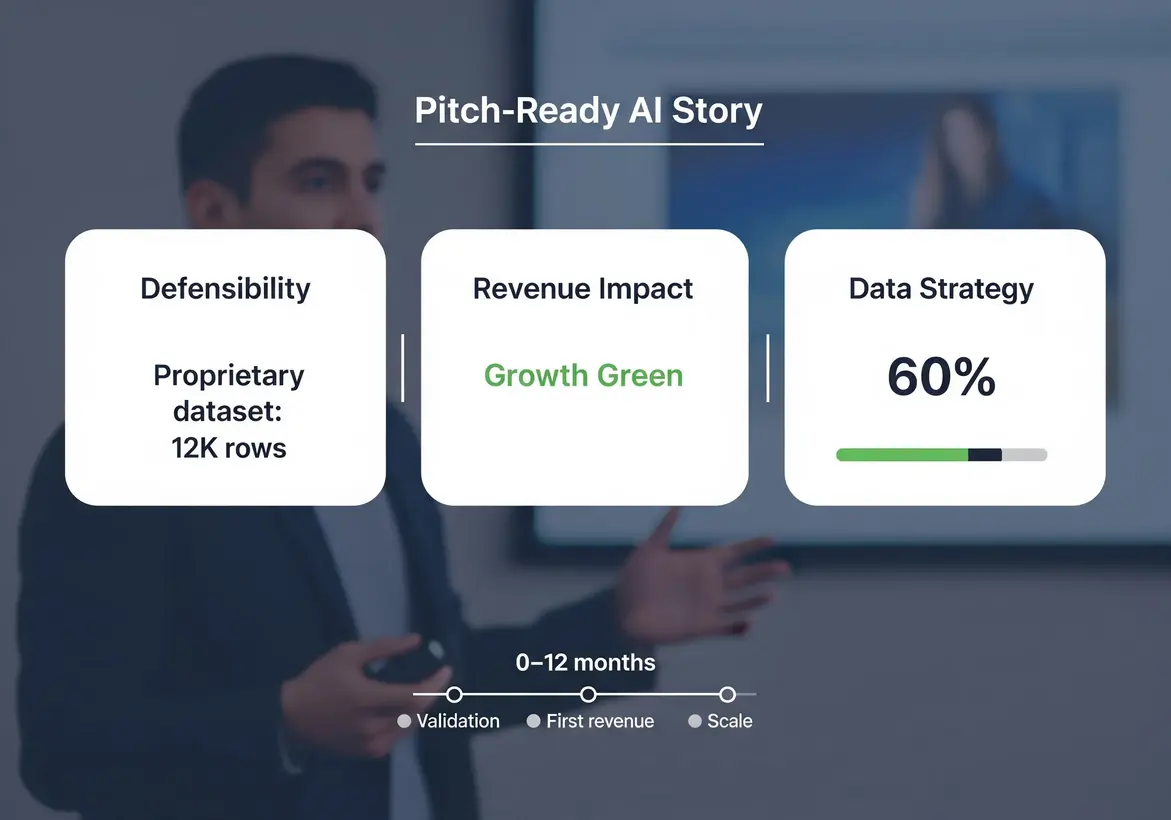
Despite the AI gold rush, investors remain wary of “AI-washed” startups or solo founders with no clear plan for scaling human capital. The winning founder narrative:
- Demonstrates practical AI use (not hand-waving buzzwords) tied to clear metrics (CAC reduction, faster market entry, higher net revenue retention).
- Builds credibility with investors by presenting a roadmap for evolving from “founder-does-everything (with AI help)” to “founder-leads-team (of humans and AI)”—signaling succession, resilience, and long-term outcomes.
- Clearly defines the “human edge”—how a lean team augmented by AI achieves more with less, and sets the stage for attracting future talent.
Avoiding Over-Automation Pitfalls Before Product-Market Fit
Successful founders resist the temptation to over-automate customer touchpoints, support, or R&D until they have validated authentic market pull and reliable feedback loops. This prevents:
- Missed signals about product-market fit from customers who “tolerate” but do not love automated interactions
- Investing resources into AI-dependent processes that may need radical change as real user feedback arrives
Building Proprietary Data/IP While Using Commodity AI Tools
Relying solely on off-the-shelf AI SaaS can undermine future defensibility. Wise AI-native founders:
- Prioritize early collection of differentiated data—unique user behaviors, niche domain insights, or workflow metadata
- Layer bespoke models or proprietary workflows atop commodity AI, increasing switching costs and long-term value
Without these moves, startups risk being outpaced by rivals using the same AI tools with deeper pockets.
Defining Future Human Roles as the Company Scales
A critical, founder-led task is scripting the narrative—and developing systems—for how actual humans will be added to the company as needs shift:
- Where will human skill, creativity, or ethical oversight become bottlenecks for scaling?
- How will new hires be integrated into AI-augmented workflows, with paths for growth, upskilling, and strategic impact?
- How do founders set expectations (with investors and hires) that human-AI collaboration is not a temporary tactic, but the backbone of enterprise evolution?
Can leadership training programs effectively prepare executives for rapid disruption?
Yes, but only when these programs are deeply contextual, scenario-based, and focused as much on adaptive decision-making as on technical know-how. For founder-CEOs in AI-rich domains, traditional leadership programs must be retooled:
- Focus on ambiguity tolerance, “learning to learn,” and rapid sense-making
- Incorporate hands-on exposure to evolving AI tools, leaning into the iterative development of both product and leadership skill
- Regularly surface and challenge founder leadership psychology—ranging from risk appetite to ethical boundaries—since CEO beliefs set the tone for the entire team’s response to disruption
Programs grounded in integral coaching and systemic diagnosis (not just skill tick-boxes) more reliably turn disruption from existential threat into clarified opportunity.
Conclusion: The Future-Proof Founder CEO
In the AI-accelerated world, the most successful first-time founder CEOs will not be those who only master technology or only assemble great teams. They will be the ones who integrate vision, AI leverage, operational rigor, and cultural wisdom—who evolve from founder as “digital one-person army” to leader of a dynamic human-AI organization. Founder resilience, adaptability, and ethical clarity will differentiate ventures that last from those outpaced by the same AI wave they hoped to ride.
The journey demands not just skill but self-awareness, as every founder faces the decision to pause, diagnose, and redesign—sometimes daily. How will you balance vision, automation, and the irreplaceable edge of human ingenuity as you shape your venture’s story in the AI era?
FAQ: Leadership Development for First-Time Founder CEOs in the AI Era
How do I decide which roles to automate first versus hire for as a new founder?
Start by mapping all essential workflows and identifying which are commodity (repeatable, well-defined) and which drive unique value creation. Automate areas like scheduling, basic research, or initial customer support using AI tools—these save time without creating risk. For roles involving product strategy, creative problem solving, or relationship-building, prioritize human hires or hybrid approaches. Continually reassess as the business evolves, using frameworks from ethical AI design and leadership development to ensure decisions are aligned with your brand and values.
What are the risks of over-automating early in my startup journey?
Over-automation before product-market fit can distance you from customer feedback, reduce opportunities for learning, and erode human touch—creating friction with prospective investors or early hires. There’s also the risk of “data blindness,” where too much reliance on AI-generated insights misses out on nuanced user needs or cultural factors. Balance speed with deliberate human checkpoints, especially in discovery and engagement stages.
How should I explain my AI-augmented lean team to skeptical investors?
Present practical outcomes: demonstrate cost efficiency, rapid iteration, and concrete traction achieved via strategic AI use. Show you have plans to transition from founder-does-all to founder-leads (of humans and AI) by communicating your roadmap for future human hiring and growth points. Back this up with clear metrics and early adoption signals, reinforcing that your approach is intentional and scalable.
How can I address team anxiety about AI replacing their roles?
Foster open dialogue about AI’s real purpose—augmentation, not replacement—and share examples of how AI allows the team to focus on higher-impact work. Invest in upskilling and prompt engineering training, create rituals that recognize both human and AI contributions, and clarify that future roles will evolve with company needs, not be eliminated arbitrarily.
What leadership skills should I prioritize to stay ahead as an AI-native founder?
Develop AI fluency (prompt engineering, tool evaluation), adaptability (embracing ambiguity and rapid pivots), systemic awareness (diagnosing performance at individual, team, and organizational levels), and emotional resilience. Create routines for self-reflection and feedback, seek mentorship and coaching, and keep pace with emerging AI technologies and practices.
Should I use only off-the-shelf AI tools, or invest in building custom solutions?
Start with off-the-shelf tools for speed and capital preservation unless your product’s value hinges on proprietary technology. Begin collecting unique data from day one, then layer custom models or workflows as you discover defensible differentiators. Building too early risks wasted resources; waiting too long risks commoditization. Iterate based on clear signals from customers and market traction.
When is it time to transition from “solo founder with AI” to hiring a broader team?
Transition when either (1) growth bottlenecks can’t be resolved by further automation, (2) critical expertise is needed for scale, compliance, or market credibility, or (3) investor/customer feedback signals that human touch is necessary for growth. Plan this well ahead, recruiting individuals comfortable working in an AI-augmented environment.
Continue Your Leadership Journey
- First-time founder CEOs — Explore tailored leadership development approaches for founders navigating AI-driven zero-to-one ventures
- AI leverage — Uncover competitive intelligence strategies that empower CEOs to make data-informed, AI-augmented decisions
- Founder leadership challenges — Dive into frameworks and methodologies that address the real psychological and operational hurdles for tech-first founders
- Founder resilience — Practical insights on building resilience and well-being for founders leading through AI-fueled pressures and change